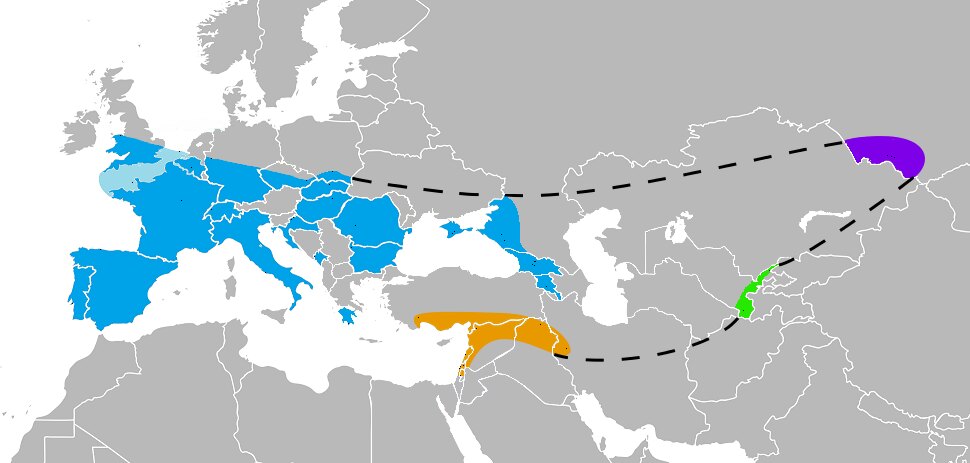
Around 47,000 years ago, somewhere between the LevantLevantA region of the eastern Mediterranean Near East (Israel, Lebanon, Syria, Jordan), a major crossroads of the first human migrations out of Africa.→ and the steppes of Eurasia, groups of Homo sapiensHomo sapiensThe present-day human species, which emerged in Africa around 300,000 years ago, the only surviving human lineage after the extinction of Neanderthals and Denisovans.→ newly out of AfricaOut of AfricaThe dispersals of Homo sapiens out of Africa, including a major expansion c. 70,000 to 60,000 years ago and earlier exits.→ met populations of NeanderthalsNeanderthalsA fossil humanity of Eurasia, robust and cold-adapted, extinct around 40,000 years before present.→ who had lived there for hundreds of thousands of years. From these encounters came children of mixed ancestry, and part of their genetic heritage crossed the millennia down to us. Today, anyone whose ancestors are not exclusively African carries, on average, 1 to 2 percent of DNADNAThe molecule carrying genetic information, used to reconstruct kinship between species.→ inherited from Neanderthals. But this inheritance is no uniform sprinkling. When geneticists map precisely where these ancient fragments sit, they find a rugged landscape, with regions richly populated by archaicArchaicRefers to an ancient, now-extinct human population or form (Neanderthals, Denisovans, ghost lineages), as opposed to anatomically modern humans.→ sequences and others, by contrast, almost entirely swept clean. The X chromosome ranks among the poorest of all.
This finding is no mere curiosity. The way Neanderthal introgressionIntrogressionThe lasting transfer of DNA segments from one population or species into another through repeated interbreedingInterbreedingGenetic mixing between human populations or species; between Neanderthals and Homo sapiens it left 1 to 2% of Neanderthal DNA in non-Africans.→, detectable in genomes long afterwards.→ is distributed across our genome tells a precise biological story, that of a hybridisationHybridisationCrossing between two distinct species or lineages, such as Homo sapiens and Neanderthals, leaving a trace in the genome.→ partly successful but also partly thwarted by the laws of population genetics. By reading the map of survivals and absences, researchers reconstruct not only the quantity of admixture but its intimate nature, its constraints and even, according to recent work, the sex of the partners who mated most often. Ancient DNAAncient DNAGenetic material preserved in old remains, often degraded, sequenced with cutting-edge techniques.→, extracted from bones tens of thousands of years old, serves here as the touchstone that confirms or corrects these reconstructions.
The hole in the X chromosome
In 2014, the team of Sriram Sankararaman, in David Reich's laboratory at Harvard, published in Nature a fine-grained map of Neanderthal ancestry in more than a thousand living individuals. The most striking result lay in a massive statistical anomaly. On the autosomes, the 22 pairs of non-sex chromosomes, Neanderthal DNA was found at comparable levels from one chromosome to another. But on the X chromosomeX chromosomeOne of the two sex chromosomes, present in two copies in females and a single copy in males.→, the proportion collapsed, roughly fivefold lower than the autosomal average. As if some force had patiently expelled the archaic segments from this particular chromosome.
The same work revealed a second, equally telling signal. Regions of the genome containing genes strongly expressed in the testes were also significantly depleted of Neanderthal DNA.1 Two converging clues, then, both pointing towards male reproduction. The X chromosome holds a singular place in the biology of fertility, for in many species it concentrates genes involved in sperm production and in reproductive compatibility between diverging lineages. That these regions should be precisely the ones from which Neanderthal heritage has been driven out was, in the authors' eyes, no accident.
The conclusion they drew was cautious but heavy with meaning. Certain Neanderthal versions of these genes, placed back into a modern genetic background, would have reduced the fertility of the men who carried them. Over the generations, as those carriers left fewer descendants, the variants concerned grew rare, then vanished. The genome of living humans would thus retain the imprint, in negative, of a partial biological incompatibility between the two human lineages.
Haldane's rule and the sterility of male hybrids
To understand why the X chromosome and the testis genes stand in the front rank of casualties, one must invoke a principle framed as early as 1922 by the British geneticist J. B. S. Haldane. Haldane's ruleHaldane's ruleThe principle that, in a cross between lineages, the heterogametic sex (male in mammals) is the first affected by sterility or inviability.→ states that when a cross between two species or two lineages produces offspring of which one sex is sterile or inviable, it is almost always the heterogametic sex that is affected, that is, the one carrying two different sex chromosomes. In mammals, including humans, that sex is the male, bearing an X and a Y where the female has two X chromosomes.
This rule, confirmed across a multitude of animal species from fruit flies to mice, is explained partly by the peculiar behaviour of the X chromosome. In the male, the single copy of the X is not doubled by a second version able to mask its flaws, so that any Neanderthal variant poorly tuned to the rest of the genome is fully expressed, without a safety net. The genes of male fertility, often lodged on the X and in testicular regions, thus become the preferred friction points between two genomes that had diverged for some 500,000 years before meeting again. The first male hybrids would have suffered reduced fertility, a phenomenon biologists call hybrid sub- or infertility.
The mechanism that then cleaned the genome has a name, purifying selectionPurifying selectionA form of natural selection that gradually removes harmful genetic variants over the generations.→. This is not a selection that favours advantageous new traits, but a sorting that progressively eliminates harmful variants. In every generation, the slightly deleterious Neanderthal segments, in particular those tied to male reproduction, reduced the offspring of their carriers. Multiplied over hundreds of generations, this pressure carved out the deficit observed on the X chromosome and near the testis genes. It should be noted that not all explanations converge on hybrid infertility alone, some researchers also invoking the small size of the Neanderthal population, which had accumulated a burden of weakly deleterious mutations that selection then purged in modern humans.
Genomic deserts and the weight of selection
That same year of 2014, a second team led by Benjamin Vernot and Joshua Akey, then at the University of Washington, reached complementary conclusions by a different method. Rather than comparing modern genomes to a reference Neanderthal sequence, these researchers reconstructed the archaic fragments directly from hundreds of present-day human genomes, European and East Asian, then reassembled the equivalent of about a fifth of the Neanderthal genome scattered across our populations.2
Their map confirmed the existence of vast chromosomal regions almost entirely devoid of Neanderthal DNA, which geneticists have nicknamed the deserts of introgressionDesert of introgressionA vast chromosomal region almost entirely devoid of archaic DNA, emptied by selection.→. These deserts are not randomly placed. They often coincide with zones rich in essential genes, and the largest of them covers a wide stretch of the X chromosome. In these sectors, selection was so effective that it left no measurable archaic heritage at all. Conversely, other regions kept Neanderthal variants, sometimes because they conferred an advantage, for example genes linked to skin pigmentation, keratin or immune response, better suited to the Eurasian environments the Neanderthals had long inhabited.
Vernot and Akey's work also suggested that hybridisation had carried a fitness cost, and that it may have occurred on several occasions, before and after the split between the ancestors of Europeans and East Asians. The picture emerging from these two pioneering studies was that of a real but fragile admixture, of which the modern genome preserved mostly what did not hamper reproduction, and occasionally what helped it. The genomic deserts are, in that sense, the scars of a ruthless selection exerted on a hybrid lineage over tens of thousands of years.
Who was mating with whom, and when
Beyond the how much and the why, the genetic map allows an almost intimate question to be raised, that of the direction of these unions. A study published in 2026 in Science, carried out in Sarah Tishkoff's laboratory at the University of Pennsylvania, tackled the problem by examining not Neanderthal DNA in modern humans but the reverse, the share of modern human ancestry lodged in ancient Neanderthal genomes. The authors noted a relative excess of about 62 percent modern human ancestry on the Neanderthals' X chromosome.3
This figure opens a window onto the demography of mating. Because a mother always passes an X chromosome to her children, while a father passes his only to his daughters, an ancestry imbalance on the X betrays a bias in the sex of the partners. The signal picked up by Tishkoff's team is consistent with unions formed mostly of Neanderthal men and Homo sapiens women. The authors consider a mating preference to be the simplest explanation, even though sex-biased migration scenarios could, in theory, produce comparable patterns. This is all the more notable because it runs against many documented cases of contact between human populations, where it is often the women of the expanding group who mated with the men of the resident group.
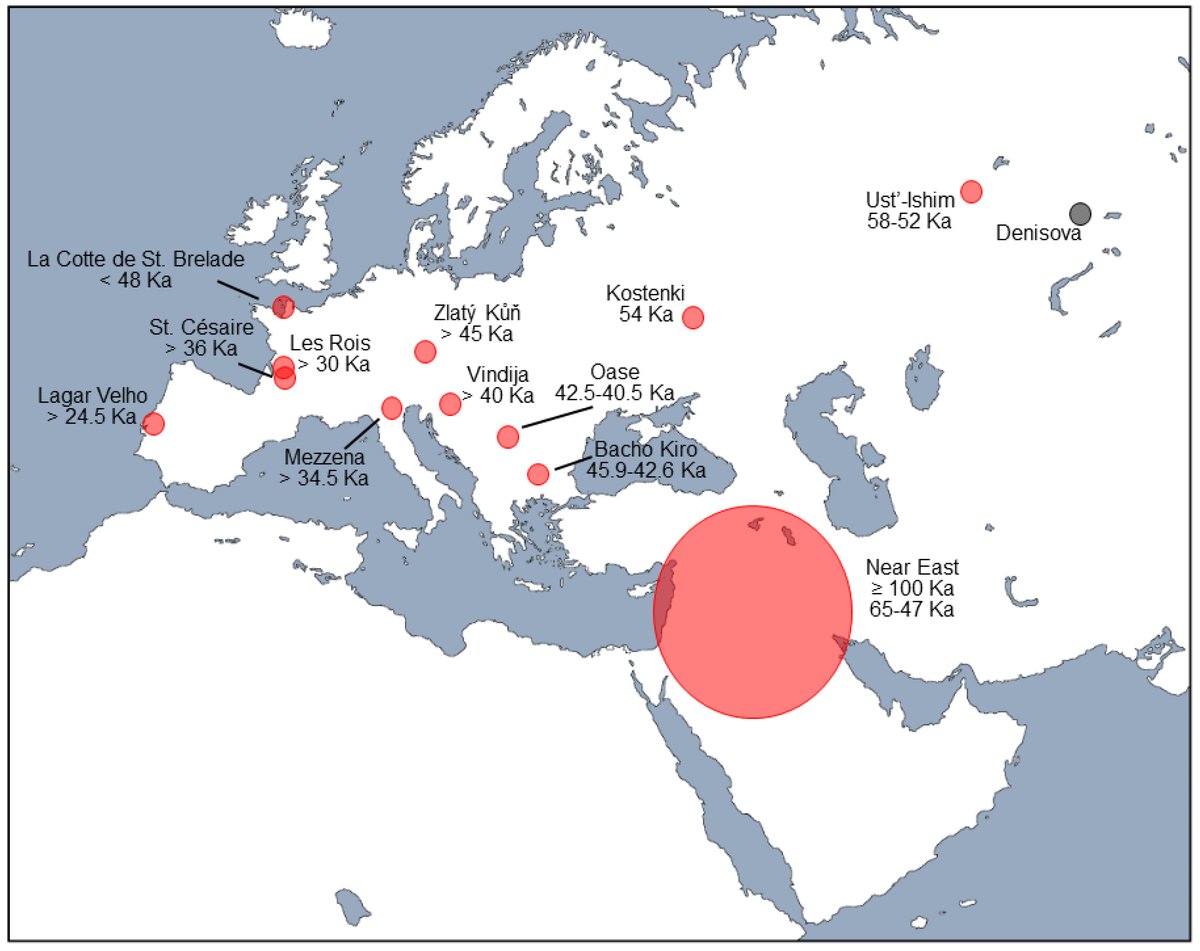
There remains the question of date. For a long time the main mixing was placed within a broad range. Two studies published in December 2024 narrowed it considerably. In Science, the team of Leonardo Iasi, of the Max Planck Institute for Evolutionary Anthropology in Leipzig, dated the principal episode of gene flow to around 47,000 years ago, estimating that it had spread over a period of about 7,000 years rather than a single instant.4 The same week, in Nature, the team of Arev Sümer, to which Iasi contributed, analysed the oldest known modern human genomes, from the sites of Ranis in Germany and Zlatý kůň in the Czech Republic. These genomes carried Neanderthal segments from a single admixture event shared by all non-Africans, dated to between 45,000 and 49,000 years ago.5
The two works converge on a common scenario, that of a major and largely single gene flow, ancestral to all non-African populations, set within a window of a few thousand years around 47,000 years before present.6 This dating coincides remarkably with the archaeological traces of a coexistence between Homo sapiens and Neanderthals in Europe, shortly before the latter disappeared. It also imposes a time limit, for the Ranis individuals, about 45,000 years old, belonged to a lineage that left no descendants today, proof that Europe saw several waves of settlement, some of them without a future.
This tightening of the date carries consequences that reach beyond chronology alone. If the bulk of the admixture was concentrated in a window of a few millennia, then the clock of selection began to tick almost simultaneously for all non-Africans, and the genomic deserts seen in Europeans, Asians and Oceanians derive largely from the same initial stock of Neanderthal DNA, sorted afterwards in regional contexts. The longest archaic segments, still little fragmented by recombination, confirm this antiquity, for the shorter an introgressed fragment is, the greater the number of generations elapsed since it entered the genome. By measuring the length of these blocks, geneticists can read time itself, inscribed in the physical structure of our chromosomes.
A map that tells a story
From the fine mapping of the genome there emerges, then, a coherent narrative. The ancestors of non-African humans did indeed mingle with Neanderthals, during a main episode dated to around 47,000 years ago, in unions where Neanderthal men seem to have fathered children more often with Homo sapiens women. But the Neanderthal share most intimately tied to male fertility, concentrated on the X chromosome and in the testis genes, was progressively eliminated by purifying selection, in keeping with Haldane's rule. The deserts of introgression are the traces of this cleansing, and the adaptive regions preserved are its positive counterpart.
Each of us, provided our roots reach beyond AfricaAfricaThe cradle of humankind: the continent where the first hominins appeared, then Homo sapiens around 300,000 years ago, before the expansion to the rest of the world.→, thus carries within a mosaic of archaic fragments, sorted by tens of thousands of years of evolution. The near-empty X chromosome and the genomic deserts are not innocent voids, but the negative memory of a founding encounter between two humanities.
One must guard against too simple a reading of these data. Statistical biases, the variable quality of ancient DNA and the difficulty of distinguishing selection from other demographic processes all demand caution, and the debate remains lively between the proponents of hybrid infertility and those of the Neanderthal mutational burden. The two mechanisms are not mutually exclusive, and may well have acted together. What is now solid is the pattern itself, this hollow signature on the X chromosome and in the reproductive genes, reproducible from one study to the next. Ancient DNAAncient DNAGenetic material preserved in old remains, often degraded, sequenced with cutting-edge techniques.→ continues, year after year, to sharpen this story, and the next genomes unearthed will no doubt refine still further the portrait of this admixture that made us what we are.
Article bien calibré pour un public non-spécialiste. La complexité n'est pas escamotée.
Ce qui me plaît c'est que vous citez vos sources. Je peux vérifier par moi-même.
J'ai visité ce type de site lors d'une excursion. Votre article m'aide à mieux comprendre ce que j'ai vu.