For decades the image seemed carved in stone: men setting out to hunt big game, women staying at camp to gather roots and berries, and precious meat flowing first toward the hunters. Its very simplicity made this scheme compelling, and it long shaped our view of life in the PalaeolithicPalaeolithicThe oldest and longest period of prehistoryPrehistoryThe span of human history before the invention of writing, from the Palaeolithic to the Metal Ages, known mainly through material remains.→ (c. 3.3 Ma–12,000 BC), defined by chipped stone tools and a hunter-gatherer way of life.→. In recent years it has begun to crack. Unexpected burials, a rereading of female physiologyPhysiologyThe study of how the body functions, drawn on to assess women's aptitude for hunting.→ and above all the chemical analysis of ancient bones are forcing researchers to reconsider who hunted, who ate what, and in what proportions. The inquiry, far from closed, now pits teams and methods against one another, and it is a reminder of how tempting, yet how risky, it is to project our own gender roles onto worlds tens of thousands of years old.1
The origins of a story: "Man the Hunter"
The tale of the male hunter did not come from nowhere. In April 1966, a symposium convened at the University of Chicago brought together leading anthropologists, among them Richard Lee and Irven DeVore. Their work, published in 1968 as Man the Hunter, cast hunting as the engine of human evolution: it was by pursuing game, the argument ran, that our lineage developed bipedalismBipedalismA mode of locomotion involving standing and moving upright on the two lower limbs.→, tools, language and cooperation.7 Within this frame, the sexual division of labourSexual division of labourThe allocation of tasks between men and women in a society, long assumed fixed and universal in prehistory.→ looked like an almost timeless biological given: men to hunting and confrontation, women to the tasks judged less dangerous and to plant collecting.
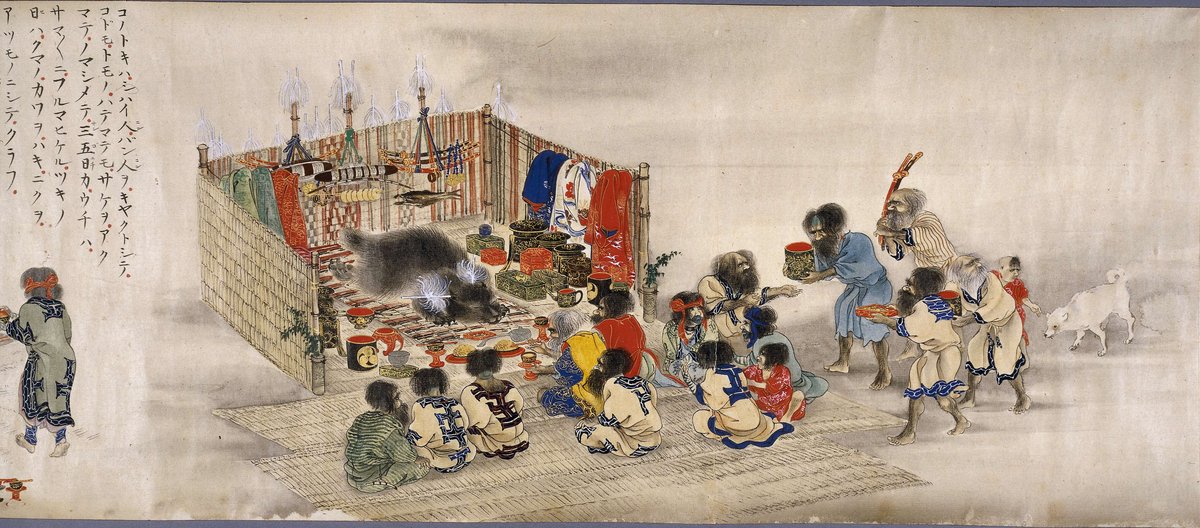
This model was challenged early on. As soon as the 1970s, researchers such as Jane Collier and Michelle Rosaldo stressed the weight of cultural assumptions in that reading, while others recalled an inconvenient fact: among many hunter-gatherer peoples studied in the twentieth century, plant gathering, largely done by women, often supplied the bulk of daily calories, relegating hunted meat to an irregular contribution. Frequently published in young feminist journals rather than in the major scientific titles, these critiques long struggled to gain traction. The idea of a strict, universal division of labour remained dominant, at times serving as a "natural" warrant for hierarchies of far more recent date.5
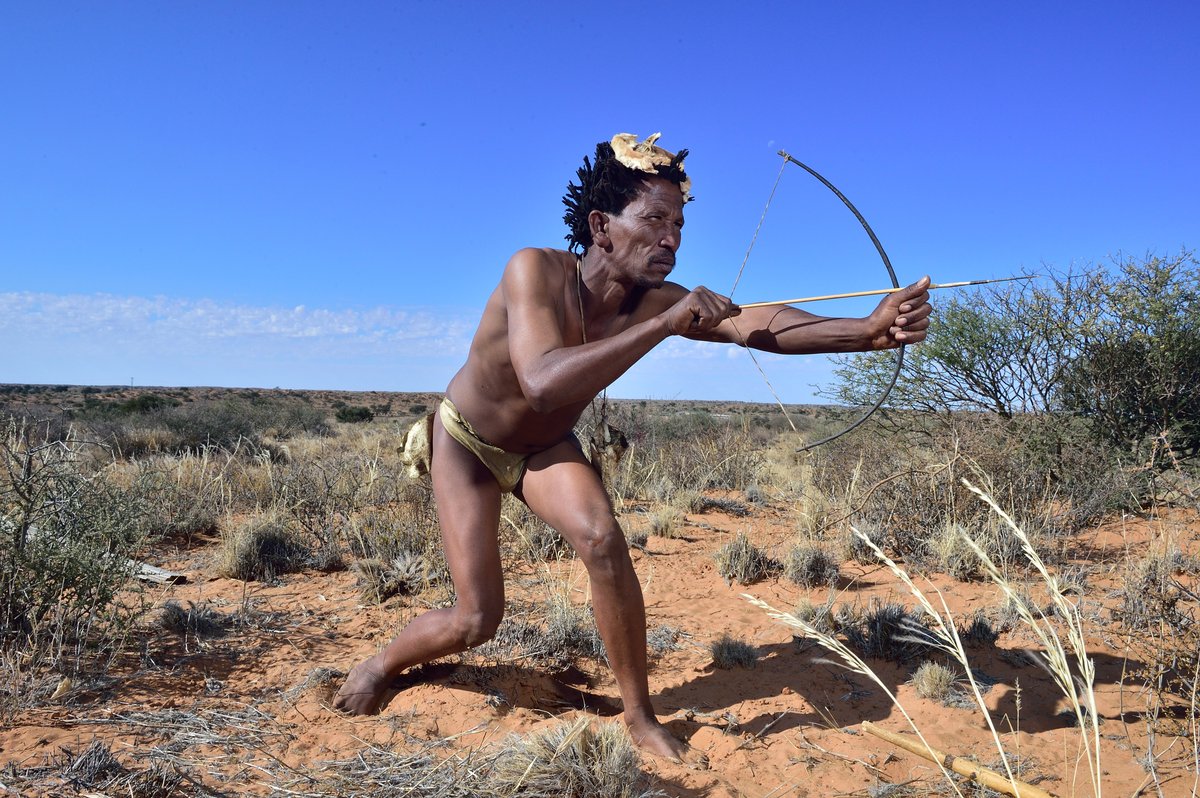
The underlying problem is one of method. Unable to observe Palaeolithic societies directly, prehistorians leaned on ethnographic analogy, transposing onto past hunter-gatherersHunter-gatherersA way of life based on hunting, fishing and gathering wild resources, without farming or herding; it dominated almost the whole of human history.→ the behaviour of present-day groups such as the San of the Kalahari or the Hadza of Tanzania. But these populations are in no way living fossils: they have their own history, their contacts with farming and herding neighbours, their recent transformations. The "Kalahari debate," which divided specialists in the 1980s, showed precisely how far these so-called primitive societies had in fact been reshaped by centuries of exchange. Projecting their organisation onto worlds tens of thousands of years old is therefore a hypothesis, not a proof.
Wilamaya Patjxa: a hunter from 9,000 years ago
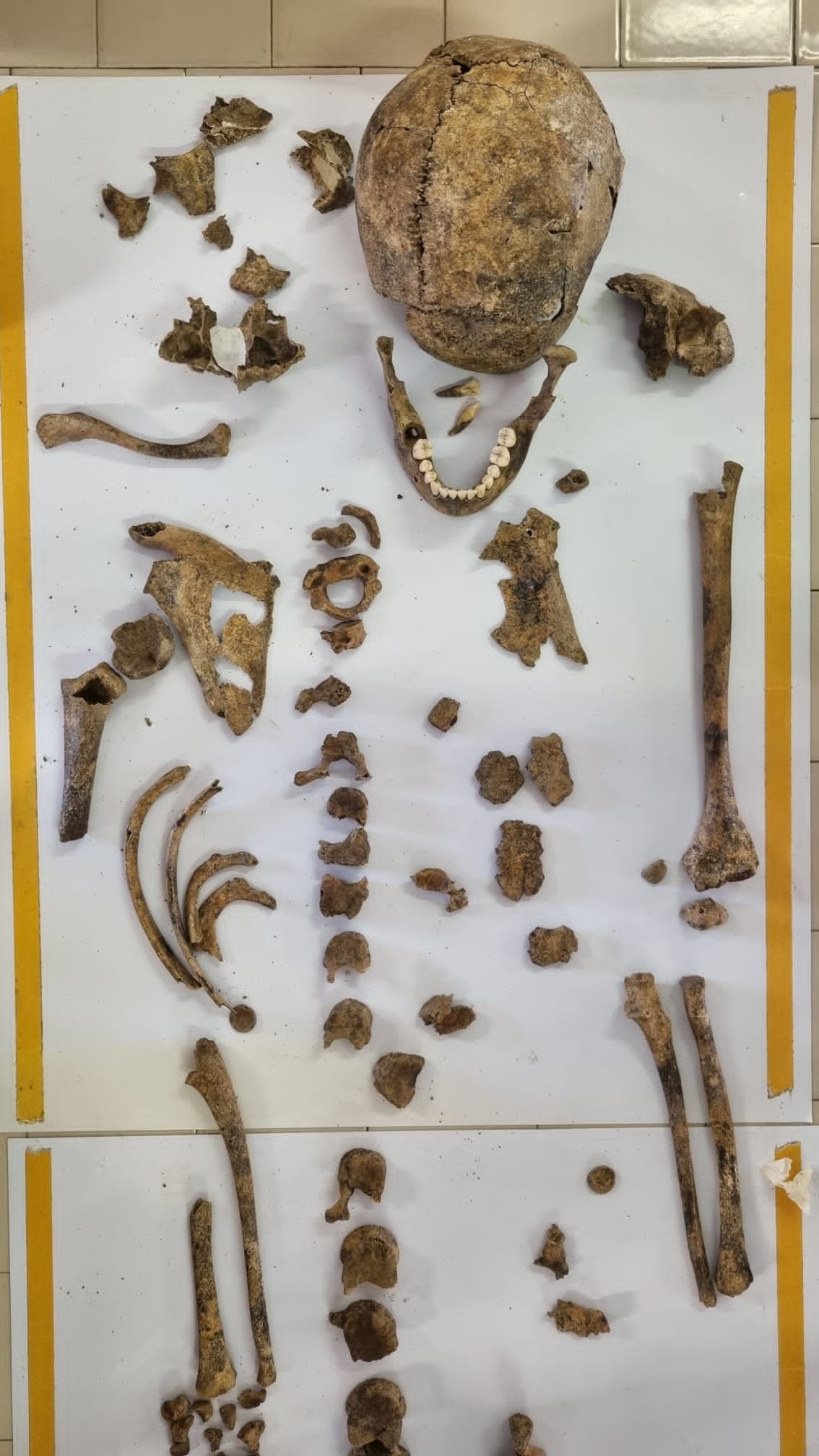
In November 2020, an Andean discovery dramatically revived the debate. At the site of Wilamaya Patjxa, on the Peruvian altiplano, nearly 3,900 metres above sea level, the team led by archaeologist Randall Haas uncovered a burialBurialThe intentional deposition of a body, sometimes with offerings; a marker of symbolic behaviour.→ around 9,000 years old. Around the individual, labelled WMP6, lay a genuine hunting kit: stone projectile points, scrapers, tools for butchering and processing game. Yet analysis of the bones, followed by the study of proteins in the tooth enameltooth enamelThe hardest tissue in the body, laid down in rhythmic layers during tooth formation that preserve a precise memory of time.→ (a proteomicPalaeoproteomicspalaeoproteomicsThe study of ancient proteins preserved in fossils; more resistant than DNA, they allow remains to be identified where the genome has vanished.→The study of ancient proteins preserved in fossils (bone, tooth enamel); can reveal species or sex when DNADNAThe molecule carrying genetic information, used to reconstruct kinship between species.→ is gone.→ approach), concluded that this was a young woman, aged 17 to 19. Published in Science Advances, the find was presented as the oldest hunter burial identified in the Americas.1
Haas and his colleagues did not stop at this single case. They reviewed the known burials of the late PleistocenePleistoceneThe geological epoch of the great ice ages (c. 2.6 Ma–11,700 BP), spanning most of human prehistory.→ and early HoloceneHoloceneThe current geological epoch, begun about 11,700 years ago at the end of the last ice age; the setting of all post-glacial history.→ across the Americas, 429 individuals spread over 107 sites. Of these, 27 lay with big-game hunting tools: 16 were male, 11 female. From this ratio the authors drew a bold but cautiously worded statistical estimate: female participation in hunting may have reached 30 to 50 per cent in these populations. To meet the immediate objections, Haas and Ashley Smallwood analysed in 2023 the microscopic wear on the Wilamaya Patjxa points: they do bear projectile impact marks, confirming their use in hunting (even if some also show cutting traces, like knives).2
The body as argument: female physiology
To the archaeological question is added a biological one: was the female body "made" for hunting? In 2023, in the journal American Anthropologist, Cara Ocobock and Sarah Lacy published two companion papers titled "Woman the Hunter." The first, devoted to the physiological evidence, defends an against-the-grain thesis: in terms of endurance, women are often at an advantage. Oestrogen would favour the use of fat as fuel during prolonged effort, an asset for persistence hunting, which consists of chasing prey until it is exhausted. A wider pelvis would also allow a metabolically more economical stride.3
The second paper, centred on archaeology and palaeoanthropologyPalaeoanthropologyThe science that studies human evolution from the fossil remains of hominins (bones, teeth, footprints) and their context, to reconstruct our biological origins.→, points the same way. The authors note that ancient female skeletons show lesions and wear marks on the body very similar to those of men, notably at the elbows and shoulders, consistent with throwing and heavy work. They also stress that women were buried with weapons, a funerary gesture that, in their view, would make little sense if hunting had held no place in their lives. "There was no deep division of labour in our evolutionary past," Cara Ocobock sums up. The claim, picked up by many media outlets, quickly spilled beyond the academic circle.4
The authors also argue that the hormonal machinery often invoked to disqualify women, in particular around pregnancy and reproduction, has long been overstated. Pregnancy and lactation do impose energetic costs, but they do not fill a woman's entire adult life, and many foraging societies rely on shared childcare that frees mothers for strenuous tasks. The real question, they suggest, is not whether a female body can hunt, but why researchers so readily assumed it could not. Their physiological case remains a hypothesis to be tested rather than a demonstration, and some colleagues find the leap from modern sports science to Palaeolithic behaviour too swift. It nonetheless shifts the burden of proof: biology, on its own, offers no decisive reason to confine women to gathering.
What the isotopes whisper
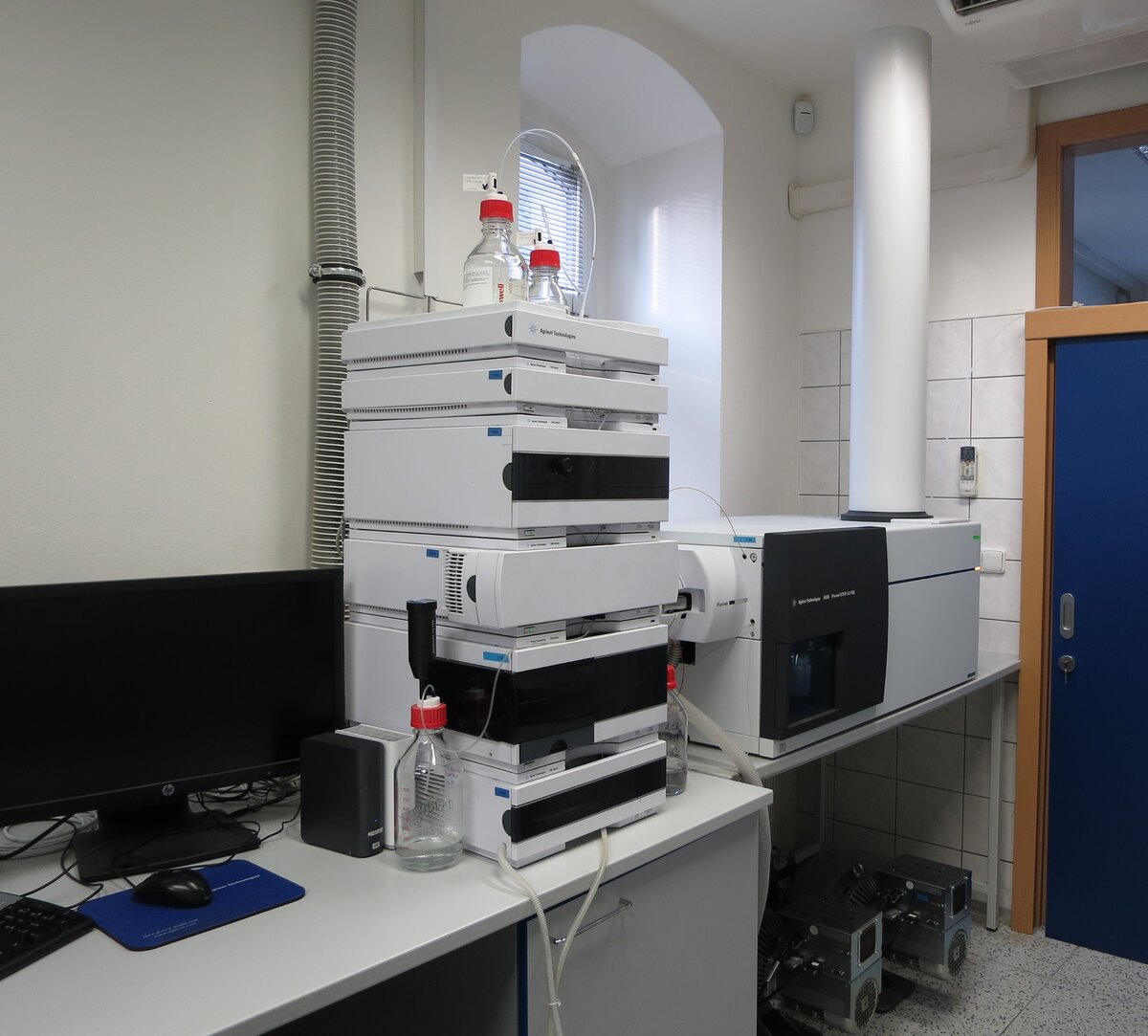
To learn who ate what, burials and tools are not enough: one must question the flesh itself, or what remains of it. That is the role of the analysis of stable isotopesisotopic analysesMeasurement of the ratios between variants of the same element (oxygen, strontium, barium) in enamel, which inform on diet, climateClimateThe long-term average atmospheric conditions of a region; its variations (glaciations, aridifications) shaped migrations, agriculture and the collapse of prehistoric societies.→ and mobility.→ of carbon (δ13C) and nitrogen (δ15N), measured in the collagenCollagenThe main protein of bone, used as the medium for isotopic analysis of ancient diet.→ of the bones. Nitrogen in particular rises at each rung of the food chain: a regular consumer of meat and animal products shows higher values than a mostly plant-based eater. By comparing men and women from the same cemetery, one can therefore, in theory, detect any inequality in access to animal protein.9
The most striking result is the absence of a single rule. At the Early NeolithicNeolithicThe "New Stone Age": a period marked by farming, herding, settlement and pottery, from around 10,000 BC.→ Linearbandkeramik cemetery of Kleinhadersdorf, in Austria, men show very slightly higher δ15N values, but with no statistically significant difference between the sexes, a pattern found at other sites of the same culture. Conversely, at the Iron AgeIron AgeThe last period of protohistory (from c. 1200 BC in Europe and the Near East), marked by iron metallurgy and the first kingdoms.→ site of Münsingen, in Switzerland, the gap is clear: men appear to have had better access to meat and dairy products than women. The same contrast appears at the medieval cemetery of Giecz, in Poland, where men consumed more animal protein. In certain ancient populations of Siberia (Cis-Baikal), it is on the contrary the women who display distinct isotopic signatures. In other words, dietary inequality between the sexes does sometimes exist, but it is in no way universal: it depends on periods, regions and economies.8
These chemical signatures nonetheless demand a cautious reading. A gap in δ15N does not necessarily mean unequal access to meat: it may reflect the consumption of freshwater fish, which is very rich in nitrogen, or physiological effects linked to pregnancy, which alter nitrogen metabolism in women. Prolonged breastfeeding likewise leaves a lasting imprint in bones formed during childhood, blurring comparisons. To untangle these factors, researchers now combine several isotopes (sulphur, strontium) and take age at death into account. The general conclusion is only the stronger for it: where inequality in access to animal protein does appear, it looks more bound up with social status, local economy and culture than with any biological law for sharing meat.
The backlash: when the critics reply
The media enthusiasm prompted a cautious, even severe, scientific reaction. In 2023 a wide-ranging ethnographic study by Abigail Anderson, Cara Wall-Scheffler and colleagues, published in PLOS ONE, claimed that women hunted in nearly 79 per cent of documented hunter-gatherer societies, and most often intentionally. Widely circulated, the work seemed to bury "Man the Hunter" for good.5 But in 2024 a team led by Vivek Venkataraman published a stinging rejoinder in Evolution and Human Behavior. Replaying the analysis on the same database, these researchers concluded that the method was biased toward female hunting: a sample selected only from societies with explicit data, a coding scheme that treated the slightest mention of female hunting as regular practice, and discrepancies between primary and secondary sources.6
Their message is nuanced: yes, women do sometimes hunt, and it is documented on every continent; no, this does not erase the existence of genuine sex-based divisions of labour in many societies. The Wilamaya Patjxa burial itself is not beyond caveats. In the absence of well-preserved pelvic bones in many ancient cases, sex attribution sometimes remains fragile, and the presence of points in a grave does not on its own prove that the deceased hunted big game day to day: an object may be an offering, an heirloom or a symbol. The "30 to 50 per cent" statistic rests, the sceptics recall, on a sample of 27 individuals, modest given the ambition of the conclusion.
What this exchange reveals is less a clash of facts than a clash of thresholds: how much female hunting counts as hunting, and how a single burial should weigh against broad cross-cultural patterns. Even the critics concede that women hunted in the past, and even the boldest proponents stop short of claiming that the sexes everywhere did identical work. The disagreement is one of degree and of framing, and that is precisely why media headlines, which trade in clean reversals, have so often distorted it. The scholarly picture that emerges is not a victory for one camp but a more demanding one, in which flexibility, local context and individual life histories matter more than any universal rule.
Not replaying the present in the past
What should we take from this shifting debate? First, that the old story of a fixed division of labour, in which meat was a male privilege, does not survive scrutiny: the data, both archaeological and isotopic, sketch a far more flexible mosaic, where roles vary from group to group and age to age. Second, that caution is needed in both directions. Replacing "Man the Hunter" with an equally universal "Woman the Hunter" would be to commit the same methodological error: projecting a contemporary expectation onto a past that knew nothing of it.
The firmest lesson may be epistemological. Each generation of researchers tends to read into bones and stones the preoccupations of its own time. The pioneers of the 1960s saw the virile hunter there; part of today's public looks for equality. Prehistory itself knew neither of our schemes. Faced with an Andean burial, a nitrogen spike in a Neolithic femur or the wear on a shoulder, the prehistorian's task is not to decide in favour of our moral comfort, but to hold together the complexity of the evidence and humility before what may, perhaps forever, escape us. That is the price at which the question of gender and meat ceases to be a mirror of our quarrels and becomes once again a genuine scientific puzzle.1
Ce site est devenu indispensable pour préparer mes voyages culturels et archéologiques.
L'angle est honnête et bien documenté. La bibliographie en fin de page est un vrai plus.
C'est vertigineux de réaliser à quel point nos ancêtres étaient déjà pleinement humains.