In February 2007, at an archaeological site on the outskirts of Mantua (Lombardy, Italy), an archaeologist named Elena Menotti and her team uncovered something extraordinary: two human skeletons locked in an embrace, face to face, arms and legs intertwined in a final clasp. This couple had rested so for nearly 6,000 years. The world's press seized on the image. The "Lovers of Valdaro" were born into the collective imagination.1
The Valdaro site, in the commune of San Giorgio Bigarello, forms part of the archaeological basin of Mantua, an area rich in neolithicNeolithicThe "New Stone Age": a period marked by farming, herding, settlement and pottery, from around 10,000 BC.→ and ChalcolithicChalcolithicThe "Copper Age": a transition between the Neolithic and the Bronze Age, marked by the first copper objects (Ötzi's era).→ remains. The two individuals -- osteological analysis identifies them as a young man and a young woman, both approximately 20 to 25 years old -- lay in a shallow pit with no notable funerary goods. Their bodies had decomposed in the original position of their burialBurialThe intentional deposition of a body, sometimes with offerings; a marker of symbolic behaviour.→: face to face, looking at one another.
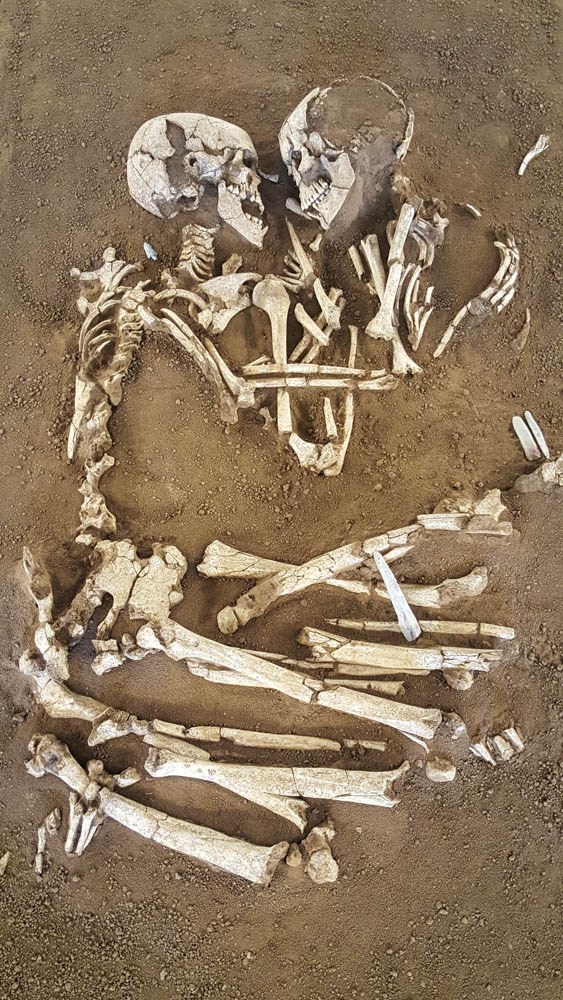
Radiocarbon dating placed their death between 5,000 and 5,500 years before our era -- a range corresponding to the Final Neolithic or Chalcolithic, a transitional period between farming societies and the first copper cultures. At this time, the Po Plain was densely populated with agricultural communities burying their dead according to varied rituals.
But a double burial, placed so intimately, remains extremely rare in the European archaeological record. The catalogue of double burials known for this period contains very few examples where bodies are intentionally placed in direct contact. Researchers therefore quickly asked: what happened at Valdaro?
Several hypotheses have been advanced. Simultaneous death might indicate an accident, epidemic, or act of violence. But the absence of traumatic traces on the bones -- no fractures, no arrow or weapon wounds -- rules out obvious violent causes. The hypothesis most accepted today is death by illness or malnutrition, with the two individuals buried together by a community wishing to reunite them in death as they had been in life.2
Analysis of the male skeleton revealed slight spinal deformation, and both individuals showed signs of anemia -- hints of fragile health, perhaps linked to the nutritional conditions of a nascent agricultural community. Domesticated cereals provided carbohydrates but could lack essential amino acids.
Since their discovery, the Lovers of Valdaro have been transported intact -- in their block of earth -- to the National Archaeological Museum of Mantua, where they are displayed to the public. Moving such an osseous ensemble without detaching it was technically perilous; archaeologists opted for block extraction to preserve the exact spatial relationships between the two skeletons.
Beyond the romantic symbol, the Lovers of Valdaro remind us that prehistoric funerary practices reflected affective and social bonds as complex as our own. Whether this gesture was dictated by love, respect, belief in an afterlife, or a cultural convention we cannot know, it testifies to a human community that cared for its dead and granted them an existence in the beyond.
No comments yet. Be the first.