To the modern eye, the Arabian Peninsula conjures an image of boundless desert — scorching, empty, inhospitable. Yet across the PleistocenePleistoceneThe geological epoch of the great ice ages (c. 2.6 Ma–11,700 BP), spanning most of human prehistory.→ this territory was repeatedly transformed beyond recognition: a mosaic of savannas, permanent lakes, seasonal rivers and gallery forests, roamed by elephants, hippos and camels larger than any alive today. It is through this forgotten «green corridor» that thousands of generations of hominins migrated, hunted, engraved rock, and eventually settled — leaving behind a prehistoric archive that archaeologists are only now beginning to decipher.
Green Arabia: when the desert was savanna
For much of the twentieth century, the Arabian Peninsula was considered an ecological dead-end — an arid barrier between AfricaAfricaThe cradle of humankind: the continent where the first hominins appeared, then Homo sapiens around 300,000 years ago, before the expansion to the rest of the world.→ and Eurasia, irrelevant to the story of human dispersal. This view has been overturned over the past two decades by a convergence of geology, palaeoclimatology and archaeology. The peninsula experienced at least five to seven major humid episodes over the past 400,000 years, driven by precessional cycles of Earth's orbit (roughly every 21,000 years). During these «Arabian pluvial» phases, the African monsoon system migrated northward, watering a peninsula that today receives less than 100 mm of rain per year.
Palaeoclimatologists have reconstructed these episodes from several archives: speleothems in Omani and Yemeni caves, lake sediments in closed basins of the Nefud Desert, and oxygen isotopes in fossil mollusc shells. The evidence converges: during marine isotope stages 11, 9, 7, 5e, 3 and 1, central Arabia was carpeted with grassland dotted with permanent lakes spanning tens of kilometres. Hippos swam where the Empty Quarter now stretches to the horizon.
A corridor between two worlds
This transforms the geography of human dispersal out of Africa. The Levantine route — via the Sinai and the Levant — has long been considered the only viable exit. Accumulating evidence since 2010 suggests a more complex picture: Arabia offered an alternative, perhaps primary, corridor during humid phases. Populations could cross the Bab-el-Mandeb Strait (under 30 km at low sea level during glaciations) and move through a temporarily verdant peninsula into South Asia and Eurasia. This is not academic geography: it explains why some living populations in South Asia and Oceania carry genetic signatures of dispersal waves older than the main 60,000-year exodus from Africa.
Khal Amishan: the oldest human presence (−400,000 years)
The site of Khal Amishan, in the Tabuk region of northwestern Saudi Arabia, has yielded the oldest known evidence of human occupation in the country. The artefacts belong to the AcheuleanAcheuleanA stone-tool industry (c. 1.7 Ma–300,000 BP) characterised by large, finely worked almond-shaped bifaces. Associated with Homo ergaster and erectus and spread from Africa to Europe and Asia.→ tradition — bifaces, cleavers and characteristic flakes linked to a technology widespread across Africa and Europe from roughly 1.7 million to 300,000 years ago. Optically stimulated luminescence (OSL)Luminescence (OSL)Optically stimulated luminescence dating: measures the last exposure of sediment grains to light.→ dating of the enclosing sediments places these tools at approximately 400,000 years before the present.
The identity of the toolmakers remains uncertain. At that time, Africa housed several homininHomininMember of the subtribe Hominina, comprising the human lineage (Homo, Australopithecus, Paranthropus…) but excluding orangutans and gibbons. The term progressively replaces "hominid" in its narrow sense.→ species including Homo heidelbergensis and ancestral Neanderthal lineages. Homo sapiensHomo sapiensThe present-day human species, which emerged in Africa around 300,000 years ago, the only surviving human lineage after the extinction of Neanderthals and Denisovans.→ did not yet exist. These anonymous stone-knappers may have been descendants of H. erectus who migrated from Africa during an earlier humid phase, or members of a lineage not yet clearly defined. What their tools unambiguously show is an ecological strategy that would guide hominins for hundreds of thousands of years to come: follow the water.
This research forms part of the PalaeoDeserts Project, a multi-year programme coordinated since 2012 by the Max Planck Institute for Evolutionary Anthropology and the Saudi Heritage Authority. The project has transformed knowledge of Arabian prehistoryPrehistoryThe span of human history before the invention of writing, from the Palaeolithic to the Metal Ages, known mainly through material remains.→ by documenting dozens of sites spanning Acheulean through NeolithicNeolithicThe "New Stone Age": a period marked by farming, herding, settlement and pottery, from around 10,000 BC.→ periods in regions that had never been systematically surveyed.
The footprints of Lake Alathar (−120,000 years)
In spring 2017, during a fieldwork campaign in the Nefud Desert, palaeoanthropologist Mathew Stewart (Max Planck Institute) noticed footprints eroding from the surface of an ancient lakebed. After years of analysis, the results were published in 2020 in Science Advances (¹): seven human footprints 120,000 years old — the oldest yet found in Saudi Arabia.
The site, named Alathar («the trace» in Arabic), was once a permanent lake covering several square kilometres at the heart of what is now one of the world's most arid deserts. OSL dating of quartz grains from the enclosing sediments places the footprints at 112,000–121,000 years ago, corresponding to marine isotope stage 5e — a period of intense warmth and humidity when the African monsoon penetrated deep into the peninsula.
A moment frozen for 120,000 years
Four of the seven footprints belong to two or three individuals walking together in the same direction. Their dimensions indicate adult-sized humans anatomically incompatible with Homo neanderthalensis, which was in any case absent from this region at that time. The walkers were, in all probability, anatomically modern Homo sapiens.
Around the human traces, 233 animal fossils were identified: giant camel tracks, elephant and hippo prints, and the remains of various herbivores. Predator traces complete the picture. This faunal community evokes the African savanna today. The absence of stone tools and the brevity of the passage suggest these were travellers passing through, not settlers. «Footprints represent a snapshot in time — of the order of hours or days. We don't get that resolution from other archaeological evidence», notes Mathew Stewart.
The Al Wusta finger bone: Homo sapiens out of Africa (−88,000 years)
A year before the Alathar footprints were published, another discovery in the Nefud had already shaken the chronology of human dispersal. At the site of Al Wusta in the heart of the An-Nafud Desert, a team led by Huw Groucutt and Michael Petraglia recovered in 2016 a small, unremarkable-looking bone: an intermediate finger phalanx from an adult human hand. Morphological analysis and uranium-series/electron spin resonance (U-series/ESR) dating place the bone at 88,000 ± 9,000 years before the present. Published in 2018 in Nature (²), it was then the oldest Homo sapiens fossil known outside Africa and the immediate Levant.
The morphology is unambiguous — the phalanx matches anatomically modern populations. The geological context confirms the setting: lake sediments surrounding the bone, alongside hippo fossils and freshwater fish in the same stratigraphic layers, all pointing to a person who lived beside a lake in a temporarily verdant Arabia. The Al Wusta phalanx forced prehistorians to revise the timeline of H. sapiens dispersal. Before this discovery, consensus placed the main out-of-Africa exodus at roughly 60,000–70,000 years ago. The phalanx proves that at least some groups reached the interior of Arabia far earlier — during a climatic window that subsequently closed, isolating or eliminating these early pioneers.
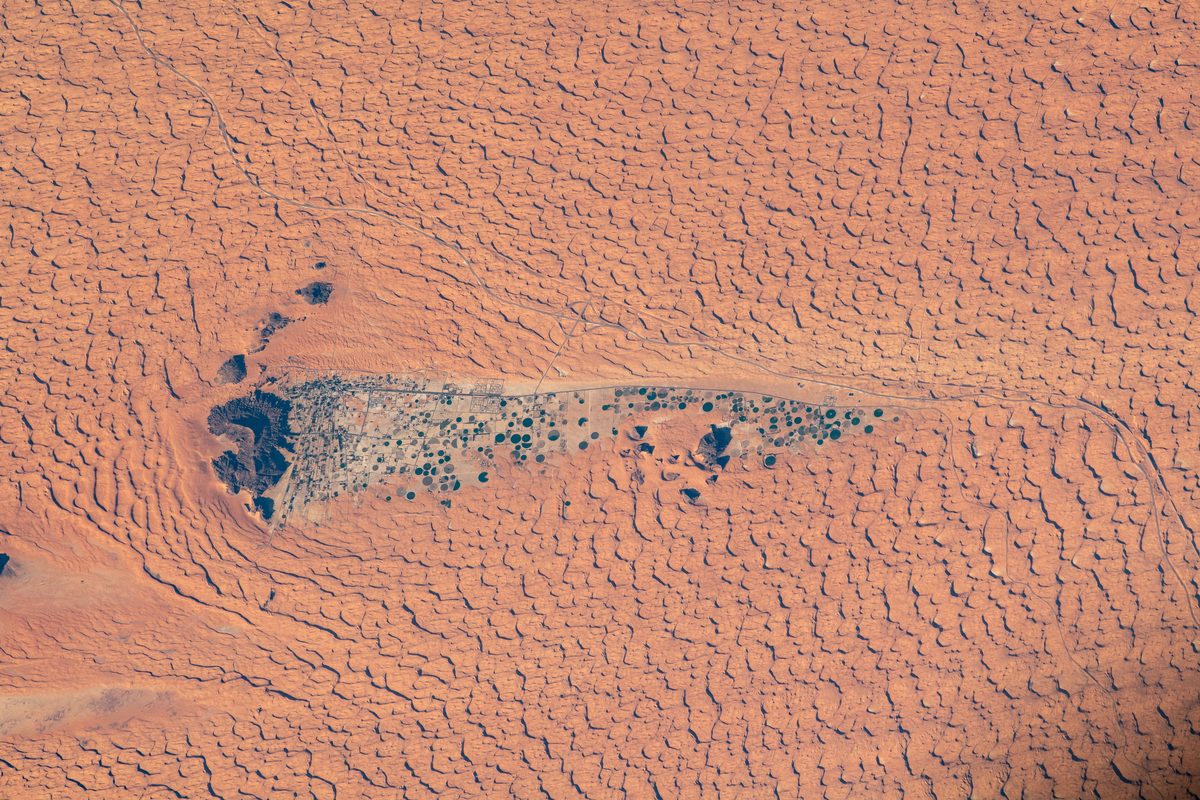
These successive discoveries from sites within 200 kilometres of each other across the Nefud reveal that this region was a regularly frequented crossroads: an «attractor zone» around water resources that served as a refuge during progressive aridification and a launchpad during climatic expansion phases.
Five waves of migration: Arabia as corridor
Taken together, the archaeological and palaeoclimatic evidence from the Arabian Peninsula paints a complex picture: not a single out-of-Africa exodus, but at least five successive dispersal waves of hominins over the past 400,000 years, each coinciding with an Arabian humid phase.
The PalaeoDeserts Project has documented lithic assemblages corresponding to each wave. Acheulean tools (~400,000 years) mark the earliest known migrationsMigrationsLong-distance movements of populations; a major driver of human history (the exit from Africa, the peopling of continents, Neolithic and steppe expansions).→. Mode 3 (Levallois) assemblages, linked to Neanderthals or ancestral forms, appear around 200,000–300,000 years ago. Mode 4 technologies (blade knapping, projectile points) mark H. sapiens passages between 120,000 and 55,000 years ago. Between humid phases, Arabia became an impassable desert: populations that had entered were either pushed toward coastal refugia or disappeared without detectable descendants. Arabia functioned as a «population pump» — alternately magnet and trap depending on the climateClimateThe long-term average atmospheric conditions of a region; its variations (glaciations, aridifications) shaped migrations, agriculture and the collapse of prehistoric societies.→.
This multi-wave chronology aligns with population genetics data. Genomes of living populations carry traces of at least two waves of H. sapiens expansion out of Africa: an ancient wave (>100,000 years ago, detected in Melanesian and Australian populations), and the main wave (~60,000–70,000 years ago) from which most present-day non-African humanity descends.
Monumental rock art in the Nefud (−12,800 to −11,400 years)
In October 2025, an international team published in Nature Communications (³) a discovery that redrew the map of Arabian prehistory yet again. In the southern Nefud, three sites — Jebel Arnaan, Jebel Misma and Jebel Mleiha — yielded 62 rock art panels totalling 176 engravings, dated to between 12,800 and 11,400 years ago. These are the oldest directly dated evidence of human occupation in the Arabian interior during the Pleistocene-HoloceneHoloceneThe current geological epoch, begun about 11,700 years ago at the end of the last ice age; the setting of all post-glacial history.→ transition, definitively refuting the idea of a «desert vacuum» isolating Arabia's heartland.
Life-size camels on vertiginous cliffs
The engravings cover steep rock faces, some panels rising 39 metres above the ground and spanning over 20 metres across. The deep pitting technique required scaffolding or rope access. Dominant motifs are camels (74% of animal depictions), alongside ibex, gazelles, equids and an aurochs. Individual camels reach 3 metres in length. The anatomical detail is extraordinary — swollen necks of males in rut, thick winter coats, walking and galloping gaits carefully differentiated.
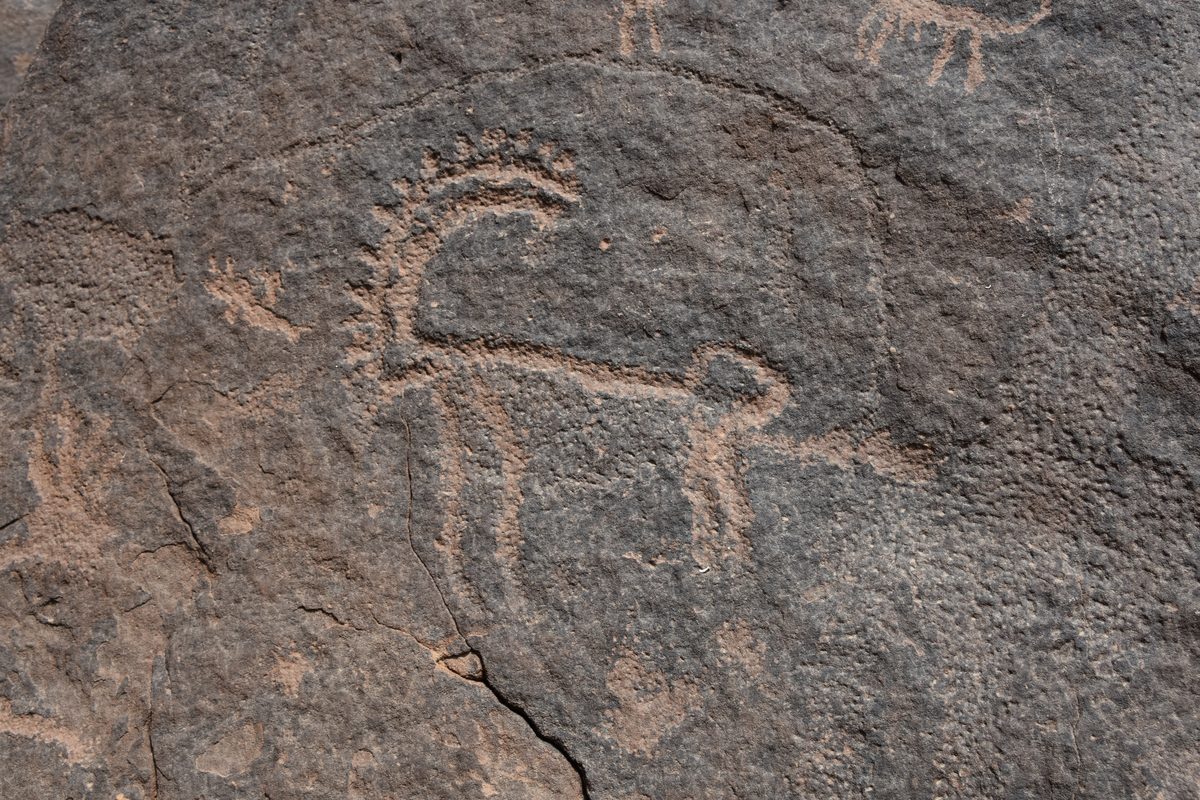
This level of detail implies sustained, close observation of animal behaviour — probably linked to seasonal water availability cycles. Sediment analyses in nearby dry basins confirmed that seasonal lakes existed in the area between 17,000 and 13,000 years ago, providing the lifelines that kept mobile groups in what might otherwise have been uninhabitable terrain.
Long-distance connections and unexpected exchanges
Excavations beneath the panels recovered over 1,200 artefacts: bladelets, scrapers, drills and finely retouched points. Some points match El Khiam and Helwan types from early Neolithic Levantine cultures — evidence of connection or mobility linking northern Arabia to Levantine or coastal populations at the Pleistocene-Holocene boundary. Ground-stone beads, a green pigment crayon and marine shells sourced hundreds of kilometres away confirm long-distance exchange networks: far from isolated groups, these nomads maintained contact across thousands of kilometres of desert and coastline.
The positioning of the engravings near ancient lakebeds and dry watercourses was no coincidence. The researchers propose that the panels served as mnemonic beacons — marking water sources, migration routes and territorial boundaries in a landscape where memory of the terrain was literally a matter of survival.
The first villages: towards sedentismSedentismThe shift from a nomadic life to lasting settlement in one place, a precondition for the rise of villages.→ (−11,000 years)
As the Holocene established itself and monsoon patterns stabilised certain Arabian regions, previously nomadic groups began building more lasting ties to specific places. The site of Masyoun, in western Saudi Arabia, is considered the oldest known stable settlement in the peninsula, dated to approximately 11,000 years before the present.
This pre-ceramic site illustrates the transition from hunter-gatherer mobility to incipient sedentism. Excavations revealed circular dwelling structures, repeatedly used hearths and accumulated food waste — the classic signatures of prolonged, repeated occupation of a single location. Faunal and botanical analysis indicates a mixed economy: gazelle hunting, intensive collection of wild seeds and nuts, and systematic exploitation of water resources.
This early Arabian sedentism — contemporary with the first Neolithic cultures of the Fertile CrescentFertile CrescentAn arc-shaped region of the Near East (Levant, Mesopotamia) where farming and herding first emerged.→ — reflects a process unfolding simultaneously across continents. As in the Levant and Anatolia, early Holocene communities in Arabia were experimenting with a new relationship to space and time: cultivate rather than forage, keep rather than follow, build rather than fold the tent.
Jubbah and Shuwaymis: Holocene rock art (−8,000 years and beyond)
In the millennia following the Neolithic transition, the Arabian Peninsula witnessed an unprecedented artistic flowering. The sites of Jubbah and Shuwaymis, in the Ha'il region of northwestern Saudi Arabia, constitute one of the world's largest concentrations of petroglyphs. Inscribed on the UNESCO World Heritage List in 2015, they encompass tens of thousands of engravings across sandstone cliffs stretching for kilometres.
The oldest panels at Jubbah date to roughly 8,000 years before the present, but the layering of motifs documents continuous use across millennia. The earliest artists depicted an abundant fauna: aurochs, gazelles, addax, ostriches, lions and hunting dogs, alongside humans armed with spears and bows. The composition — especially the presence of aurochs and addax, now extinct or locally absent — confirms that early Holocene Arabia was far wetter and more biodiverse than today.
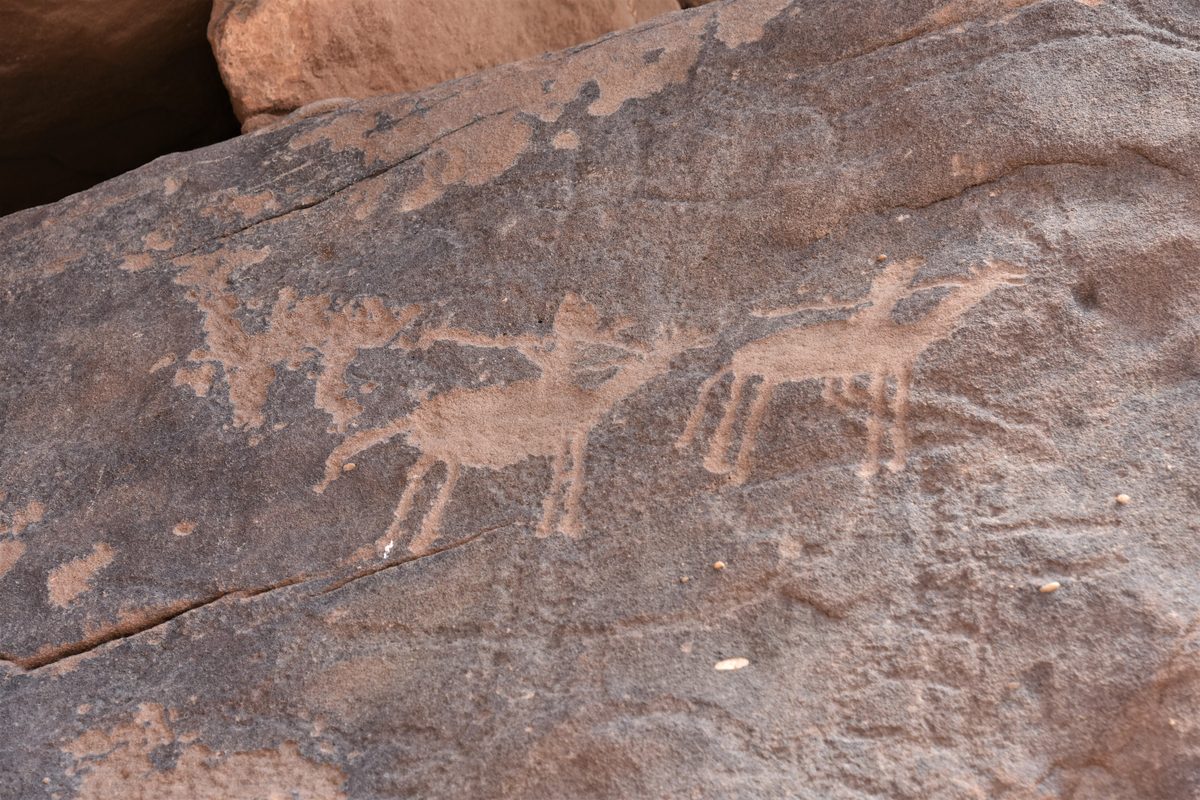
At Shuwaymis, some 50 kilometres to the south, the panels record the progressive arrival of domestic cattle and domesticated camels — two revolutions that transformed the peninsula's economy from around 5,000 years ago. Dogs on leashes appear in several scenes, documenting the deep antiquity of the human-animal bond in the region. Thamudic inscriptions — a North Arabian script of the Iron AgeIron AgeThe last period of protohistory (from c. 1200 BC in Europe and the Near East), marked by iron metallurgy and the first kingdoms.→ — accompany many engravings, providing the earliest traces of writingWritingA system of conventional signs used to fix language or information durably; its appearance (c. 3300 BC) marks, by convention, the end of prehistory.→ in Arabia before the alphabets that would give rise to Classical Arabic.
Saudi Arabian palaeoanthropologyPalaeoanthropologyThe science that studies human evolution from the fossil remains of hominins (bones, teeth, footprints) and their context, to reconstruct our biological origins.→: a new chapter
For decades, Saudi Arabia remained a prehistoric terra incognita, partly for logistical reasons and partly for administrative ones. That gap is being closed at remarkable speed. Since the creation of the Saudi Heritage Authority in 2020 and the launch of Vision 2030, investment in archaeology has surged.
Dozens of international missions now operate simultaneously across Saudi territory. The PalaeoDeserts Project (Max Planck Institute), the French-Saudi CAFA mission, and University College London teams are exploring regions that had never been systematically surveyed. Satellite remote sensing and LiDARLiDARLaser-based remote sensing (from "Light Detection And Ranging"): a sensor fires light pulses and measures the echo's return time to map a surface in three dimensions. Mounted on a plane or a drone, it slips through gaps in the canopy and reconstructs the bare-earth relief, revealing structures invisible beneath vegetation.→ surveys have identified thousands of potential sites across the Nefud, the Rub'al-Khali and the Hejaz — a fraction of which have received any ground investigation.
In fewer than fifteen years, Saudi Arabia has moved from a blank space on the prehistoric map to one of the most strategically important terrains for understanding human evolution. Each field season rewrites the textbooks: new extinct fauna, new tool types, new rock art sites, new dates that push the boundaries of what seemed possible in such a challenging environment. Arabia was not on the margins of human prehistory. It was, repeatedly, its geographical centre — the place through which thousands of generations of hominins passed on their way to colonise the world.
Je n'aurais jamais imaginé que l'Arabie Saoudite puisse avoir une telle richesse préhistorique. Les images de lacs fossiles et d'anciennes savanes dans ce qui est maintenant un désert sont frappantes. Cela change completement l'image qu'on se fait de l'histoire humaine au Moyen-Orient. Merci pour cet article qui ouvre des horizons inattendus.
L'Arabie préhistorique est un terrain de recherche en pleine expansion depuis une dizaine d'années. Les travaux dans le cadre du projet PALAEODESERT ont mis au jour des centaines de sites paléolithiques dans des zones aujourd'hui totalement désertiques mais qui étaient des savanes verdoyantes lors des périodes humides du Pléistocène. Ces découvertes confirment que l'Arabie était un corridor migratoire crucial.