Australopithecus anamensis holds a key position in human evolution: the oldest confirmed australopith, living between 4.2 and 3.9 million years ago, and most likely the direct ancestor of Lucy (A. afarensis). Its discovery at Kanapoi, Kenya in 1994, and a complete skull found in Ethiopia in 2019, have substantially clarified the deep origins of our lineage.
The Kanapoi Discovery
In 1994, Maeve Leakey and Alan Walker excavated Kanapoi in Kenya's Turkana district, recovering mandible KNM-KP 29281, the type specimen of the new species1. Named anamensis from the Turkana word for "lake," the species is now known from about 100 specimens from Kenya and Ethiopia. BipedalismBipedalismA mode of locomotion on two hind limbs, the defining trait of the human lineage, appearing over 7 million years ago. Visible in the anatomy of the pelvis, femur and foramen magnum.→ is confirmed by the Kanapoi tibia (KNM-KP 29285), whose articular surface angle indicates upright walking.
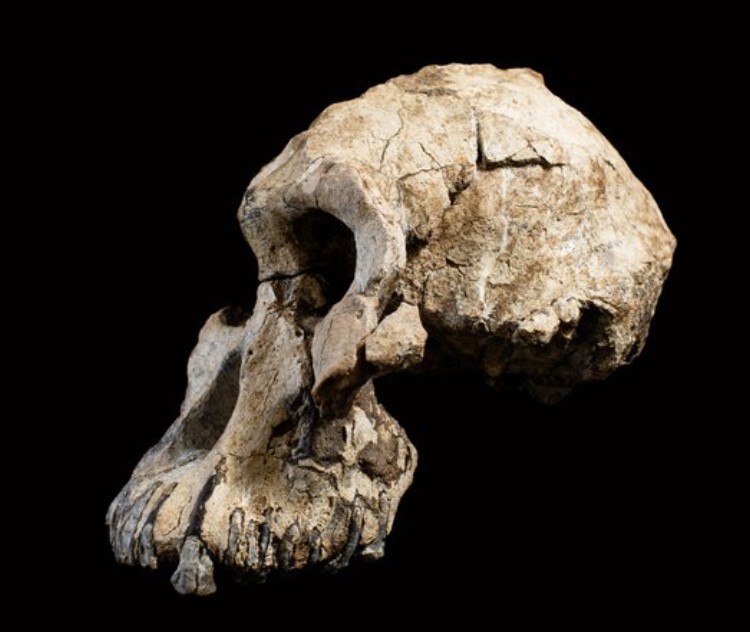
A Complete Skull at Last (2019)
For over twenty years, A. anamensis was known mainly from jaws and teeth. In 2019, the publication in Nature of a nearly complete skull (MRD-VP-1/1) from Woranso-Mille, Ethiopia changed the picture2. Dated to 3.8 million years, MRD shows a very prognathic face and small brain (365-370 cc). Its discovery in the same region and time period as early A. afarensis implies the two species coexisted for at least 100,000 years, questioning the simple linear anamensis → afarensis model.
Evolutionary Position
Most paleoanthropologists consider A. anamensis directly ancestral to A. afarensis (Lucy, 3.9-2.9 Ma), based on stratigraphic continuity, intermediate dental morphology, and geographic overlap. However, the 2019 discovery suggests they may have been contemporary sister species from a common ancestor. Either way, A. anamensis represents the transition from tree-climbing Ardipithecus-like ancestors to the committed bipeds that would flourish across AfricaAfricaThe cradle of humankind: the continent where the first hominins appeared, then Homo sapiens around 300,000 years ago, before the expansion to the rest of the world.→ for the next two million years.
No comments yet. Be the first.