A forest long thought impassable
Our species emerged in AfricaAfricaThe cradle of humankind: the continent where the first hominins appeared, then Homo sapiens around 300,000 years ago, before the expansion to the rest of the world.→ roughly 300,000 years ago, then spread across every continent and nearly every environment on the planet. Yet in this grand narrative one biome was kept apart: the humid tropical forest. Hot, saturated with moisture, dark beneath an unbroken canopy, broken up by swampy ground and poor in large, easy game, it was treated as a hostile setting that early Homo sapiensHomo sapiensThe present-day human species, which emerged in Africa around 300,000 years ago, the only surviving human lineage after the extinction of NeanderthalsNeanderthalsA fossil humanity of Eurasia, robust and cold-adapted, extinct around 40,000 years before present.→ and Denisovans.→ would have avoided until recent times. Textbooks placed humanity's origins in open savannas, along coastlines and around great lakes, never under the equatorial canopy.1

That conviction rested partly on a lack of data. Acidic forest soils preserve bone poorly, vegetation quickly swallows sites, and field conditions make excavation hard. Until this study, the oldest secure evidence of human occupation in an African rainforest reached back only about 18,000 years; the oldest known trace of forest habitation anywhere, across all regions, came from Southeast Asia and dated to roughly 70,000 years.2 The idea of an equatorial forest frequented as far back as the Middle PleistoceneMiddle PleistoceneGeological subperiod (about 770,000 to 126,000 years ago) marked by growing behavioural complexity among hominins.→ therefore seemed out of reach. It is this frontier that the international team gathered around Eslem Ben Arous, James Blinkhorn and Eleanor Scerri pushed back.
This bias is not merely a documentary gap: it shaped a whole scientific imagination. By concentrating research on East Africa, its volcanic rifts and its lake sediments favourable to preservation, palaeoanthropologyPalaeoanthropologyThe science that studies human evolution from the fossil remains of hominins (bones, teeth, footprints) and their context, to reconstruct our biological origins.→ long drew a map of human origins on which vast regions, forested Central and West Africa first among them, remained almost blank. The lack of discoveries there was read as a lack of settlement, when it chiefly reflected a lack of excavation and the rarity of preservation conditions. Overturning that assumption meant looking for evidence where no one expected it, and acquiring the tools able to read it.
Bété I, a site unearthed then forgotten
The story begins in the 1980s. At the locality of Anyama, some twenty kilometres north of Abidjan, a joint Ivorian-Soviet mission excavated a deeply stratified sequence named Bété I. Professor François Yodé Guédé, of Félix Houphouët-Boigny University, uncovered knapped stone tools attributed to the Middle Stone AgeMiddle Stone AgeA long phase of African prehistory (c. 300,000 to 40,000 years ago), the African equivalent of the Middle Palaeolithic, marked by the rise of symbolic behaviour.→Middle Stone Age (MSA)The African Middle PalaeolithicMiddle PalaeolithicA Palaeolithic period (c. 300,000 to 40,000 years ago) associated mainly with Neanderthals and early Homo sapiens, marked by Levallois tools.→, roughly 300,000 to 30,000 years ago, marked by flake tools often produced by the Levallois method and associated with Homo sapiens.→, the African Middle Palaeolithic. But the means of the day allowed neither the dating of these layers nor the reconstruction of the environment in which they were laid down. Worse, the results were published only in Russian-language journals, inaccessible to the wider scientific community, and the site slipped back into obscurity.3
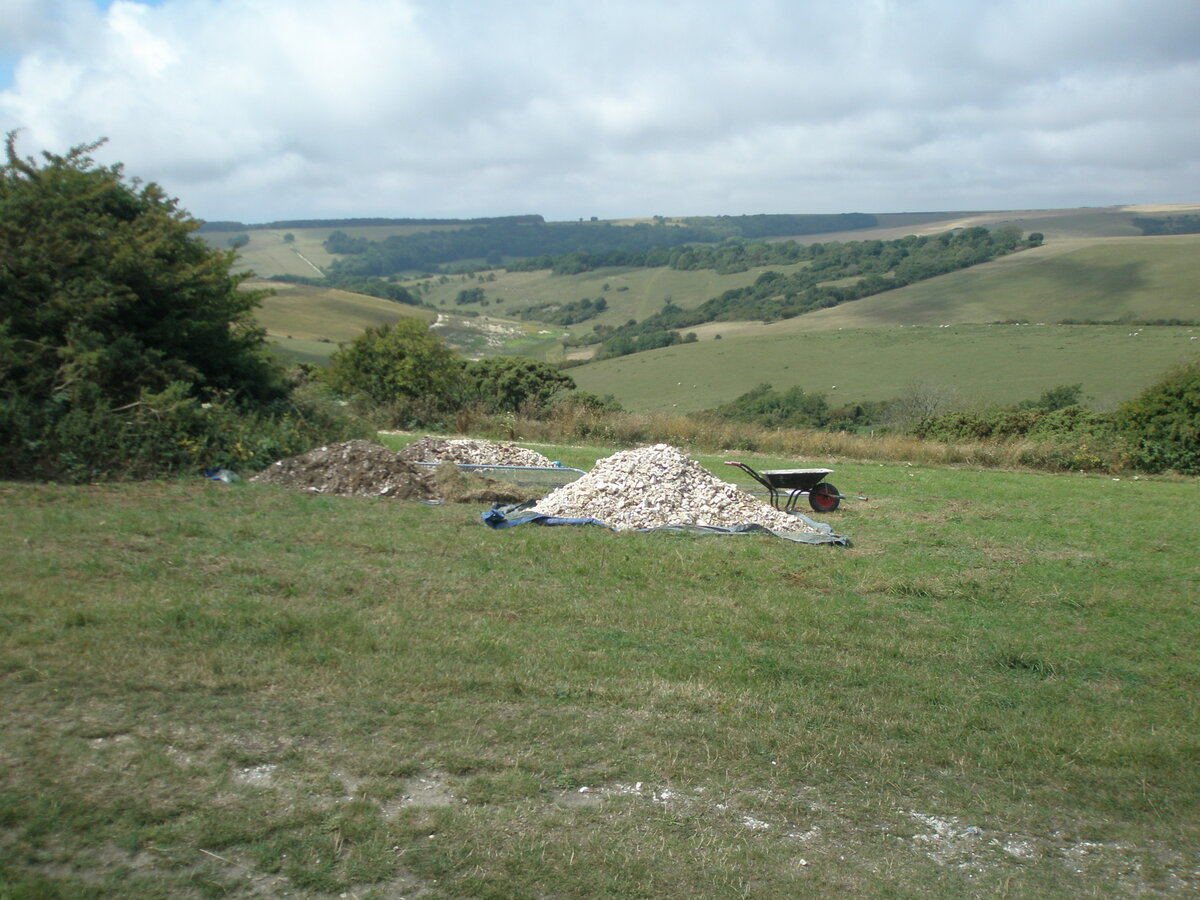
Several recent climateClimateThe long-term average atmospheric conditions of a region; its variations (glaciations, aridifications) shaped migrations, agriculture and the collapse of prehistoric societies.→ models suggested this region could have been a lasting forest refuge, even during the dry phases when forests fragmented elsewhere in Africa. For Eleanor Scerri, who leads the Human Palaeosystems group at the Max Planck Institute of Geoanthropology, the site thus offered the best chance to find out how far back forest habitation extended. In 2020, with support from the Leakey Foundation, archaeologist James Blinkhorn (University of Liverpool and the Max Planck Institute) mounted an expedition to reopen Bété I. With the help of Professor Guédé, still a full partner in the project, the team managed to relocate the original trench and re-investigate it using methods that did not exist thirty or forty years earlier.3
Finding a trench opened in the 1980s, in a landscape that vegetation has reclaimed and that the growth of Abidjan is eating into, was anything but obvious. Professor Guédé's field memory proved decisive: without it, the site might have stayed untraceable. This collaboration also embodies a rare kind of scientific continuity, between the original excavators and a new generation of researchers who took up the file with different means. Far from erasing the Soviet-Ivorian work, the 2025 study validates it and finally gives it the international audience it had lacked.
The Bété I sequence also offers a rare asset for a forest context: a thick, well-defined stratigraphyStratigraphyThe study of the superimposed layers (strata) of an archaeological site; each layer corresponds to a phase of occupation and yields a relative chronology.→ in which the layers follow one another without major mixing. This integrity is crucial, for it guarantees that the dated tools and sediments belong to the same layers, and that the environmental signals sampled genuinely reflect the time of human occupation rather than contamination by more recent deposits. It is this quality of preservation, as much as the choice of location, that made the study possible.
Dating the quartz: OSL and ESR push back the horizon
The heart of the work is chronological. To assign an age to the tool-bearing layers, the researchers combined two families of methods applied to the quartz grains in the sediments: optically stimulated luminescence (OSL)Luminescence (OSL)Optically stimulated luminescence datingLuminescence datingA method dating the last heating or light exposure of sediments and minerals by measuring energy trapped in the crystal.→: measures the last exposure of sediment grains to light.→, which measures the time elapsed since the grains were last exposed to daylight, and electron spin resonance (ESR)Electron spin resonance (ESR)A dating method estimating the natural radiation dose accumulated in a material such as quartz since it was buried.→, which estimates the radiation dose accumulated since burialBurialThe intentional deposition of a body, sometimes with offerings; a marker of symbolic behaviour.→. These two clocks, independent of one another, overlap and reinforce the reliability of the result.1
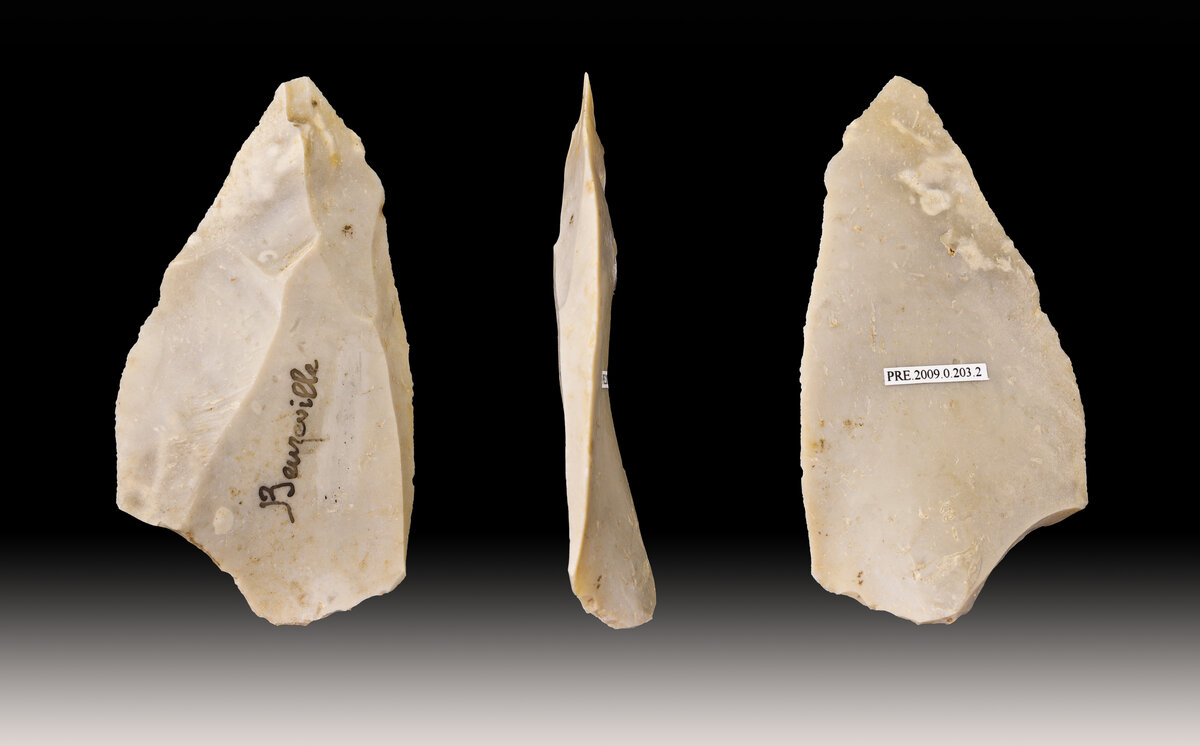
The verdict is clear: the oldest tool-bearing layer at Bété I is dated to around 150,000 years. At a stroke, the first firm evidence of human settlement in an African rainforest is pushed back by more than 130,000 years, a leap that more than doubles the previous estimate. The artefacts, knapped according to schemes typical of the Middle Stone Age, link these occupants to our own species. This is therefore no fleeting passage along the forest edge but a settled presence, inscribed in the long span of the sedimentary sequence.2
The choice to date quartz is not incidental. In a humid tropical setting, organic matter degrades fast and radiocarbon, limited to some 50,000 years, is in any case out of the running for deposits this old. Mineral grains, by contrast, record time faithfully: sunlight resets the OSL clock to zero at the moment the grain is buried, while ESR measures the gradual accumulation of defects in the crystal under the effect of ambient radioactivity. Making these two systems, sensitive to distinct physical phenomena, converge allows anomalies to be detected and the age range to be tightened.
The result says not only when humans lived there but also what they were making. The African Middle Stone Age corresponds to a sophisticated technical repertoire, resting in particular on prepared-core methods that yield flakes of predictable shape from a carefully shaped block. Finding this kind of industry deep in tropical forest indicates that the groups involved had versatile equipment suited to exploiting a wooded environment, not a degraded or improvised toolkit of mere passers-by.
Reconstructing a vanished forest
Dating the tools was not enough: it still had to be shown that Bété I was indeed covered by tropical forest when they were abandoned, and not by savanna or a thin wooded gallery. The team therefore carried out a multi-proxy environmental reconstruction from thirty-seven sediment samples, combining fossil pollen, phytolithsPhytolithA tiny silica body formed in plant tissues that survives in sediments after the plant decays, used to identify past vegetation.→, leaf waxes and stable isotopesStable isotopesNon-radioactive forms of an element (carbon, nitrogen, oxygen) whose ratios in bone and teeth reveal an individual's diet, mobility and geographic origin.→. Each indicator sheds different light on past vegetation and climate.1
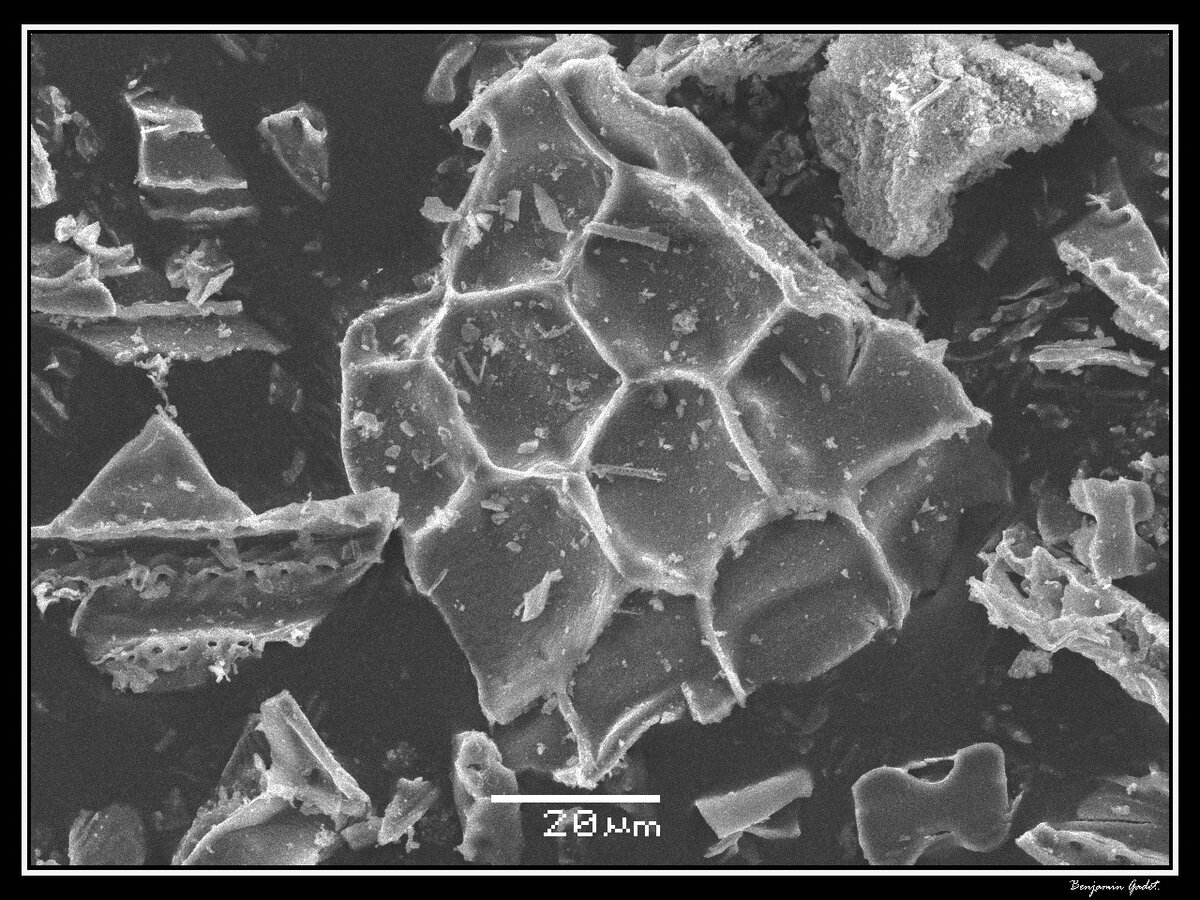
The results converge on a single picture: a dense, humid forest. The phytoliths are overwhelmingly arboreal, grasses nearly absent, which rules out both an open savanna and a narrow strip of forest along a watercourse. The pollen matches taxa typical of humid West African forests, including flooded-forest species. The C3 isotopic signature confirms the dominance of trees and shrubs over the C4 grasses of open settings. Aquatic and semi-aquatic biomarkers, finally, signal nearby wetlands. More striking still, the forest persists through the sequence even across the drier phases of the PleistocenePleistoceneThe geological epoch of the great ice ages (c. 2.6 Ma–11,700 BP), spanning most of human prehistory.→, confirming the ecological-refuge status anticipated by the climate models: an island of stable forest while others were breaking apart.4
The strength of this demonstration lies in the multiplication of independent lines of evidence. A single indicator could invite argument: pollen can travel long distances, phytoliths can be reworked. But when pollen, phytoliths, leaf waxes, isotopes and biomarkers all tellTellAn artificial mound formed by the accumulation of successive layers of settlement remains at the same spot, typical of the Near East. Each destruction-rebuilding event adds a stratum.→ the same story, that of a humid forest set beside swampy ground, the interpretation becomes hard to dispute. Leaf waxes, robust molecules that persist for a long time in sediments, carry a chemical signature directly tied to the type of plants that produced them, which makes them an especially valuable witness.
This environmental lock was indispensable. Without it, a critic could always have objected that the tools did date to 150,000 years but that the forest only came to cover the site later. By anchoring human occupation and forest cover in the same dated layers, the study shuts that door and turns a mere chronological coincidence into evidence of genuine human life in tropical forest.
A pan-African Homo sapiens
Beyond the dating record, Bété I feeds a central debate about our origins. For several years, the model of a single cradle, one precise region from which humanity would have emerged, has been giving way to a so-called pan-AfricanPan-African modelThe hypothesis that Homo sapiens emerged not from a single region but from a network of populations spread across varied habitats throughout Africa, linked by gene flow.→ view, or African multiregionalism. In this framework, Homo sapiens descends not from an isolated population but from a network of groups scattered across the whole continent, occupying contrasting habitats, savannas, coasts, lake margins and now tropical forests, and linked by intermittent gene flow. Ecological diversity thus becomes a founding trait of our species rather than a late conquest.2
In this scheme, Homo sapiens' ability to occupy environments as opposed as an arid savanna and a water-logged forest is no detail: it may be one of the keys to our evolutionary success. Where other human species seem to have been more narrowly tied to particular environments, our lineage would have developed very early a behavioural and technical plasticity allowing it to thrive in varied niches. Bété I adds the tropical forest to this catalogue of environments mastered from a remote date, and reinforces the idea of an origins humanity that was generalist, mobile and adaptable.
For Eleanor Scerri, these results show that the diversity of environments sits at the very heart of the human story, reflecting a subdivided population structurePopulation structureThe organisation of a species into partly isolated subgroups that exchange genes irregularly; the 'structured stem' model describes the origin of Homo sapiens this way.→ in which different groups lived in distinct regions and habitat types. Folding the tropical forest into this mosaic fills a major gap in the map. It also raises a new question, which the researcher states openly: if humans occupied these ecosystems as early as 150,000 years ago, what effect did they have on the plants and animals that shared their space? In other words, how far back must we go to find the first traces of human alteration of so-called pristine environments?3
Bété I does not close the inquiry, then; it opens it. Professor Guédé notes that this discovery is the first of a long list, since many other Ivorian sites await study to document the human presence in forests. West Africa, long a blank space on the map of human evolution, may well prove to be one of its richest frontiers in the years to come, provided that the funding and field partnerships follow. By rehabilitating forty-year-old excavations and long-neglected archives, this research also offers a lesson in method: old collections, re-read with today's tools, can still upend our understanding of the deepest past.4
There remains the question raised by Eleanor Scerri, which reaches far beyond Ivorian prehistoryPrehistoryThe span of human history before the invention of writing, from the Palaeolithic to the Metal Ages, known mainly through material remains.→: if our ancestors frequented tropical forests as early as 150,000 years ago, the image of ecosystems left untouched until very recent times starts to waver. The forests we call primary today may have been inhabited, travelled through and subtly shaped by human communities over tens of thousands of years. Understanding this ancient coevolution between humans and forest is no academic curiosity: at a time when those same forests stand on the front line of climate and biodiversity concerns, knowing since when and how humans have been part of them also sheds light on how we picture their future.
No comments yet. Be the first.