In the heart of the Konya Plain in central Anatolia (modern Turkey), two artificial mounds - the tells - were accumulated layer upon layer by NeolithicNeolithicThe "New Stone Age": a period marked by farming, herding, settlement and pottery, from around 10,000 BC.→ inhabitants over nearly two millennia. This is Catalhoyuk, one of the most important and most extraordinary archaeological sites humanity has ever left behind. Populated between approximately 7500 and 5700 BCE, this settlement housed between 5,000 and 8,000 people at its peak - a remarkable figure for the time - in houses so tightly packed that there were no streets, squares, or pathways between them. People moved from rooftop to rooftop and entered their homes by ladder. Catalhoyuk is the city before the city, the earliest known experiment in large-scale collective life.
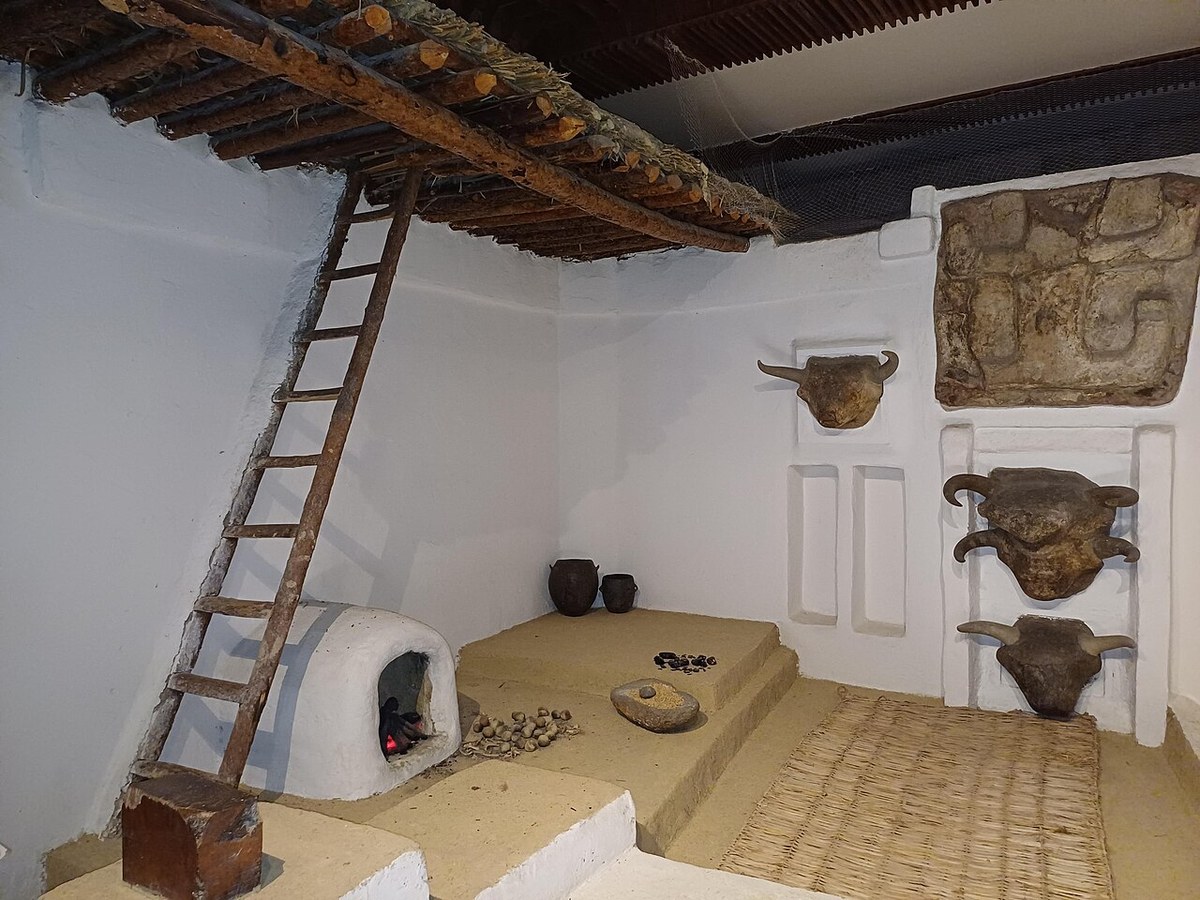
This site resembles nothing else known. No palace, no distinct temple, no visible elite quarter. Each house is roughly identical, organised around a main room with a hearth, a raised sleeping platform and storage spaces. The dead were buried directly beneath the floors, under the platforms or in the corners of the room. People literally lived above their ancestors, in a spatial and symbolic continuum between the living and the dead that has no equivalent in European prehistoric archaeology.
James Mellaart and the discovery of the site
Catalhoyuk was discovered in 1958 by British archaeologist James Mellaart, who excavated the site between 1961 and 1965. His work revealed a world of unsuspected symbolic richness: dozens of rooms with walls covered in paintings depicting bulls, deer, vultures, and human figures hunting. Bucrania - skulls of wild cattle, the aurochs - were embedded in the walls or set into benches. Voluminous female figurines, sometimes called "mother goddesses" though this interpretation is contested, were found throughout the excavations[1].
Mellaart was nonetheless dogged by controversy. Accused of fabricating documents relating to "frescoes" he claimed to have seen and then lost, he was expelled from Turkey in 1966. Excavations stopped for nearly thirty years. It was not until 1993 that archaeologist Ian Hodder, of Cambridge University, resumed work with an international multidisciplinary team. His methods, based on "reflexive" archaeology, incorporated local inhabitants and acknowledged the subjectivity of excavators. The results transformed our understanding of the site.
A surprisingly egalitarian society
One of the most striking findings of the modern excavations concerns Catalhoyuk's social structure. Osteological and isotopic analysis of the skeletons found under the floors - several hundred in total - shows no significant difference between men and women in terms of diet, access to resources or physical activity[2]. Traumatic injuries are equivalent in both sexes, suggesting comparable participation in dangerous tasks. Analysis of the habitation layouts also reveals no "main" house or centralised prestige building.
This apparent equality contrasts sharply with what would develop in subsequent millennia, in the Near EastNear EastA region of western Asia (Levant, Mesopotamia, Anatolia, Iran), cradle of the Neolithic revolution, agriculture, the first cities and writing.→ and Europe alike, where the accumulation of wealth, social stratification and male dominance would gradually take hold as urbanisation increased. Does Catalhoyuk represent a pivotal moment - a Neolithic society that had not yet tipped into hierarchy? Some researchers, including Hodder himself, urge caution: the absence of visible evidence for hierarchy is not proof of its absence. Inequalities may have been expressed in ways that archaeology struggles to detect.
Death, memory and living houses
The practice of burying the dead beneath the floors of dwellings is one of Catalhoyuk's most disconcerting features. It is not an accident or constraint: it is a deliberate choice, repeated over centuries. Some houses contained dozens of superimposed burials, accumulated generation after generation. DNADNAThe molecule carrying genetic information, used to reconstruct kinship between species.→ analyses have shown that the individuals buried in the same house are not always biologically related, suggesting that the "house bond" was social or ritual rather than strictly familial[3].
The skulls of certain individuals were removed after decomposition, sometimes coated with plaster and repainted before being kept or redeposited. This practice of "plastered skullsPlastered skullsHuman skulls whose face was remodelled in lime plaster, sometimes with shells for eyes; a Neolithic funerary practice linked to ancestor worship.→" is known from other Neolithic Near Eastern sites (Ain Ghazal, Jericho), but at Catalhoyuk it reaches a particular intensity. It testifies to an elaborate ancestor cult, a relationship between the living and the dead that goes far beyond simple burialBurialThe intentional deposition of a body, sometimes with offerings; a marker of symbolic behaviour.→.
Art, symbolism and bucrania
The walls of Catalhoyuk are not mere partitions: they are the space of intense symbolic production. They bear hunting paintings, scenes of bulls charged by hunters, vultures hovering above headless bodies. These scenes are not static: the walls were regularly whitewashed, then redecorated, layering meanings and histories upon the same surface[1]. Some rooms have yielded up to a hundred successive plaster layers, each potentially bearing its own iconography.
The bucrania - aurochs skulls set into walls or benches - form the other great symbolic axis of the site. The aurochs, the wild ancestor of domestic cattle, was a dangerous and powerful animal. Its capture and incorporation into the domestic space may have signalled the hunter's courage, the power of the house, or pertained to a religious register we can only glimpse. Full cattle domestication would only be established after Catalhoyuk's end: at the time of the site, the aurochs was still wild, hunted and feared.
Food, farming and herding
The inhabitants of Catalhoyuk practised cereal agricultureAgricultureThe cultivation of plants and production of food by working the soil, which emerged in the Neolithic in the Near East and independently elsewhere; it radically transformed human societies.→ (emmer wheat, barley) and kept sheep and goats. They also hunted - aurochs, deer, boar - and gathered wild plants. Analysis of phytoliths, carbonised seeds and lipid residues in pottery has enabled the reconstruction of a balanced diet, drawing equally on cereals and animal proteins[4]. The inhabitants were not year-round sedentaries: some evidence suggests that part of the population still practised seasonal transhumance with flocks in the surrounding hills.
Abandonment and legacy
Around 5700 BCE, Catalhoyuk was abandoned. The reasons are unclear. No major fire, no attack, no natural catastrophe is detected. Some researchers cite environmental degradation from agricultural overexploitation of surrounding land. Others suggest a shift in lifestyle toward smaller, more mobile settlements. The fact is that the west mound, which succeeded the east mound as the settlement's core in the sixth millennium BCE, was also abandoned without apparent violence.
What Catalhoyuk has bequeathed to history is immense. Listed as a UNESCO World Heritage Site in 2012, it remains one of world prehistoryPrehistoryThe span of human history before the invention of writing, from the Palaeolithic to the Metal Ages, known mainly through material remains.→'s most fertile laboratories. It proves that dense collective life, elaborate symbolic speculation and complex ritual practices were not inventions of "classical" civilisation: they were already fully present 9,000 years ago, in a city without visible kings or priests, where the dead slept beneath the feet of the living and aurochs skulls gazed down from the walls.
No comments yet. Be the first.