A few kilometres from Guareña, in the province of Badajoz, an artificial mound had for centuries overlooked the alluvial plain of the Guadiana without yielding its secret. Since 2014, a team from the Institute of Archaeology of Mérida, a joint unit of the Spanish National Research Council (IAM-CSIC) led by Sebastián Celestino Pérez and Esther Rodríguez González, has been excavating an exceptional building there. The site, named Casas del Turuñuelo, belongs to the TartessianTartessosIron AgeIron AgeThe last period of protohistory (from c. 1200 BC in Europe and the Near East), marked by iron metallurgy and the first kingdoms.→ civilisation of the south-west of the Iberian Peninsula (ninth to fifth century BCE), born of the encounter between native populations and Phoenician merchants.→ culture, the Iron Age civilisation that flourished in the south-west of the Iberian Peninsula between the ninth and fifth centuries BCE.1
What the excavation has revealed exceeds the most optimistic expectations. The building, made of unbaked earthen brick, still stands two storeys high, a unique case for a construction of this period anywhere in the western Mediterranean. Before being deliberately burned and then buried, it received an offering of staggering scale: dozens of sacrificed animals, chief among them horses. And in 2023 the team announced a discovery that forces specialists to rethink an entire civilisation: the first figural representations of human faces in Tartessian history.
The Turuñuelo is not an isolated site. It belongs to a ritual landscape that includes other Extremaduran sanctuaries, such as Cancho Roano and La Mata, all marked by the same final gesture of destruction and sealing. But through its state of preservation, the richness of its finds and its sculptures, it has become the keystone of a new understanding of Tartessos, long reduced to the status of a mirage halfway between Greek legend and archaeology.
Tartessos, a culture between natives and PhoeniciansPhoeniciansA people of sailors and traders from the Levant (modern Lebanon) who founded trading posts across the western Mediterranean from the start of the first millennium BC.→
Tartessos was first a name in ancient literature before it was a reality in the field. Herodotus mentions a prosperous city on the Iberian coast and its king Arganthonios, famed for his longevity and his wealth in metals. Behind these accounts lies a very real culture, born from the encounter, from the eighth century BCE onward, between the native populations of the south-west of the peninsula and the PhoenicianPhoenicianRelating to the merchants and seafarers of the LevantLevantA region of the eastern Mediterranean Near East (Israel, Lebanon, Syria, Jordan), a major crossroads of the first human migrations out of Africa.→ who founded trading posts on the Iberian coasts and deeply influenced Tartessos.→ merchants who came to found trading posts on the Andalusian coasts.6
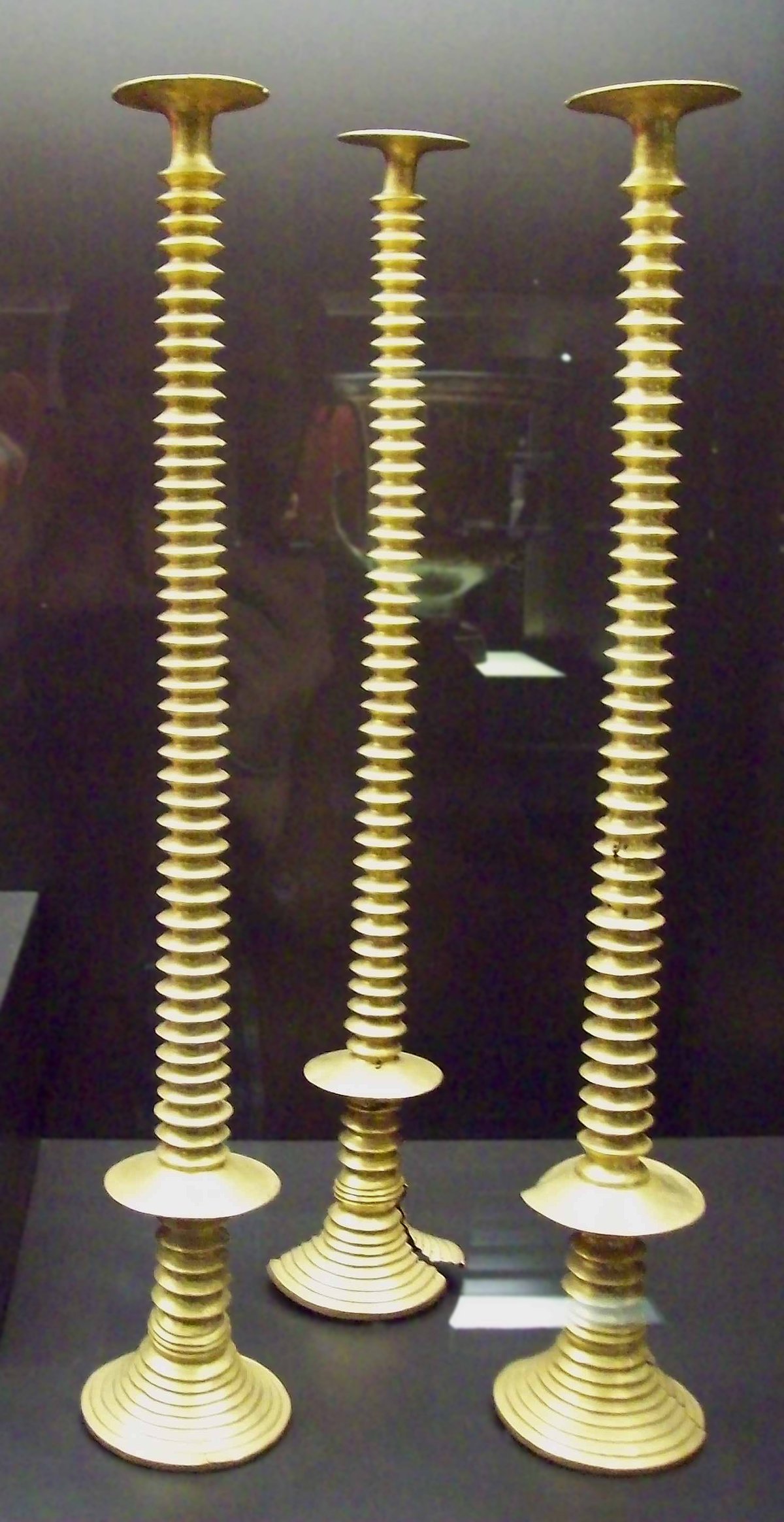
From this contact arose what researchers call the OrientalisingOrientalisingCultural phase during which Iberian elites adopted the techniques, luxury goods and motifs of the eastern world spread by the Phoenicians.→ period: the local elites adopted the techniques, the luxury goods and part of the imaginary of the eastern world. GoldsmithingGoldsmithingThe art of working precious metals (gold, silver) into jewellery, vessels and ornaments; the Maikop kurgans are among the earliest evidence of elite goldsmithing.→ offers its most dazzling testimony. The Aliseda Treasure, found in the province of Cáceres, gathers gold ornaments worked according to the Phoenician processes of granulation, filigree and soldering, mixing eastern deities and Egyptian-inspired motifs. This prestige production fed long-distance trade and signalled the rank of those who wore it.7
Tartessos also left the oldest known inscriptions on the peninsula, in a script derived from the Phoenician alphabetalphabetA writing system in which each sign notes a single elementary sound, allowing writing with a very small number of letters.→ and recording a language still largely undeciphered. Its economy rested on the exploitation and trade of metals, silver and copper in particular, which drew seafarers from across the Mediterranean. At its height, the Tartessian sphere of influence covered what are now western Andalusia, Extremadura and southern Portugal. Then, towards the end of the fifth century BCE, this culture declined and vanished, for reasons still debated, leaving behind carefully closed sanctuaries, as if its memory had been deliberately sealed away.
For a long time, researchers placed the heart of Tartessos on the Atlantic coast, around the mouth of the Guadalquivir and the region of Huelva, where contacts with the Phoenicians were concentrated. The growing number of excavations in Extremadura, far from the sea, has deeply altered that picture. In the Guadiana valley, inland, a series of monumental sites attests a late and dynamic expansion of the Tartessian culture, at the very moment when the coastal centres were facing difficulties. Casas del Turuñuelo belongs to this final phase, and has become one of its most eloquent witnesses: not the twilight of an exhausted civilisation, but the assertion of a prosperous local power, able to mobilise considerable resources to build and to sacrifice.
A monumental building of unbaked earth
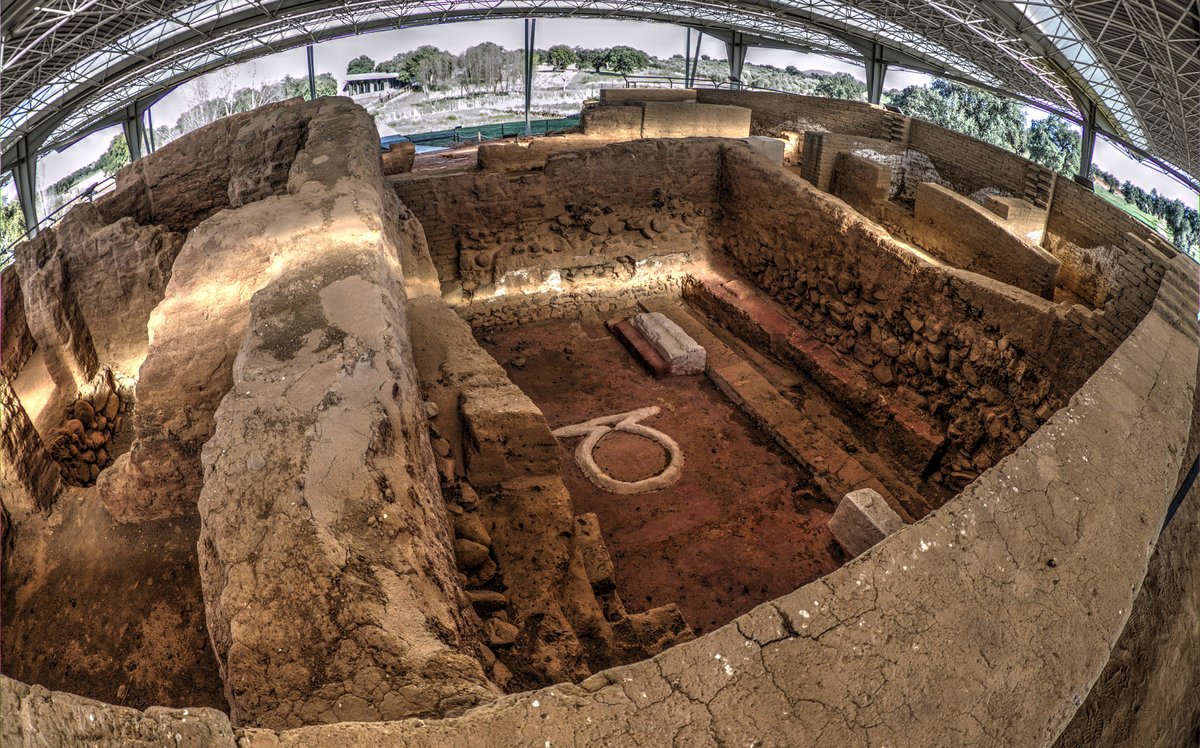
The heart of the site is a vast building constructed in adobeAdobeSun-dried unbaked earthen brick, the main building material of the Casas del Turuñuelo structure.→, that is, sun-dried unbaked earthen brick, raised on stone foundations. Its preservation is quite simply without equal: archaeologists move between walls that still rise through two levels, making the Turuñuelo the best preserved protohistoric building in the entire western Mediterranean. The controlled collapse of the building and its burialBurialThe intentional deposition of a body, sometimes with offerings; a marker of symbolic behaviour.→ beneath a mound sealed the whole like a time capsule.4
A monumental staircase connected the central courtyard to the upper floor. Its study held a major technical surprise: the lower steps are made of parallelepiped blocks assembled with lime mortar, which constitutes the oldest known evidence of a lime mortar produced to make ashlar-type blocks in protohistoric Iberia. Such know-how testifies to an architectural mastery that was not expected in this region at this period.4
The finds recovered inside the building match the architecture. They include fine tableware, imported objects and, above all, the oldest wool textiles and the oldest twill weaves known to date on the Iberian Peninsula. These fabrics, preserved by the particular conditions of the burial and the fire, open a rare window onto perishable products that normally do not survive, and they hint at a textile craft already capable of complex techniques. The Turuñuelo was no mere fortified farm: everything about it, from its two-storey elevation to the quality of its fittings, points to a place of power and worship, where wealth, craftsmanship and ritual practices were concentrated under a single roof.
The hecatomb: the greatest animal sacrifice of the ancient West
In 2017, excavation of the building's courtyard brought to light a striking scene: animal skeletons laid out in successive layers, among them sixteen horses, two bulls and a pig. The discovery was immediately recognised as the largest mass animal sacrifice documented in the ancient western Mediterranean, a true hecatombHecatombSacrifice of a very large number of animals offered to the gods; at the Turuñuelo, fifty-two beasts including many horses.→ offered to the gods before the closing of the sanctuary.3
The following campaigns and a study published in November 2023 in the journal PLOS ONE, led by María Pilar Iborra Eres with Esther Rodríguez González and Sebastián Celestino Pérez, considerably refined the picture. In all, fifty-two animals were identified: forty-one equids, mostly adult horses, six cattle, four pigs and one dog. Radiocarbon dating and taphonomic analysis show that these sacrifices took place in three successive phases, spread over several years, and not during a single event.2
The detail of the phases illuminates the nature of the ritual. In the first two, the carcasses were deposited more or less whole, without particular treatment. In the third, by contrast, the skeletons, apart from the equids, bear cut marks characteristic of preparation for consumption: a feast therefore accompanied part of the sacrifices. An isotopic analysis, published in a complementary study, further suggests that some animals had not been raised on site and were brought from elsewhere, perhaps by communities who came to take part in these great collective ceremonies.2 The horse, a costly and prestige-laden animal, holds a central place in these rites, underlining the scale of the investment made to bring the sanctuary's life to a close.
The first faces of Tartessos
The discovery announced by the CSIC in April 2023 sent a shockwave through the world of archaeology. In the area of the eastern entrance leading to the courtyard, where the hecatomb had been found, the team unearthed five carved reliefs depicting human faces, dated to the fifth century BCE. These are the very first figural representations of human beings attributed to the Tartessian culture.1
Two of these reliefs are almost complete and show female faces adorned with large hoop earrings, precisely the type previously known only from the jewellery of the Aliseda Treasure. For the first time, the object and its use are brought together: these sculptures are also the first known representations of Tartessian gold ornaments worn on a face. A third relief, fragmentary, preserves part of what appears to be a helmet and has been interpreted as the figure of a warrior; the last two are too damaged to be read with certainty.1
The quality and finesse of execution of the female faces led researchers to see in them representations of deities, perhaps figures of the Tartessian pantheon, without excluding that they might be aristocratic women. Whatever interpretation prevails, the significance of the find is considerable. Tartessos was indeed held to be an aniconicAniconicSaid of a culture that refrains from representing the divine in figural form, preferring symbols, animals, plants or sacred stones.→ culture, that is, one that refused figural representation of the divine, expressing it instead through animal or plant motifs and through baetylsBaetylA sacred stone venerated as the presence or support of a deity, in the absence of any figural image.→, the sacred stones that stood in for images. The Turuñuelo reliefs overturn this assumption and compel a rethinking of the Tartessians' relationship to image and to the sacred.1
Bronzes, a votive chariot and the closing of the sanctuary
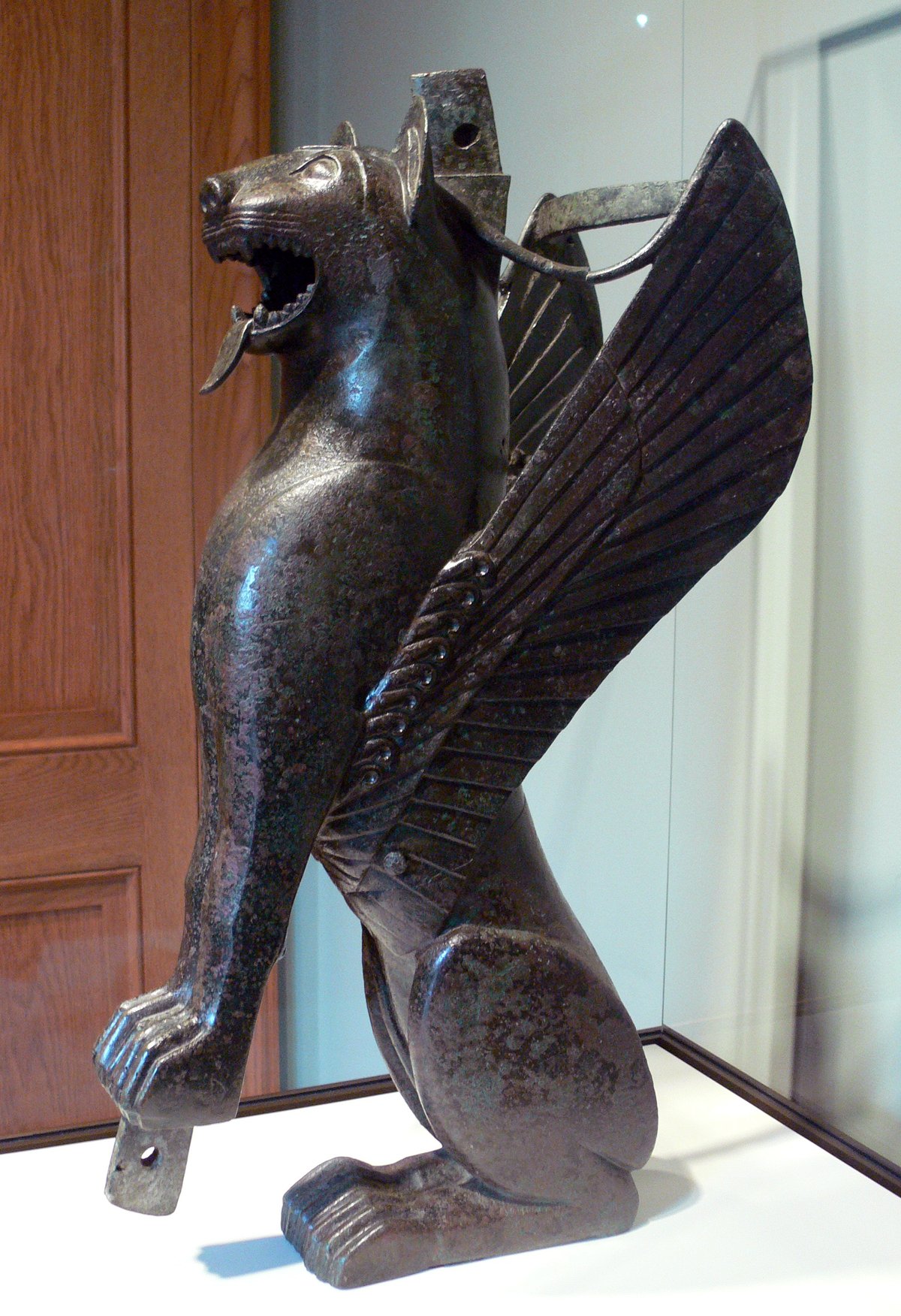
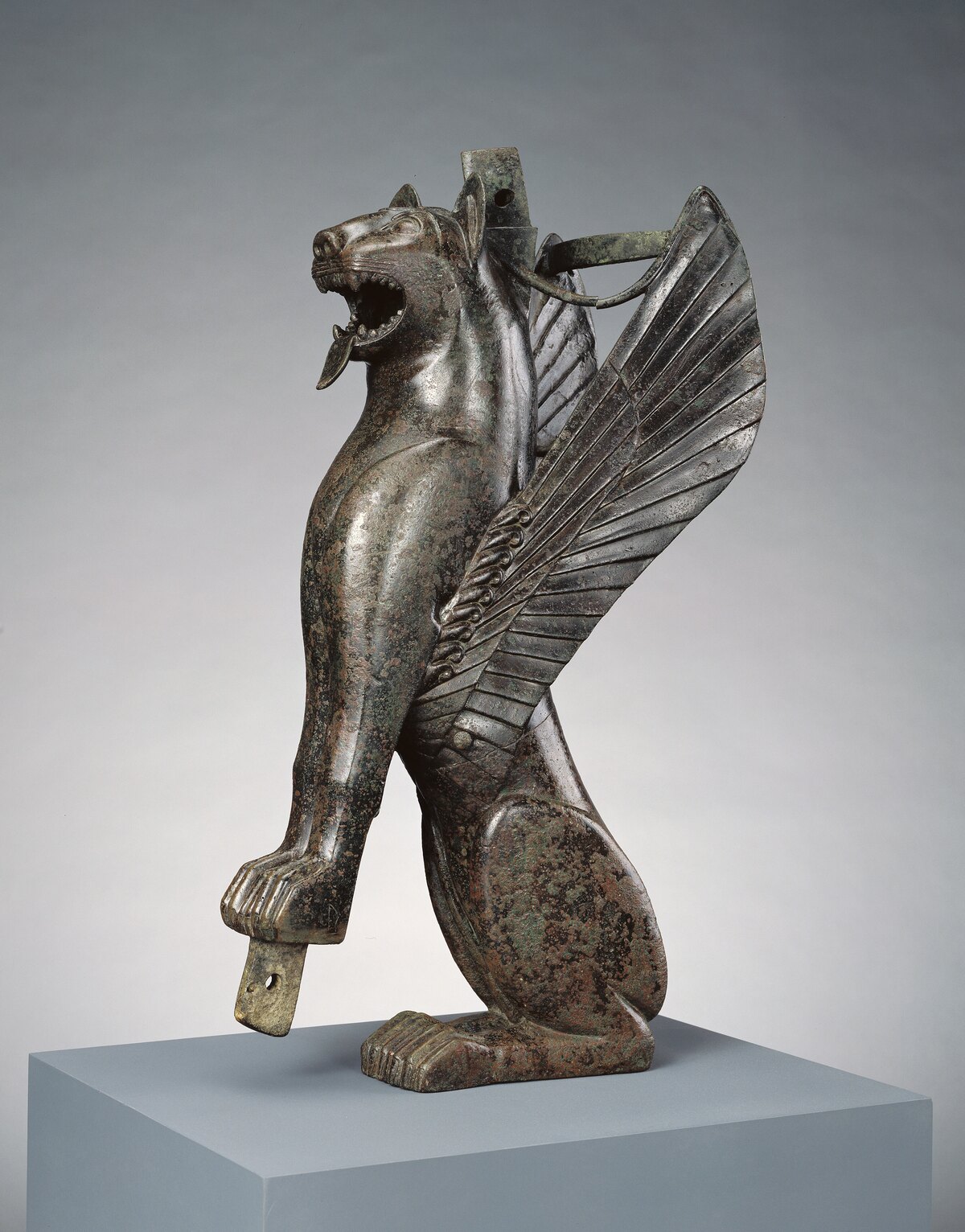
To the sculptures and textiles is added a metalwork assemblage of rare richness. The most spectacular piece is a bronze votive chariot, of great decorative and iconographic complexity, found in a passageway of the building. Also dated to the fifth century BCE, it is considered an object without known parallel anywhere on the Iberian Peninsula. It comes from a sector that had already yielded an altar in the shape of a stretched bull's hide, a form characteristic of the sanctuaries of this cultural area.5
This chariot, small in size and clearly ritual rather than utilitarian in purpose, joins a set of bronze objects that illustrate the virtuosity of Tartessian craftsmen and their taste for elaborate forms. Associated with the sacrificed horses, such vehicles evoke a whole imaginary of equestrian prestige and status, in which the mount, the harness and the chariot share a single language of power. The Turuñuelo thus confirms the central place of the horse and its trappings in the ideology of the elites of the Iberian Iron Age.
The bull's-hide altar deserves particular attention in this respect. This outline, evoking an animal skin stretched out on the ground, recurs on other supports of the Tartessian culture and even on certain votive plaques. It links the sacred architecture of the building directly to the animals slaughtered in the courtyard, as if the space of worship had been conceived around the sacrifice. The recurrence of this motif, from the bronze finds to the fixed fittings of the sanctuary, outlines a coherent symbolic system in which the bull and the horse, precious metal and fire each held a precise function.
There remains the most enigmatic gesture, the one that closes the building's history. Towards the end of the fifth century BCE, the sanctuary was deliberately burned, after the sacrifice and the feast, then entirely covered by an earthen mound about ninety metres across and six metres high. Nothing indicates a violent destruction by an enemy: everything points to a ritualised abandonment, carried out according to a precise protocol of sealing. The neighbouring sanctuaries of Cancho Roano and La Mata bear traces of comparable practices, suggesting a shared regional custom, perhaps linked to the decline of the Tartessian culture itself.4
Why close so carefully, and with so much wealth, a building still in good order? Researchers propose the idea of a closing rite meant to neutralise a place of worship, to render it inviolable, or to mark the end of a cycle. The fire and the burial had an unforeseen consequence: by freezing the building and its contents, they have bequeathed to us one of the best preserved assemblages of European protohistoryProtohistoryThe transitional period between prehistory and history, covering societies without their own writing but known through external texts.→. Each excavation campaign at the Turuñuelo adds a piece to the file, and the civilisation long taken for a myth is gradually acquiring a face, in the most literal sense of the word.
La structure de vos articles est un modèle : accroche, développement, sources. Simple et efficace.
Le soin du geste, la transmission du savoir-faire... c'est exactement ce que je vis dans mon atelier.
Je lis ça pendant mes pauses. C'est le meilleur contenu historique que j'ai trouvé sur le web.