Between 2600 and 1900 BCE, a remarkably sophisticated civilisation flourished in the Indus basin — the territory of modern Pakistan and northwestern India. The Indus civilisationIndus CivilisationA major Bronze Age urban civilisation (c. 2600-1900 BC) across present-day Pakistan and north-west India: planned cities (Harappa, Mohenjo-daro), standardised bricks, undeciphered script, no monumental palaces.→ (also called the HarappanHarappanPertaining to the Indus Civilisation, named after its first excavated site, Harappa (Pakistani Punjab); refers to the material culture, script and people of that civilisation.→ civilisation after its principal city) constituted one of the three great urban civilisations of the Bronze AgeBronze AgeA protohistoric period following the Neolithic, defined by bronze metallurgy (a copper-tin alloy) and the rise of the first cities and states; in Egypt it corresponds to the age of the first pyramids.→, alongside Mesopotamia and ancient Egypt. At its peak, it covered more than 1.25 million km2 and encompassed several dozen cities and hundreds of villages.
The two main metropolises of this civilisation — HarappaHarappaA major city of the Indus Civilization, in the Pakistani Punjab, the first site excavated and the one that gave the Harappan culture its name.→ and Mohenjo-daroMohenjo-daroOne of the largest cities of the Indus Civilization (Sindh, Pakistan), famed for its Great Bath and grid layout; a World Heritage site.→ — astonish by their urban planningUrban planningThe planned organisation of urban space (streets, districts, water and drainage networks, public buildings); the Indus Civilisation offers an early and remarkable example.→. Streets are laid out in orthogonal grids, houses are built from standardised bricks of uniform size, and each district is equipped with a wastewater drainage system of an efficiency not matched in Europe for millennia. Public buildings — the great ritual bath of Mohenjo-daro, the monumental "granaries" — imply centralised administrative organisation and long-term planning.
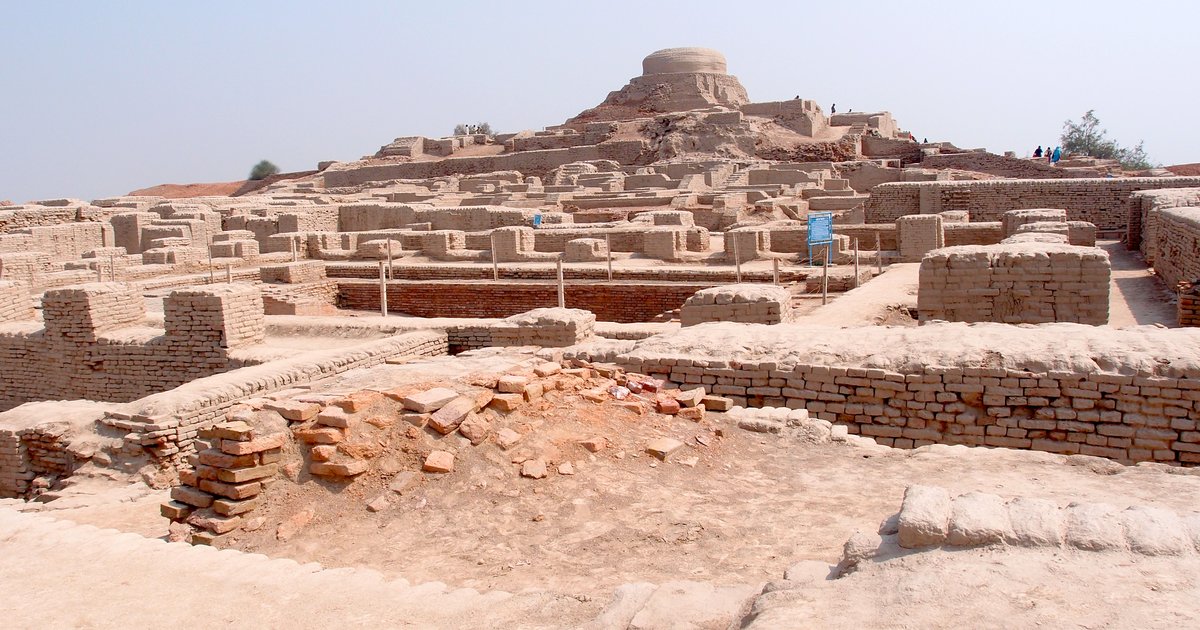
What makes the Indus civilisation so enigmatic for researchers is what it has not left us. Its writingWritingA system of conventional signs used to fix language or information durably; its appearance (c. 3300 BC) marks, by convention, the end of prehistory.→ — represented by more than 400 symbols engraved on steatite seals — has never been deciphered. We therefore do not know the name of this civilisation in its own language, the names of its gods, kings, or rulers. Excavations have revealed no royal palace, no sumptuous royal tomb, no monument glorifying a sovereign — suggesting either a relatively egalitarian social organisation, or a political power of a very different nature from that of Egypt or Mesopotamia.
The decline of the Indus civilisation around 1900 BCE remains debated. Older theories invoked an Aryan invasion, but modern genetic and archaeological analyses point instead to a combination of climatic factors (progressive drying, monsoon disruption) and epidemics that weakened urban centres. The populations did not disappear: they dispersed eastward and southward, and their descendants contributed to the formation of later Indo-Gangetic civilisations.
No comments yet. Be the first.