Between 2600 and 1900 BCE, a civilization of remarkable sophistication flourished in the Indus basin, across the territory of present-day Pakistan and northwestern India. The Indus civilization -- also called the HarappanHarappanPertaining to the Indus Civilisation, named after its first excavated site, Harappa (Pakistani Punjab); refers to the material culture, script and people of that civilisation.→ civilization, after its first major identified site -- rivals Mesopotamia and ancient Egypt in extent and complexity. Yet it remains partly an enigma: its script has never been deciphered, and its political and religious structures remain obscure.1
Cities, Urban PlanningUrban planningThe planned organisation of urban space (streets, districts, water and drainage networks, public buildings); the Indus Civilisation offers an early and remarkable example.→, and Engineering
The Indus civilization is distinguished above all by its cities. Mohenjo-daroMohenjo-daroOne of the largest cities of the Indus Civilization (Sindh, Pakistan), famed for its Great Bath and grid layout; a World Heritage site.→ (Sindh, Pakistan) and HarappaHarappaA major city of the Indus Civilization, in the Pakistani Punjab, the first site excavated and the one that gave the Harappan culture its name.→ (Punjab, Pakistan) are the two best-known metropolises, but more than 1,000 Harappan sites are known today, some covering several dozen hectares. At their peak, these cities may have housed 40,000 to 80,000 inhabitants.
Harappan urban planning reveals remarkable collective planning: streets are organized in an orthogonal grid, fired-brick houses are built to standardized proportions (1:2:4 for height:width:length), and each dwelling is connected to a network of underground drains -- the world's first urban sanitation system. The Citadel of Mohenjo-daro contains a Great Bath measuring 12 x 7 meters, possibly of ritual function.2
An Undeciphered Script
The Indus civilization developed a writingWritingA system of conventional signs used to fix language or information durably; its appearance (c. 3300 BC) marks, by convention, the end of prehistory.→ system of approximately 400 to 600 signs, found primarily on small steatite seals. These seals depict real or mythical animals -- unicorn, bull, buffalo, rhinoceros, elephant -- accompanied by brief inscriptions. Despite more than a century of attempts, no researcher has succeeded in deciphering this writing, for lack of a bilingual text comparable to the Rosetta Stone.
Debate on the nature of this script remains vigorous: some consider it a complete logographic system capable of noting a language; others argue it is simply a non-linguistic symbolic marking system. The question may only be resolved through the discovery of a longer text or bilingual document.
Trade Networks and Craftsmanship
The Harappans traded intensively with Mesopotamia, Central Asia, and the Persian Gulf. Harappan seals have been found at Ur and Lagash; carnelian and lapis lazuli beads of Indus origin appear in Sumerian royal tombs. In return, Indus cities imported metals, timber, and textiles.
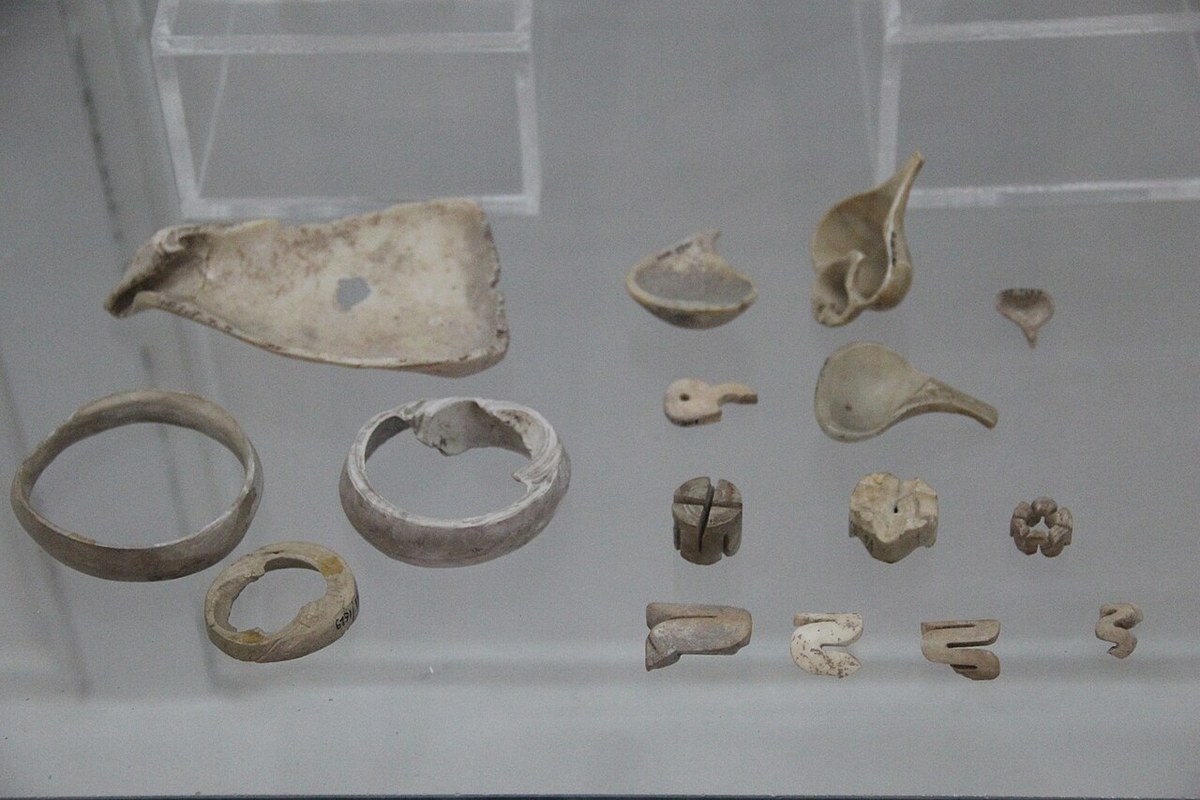
Harappan craftsmanship is of exceptional quality. The "Dancing Girl" of Mohenjo-daro -- a 10-cm bronze statuette of a young woman balanced on one leg, adorned with bracelets -- remains one of the masterpieces of world prehistoric art. Basalt weights, perfectly calibrated to a standardized measurement system, attest to regulated commerce and developed economic administration.3
A Mysterious Collapse
Around 1900 BCE, the Harappan civilization enters decline. Major cities are gradually abandoned, the population disperses eastward and southward, and urban sophistication fades. The causes of this collapse remain debated: prolonged drought linked to monsoon changes, river course modifications, epidemics, or pressure from external populations?
The Aryan invasion theory -- long advanced to explain this collapse -- is no longer supported by current archaeological data. Genetic analyses do show migrationsMigrationsLong-distance movements of populations; a major driver of human history (the exit from Africa, the peopling of continents, Neolithic and steppe expansions).→ of populations from the Pontic steppeSteppeA vast semi-arid, treeless grassland of Eurasia, suited to nomadic herding and the horse; a corridor for the movement of peoples and technologies in later prehistory.→ toward the Indian subcontinent around 2000-1500 BCE, but this arrival is later and does not alone explain the Harappan decline. Current consensus leans toward a combination of climatic and ecological factors.
The Indus civilization remains one of antiquity's great "silent" civilizations -- silent because its writing still escapes us. But excavations continue, notably at Rakhigarhi (Haryana, India) and Dholavira (Gujarat, India), and each decade brings its share of discoveries that illuminate this major enigma of human history a little more.
No comments yet. Be the first.