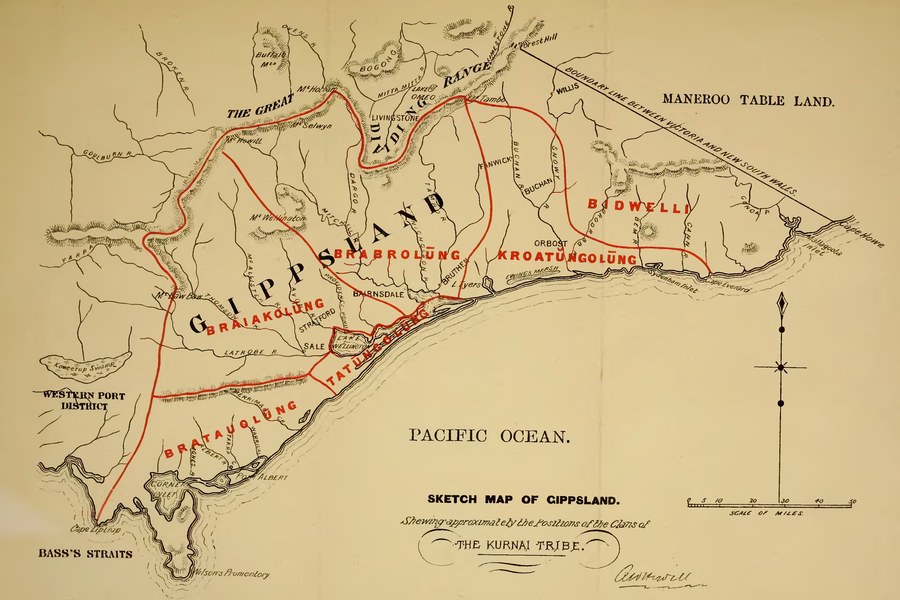
Carefully selected grasses, carried to the back of a cave, spread in thin layers, then burned. This gesture, repeated for twenty-five millennia, has just been revealed by microscopic plant traces preserved in the sediments of Cloggs Cave, a cavern in Gippsland, Victoria, Australia. The study, published on 22 July 2026 in Frontiers in Environmental Archaeology, demonstrates the depth and continuity of the spiritual traditions of the GunaiKurnai Aboriginal nation.1
Cloggs Cave: a sacred site across the ages
Nineteenth-century ethnographic accounts and the oral traditions of the GunaiKurnai already described several caves in Gippsland as places dedicated to spiritual ceremonies. These cavities were frequented by initiated men and women called "mulla-mullung," individuals reputed for their powers of healing, magic, or cursing. What no one knew until now was that these practices stretched back more than 25,000 years.
New excavations were conducted in 2019 and 2020 at the request of the GunaiKurnai Land and Waters Corporation. Representatives of this Indigenous organisation participated in every stage of the project, from the study's design through to the interpretation and dissemination of results.
Phytoliths: microscopic, indestructible archives
To reach so far back in time, researchers relied on the analysis of phytoliths - tiny silica structures produced by plant tissues. Unlike pollen, which is dispersed by wind or insects, phytoliths generally accumulate at the exact place where a plant decomposes.
"No plant grows inside the cave due to the absence of light; the phytoliths can therefore only have arrived there carried by humans, or more rarely by animals such as possums via their fur or droppings," explains Dr Elle Grono, postdoctoral researcher at the Australian National University and lead author of the study. Using microscopes, her team identified several thousand phytoliths from two deep excavation pits reaching 1.5 and 2.3 metres respectively.2
Carefully chosen plants, burned in successive layers
"We show here that the Ancestors selected whole grasses from the surrounding landscape, transported them to Cloggs Cave, spread them in thin layers before burning them. Over time, sediments covered these charred layers, preserving them one above another for thousands of years," details Elle Grono.
The most recent levels contained 73 thin ash layers, accumulated between 4,400 and 1,600 years ago. Botanical analysis reveals a highly precise selection: no fewer than 29 different phytolithPhytolithA tiny silica body formed in plant tissues that survives in sediments after the plant decays, used to identify past vegetation.→ types from grasses, herbaceous plants and woody vegetation were identified. Drought-resistant species and woody plants were present only in very small quantities, indicating that the cave's occupants favoured species growing in the immediate vicinity of the site, and transported whole plants - stems, leaves, flowers and roots - rather than hastily collected material.3
25,000 years of ritual continuity
One of the most striking findings concerns the frequency of burning: up to 18% of the phytoliths found show traces of combustion or melting. More significantly, these signs appear throughout all the archaeological layers, covering nearly 25,000 years of continuous occupation. For the researchers, this continuity testifies to a ritual practice transmitted from generation to generation over tens of millennia.
The excavations also yielded a surprise: a 28-centimetre upright stone, installed approximately 2,000 years ago and interpreted as a ritual element deliberately put in place by the cave's ancient occupants.
Professor Bruno David of Monash University, co-director of the excavations with the GunaiKurnai Land and Waters Corporation, notes that "this practice is consistent with GunaiKurnai traditions, where ash was used to perform acts of magic and ritual, but also to detect the footprints of any person - including spiritual beings - entering the cave." The study stands as a striking demonstration of the temporal depth of Australia's Indigenous cultural traditions, and of the scientific value of knowledge transmitted orally across millennia.4
No comments yet. Be the first.