The Bogotá altiplano, in the heart of the Colombian Andes, remembers everything. Its lagoons, limestone cliffs and ancient rock shelters have preserved traces of tens of thousands of years of human occupation. But a genomic study published in May 2025 in Science Advances has uncovered something unexpected: an entire population, living there 6,000 years ago, that belongs to no known Native American genetic family -- and that disappeared without leaving any descendants.
The researchers, led by Colombian and international teams, analysed ancient DNAAncient DNAGenetic material preserved in old remains, often degraded, sequenced with cutting-edge techniques.→ from 21 individuals recovered from several archaeological sites on the altiplano, spanning a window of 6,000 years -- from −6,000 to −500 before present. Among them, the oldest individuals, dated to around 6,000 BP, displayed a genetic profile never previously observed in any ancient or modern population from the Americas.
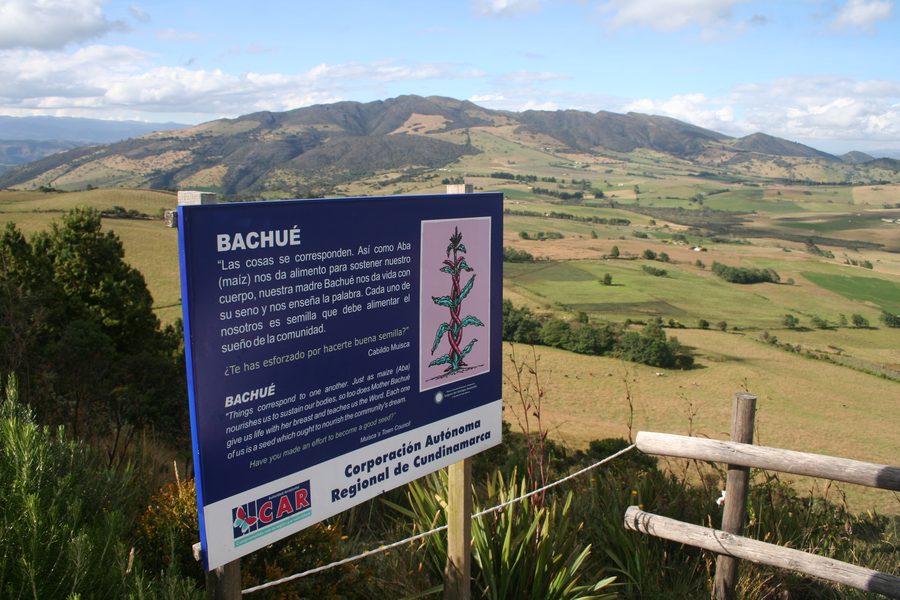
Hunter-gatherersHunter-gatherersA way of life based on hunting, fishing and gathering wild resources, without farming or herding; it dominated almost the whole of human history.→ from nowhere
These first inhabitants of the altiplano were hunter-gatherers, probably descended from the earliest wave of settlement of South America. The researchers describe them as a "basal lineage" -- meaning a very early branch of the South American population tree -- that diverged at the time of the initial colonisation of the continent, possibly as people crossed the Darién Gap linking Central to South America.
Their genetic distinctiveness is striking: they share no identifiable ancestry with North American populations, with known Andean groups, or with Amazonian populations. They represent, according to the study's authors, "a previously unknown preceramic lineage derived from the initial South American radiation".
The archaeological site of Checua, in the municipality of Nemocón (Cundinamarca), is one of the main sources of these remains. This open-air preceramic site, excavated notably by archaeologist Ana María Groot since the 1990s, has yielded thousands of stone and bone tools, burials, and even a bone flute, attesting to continuous occupation between 8,500 and 3,000 BP. Other comparable sites, such as Aguazuque (Soacha) and El Abra (Zipaquirá), confirm the density of this prehistoric settlement on the Bogotá plateau.
A total disappearance, unexplained
What makes this discovery particularly striking is what happens next. Around −2,000 years before present (roughly 2,000 years ago), the genetic signature of this population vanishes completely from the region's biological record. The individuals then inhabiting the altiplano display an entirely different profile -- most likely that of populations speaking Chibchan languages, ancestors of the Muisca.
This is not a simple blending or gradual absorption: the "ghost lineage" evaporated without leaving any detectable trace in the genetic heritage of later populations. Such a total disappearance is rare, even without precedent at this scale in South America.
What happened to this population?
The study's authors do not know. Several scenarios are plausible: brutal demographic replacement, epidemics, displacement to other regions with no return, or absorption into a numerically overwhelming population that diluted all genetic traces below the detection threshold. The study notes that this replacement is "unusual, especially in South America", where such radical genetic substitutions remain exceptional.
What is certain is that Colombia's ghost lineage fits into a broader picture of the complexity of the peopling of the AmericasPeopling of the AmericasThe migrations that led Homo sapiens to occupy the American continent, from Beringia; its date and routes remain debated.→. Far from being a simple linear surge from the Bering Strait southward, the colonisation of the American continent appears to have been a mosaic process, involving pioneer populations, geographic isolation, replacements and fusions, the full richness of which we are only beginning to perceive thanks to palaeogenomicsPalaeogenomicsThe study of ancient genomes from DNA preserved in bones, teeth or sediments, to trace evolution and lineages.→.
A game-changing tool: palaeogenomics
The study published in Science Advances is representative of an ongoing revolution in prehistoric sciences. By sequencingSequencingReading the order of the bases (A, T, G, C) of a DNA molecule; high-throughput sequencing reads millions of fragments in parallel.→ ancient DNA extracted from teeth and bones, researchers can now reconstruct demographic histories that archaeology alone could never reveal. Entire populations, never suspected from ceramics or tools, suddenly emerge from the genetic archive.
This is precisely what happened at Checua: the skeletons had been known for decades; their full genomic sequencing was only completed in 2025. And what they revealed forces us to rewrite an entire chapter of Colombian -- and perhaps American -- prehistoryPrehistoryThe span of human history before the invention of writing, from the Palaeolithic to the Metal Ages, known mainly through material remains.→.
An Amerindian Puzzle Reassembling Itself
The discovery of a ghost lineage at Checua is part of a broader movement in palaeogeneticsPalaeogeneticsThe study of ancient DNA extracted from remains (bones, teeth, sediments, walls) to reconstruct the past of populations.→ that is profoundly reshaping our understanding of the peopling of the Americas. Since the 2010s, several major studies have provided evidence for the existence of multiple "ghost lineages" -- populations that contributed genetically to current Amerindians without any direct representative having been found outside the American continent. The best known is the so-called "Population Y" of Amazonia, identified from the DNADNAThe molecule carrying genetic information, used to reconstruct kinship between species.→ of groups such as the Surui and Karitiana in Brazil, whose ancestry partly derives from an Asian source distinct from the principal Siberian ancestry and more reminiscent of the populations of South-East Asia and Oceania.[6]
Closer geographically, the Yana PalaeolithicPalaeolithicThe oldest and longest period of prehistory (c. 3.3 Ma–12,000 BC), defined by chipped stone tools and a hunter-gatherer way of life.→ Siberians (Arctic Russia), identified in 2019 from remains dated to 32,000 BP, were recognised as a partial founding group of Amerindian populations, distinct from the dominant East Asian ancestry. These successive discoveries paint an increasingly complex picture: the Americas would not have been peopled by a single migratory wave from a single founding group, but by at least two, possibly three or four populations of partially different origins, which succeeded one another or intermixed over a period perhaps spanning several millennia around the end of the last glacial maximumLast Glacial MaximumThe peak of the last glaciation (c. 26,000 to 19,000 years ago), with ice sheets at their greatest extent; it pushed populations towards southern refuges.→.
The ghost lineage identified at Checua, Colombia, adds to this picture as a specifically South American element. The population carrying this distinct ancestry appears to have occupied northern South America for a period long enough to leave a significant demographic imprint, before being replaced -- or absorbed -- by populations with different genetic profiles. This replacement, whose causes remain undetermined, raises questions about the dynamics of human populations in a South America still undergoing initial colonisation.
Colombia occupies a strategically important geographic position in this debate: situated between the Isthmus of Panama, through which the first migrants entering South America probably passed, and the great plains of Amazonia and the Andes, it constitutes a demographic bottleneckBottleneckA sharp, temporary reduction in a population's size that lastingly impoverishes its genetic diversity.→ that all populations peopling the southern continent had to pass through. The discovery at Checua suggests that this passage was not unidirectional and linear, but involved populations with distinct evolutionary histories, contributing to the remarkable genetic diversity of current South American Amerindian populations, which remains among the highest in the world relative to population density.
All these discoveries converge on a conclusion: the peopling of the Americas, long envisaged as a single and relatively simple event, is revealing itself to be a long, complex and multi-phase process, involving populations of diverse origins whose interactions and successive replacements produced the genetic mosaic we observe in indigenous American peoples today. Checua is Colombia's contribution to this puzzle still in the process of being reconstructed.
What Now? The Next Steps in Research
The publication of the Checua genetic results has opened as many questions as it has resolved, and the scientific community agrees on the need to considerably expand the available database to advance understanding of the peopling of South America. Additional excavation campaigns are planned at the Checua site and at several contemporary deposits still little explored in the Colombian Andean foothills, with the objective of obtaining better-preserved human remains permitting more complete genetic analyses and more precise datings.[7]
The sequencing of ancient human remains from sites distributed across the entire Colombian territory constitutes the most urgent scientific priority. Skeletal collections already excavated and preserved in Colombian museums -- notably at the Museo Nacional de Colombia and in university collections -- could yield precious genetic data if conservation conditions have permitted DNA survival. Systematic comparisons with contemporary sites in Panama, Venezuela and Ecuador would allow the geographic boundaries of the ghost genetic lineage identified at Checua to be defined and the demographic movements of this mysterious population to be reconstructed.
A crucial dimension of this future research concerns the involvement of Colombia's contemporary indigenous communities in the design and realisation of archaeological and genetic projects. Many Colombian indigenous communities have expressed reservations -- or explicit opposition -- to ancient DNA sequencing projects perceived as a form of appropriation of their ancestral heritage by foreign academic institutions. Finding modes of collaboration that are respectful, transparent and beneficial to the communities concerned -- by sharing results, associating community members with research and respecting their cultural protocols regarding human remains -- is an indispensable ethical condition for the progress of this research.
Je cherchais des informations fiables sur ce sujet. L'article tombe à pic.
J'ai enfin trouvé un site qui explique la préhistoire sans me noyer dans le jargon.