On the high plains surrounding Bogotá, nearly 2,600 metres above sea level, archaeologists have spent decades excavating some of the oldest hunter-gatherer sites in South America. In 2025, an international team published in the journal Science Advances the first ancient genomes ever obtained for Colombia, and the result surprised even the specialists.1 The oldest individuals analysed, buried at the Checua site around 6,000 years ago, belong to a population that passed its genes to no one. Not to the groups that came after them in the region, nor to today's Indigenous peoples. An entire lineage appears to have vanished without leaving the faintest trace in modern genomes.
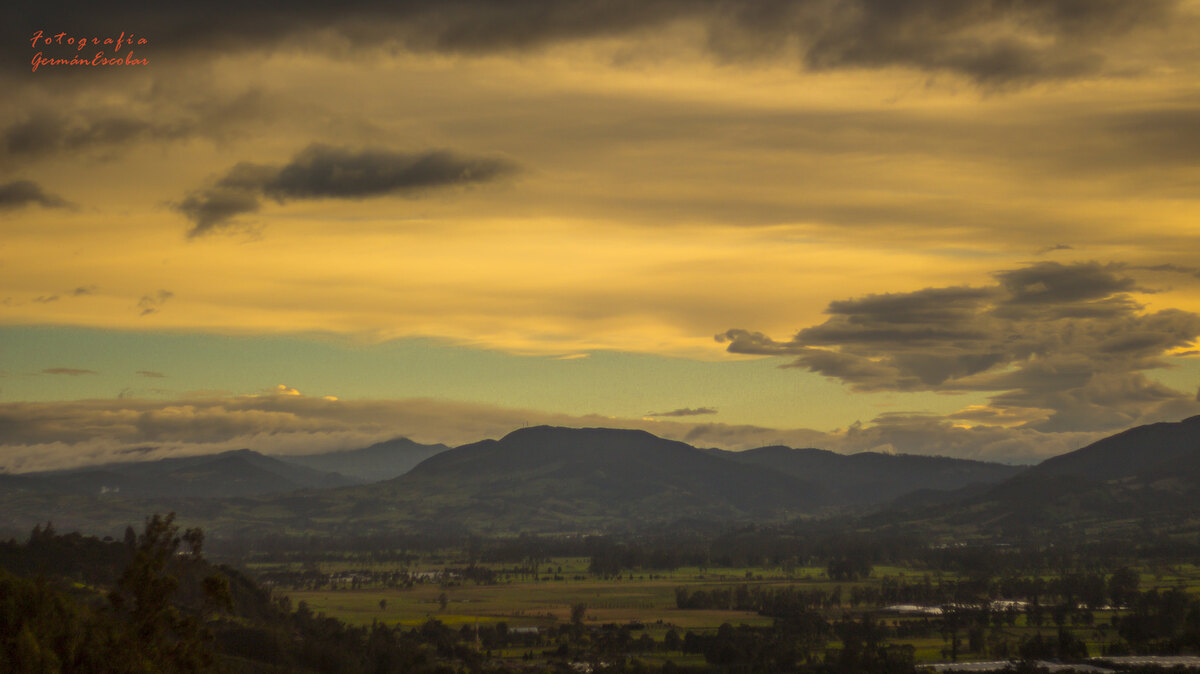
The study, led by researchers from the University of Tübingen and the Senckenberg Centre for Human Evolution, in collaboration with the Universidad Nacional de Colombia, analysed ancient DNADNAThe molecule carrying genetic information, used to reconstruct kinship between species.→Ancient DNAGenetic material preserved in old remains, often degraded, sequenced with cutting-edge techniques.→ extracted from the bones and teeth of 21 individuals from five sites on the Altiplano, spanning from 6,000 to 500 years before present.1 Of these 21 people, seven formed the most puzzling group: the preceramic hunter-gatherersHunter-gatherersA way of life based on hunting, fishing and gathering wild resources, without farming or herding; it dominated almost the whole of human history.→ of Checua. For the first time, Colombia, long a blind spot in American paleogeneticsPalaeogeneticsThe study of ancient DNA extracted from remains (bones, teeth, sediments, walls) to reconstruct the past of populations.→, yielded a direct genetic archive of its earliest inhabitants.
Skeletons that lead nowhere
The central finding fits in a single sentence, set down in black and white by the authors: these hunter-gatherers carry no particular affinity to ancient North American groups, and contribute genetically neither to ancient nor to present-day South American populations.1 In other words, their genes are a dead end. The Checua individuals did descend from the first great peopling wave to reach South America, the one that crossed the isthmus before spreading across the continent, yet this local branch died out with no detectable posterity.
"We could not find any descendants of these early hunter-gatherers of the Colombian high plains, their genes were not passed on," summarises Kim-Louise Krettek, the study's first author. "That means in the area around Bogotá there was a complete exchange of the population."2 The observation stands out, because South America has so far mostly yielded examples of strong genetic continuity, where modern populations extend lineages settled for millennia. For archaeologist Andre Luiz Campelo dos Santos, who did not take part in the work, the result is "unexpected": until now, researchers did not believe another distinct lineage could appear in South America.3
What is striking is the combination of two anomalies. On one hand, the Checua population does not clearly attach to the known North or South American ancestries, those that geneticists had defined from genomes already sequenced elsewhere on the continent. On the other hand, it has no extension toward the present. It is this double rupture, upstream and downstream alike, that justifies the term "ghost" lineage used by commentators.
The Checua site, north of Bogotá, is no stranger to prehistorians. The high plains of the Cundiboyacense Altiplano rank among the oldest and best-studied peopling grounds in South America, with preceramic occupations documented for more than ten millennia. It was known, therefore, that hunter-gatherers had long lived there, knappingknappingThe set of operations for fracturing a stone block to extract flakes or blades.→ stone and exploiting the resources of the high-altitude wetlands and forests. What was missing was the genetic piece of the dossier. By linking, on a single transect, individuals spread across six thousand years, the study does not merely describe an isolated population: it reveals several successive shifts in the region's demographic history, the sharpest of which is this tipping point that erases the Checua lineage.1
The peopling of the AmericasPeopling of the AmericasThe migration of the first modern humans into the Americas from Asia via Beringia, long dated to around 13,000 years ago (the "Clovis first" model) but pushed back beyond 20,000 years by sites such as White Sands.→ as a backdrop
To grasp the scale of the surprise, the broader framework of the peopling of the AmericasPeopling of the AmericasThe migrationsMigrationsLong-distance movements of populations; a major driver of human history (the exit from Africa, the peopling of continents, Neolithic and steppe expansions).→ that led Homo sapiensHomo sapiensThe present-day human species, which emerged in Africa around 300,000 years ago, the only surviving human lineage after the extinction of Neanderthals and Denisovans.→ to occupy the American continent, from BeringiaBeringiaA vast land bridge emergent between Siberia and Alaska during the last glaciation, at the site of today's Bering Strait; a cold steppe through which the first Americans passed.→; its date and routes remain debated.→ must be recalled. The first humans reached the continent from Siberia, crossing the Bering land bridgeBering land bridgeThe strip of land (Beringia) linking Asia to America during the last Ice Age, the entry route of the first Americans.→ that linked Asia to Alaska during the last Ice Age, at least 15,000 years ago, with some studies arguing for an even earlier arrival.3
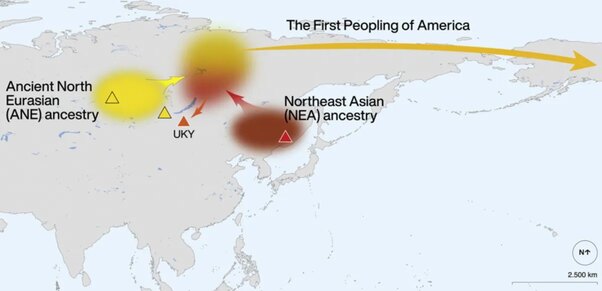
Once through the Beringian gateway, this founding population split. Geneticists classically distinguish a North American lineage and a South American lineage, separated very early, probably more than 14,000 years ago.5 It was the latter that spread toward Central and then South America. Field data confirm an ancient human presence in the south of the continent: the Monte Verde site in Chile attests to occupation at least 14,550 years ago.3 The precise timeline of this dispersal remains poorly known, however, and paleogenomic work of recent years has shown the story to be far bushier than once thought, with successive waves, admixtures and disappearances.6
In this picture, Colombia holds a strategic position: any traveller coming from the north and heading toward Amazonia, the Andes or the Southern Cone had, in one way or another, to cross this territory. One therefore expected to find there the genetic signatures of the first waves, and above all a continuity linking the earliest inhabitants to present-day peoples. The Altiplano study shows reality was more jolted. As Harvard anthropologist Christina Warinner points out, Colombia was "a key region for understanding the peopling of South America", yet it remained "a blank spot in ancient DNA studies of the Americas".4
The Isthmo-Colombian area, a crossroads
Colombia and the strip of land linking it to Central America form what specialists call the Isthmo-Colombian areaIsthmo-Colombian areaThe contact and transit zone linking Central America to the northern Andes, a crossroads of human and cultural movement.→, a biological and cultural crossroads between the two halves of the continent. This bottleneckBottleneckA sharp, temporary reduction in a population's size that lastingly impoverishes its genetic diversity.→, running from Costa Rica and Panama to the northern Andes, channelled human movement for millennia. Understanding what played out there sheds light both on the final peopling of South America and on later exchanges between north and south.

It was precisely through this corridor that the population which supplanted the Checua hunter-gatherers arrived, much later. By around 2,000 years before present, the local ancestry of the Altiplano is replaced by populations from Central America.1 These newcomers brought ceramics, new techniques and, very probably, the Chibchan languagesChibchan languagesA language family spoken from Central America to northern Colombia, linked to the populations that replaced the Altiplano hunter-gatherers.→, a linguistic family still spoken today from Central America to northern Colombia. A telling detail: the Altiplano individuals dating to less than 2,000 years ago are genetically closer to Chibchan speakers from Panama than to present-day Indigenous Colombians.1
This result overturns the expected direction of influence. Rather than a South America peopled once and for all from the south, we see Central America re-injecting populations into the southern continent at a relatively recent date. For Christina Warinner, the study highlights "the deep history of population migration and mixing in the formation of today's populations" and marks Central America as a "key region" that influenced the development of complex societies in both north and south.4 The Bogotá Altiplano, where the Muisca civilisation would later flourish, thus appears as a palimpsest on which several populations followed one another without always mixing.
Reading DNA in the tropics
If Colombia had stayed silent until now, it was not for lack of sites or of bones, but because reading ancient DNA in the tropics is a technical feat. The DNA molecule degrades over time, and that degradation accelerates under heat and humidity.3 The warm, humid climates that dominate much of tropical America are therefore the worst enemies of genetic preservation.
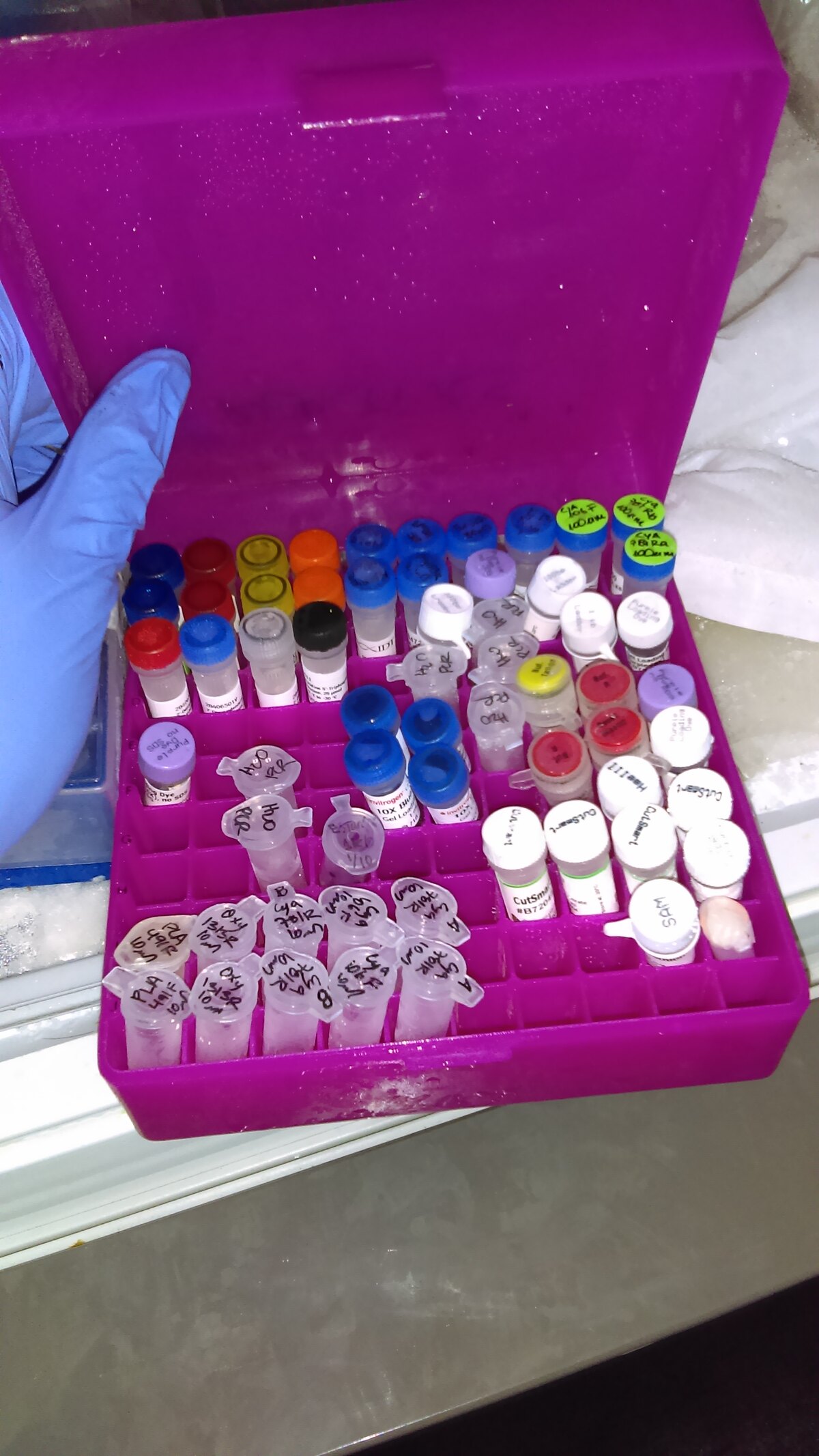
This is where the altitude of the Altiplano proved decisive. The high plains around Bogotá, perched above 2,600 metres, offer a cool, temperate climate that slowed the breakdown of the genetic fragments lodged in bones and teeth. The Checua burials lie at a particularly high elevation, which allowed usable DNA to be recovered from individuals six millennia old, where contemporary remains from low altitudes would likely have been genetically unreadable. Laboratory work relies on cleanrooms, strict protocols against contamination by modern DNA, and sequencingSequencingReading the order of the bases (A, T, G, C) of a DNA molecule; high-throughput sequencing reads millions of fragments in parallel.→ methods able to reconstruct a genome from tiny, damaged fragments.
There remains the question of what, exactly, a ghost lineageGhost lineageAn ancient human population known only by the trace it left in the genomes of present-day populations, without any confirming fossil.→ is. In paleogenetics, the phrase denotes a population whose imprint can be sensed without its genomes necessarily being held, either because it contributed, in residual fashion, to the makeup of other groups, or because it existed and then disappeared. The Checua case is a particularly clear variant: here, the population's genomes are indeed in hand, but it is those genomes that have become "ghosts", in the sense that they match neither the known lineages upstream nor any population downstream. A fully documented branch, and yet one without clear roots or descent.
That distinction matters for how such discoveries are framed in the press. Headlines reach easily for the language of mystery and of lost peoples, yet the science here is sober and quantitative. The Checua genomes are real data, carefully authenticated against contamination and placed within a continental comparison. What makes them a ghost is not the supernatural but the statistics: their ancestry neither derives cleanly from, nor flows into, the lineages we can currently sample. Naming that honestly is part of the work, and the study does so without overreaching.
A population turnover, not a solved mystery
Why did this population disappear? The study does not settle the matter, and its authors refrain from any hasty conclusion. Several scenarios remain open.3 The Checua hunter-gatherers may have declined under the effect of environmental change, epidemics or food shortages. They may have been supplanted by the farming groups arriving from the north. Or they may, finally, have gradually blended into these new populations to the point that their genetic signature was diluted until undetectable. These hypotheses are not mutually exclusive, and only the accumulation of new genomes, across more sites and periods, will allow them to be told apart.
What is established, by contrast, is the reality of the turning point that occurred around 2,000 years ago: a profound demographic renewal, in which one ancestry gave way to another, accompanied by a cultural shift visible in the archaeology, with the arrival of ceramics and new ways of life. Here genetics and material culture tellTellAn artificial mound formed by the accumulation of successive layers of settlement remains at the same spot, typical of the Near East. Each destruction-rebuilding event adds a stratum.→ the same story, that of a replacement rather than a slow evolution in place.
Care is also needed not to read this replacement as the end of a people in the sense we might mean today. A genetic signature that fades says nothing, on its own, about the fate lived by individuals or by a community. Knowledge, techniques and stories may have passed across biological boundaries, and minority maternal or paternal lineages may have persisted locally without surfacing at the scale of a twenty-one-genome sample. The authors' caution rests precisely on this: the observed turnover is a robust statistical fact at the population level, not the detailed narrative of an extinction. The cultural heirs of the Altiplano's first inhabitants are not to be read in the genes alone.
It is worth stressing, too, how much the result depends on method. A null finding, the absence of descendants, is only as strong as the comparative dataset behind it, and the Americas remain unevenly sampled. Future genomes from lowland Colombia, from Amazonia or from the Caribbean coast could yet reveal faint echoes of the Checua lineage that current data cannot see. For now, the signal is clear and the gap it fills is real, but the picture is a first sketch rather than a closed chapter, and the researchers present it as such.
Beyond the Colombian case, these results are a reminder that the history of the peopling of the Americas is not a simple tree branching without return. It is a web of waves, refluxes, encounters and erasures, some of whose branches died out leaving no living trace. By filling one of the last great gaps in the continent's genetic map, the Bogotá Altiplano offers us a rare snapshot of a population that lived, thrived for millennia, then vanished from the genes of humanity. The first ancient genomes from Colombia have not merely filled an empty box: they have added a ghost to the history of the first Americans.
Ce résultat illustre parfaitement la complexité du peuplement des Amériques. Pendant longtemps on pensait à un flux migratoire unique depuis l'Asie via le détroit de Béring. Les études génétiques récentes montrent au contraire des vagues multiples, des lignées disparues et des mélanges complexes. Le modèle simplifié est définitivement obsolète.
La découverte d'une lignée fantome chez les populations amérindiennes de Colombie est l'un des résultats les plus spectaculaires de la paléogénomique de ces dernières années. Cela signifie qu'un groupe humain aujourd'hui disparu a contribué génétiquement aux populations amazoniennes sans laisser de traces archéologiques identifiables. L'ADN révèle ce que les pierres ne peuvent pas dire.