In a field in North Yorkshire, near the small town of Boroughbridge, three gigantic stones stand in a line like sentinels. The tallest is more than six metres high. Locals call them the Devil's Arrows: according to an old legend, the Devil hurled them from a nearby hill to destroy a town. The reality is less diabolical but just as astonishing. A study published in September 2026 in the Proceedings of the Royal Society A reveals that these standing stonesMenhirA stone erected vertically by humans, standing alone or in rows (alignments), emblem of the Breton Neolithic megalithic tradition. From Breton men (stone) and hir (long).→, each weighing more than 25 tonnes, did not come from the nearest quarry, as had long been assumed, but from a rock outcrop at least 18 kilometres away, deliberately chosen by their prehistoric builders.12
Led by Anthony Clarke of Curtin University in Australia and Jim Leary of the University of York in the UK, the investigation sheds new light on the choices, the efforts and perhaps the beliefs of the communities who raised these monoliths some 4,000 years ago.1
Britain's tallest stone row
Today the Devil's Arrows form an alignment about 174 metres long, running roughly north to south. The largest of the three stones is nearly 6.9 metres tall, making it one of the tallest standing stones in Britain. Originally the row probably comprised four or five stones, which made it a rarity: stone rows on this scale are exceptional in the British lowlands.12
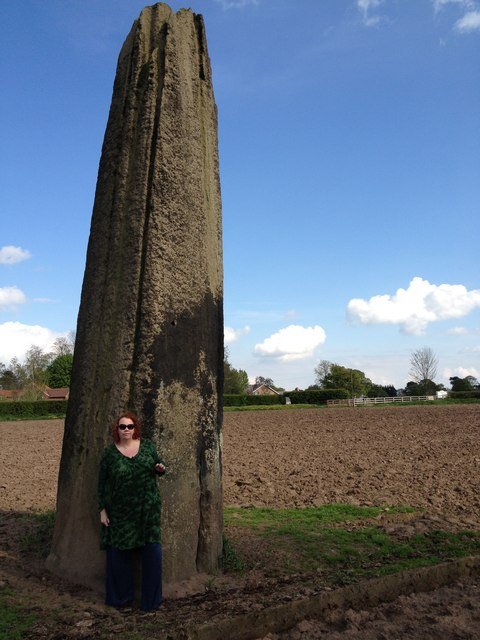
The stones probably date from the end of the NeolithicNeolithicThe "New Stone Age": a period marked by farming, herding, settlement and pottery, from around 10,000 BC.→ or the beginning of the Bronze AgeBronze AgeA protohistoric period following the Neolithic, defined by bronze metallurgyMetallurgyThe techniques of extracting and working metals (copper, bronze, gold); its rise in the Eneolithic and Bronze Age transformed tools, weapons and social hierarchies.→ (a copper-tin alloy) and the rise of the first cities and states; in Egypt it corresponds to the age of the first pyramids.→, around 2000 BCE.1 They stand in a landscape rich in monuments of the same period: some fifteen kilometres to the north, the three great Thornborough hengeshengeA Neolithic circular enclosure bounded by a ditch and bank, often associated with standing stones.→ form one of the most impressive ceremonial complexes in Britain. At the end of the Neolithic, the valley of the River Ure seems to have been a genuine sacred corridor.
The tops of the stones are scored with deep vertical grooves, cut by rain and frost over four millennia. They give the stones the tapering look that probably inspired the name "arrows".
A devilish legend
The stones take their name from a persistent local legend. According to tradition, the Devil, furious with the people of the nearby town of Aldborough, hurled these huge "arrows" from a hill to destroy it. But his missiles fell short, lodging in the ground near Boroughbridge, where they still stand. Aldborough was no random choice: it is the former Isurium Brigantum, an important Roman town in northern Britannia, long far more prestigious than the stones themselves.
As so often, the legend tried to explain what collective memory no longer understood. Two thousand years after they were raised, the Devil's Arrows had become enigmas whose human origin had been forgotten. Over the centuries they suffered damage: one stone of the row is said to have been pulled down and broken in the early modern period, perhaps by treasure seekers or for its stone.
Their survival to the present day is almost miraculous. Three sandstone giants have remained upright for four millennia amid cultivated fields, silent witnesses to a sacred landscape whose logic we are only beginning to grasp.
Plumpton or Brimham?
The Devil's Arrows are cut from a coarse sandstone typical of northern England, Millstone Grit. This sandstone outcrops in several places in the region. For a long time, researchers assumed that the stones came from Plumpton Rocks, an outcrop near Knaresborough that is now an ornamental garden. It was the nearest source, and therefore the most logical.12
But that still had to be proven. Identifying the origin of a standing stone without damaging it is a challenge. Conventional provenance techniques require samples to be taken, which is out of the question on a protected monument. The team therefore developed a very low-impact sampling method: they simply pressed adhesive tape onto the surface of the stones to collect fine mineral grains that had come loose naturally.12
The geological fingerprint of grains
Every sandstone is made of grains eroded from older rocks, then carried and deposited by rivers. Some of these grains, such as zircons, preserve the age of the rocks they came from. The full set of ages measured in a sample forms a kind of geological fingerprint, unique to each outcrop.1
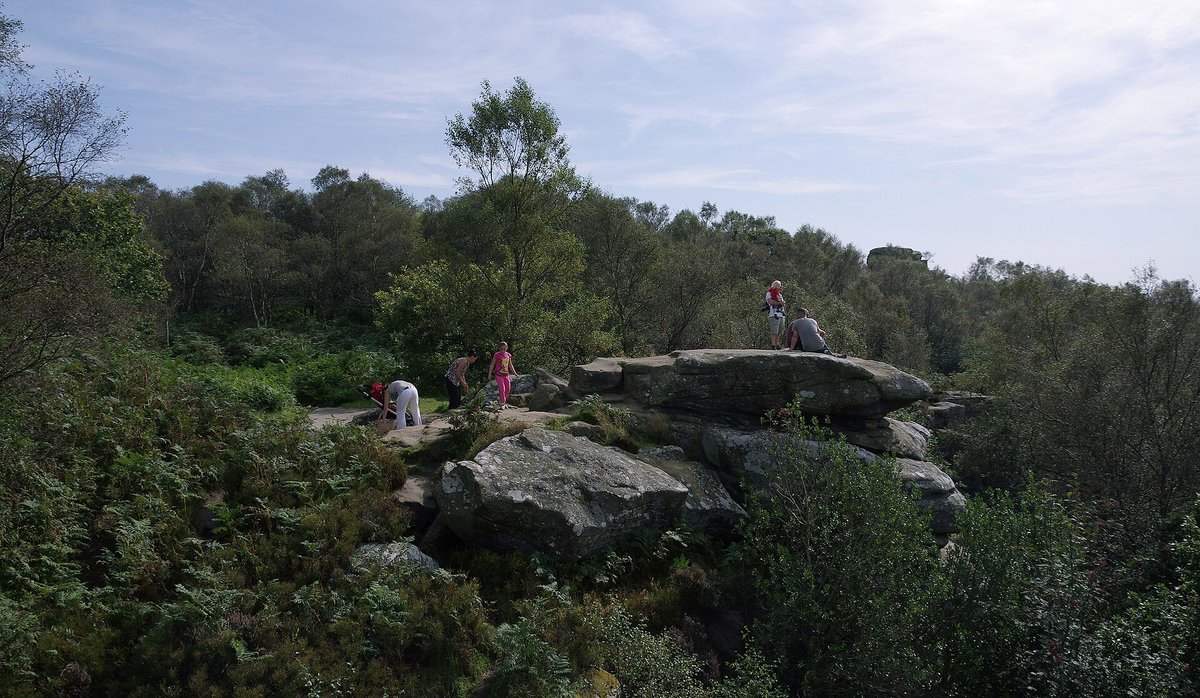
By comparing the fingerprint of the grains taken from the Devil's Arrows with those of the various possible sources, the researchers obtained an unequivocal result: the stones did not come from Plumpton Rocks but from Brimham Rocks, a spectacular group of weathered sandstone tors perched on moorland in Nidderdale, about 18 kilometres from the monument.12
The analysis also ruled out another hypothesis: natural transport by glaciers, which might have dropped erratic boulders near the site during the last glaciation. The characteristics of the stones do not fit that scenario. It was therefore people who moved them.1
Eighteen kilometres with 25-tonne blocks
The feat is considerable. Each stone weighs more than 25 tonnes. They had to be detached from the outcrop, shaped, and then moved at least 18 kilometres across rolling country, crossing watercourses, before being raised upright. "Each stone weighs more than 25 tonnes, so moving them would have required incredible planning, coordination and engineering skill," says Anthony Clarke.1
The techniques used remain unknown, but archaeologists imagine wooden sledges sliding on rails or rollers, hauled by dozens or even hundreds of people with ropes of plant fibre or leather. Such an undertaking would have mobilised a whole community for weeks, and required a social organisation able to feed, coordinate and motivate the teams.
Why go so far?
The most fascinating question is surely this: why did the builders choose such distant stones when comparable sandstone outcropped much closer? "Our research shows that these stones were not simply taken from the nearest source; they were deliberately chosen from a challenging landscape 18 kilometres away," explains Anthony Clarke.2
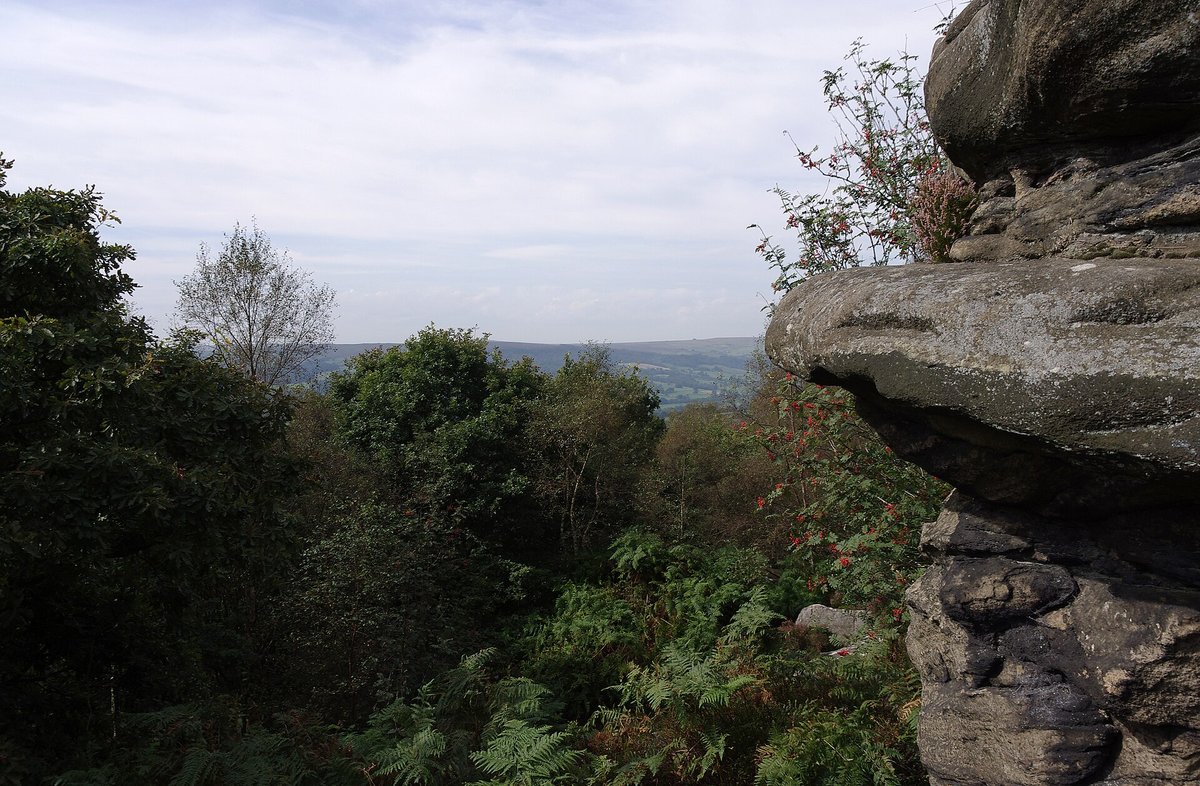
For the researchers, the answer probably lies in the place itself. With its fantastically shaped rocks, sculpted by wind and rain, Brimham Rocks is still a striking site today. It may have held cultural, symbolic or spiritual significance for prehistoric people. Taking a stone from this place was not simply acquiring a material: it was carrying away a fragment of a meaningful landscape.12
"These findings show that ancient communities were making deliberate and meaningful choices about where their stones came from," says Jim Leary. "It highlights the importance of landscape and shared belief systems, and the remarkable effort involved in moving and raising stones of this size."12
An echo of Stonehenge
This finding echoes the major discoveries made at Stonehenge. It has long been known that the "bluestones" of the famous Wiltshire monument come from the Preseli Hills in Wales, more than 200 kilometres away. And in 2024, a study by a team that already included Anthony Clarke showed that the Altar Stone, at the heart of the monument, came from north-east Scotland, more than 700 kilometres away.3
The Devil's Arrows confirm, on a more modest scale, what Stonehenge had hinted at: megalithMegalithA large stone raised or assembled by humans (menhir, dolmenDolmenA megalithic funerary structure made of one or more capstones resting on vertical uprights, often topped by an earth tumulus. From Breton dol (table) and men (stone).→, stone circleStone circleA Neolithic or Bronze Age monument of standing stones set in a ring, often ritual or astronomical in purpose.→), typical of the Neolithic and Bronze Age.→ builders did not choose their stones at random or merely for convenience. Where the stone came from mattered. It could link the monument to an ancestral place, a territory, a story.
What were stone rows for?
The exact purpose of the Devil's Arrows remains a mystery. Like many rows of standing stones, they may have marked a processional route, a territorial boundary, a gathering place or a landmark within a sacred landscape. Their roughly north-south orientation, parallel to the valley, has sometimes been linked to astronomical phenomena, although no convincing demonstration has ever been made.
Their proximity to the Thornborough henges and the River Ure suggests, at any rate, that they were part of a wider set of monuments linked by routes used during collective ceremonies. Knowing now that their stones came from a chosen place 18 kilometres away adds a new dimension: the monument may have connected two important places in the territory, the source and the destination, through the very journey of the stones.
Excavations ahead
The researchers now hope to apply their non-invasive method to other standing stones of uncertain origin, in Britain and beyond. Adhesive tape could become a valuable tool for probing monuments that cannot be touched.1
The team is also planning targeted excavations, both at the foot of the Devil's Arrows and at the Brimham Rocks source area, where traces of quarrying might be found. "These next steps could help us better understand when the stones were moved and how these extraordinary monuments were built," concludes Anthony Clarke.2 Four thousand years after they were raised, the Devil's Arrows may not yet have revealed all their secrets.
No comments yet. Be the first.