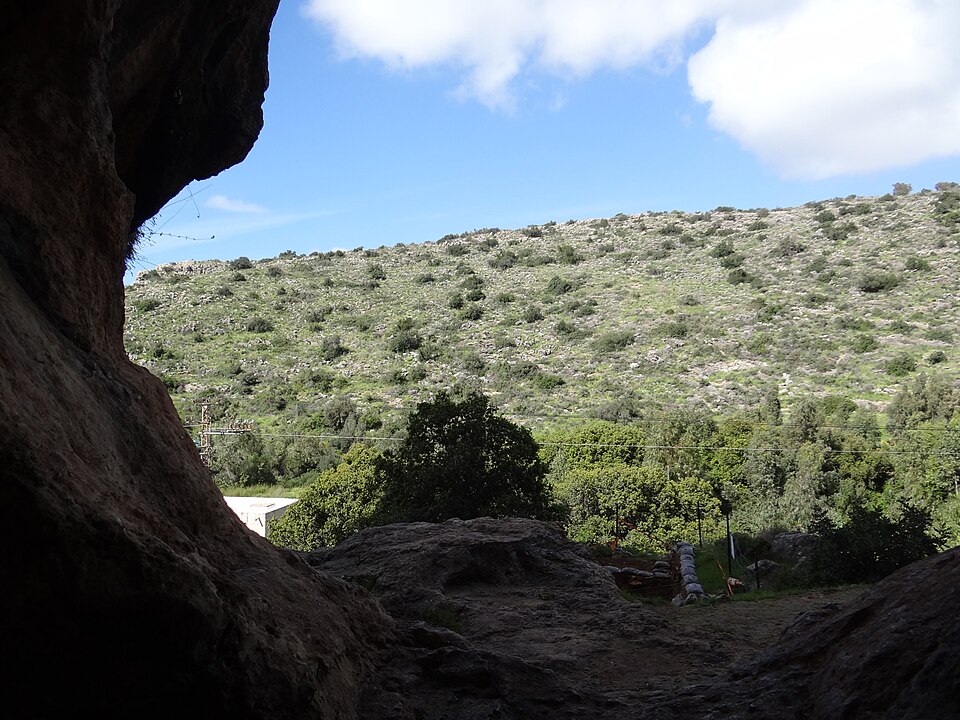
On the western flank of Mount Carmel, where the mountain plunges towards the Israeli coastal plain, a narrow cavity opened in the limestone yielded, from the 1930s onwards, one of the most debated sets of human remains in all of prehistoryPrehistoryThe span of human history before the invention of writing, from the Palaeolithic to the Metal Ages, known mainly through material remains.→. The cave of Es-Skhul, whose Arabic name means roughly "the cave of the kids" (young goats), gave up the bones of about a dozen individuals laid to rest some 120,000 years ago. These men and women look, for the most part, like Homo sapiensHomo sapiensThe present-day human species, which emerged in Africa around 300,000 years ago, the only surviving human lineage after the extinction of Neanderthals and Denisovans.→; yet their anatomy preserves robust, archaicArchaicRefers to an ancient, now-extinct human population or form (Neanderthals, Denisovans, ghost lineages), as opposed to anatomically modern humans.→ traits that have fuelled, for nearly a century, a dizzying question: what if some of them carried, in their bones and perhaps in their blood, the mark of a crossing between our lineage and that of the NeanderthalsNeanderthalsA fossil humanity of Eurasia, robust and cold-adapted, extinct around 40,000 years before present.→? Es-Skhul thus became, in the scholarly imagination, the recurring candidate for the title of "oldest hybrid" between two humanities1.
The stakes go far beyond anatomical curiosity. To recognise in these fossils the trace of an ancient hybridisationHybridisationCrossing between two distinct species or lineages, such as Homo sapiens and Neanderthals, leaving a trace in the genome.→ is to accept that the encounter between Homo sapiens and the other human forms was not a late and marginal episode, occurring during the great expansion out of AfricaOut of AfricaThe dispersals of Homo sapiens out of Africa, including a major expansion c. 70,000 to 60,000 years ago and earlier exits.→ some 50,000 years ago, but a recurrent process spread over tens of millennia, of which the LevantLevantA region of the eastern Mediterranean Near East (Israel, Lebanon, Syria, Jordan), a major crossroads of the first human migrations out of Africa.→ was one of the earliest theatres. It also means questioning the very notion of species: if two populations readily classed as distinct were able to interbreed and produce offspring, where does the boundary lie between Homo sapiens and Homo neanderthalensis? Es-Skhul, through its disconcerting mosaic of characters, forces a reformulation of these questions without ever offering a definitive answer.
Mount Carmel, a crossroads of humanity
Mount Carmel is no ordinary mountain. This limestone promontory, some twenty kilometres long, separates the Mediterranean coastal plain from the interior hills of Galilee and the Jezreel valley. Its position makes it an obligatory passage point on the great Levantine corridor, that thin band of habitable land squeezed between the sea to the west and the Syro-Arabian deserts to the east. Anyone who, during the PleistocenePleistoceneThe geological epoch of the great ice ages (c. 2.6 Ma–11,700 BP), spanning most of human prehistory.→, moved between AfricaAfricaThe cradle of humankind: the continent where the first hominins appeared, then Homo sapiens around 300,000 years ago, before the expansion to the rest of the world.→ and Eurasia had to follow this corridor. The Levant was thus, for hundreds of millennia, an airlock, a funnel through which populations from the south and the north succeeded and sometimes crossed one another1.
This geographical situation explains the exceptional density of PalaeolithicPalaeolithicThe oldest and longest period of prehistory (c. 3.3 Ma–12,000 BC), defined by chipped stone tools and a hunter-gatherer way of life.→ sites found on the slopes of Carmel and the neighbouring hills. The caves of Tabun, Es-Skhul, El-Wad and Kebara, aligned along the Nahal Me'arot, the "valley of caves", form one of the most complete stratigraphic sequences in the Old World, spanning several hundred thousand years of continuous or recurrent human occupation. A few dozen kilometres to the north-east, the cave of QafzehQafzehA cave in Lower Galilee (Israel) yielding Homo sapiens and some of the oldest known burials outside Africa.→, near Nazareth, completes this picture. Together, these sites document the coexistence, in a single region and over a long span, of Neanderthal populations and of anatomically modern populations, or populations close to being so1.
The climateClimateThe long-term average atmospheric conditions of a region; its variations (glaciations, aridifications) shaped migrations, agriculture and the collapse of prehistoric societies.→ of the Pleistocene Levant was not static. Temperate, humid phases, which pushed Mediterranean faunas and floras northward, gave way to colder, drier episodes that instead opened the way to steppeSteppeA vast semi-arid, treeless grassland of Eurasia, suited to nomadic herding and the horse; a corridor for the movement of peoples and technologies in later prehistory.→ elements arriving from the north. These climatic oscillations set the rhythm of the comings and goings of human populations. A model of alternation was long proposed: the Neanderthals, adapted to the cold, would have occupied the region during glacial phases, while the sapiens, coming from Africa, would have thrived there during temperate phases. The reality, as we shall see, proved more tangled, with the dates blurring this neat symmetry. But the idea of the Levant as a zone of contact, relay and mixing has remained the guiding thread of all interpretation of the Carmel fossils.
One point deserves emphasis: nowhere else in the world, for so ancient a period, is the proximity of two human lineages so clearly attested. The Levant is not merely the place where early sapiens were found; it is the place where they were found alongside, or nearly so, the Neanderthals, in caves sometimes a few kilometres apart and sometimes superimposed within a single cavity. It is this cohabitation, attested by stone and by bone, that gives the bones of Es-Skhul their very particular theoretical charge. No other prehistoric crossroads combines so tightly the conditions for an encounter: a geography of obligatory passage, an oscillating climate that pushes and pulls populations, and an accumulation of caves that has fixed in stone the memory of these movements. This is why Carmel came to function, in the minds of prehistorians, as a true natural laboratory for the question of origins, where each new date and each anatomical re-examination feeds a debate now more than a century old.
The history of the excavations: Garrod, McCown and Keith
The discovery of Es-Skhul belongs to one of the great archaeological campaigns of the interwar years. In 1929, the British prehistorian Dorothy Garrod, one of the major figures of the archaeology of her time and the future first woman professor at the University of Cambridge, undertook the systematic exploration of the caves of the Nahal Me'arot, within a joint project of the American School of Prehistoric Research and the British School of Archaeology in Jerusalem. The excavations extended until 1934 and mobilised, remarkably for the period, a largely female workforce recruited from the neighbouring villages1.
Es-Skhul cave proper was excavated from 1931, mainly under the direction of Theodore McCown, a young American prehistorian associated with the project. The small shelter rapidly yielded an exceptional harvest: the remains of at least ten individuals, men, women and children, including several skeletons in anatomical connection, suggesting intentional deposition. These fossils received the designations Skhul I to Skhul X. Among them, the specimen Skhul V, a remarkably complete male skull associated with a mandible, was to become the icon of the site and one of the most reproduced human fossils of the twentieth century.
The anatomical study of the remains was entrusted to Sir Arthur Keith, a Scottish anatomist of great reputation, who joined McCown for the publication. Their joint monograph, published in 1939 under the title The Stone Age of Mount Carmel, long held authority. Keith and McCown were immediately struck by the composite character of the fossils. The remains from Tabun, excavated in the neighbouring cave, displayed distinctly Neanderthal traits; those from Es-Skhul, by contrast, appeared much more modern, while retaining robust elements. The two scholars made a bold interpretive choice: they treated the whole of the Carmel fossils, Tabun and Skhul combined, as a single variable population, which they described as an intermediate, transitional type between Neanderthal and modern man. This was, in embryo, the hypothesis of a hybrid population, or of a population in the course of transformation1.
This unitary reading did not survive later progress. It was understood that Tabun and Skhul belonged to distinct moments and represented different populations: the former close to the Neanderthals, the latter to modern humans. But the intuition of McCown and Keith, that of a mosaic of characters, of a zone of morphological overlap between the two humanities, never ceased to haunt the interpretation of the site. It has even regained, since the advent of palaeogeneticsPalaeogeneticsThe study of ancient DNADNAThe molecule carrying genetic information, used to reconstruct kinship between species.→ extracted from remains (bones, teeth, sediments, walls) to reconstruct the past of populations.→, a vigour its authors could not have imagined.
Skhul and Qafzeh, archaic sapiens
To understand the place of Es-Skhul in human history, it must be set alongside its twin site, the cave of Qafzeh. The two fossil assemblages, a few dozen kilometres apart and chronologically close, are today generally grouped under the common label of the "Skhul-Qafzeh" population. They represent, in the thinking of palaeoanthropologists, one of the oldest attestations of Homo sapiens outside Africa, an early expansion, far predating the great exodus from Africa that would people Eurasia after 50,000 years ago3.
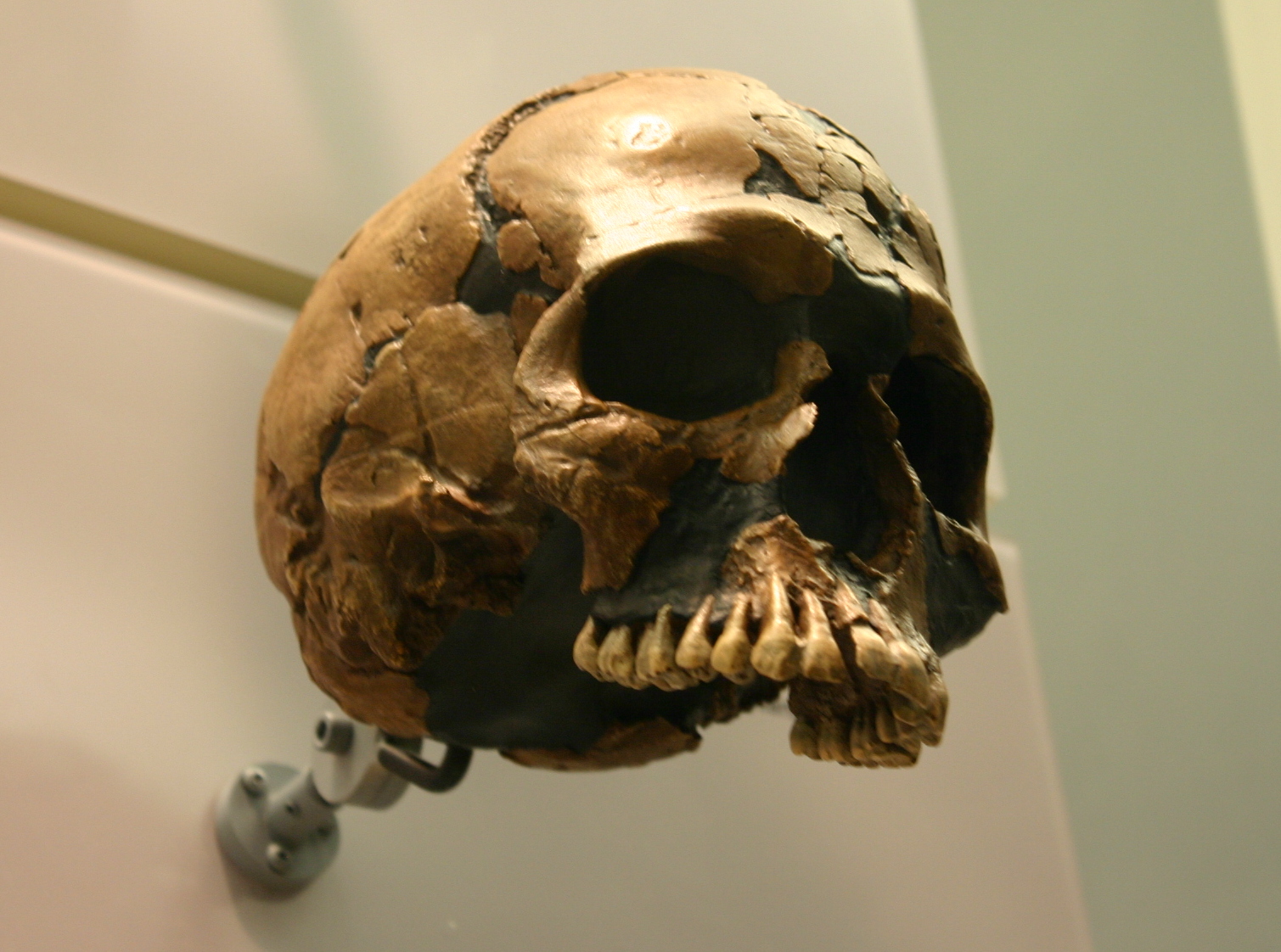
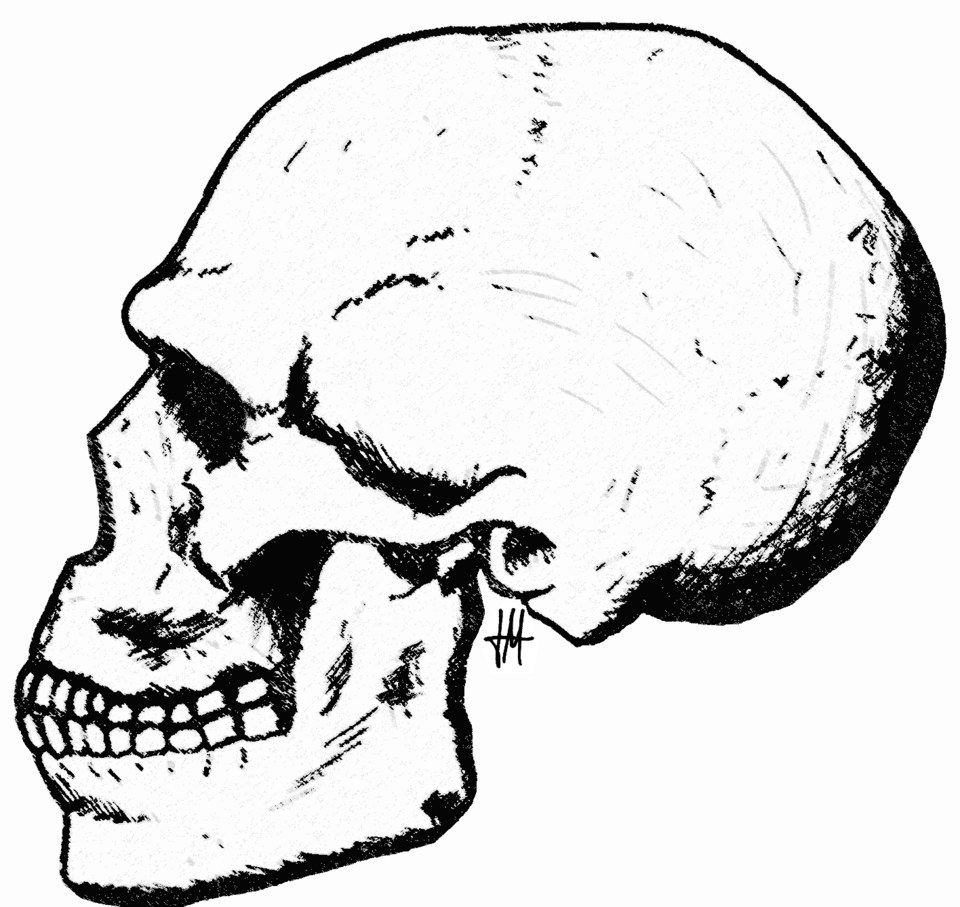
What is meant by archaic sapiens? The expression designates populations whose overall anatomy already belongs to the modern body plan, a reduced face retracted beneath the skull, a high and rounded cranial vault, an incipient chin, gracile limbs, but which retain a number of robust traits inherited from older ancestors. Among the Skhul-Qafzeh fossils, this robustness can be read in still-prominent brow ridges, a broad face, thick bones, powerful musculature. We are far from the gracility of the sapiens of the European Upper PalaeolithicUpper PalaeolithicThe final phase of the Palaeolithic (c. 45,000 to 10,000 years ago), marked by Homo sapiens in Europe, art, ornaments and a succession of cultures (Aurignacian, Gravettian, Solutrean, Magdalenian).→. But we are equally far from the typical Neanderthal morphology, with its elongated skull, projecting face and bulging occiput.
This population poses a chronological problem as fascinating as it is difficult. The dates place Skhul and Qafzeh around 90,000 to 120,000 years ago. Yet the "classic" Neanderthals of the Levant, like those of Kebara or Amud, are often more recent, between 60,000 and 50,000 years ago. In other words, in this region, the archaic sapiens may locally have preceded the best-characterised Neanderthals, instead of succeeding them. This apparent inversion ruined the simple model of a linear transition from Neanderthal to modern man and imposed the idea of populations that relay one another, cross and disappear with the climatic fluctuations, with no obvious direct lineage on site1.
Another fact deserves attention: the Skhul-Qafzeh population does not seem to have any identified direct descendants. These first sapiens of the Levant appear to constitute an early expansion that fizzled out, a branch that died out or withdrew without leaving massive genetic posterity among living humans. Analyses of the DNA of modern Eurasians indeed point to a later exodus from Africa as the main source of the peopling of the globe. Skhul-Qafzeh would then bear witness to an aborted attempt, a trial colonisation of Eurasia that came to nothing, but whose bones preserve the memory and, perhaps, the trace of an encounter with other humans.
The anatomical mosaic of the re-examined child
It is on one of the youngest specimens in the collection that the debate on hybridisation has crystallised in recent times. The fossil designated Skhul I is that of a child, whose skull and mandible were the subject, in the 2000s and 2010s, of in-depth re-examinations using modern techniques of three-dimensional imaging and geometric morphometrics. These analyses, by measuring and comparing the shape of the bones with a precision inaccessible to McCown and Keith, revived the question in a new way1.
The researchers' finding is one of a genuine mosaic. On certain characters, the Skhul child falls on the side of Homo sapiens: the general shape of the cranial vault, the morphology of part of the face, certain proportions. On others, by contrast, it presents traits that evoke the Neanderthals: the conformation of the mandible, the organisation of the inner ear reconstructed by scanner, certain details of the base of the skull. This combination, modern here, archaic there, does not reduce easily to the mere variability of a homogeneous population. It led some authors to propose that this child might represent the product of an admixture between the two lineages, or at least carry the distant echo of such a crossing in its ancestry.
The re-examination of the inner ear, in particular, drew attention. The bony labyrinth, which houses the organ of balance, displays in Neanderthals a characteristic configuration, distinct from that of modern humans, and considered a fairly reliable marker of lineage affinity because it depends little on individual living conditions. Now the scan examination of certain Carmel remains has revealed, in individuals otherwise modern, labyrinthine configurations with Neanderthal resonances. Such signals, if confirmed and generalised, would argue for a share of Neanderthal ancestry in this population1.
These conclusions must nonetheless be handled with caution. Geometric morphometrics measures shapes; it does not directly read genealogies. A "Neanderthal" trait on a modern skull may signal a crossing, but it may also reflect the retention of a plesiomorphicPlesiomorphicDescribes an ancestral (primitive) anatomical character inherited from a common ancestor, as opposed to recent derived traits.→ state, that is, an ancestral character inherited from a common ancestor of the two lineages, which the archaic sapiens had not yet lost. Distinguishing the inheritance of a recent crossing from the simple persistence of an ancient trait is one of the most formidable methodological problems in palaeoanthropologyPalaeoanthropologyThe science that studies human evolution from the fossil remains of hominins (bones, teeth, footprints) and their context, to reconstruct our biological origins.→. The mosaic of Skhul is real; its interpretation remains open.
The hybridisation hypothesis and its critics
The idea that the fossils of Es-Skhul bear witness to a crossing between sapiens and Neanderthal has a long history, going back, as we have seen, to the "transitional" interpretation of McCown and Keith. It has known several revivals. In its strong version, it sees in the Skhul-Qafzeh population an already admixed population, the fruit of a blending between sapiens arriving from Africa and Neanderthals present in the Levant or in neighbouring regions. The robustness of these fossils, their mosaic of characters, certain signals from the inner ear or the mandible, would all be indices of this composite ancestry1.
This appealing hypothesis runs into solid objections. The first is methodological: as has just been emphasised, a robust or "archaic" trait does not prove a crossing. The earliest African Homo sapiens, those of Morocco, Ethiopia or South Africa, were themselves more robust than living humans. The sapiens of Skhul-Qafzeh may simply retain the robust anatomy of their African ancestors, without any Neanderthal contribution being needed to explain it. Parsimony commands that we not invoke admixture where the simple persistence of ancestral traits suffices.
The second objection is chronological. For there to have been a crossing, the two populations must indeed have met at the right time and in the right place. Yet, in the Levant, the sapiens of Skhul-Qafzeh seem in places to predate the best-dated Neanderthals of the region. If the sapiens arrived before the classic Neanderthals settled locally, the opportunity for an on-site admixture shrinks. The partisans of hybridisation reply that contacts could have occurred elsewhere, further north, or at other times, and that the populations were mobile. The debate thus remains dependent on the precision of the dating, always disputed.
The third objection came, paradoxically, from genetics itself, paradoxically, because genetics has otherwise proved the existence of sapiens-Neanderthal admixture. But the admixture attested by the DNA of living Eurasians dates rather to 50,000-60,000 years ago, well after Skhul-Qafzeh, and concerns the lineage issuing from the great exodus from Africa, from which Skhul-Qafzeh does not directly descend. In other words, the admixture we know to be real is not, at first sight, the one that the Carmel fossils would embody. The hybridisation of Es-Skhul, if it existed, would be a distinct episode, older, and for now unverifiable by DNA, for lack of a usable genome extracted from these old bones preserved under a warm climate, little favourable to the preservation of ancient DNAAncient DNAGenetic material preserved in old remains, often degraded, sequenced with cutting-edge techniques.→.
At the close of this debate, the majority position among specialists is nuanced. Most today regard Skhul-Qafzeh as a population of archaic sapiens, robust but authentically modern, without any Neanderthal admixture being needed to account for their anatomy. The hybridisation hypothesis is not refuted, it remains possible, and even plausible given what genetics has revealed about the frequency of crossings, but it is not demonstrated for these particular fossils. Es-Skhul remains the potential "oldest hybrid" rather than the proven one: a fertile suspicion rather than a certainty.
Dating: thermoluminescence and electron spin resonance
The whole argument about Es-Skhul rests on chronology, and this was long lacking. The bones and the layers that contain them are too old for radiocarbonRadiocarbon (carbon-14)A dating method based on the decay of carbon-14, usable back to about 50,000 years.→, whose reach barely exceeds 50,000 years. It was necessary to await the development of new physical methods, in the 1980s and 1990s, to assign reliable ages to the Carmel fossils and to resolve, at least in part, the enigma of their chronological position1.
The first of these methods is thermoluminescence, or TL. When a flintFlintA hard, brittle siliceous rock, knapped by prehistoric people to produce blades, points and sharp tools.→ has been heated by fire, for example during knappingknappingThe set of operations for fracturing a stone block to extract flakes or blades.→, or because it lay in a hearth, its "clock" is reset to zero: the energy accumulated in its crystal lattice by ambient radioactivity is released as light. From that moment, the energy begins to accumulate again. By heating the sample in the laboratory and measuring the light emitted, one estimates the dose of radioactivity received since the last heating, and thus the elapsed time. Applied to the burnt flints of the Carmel caves, thermoluminescence yielded ages that, against all initial expectation, placed the sapiens of Skhul-Qafzeh very far back in time, around 100,000 to 120,000 years ago.
The second method is electron spin resonance, or ESR, sometimes called electron paramagnetic resonance. It applies in particular to tooth enamel. Under the effect of natural radioactivity, electrons become trapped in defects of the enamel crystal; their number grows with time. ESR spectrometry measures this population of trapped electrons and allows, here too, the age of the sample to be recovered. The animal teeth associated with the human fossils of Carmel were thus dated, cross-checking the results of thermoluminescence and confirming the antiquity of Skhul-Qafzeh1.
The convergence of these two independent methods marked a turning point. It established, with reasonable assurance, that the archaic sapiens of the Levant were present more than a hundred millennia ago, at a time when Eurasia was believed to be peopled only by Neanderthals and their predecessors. It is this antiquity, more than any other datum, that made Es-Skhul a pivotal site. Without it, the debate on hybridisation would lose its bite: it is because these sapiens are so old and so close to the Neanderthals in time and space that the question of their crossing arises with such acuteness. The margins of uncertainty of these dates nonetheless remain substantial, on the order of several thousand years, and feed the discussions on the respective precedence of sapiens and Neanderthals in the region.
The funerary context: burials, ochreOchreA red or yellow mineral pigment (iron oxides), used from prehistory for adornment, funerary rites and art.→ and adornment
The bones of Es-Skhul are not mere scattered remains. Several of them were found in anatomical connection, in positions that strongly suggest intentional deposition, in other words, burialsBurialThe intentional deposition of a body, sometimes with offerings; a marker of symbolic behaviourSymbolic behaviourA set of practices (adornment, pigments, art, burial) reflecting symbolic thought; long ascribed to Homo sapiens alone, now attested for Neanderthals too.→.→. This observation adds a decisive dimension to the interest of the site: not only does Es-Skhul yield very old archaic sapiens, but it also bears witness to early symbolic behaviours, to an elaborate relationship with death and perhaps with the afterlife1.
The most famous case is that of Skhul V, whose skeleton is said to have been associated with the mandible of a wild boar, deposited as a possible funerary offering. If this interpretation is correct, we would have here one of the oldest attestations of the intentional deposition of an object beside a deceased person, a gesture that presupposes a thought of the symbol, a will to accompany the dead. At Qafzeh, the twin site, comparable burials were brought to light, including a double deposition of a woman and a child, and that of a young individual on whose chest lay deer antlers. These funerary gestures, among the oldest documented for Homo sapiens, sketch a humanity already fully inhabited by the sense of ritual.
To these burials are added even more telling indices of symbolic thought. Perforated marine shells of the genus Nassarius were collected at Es-Skhul, several kilometres from the coast of the time. Their perforation, their deliberate transport far from the shore, and the wear traces left by a thread indicate that they were items of adornment, beads strung on a necklace or sewn onto a garment. These shells rank among the oldest known objects of personal ornament in humanity, comparable to those found in North Africa and South Africa for neighbouring periods. They attest the existence, more than a hundred millennia ago, of an aesthetic and symbolic behaviour: to adorn oneself, to signal one's belonging, to play on appearance1.
The use of ochre, that red or yellow pigment drawn from iron oxides, completes this picture. At Qafzeh as at other contemporary sites, pieces of ochre bearing traces of scraping or heating were found, sometimes in association with the burials. Red ochre, which evokes blood and life, may have played a role in funerary rites, in body decoration, or in practices we can only guess at. In any case, the whole, burials, shell ornaments, ochre, makes the Skhul-Qafzeh populations humans already resolutely modern on the cognitive and symbolic plane, long before the "revolution" of the European Upper Palaeolithic. On the technical plane, their stone industry belongs to the MousterianMousterianThe stone-tool industry typical of Neanderthals, based on the Levallois flaking technique.→, the same tradition as that of the Levantine Neanderthals, proof that the boundary between the two humanities did not run through material culture, but elsewhere. Both peoples knapped their flakes by the same Levallois method, hunted the same gazelles and fallow deer, sheltered in the same caves; what set them apart lay in the architecture of their bodies and, ultimately, in the depths of their genomes, not in the tools they left behind.
The long chronology of admixtures
To situate the debate on Es-Skhul correctly, it must be placed within the grand narrative written, since the early 2010s, by palaeogenetics. The sequencingSequencingReading the order of the bases (A, T, G, C) of a DNA molecule; high-throughput sequencing reads millions of fragments in parallel.→ of the Neanderthal genome, then that of the DenisovansDenisovanAn extinct human population, cousin of the Neanderthals, identified in 2010 from the DNA of remains in Denisova Cave (Siberia).→, overturned our vision of the relations between the humanities of the Pleistocene. Far from having lived in watertight isolation, these lineages crossed one another on several occasions, leaving lasting traces in our genomes3.
The best-established fact is the following: all living humans whose ancestry is not exclusively sub-Saharan carry about 1 to 2 percent of Neanderthal DNA. This inheritance stems from one or more episodes of crossing that occurred some 50,000 to 60,000 years ago, most likely in the Near EastNear EastA region of western Asia (Levant, Mesopotamia, Anatolia, Iran), cradle of the Neolithic revolution, agriculture, the first cities and writing.→, when the sapiens issuing from the great exodus from Africa met Neanderthals on their route towards Eurasia. This admixture, modest in proportion but universal among non-Africans, suffices to prove that the two populations were interfertile, that they could together produce viable and fertile offspring2.
But the picture grew still more complex. It was discovered that certain Neanderthal populations also carried sapiens DNA, a sign of older crossings, in the reverse direction, a genuine "back-flow." Analysis of the genome of an Altai Neanderthal thus revealed a sapiens contribution dating to a far more remote period, perhaps around 100,000 years ago or more. This ancient back-flow implies that sapiens had left Africa and crossed with Neanderthals well before the great expansion of 50,000 years ago. And such early sapiens, having left Africa early, are none other, potentially, than populations of the Skhul-Qafzeh type3.
It is here that the Carmel fossils regain their full importance. If genetics demonstrates that a flow of sapiens genes towards the Neanderthals existed some 100,000 years ago, then the archaic sapiens of the Levant, present precisely at that time, become serious candidates for the role of partners in this ancient crossing. Skhul-Qafzeh would no longer be merely an aborted expansion without posterity: it would be one of the populations through which sapiens genes entered, very anciently, the Neanderthal heritage. The anatomical mosaic of Es-Skhul, in this perspective, ceases to be a simple curiosity and becomes the possible face of an admixture that DNA has detected without being able, until now, to attribute to a specific fossil.
The story of admixtures has still other chapters. The Denisovans, eastern cousins of the Neanderthals, bequeathed up to 4 to 6 percent of their DNA to certain populations of Oceania and South-East Asia. Neanderthals and Denisovans themselves crossed, as was proved by the discovery of a first-generation individual, daughter of a Neanderthal mother and a Denisovan father, in Denisova Cave. The image that emerges from all of recent palaeogenetics is that of a bushy humanity, made of multiple lineages that constantly met and mingled their genes. Admixture is not the exception but the rule of the late Pleistocene. Es-Skhul, in this landscape, appears as one of the oldest possible milestones of this long history of exchanges. Each genome sequenced from a Pleistocene bone adds a new tributary to this delta, and with every season the once-tidy family tree of humankind looks more like a braided river whose channels endlessly part and merge.
Incompatibilities: Rhesus factor and the limits of fertility
If the crossings between sapiens and Neanderthals did take place, they were not for all that biologically harmless. Population genetics suggests that this interfertility was accompanied by frictions, by partial barriers to reproduction that, without forbidding it, made it less productive than between members of a single population. Several indices converge towards this idea of a reduced fertility of hybrids2.
The first index lies in the distribution of Neanderthal DNA in our genomes. This inheritance is unevenly distributed: some regions of the human genome are almost entirely devoid of it, as if natural selection had eliminated the Neanderthal variants found there. This is particularly clear for the X chromosome and for genes involved in male fertility. This pattern recalls what biologists observe in the hybrids of many animal species: male hybrids are often less fertile, even sterile, in accordance with a general rule of the biology of speciation. The sons born of sapiens-Neanderthal couples may have experienced reproductive difficulties, which would have limited the transmission of Neanderthal ancestry by that route.
The second index, more speculative, concerns the blood groups and the Rhesus factorRhesus factorA blood-group system; a Rhesus mismatch between mother and fetus can cause haemolytic disease of the newborn.→. This system, named after the rhesus monkey in which it was discovered, distinguishes individuals according to the presence or absence of an antigen on the surface of the red blood cells. An incompatibility between a Rhesus-negative mother and a Rhesus-positive fetus can trigger, during successive pregnancies, an immune reaction of the mother against the child's blood, causing haemolytic disease of the newborn, sometimes fatal before the advent of modern medicine. Analysis of ancient genomes has shown that Neanderthals, Denisovans and sapiens presented different configurations of these blood systems. Mixed couples could therefore have faced an increased risk of mother-fetus incompatibility, another possible brake on the reproductive success of cross-lineage unions2.
These incompatibilities were never total: the proof is that all of us, outside Africa, carry a little Neanderthal within us. But they shed light on why this inheritance remained modest, on the order of a few percent, even though the two populations coexisted for millennia. Between perfect interfertility and complete sterility, sapiens and Neanderthals occupied an intermediate position, that of two populations engaged in a process of separation, still able to cross but already distant enough that their hybrids paid a certain biological price. This situation, moreover, is exactly the one expected of two lineages caught in midstream of speciation.
What this changes for the definition of species
The Es-Skhul file, and more broadly that of the Pleistocene admixtures, compels a reconsideration of a notion long believed stable: that of species. According to the most classic biological definition, that of Ernst Mayr, a species is a set of natural populations actually or potentially interfertile, and reproductively isolated from other similar sets. Now, by this criterion, Homo sapiens and Homo neanderthalensis would not be two distinct species, since they crossed and left fertile descendants in our genomes2.
Should we then abandon the name Homo neanderthalensis and make the Neanderthals a mere subspecies of our own, Homo sapiens neanderthalensis? Some researchers propose this. Others object that interfertility is not an all-or-nothing criterion: between populations that cross freely and species totally isolated, there exists a continuum of partial barriers. The concept of species, devised for living organisms observed over short spans, proves ill-equipped to grasp fossil lineages that separate, recross and mingle over hundreds of millennia. Biological reality is made of gradients, of porous boundaries, of populations in the course of divergence; nomenclature, by contrast, demands clear boxes. Hence a persistent unease, which mosaic fossils like those of Es-Skhul only sharpen.
One notion has come to the fore to think this situation: that of a metapopulation, or of a network of connected populations. Rather than seeing the humanity of the Pleistocene as a tree with neatly separated branches, it is now conceived as a bush, or even as a network of streams that divide and rejoin, a "delta" rather than a family tree. The different human forms, sapiens, Neanderthals, Denisovans and others still unidentified, would be the branches of a single river, separated long enough to diverge anatomically and genetically, but never completely enough to lose all capacity to rejoin. In this model, to ask whether Es-Skhul is "sapiens" or "hybrid" is perhaps to pose a wrong question: these fossils belong to a world in which the categories we project did not yet have a clear-cut reality.
This conceptual revision has a scope that overflows palaeoanthropology. It invites us to think of our own species not as a pure essence, sprung intact from an African cradle, but as the product of a history of encounters, mixtures and borrowings. A share of what we are, a few percent of our genome, genes linked to immunity, to pigmentation, to adaptation to altitude, comes to us from vanished humanities that our ancestors loved enough to have children with them. Es-Skhul, by its antiquity and its ambiguous anatomy, is one of the oldest possible material witnesses to this disturbing and beautiful truth: we are, in part, the heirs of other humanities.
Conclusion
Nearly a century after the excavations of Dorothy Garrod and Theodore McCown, the cave of Es-Skhul has not yielded all its secrets. The archaic sapiens who rest there remain enigmatic: too modern to be Neanderthals, too robust to merge with living humans, they embody an anatomical mosaic that neither simple variability nor admixture alone explains decisively. The hybridisation hypothesis, formulated from the outset in another form by McCown and Keith, has never been refuted; nor has it been demonstrated for these particular fossils, for lack of usable DNA1.
What science has established, by contrast, is that admixture between sapiens and Neanderthals was real, recurrent, and far older than was believed. The back-flow of sapiens genes towards the Neanderthals, detected around a hundred millennia ago, points to a time window in which populations of the Skhul-Qafzeh type were precisely present in the Levant. Without being able to assert it, one may therefore regard Es-Skhul as one of the oldest possible faces of these encounters, a serious, if unproven, candidate for the symbolic title of "oldest hybrid"3.
Beyond the particular case, Es-Skhul teaches us caution and humility. Caution before fossils that have been placed in turn in every box, transitional for some, modern for others, hybrid for others still. Humility before the complexity of the real, which mocks our classifications and makes the human bush an interlacing of branches that touch. If these bones a hundred and twenty millennia old have a lesson to pass on to us, it is doubtless this one: humanity has never been a pure and solitary lineage, but a story of crossroads, of which Mount Carmel was, very long ago, one of the earliest and most moving. Future generations of researchers, armed with ever more sensitive DNA-extraction techniques and finer dating methods, may one day decide what we can today only glimpse. In the meantime, the cave of the kids continues to keep watch on the mountain's flank, a discreet guardian of a secret that touches the most intimate part of our own identity as a species.
À mon âge, je continue à apprendre. Et grâce à vous, la préhistoire n'est plus un angle mort.
Es-Skhul et le site voisin de Qafzeh me fascinent car ils montrent des comportements funéraires très élaborés pour une période aussi ancienne. Les individus étaient enterrés avec des parures de coquillages et des ocres. Cela confirme que la pensée symbolique est bien plus ancienne que l'arrivée d'Homo sapiens en Europe, et qu'elle n'est pas née sur le sol européen.
La grotte d'Es-Skhul au mont Carmel en Israel est un site clé pour comprendre les premières migrations d'Homo sapiens hors d'Afrique. Les restes d'une dizaine d'individus datés entre 80 000 et 120 000 ans montrent une morphologie déjà clairement sapiens. Mais ces populations n'ont pas colonisé le reste du monde : il a fallu attendre une sortie plus tardive pour la dispersion globale.