More than a century ago, the first specialists to enter Font-de-Gaume cave, near Les Eyzies in the Dordogne, were struck by the quality of its paintings. Polychrome bison, reindeer, mammoths — an exceptional bestiary had covered its walls for millennia. But one question remained unanswered: exactly when had these images been painted? For decades, the apparent absence of datable organic matter in the pigments — believed to consist of manganese and iron oxides — made any direct dating impossible.
In March 2026, a multidisciplinary team involving the CNRS, the Institut de physique du globe de Paris (IPSL) and the Max Planck Institute for Evolutionary Anthropology in Leipzig published in PNAS the very first absolute radiocarbon dating of PalaeolithicPalaeolithicThe oldest and longest period of prehistory (c. 3.3 Ma–12,000 BC), defined by chipped stone tools and a hunter-gatherer way of life.→ paintings in the Dordogne1. The key to this breakthrough: the discovery, using Raman spectrometry and hyperspectral imaging, of charcoal traces hidden within pigments previously considered purely mineral. Once organic carbon is identified, dating by accelerator mass spectrometry (AMS)Radiocarbon (carbon-14)A dating method based on the decay of carbon-14, usable back to about 50,000 years.→ becomes possible.
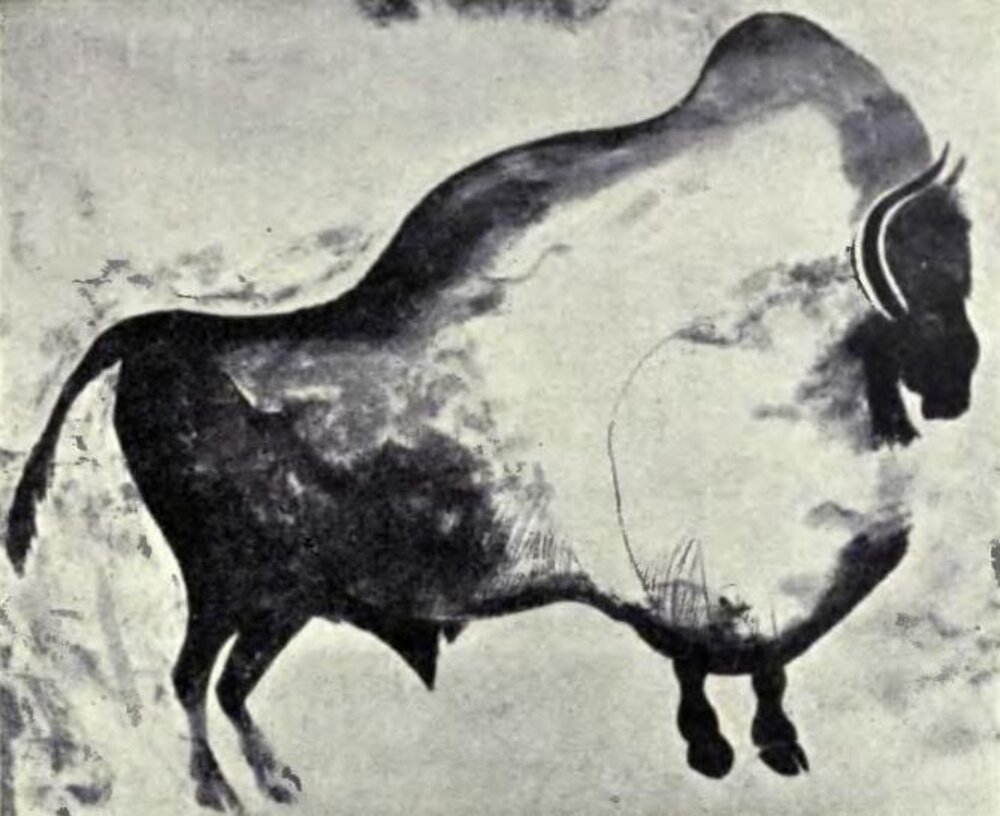
A bison dated to 13,300 years ago
Results obtained from several panels yielded ages ranging from 8,990 to 15,981 calibrated years BP. The most iconic finding is a polychrome bison in the main gallery, dated to 13,461–13,162 years BP — deep in the MagdalenianMagdalenianThe last great Upper PalaeolithicUpper PalaeolithicThe final phase of the Palaeolithic (c. 45,000 to 10,000 years ago), marked by Homo sapiens in Europe, art, ornaments and a succession of cultures (Aurignacian, Gravettian, Solutrean, Magdalenian).→ culture (c. 17,000–12,000 BC), the peak of cave art (Lascaux).→, the culture that brought cave art to its peak. A section called the "mask" reveals layers of paint spanning thousands of years, evidence that the cave was revisited repeatedly1.
The discovery settles a century-old debate: was the Dordogne contemporaneous with the great decorated caves of Cantabria (Altamira, El Castillo)? The answer is now yes for at least one phase of Font-de-Gaume. It also opens an entirely new avenue: if charcoal is more widespread than assumed in "mineral" pigments across the region, other previously undatable sites — possibly even those near Lascaux — may one day yield direct dates.
A minimally invasive technique
The method relies on micro-samples of around one milligram, causing no visible damage to the artworks. Raman analysis identifies carbon in situ before any sampling, limiting interventions to the most promising zones. This restraint is crucial for sites of extreme fragility and priceless heritage value2.
Font-de-Gaume remains, alongside the nearby Combarelles cave, one of the last major decorated caves in the Périgord still open to the public — an increasingly rare status since Lascaux closed in 1963. Dating its paintings is therefore not only a technical feat: it strengthens the case for its absolute long-term protection.
J'envoie régulièrement vos articles à mes petits-enfants. Une belle façon d'apprendre ensemble.
Les nouvelles techniques de datation directe des pigments par spectrométrie de masse permettent d'affiner considérablement la chronologie des sites ornés du Périgord. Les résultats pour Font-de-Gaume s'inscrivent dans la fourchette Magdalénien classique, cohérente avec le style des représentations. Il faut espérer que ces avancées permettront de mieux dater l'ensemble des sites encore non datés.
Font-de-Gaume est la dernière grotte ornée polychrome encore ouverte au public en France, ce qui en fait un site absolument unique. Les nouvelles datations présentées dans cet article confirment et précisent la chronologie des différentes phases de peinture. Pour un documentariste, la question est toujours : comment transmettre visuellement l'impact de ces peintures vieilles de 17 000 ans à un téléspectateur ?