For decades, archaeologists and historians have suspected deep links between Old KingdomOld KingdomThe first great period of unified pharaonic Egypt (c. 2700-2200 BC, 3rd-6th Dynasties), the golden age of the great pyramids and of a strongly centralised state.→ Egypt and Mesopotamia: ceramic style similarities, trade objects found on both sides, cognate myths. But these connections rested on artefacts and inference. Now they have biological proof.
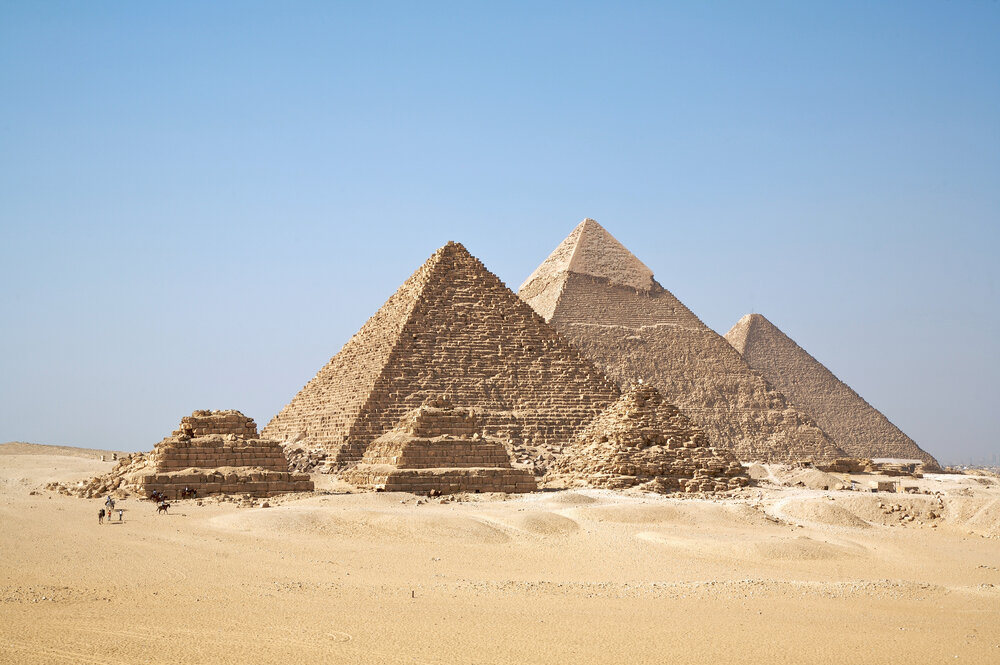
A team combining the Francis Crick Institute in London and Liverpool John Moores University has sequenced the oldest and most complete genome ever extracted from an Old Kingdom Egyptian1. The individual is a man buried in a ceramic vessel at the village of Nuwayrat, about 265 kilometres south of Cairo, who died between 4,500 and 4,800 years ago — during the dynasties that built the great pyramids.
80 % North AfricaAfricaThe cradle of humankind: the continent where the first hominins appeared, then Homo sapiens around 300,000 years ago, before the expansion to the rest of the world.→, 20 % Fertile Crescent
Genetic analysis reveals that this individual carried approximately 80 % North African ancestry and 20 % ancestry from the Fertile Crescent, the vast Near Eastern region that was the cradle of agricultureAgricultureThe cultivation of plants and production of food by working the soil, which emerged in the Neolithic in the Near East and independently elsewhere; it radically transformed human societies.→ and the first Mesopotamian civilisations1. These proportions confirm what the few partial genomes obtained so far for ancient Egypt had suggested: the Nile valley functioned, at the dawn of pharaonic civilisation, as a crossroads rather than an isolated population.
Before this study, only three complete genomes of ancient Egyptians had ever been sequenced, none from the Old Kingdom. The reason lies in chemistry: the hot, humid climateClimateThe long-term average atmospheric conditions of a region; its variations (glaciations, aridifications) shaped migrations, agriculture and the collapse of prehistoric societies.→ of the Nile valley degrades DNA far faster than the dry cold of Siberia or the temperate caves of Europe. The ceramic-vessel burialBurialThe intentional deposition of a body, sometimes with offerings; a marker of symbolic behaviour.→ of the Nuwayrat individual, which isolated his remains from the direct environment, probably enabled the exceptional preservation of his genetic material.
The Nile as an ancient superhighway
The 20 % Mesopotamian ancestry of this Old Kingdom man opens fascinating questions about the nature of these exchanges. Were they whole-population migrationsMigrationsLong-distance movements of populations; a major driver of human history (the exit from Africa, the peopling of continents, Neolithic and steppe expansions).→, movements of artisan or trading elites, or flows of ideas accompanied by a few individuals of mixed identity? Genetics alone cannot decide, but it provides powerful evidence: contacts between Egypt and the Fertile Crescent left a durable biological trace in the Nile population2.
These results are consistent with archaeological evidence placing the Naqada III period (c. 3200–3000 BC) as a time of strong Mesopotamian influence in Egypt: cylinder seals, certain iconographic motifs, and perhaps even the idea of writingWritingA system of conventional signs used to fix language or information durably; its appearance (c. 3300 BC) marks, by convention, the end of prehistory.→ arrived by these routes. The Nuwayrat genome gives flesh to those exchanges, showing they involved people as well as objects.
The next step will be to obtain comparable genomes from other periods and places in the Nile valley, mapping how ancient Egypt's genetic composition evolved across dynasties — a vast programme made possible by advances in palaeogeneticsPalaeogeneticsThe study of ancient DNAAncient DNAGenetic material preserved in old remains, often degraded, sequenced with cutting-edge techniques.→ extracted from remains (bones, teeth, sediments, walls) to reconstruct the past of populations.→ and increasingly effective international collaboration.
Parfait pour mes élèves de 5e. Je garde cet article en favori pour ma séquence préhistoire.
En tant que passionné d'Egypte, je suis attentivement toutes les études ADN sur les momies. Les résultats montrent une population beaucoup plus proche du Proche-Orient que de l'Afrique subsaharienne pour la période pharaonique, ce qui correspond aux échanges culturels et commerciaux intenses avec la Mésopotamie et le Levant. La connexion entre les deux grandes civilisations du Croissant Fertile est fascinante.
L'analyse génomique des momies égyptiennes publiée ces dernières années a bouleversé notre compréhension de la composition de la population de l'Egypte ancienne. La forte composante anatolienne et levantine dans le génome des momies de la période des pharaons contraste avec les populations égyptiennes modernes qui ont une composante subsaharienne plus importante. L'histoire génétique de l'Egypte est un roman en plusieurs volumes.