Picture a projectile no bigger than an almond, cast in lead, streaking at more than fifty metres per second toward an entrenched foe. Now picture that, just before shattering your jaw, this missile carries, moulded in relief along its flank, a message calling you by the foulest word in the Latin language. That is exactly what the combatants of the siege of Perusia lived through, in 41 and 40 BC. The Roman lead sling bulletslead sling bulletA lead sling projectile cast in an acorn (biconical) shape, often engraved with inscriptions; in Latin glans, glandes plumbeae.→, or glandes plumbeae, rank among the most astonishing objects of ancient military archaeology: perfectly lethal weapons, but also tiny billboards of propaganda, engraved with insults, threats and sometimes obscene images meant to break morale as surely as bone.
A bullet that talks: what is a lead sling bullet?
The Latin word glans simply means "acorn," the fruit of the oak. The ancients named their sling bullets this way because they shared its shape: a small oval body, pointed at both ends and swollen in the middle. Archaeologists call this a biconical or almond-shaped profile. The silhouette is no aesthetic accident; it turns a lump of metal into an aerodynamic projectile that, once launched, stabilises in flight much like a thrown rugby ball.3
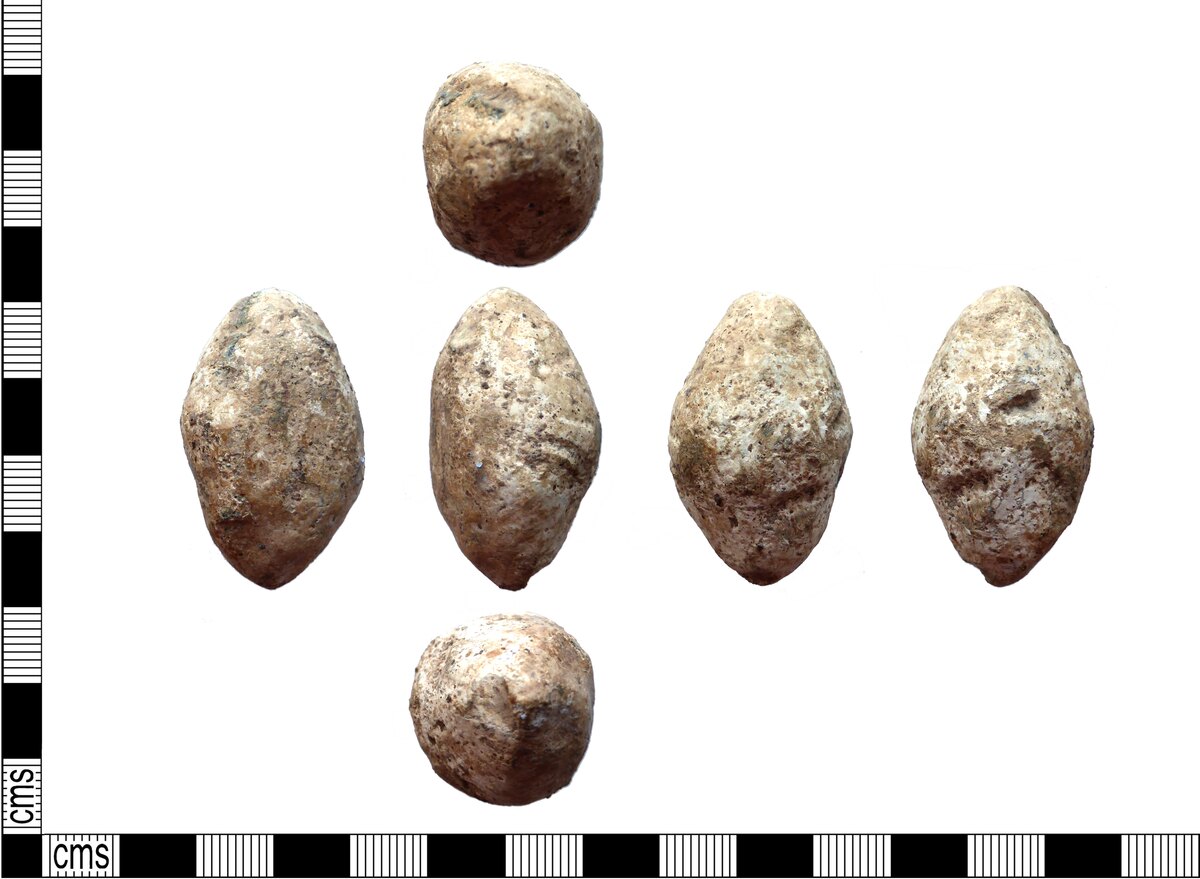
Lead was not chosen for convenience, quite the opposite. This dense metal (about 11.3 grams per cubic centimetre, ten times water and three times granite) packs a great deal of mass into a very small volume. The result is a compact bullet that offers little grip to the air and therefore flies farther than a stone of equal weight. Lead had another decisive advantage: it melts at a low temperature and pours easily, allowing series production of remarkable consistency. Excavators regularly recover clusters of near-identical bullets, a sign of organised workshops and of supply planned for the campaign ahead.3 A typical lead sling bullet measures 30 to 45 millimetres long and about twenty across, and most often weighs between 20 and 30 grams, though some examples exceed 70 grams.
Casting death in bulk: manufacture and form
Manufacture relied on two-part moulds, made of clay or stone and, more rarely, of metal. Each mould half carried the hollow shape of the bullet, often in several rows, so that a single pour produced a handful of projectiles at once. Molten lead ran in through a narrow channel at the tip of each cavity; once cooled, the mould was opened and the "cluster" linking the bullets was snapped apart. The scar left at one end, a small flat or notch, is often still visible: it is the signature of this production line.3
This is where the inscriptions came in, and they could do so in two ways. To obtain raised letters standing out from the metal, the text had to be carved backward into the mould itself: every bullet cast would then reproduce the message. This method signals genuine premeditation, since a single engraved mould could turn out hundreds of copies of the same phrase. To obtain incised letters cut into the skin of the lead, one scratched or chiselled the bullet after casting, often for longer texts such as the name of a city or a magistrate. Short, cutting words favoured relief; longer sentences, incision.3 We can see that engraving an insult into a mould was not a fit of temper but a workshop decision: someone chose, coldly, to fire a slur at the enemy in bulk.
Range, speed and battlefield effect
A slingslingA throwing weapon made of a leather or fibre strap whose pouch, loaded with a projectile, is whirled and released at high speed.→ in expert hands was a fearsome weapon. Experiments with trained slingers place the launch speed of war bullets between thirty and sixty metres per second. A 40-gram bullet thrown at sixty metres per second carries about 70 joules of kinetic energy, comparable to a heavy war arrow; double the mass and you double the energy. Above all, the sling often outranged the bow: a good slinger could reach a target at one hundred fifty, even two hundred metres.3
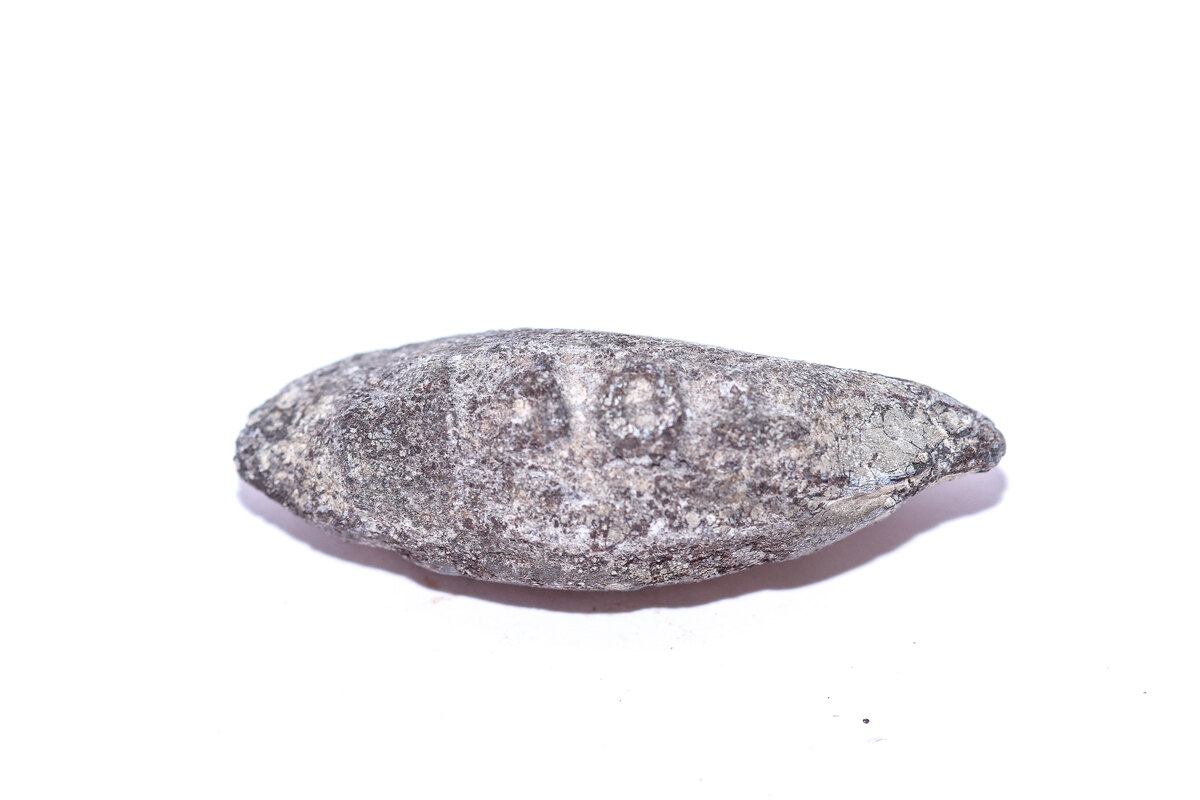
The ancients grasped this advantage well. As early as the beginning of the fourth century BC, the historian Xenophon praised the slingers of Rhodes who, thanks to their lead bullets, could reach targets beyond the range of stone slingers. In the field, these marksmen operated as skirmishers ahead of the heavy lines, harassing the enemy's light troops, hunting down archers and, during sieges, showering the defenders perched on the ramparts. A lead bullet could break bone, smash teeth, crack a skull or drive deep into the flesh. Ancient physicians describe sling wounds that had to be extracted with forceps. But in the melee, the most decisive effect was not always the body count: a rain of fast projectiles was enough to sow hesitation, to make shields rise a little higher and eyes look the wrong way.3
Greece: "Catch!" and the birth of the engraved message
Long before Rome, the Greek world had invented the art of making its projectiles speak. From the fifth century BC, and above all in the Hellenistic period, thousands of engraved lead bullets were scattered from the shores of Greece to Cyprus, Macedonia and the islands of the Aegean. The most famous example sits in the British Museum: a pair of Athenian bullets from the fourth century, one bearing a winged thunderbolt and the other a single word in raised Greek letters, ΔΕΞΑΙ (dexai), meaning "catch!" or "here, take this." The irony lands a moment before the lead.3
The Greek repertoire was rich and often terse. There are imperatives such as labe ("take"), exhortations to victory such as nika ("be victorious"), but also symbols alone: thunderbolt, trident, star, snake or scorpion, each a reminder that a sling strikes without warning. Some bullets named a city (a genitive such as "of the Rhodians" probably marked a unit or a batch), others a commander, others still the abbreviation of a royal name, like the letters that may have stood for Philip of Macedon.3 These messages were not all aimed at the enemy: a city name could reassure recruits that their arsenal was doing its job, a divine symbol could steel the ranks. The ancient bullet was already, all at once, a weapon, a badge of belonging and a voice.
Rome and Perusia: the siege of 41-40 BC
The Romans inherited this tradition and gave it, at Perusia, its rawest chapter. After the assassination of Julius Caesar, the Roman RepublicRoman RepublicThe political system of Rome from 509 to 27 BC, led by elected magistrates and the Senate, before the founding of the Empire.→ tore itself apart. In 41 BC, Lucius Antonius, brother of the triumvir Mark Antony, and Fulvia, Antony's wife, took up arms against Octavian, the future emperor Augustus. Defeated, they fell back into Perusia, an old Etruscan city perched on its Umbrian hill and protected by powerful walls. Through the winter of 41-40, Octavian's army encircled the town, starved it and finally forced its surrender once the besieged realised that no relief would come.2
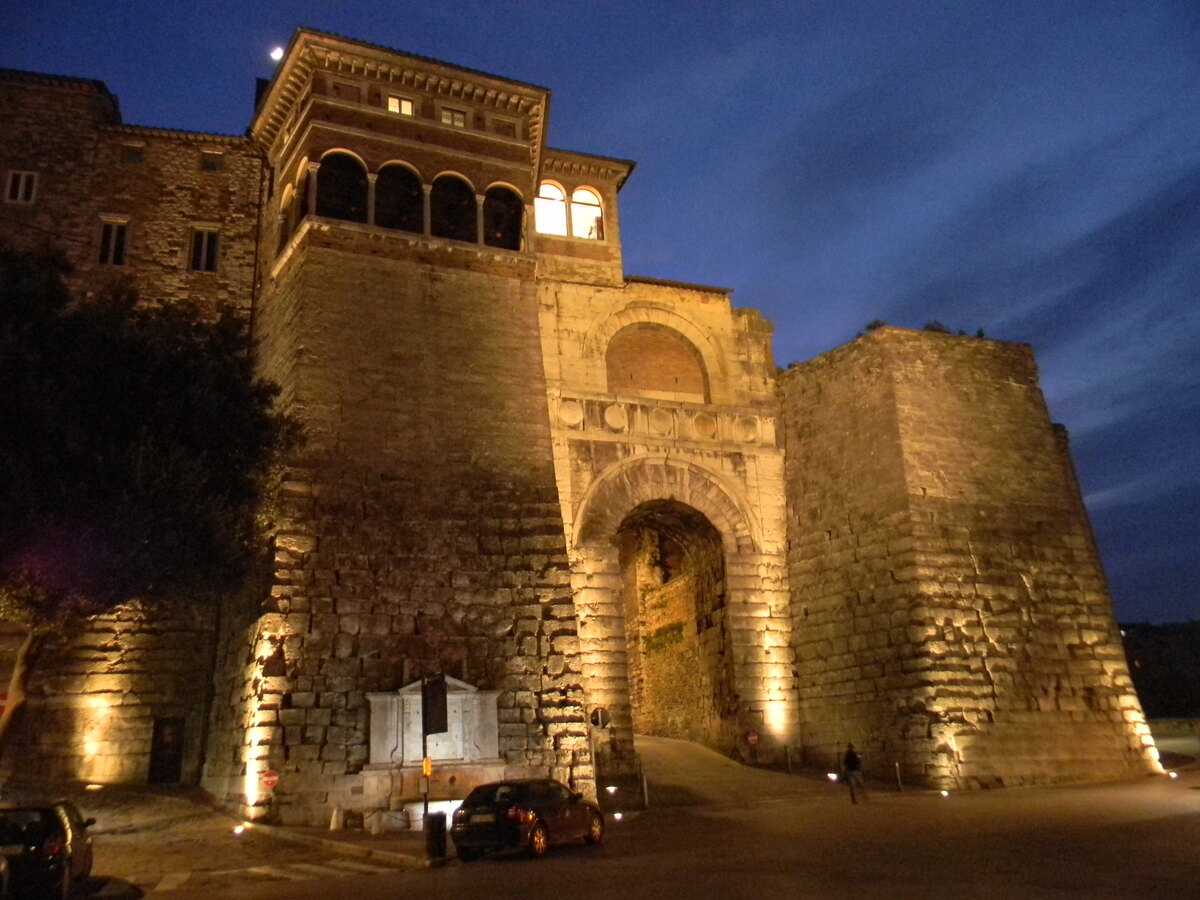
Now, throughout the siege, the two camps did not merely trade iron: they bombarded one another with words. Caesarian and Antonian infantry cast, in their moulds, lead bullets engraved with insults meant for the enemy across the line. These projectiles earned a scholarly name, the glandes perusinae, the "acorns of Perusia." Recovered in large numbers on the site, they were gathered and published as early as the nineteenth century by the epigrapher Karl Zangemeister, then revised and expanded by later scholars.14 They offer an unmatched window onto the language, the hatred and the humour of Roman soldiers in civil war.
Insults engraved in lead
The content of these bullets is unashamedly obscene, and one has to read it to grasp just how low siege propaganda could stoop. The besieged legionaries of Lucius Antonius targeted Octavian: one bullet reads PET(O) OCTAVIA CVLVM, "I am aiming for Octavius's backside," probably a way of feminising him by twisting his name; another hurls OCTAVI FELAS, a blunt sexual slur against him; a third, LAXE OCTAVI SEDE, mocks his "loose" rear.1 Each projectile turns the enemy into an object of sexual domination, in a register where humiliating a foe meant casting him in the role of the submissive.
Octavian's camp answered in the same tone. One bullet addresses L(ucius) A(ntonius) and Fulvia, calling the former "bald" (calve) and inviting them both, in crude terms, to "open wide" their backsides.1 But the most notorious bullet from Perusia targets Fulvia alone: PETO LANDICAM FVLVIAE, which can be rendered "I am aiming for Fulvia's private parts," the word landica meaning the clitoris. And landica was regarded as the single most obscene word in all of Latin; the orator Cicero took great pains to avoid word combinations that might accidentally sound like it and shock his audience. The slingers of Perusia had no such qualms about engraving it.1 A telling and grimly apt detail: the word glans, "acorn," also served in Latin slang for the male member, and some Perusian bullets were outright decorated with phalluses. Weapon and insult had become one.
Fulvia was being targeted even though she was not in the city: she was at Praeneste, some thirty kilometres away, and held no military command on the spot. It made no difference to the soldiers. Wife of Mark Antony and figurehead of his faction in Italy while he campaigned in the East, this woman of power drew every resentment. She was accused of having started the war, caricatured as a virago, "masculinised" the better to defame her.1 The glandes perusinae show that this hostile propaganda did not stay confined to the elites: it reached all the way down into the slinger's pouch.
Psychological function: propaganda, dark humour and morale
Why go to the trouble of engraving insults on a projectile that the enemy, if it reaches him, may never read? Because the effect was not limited to a hit on target. These messages belong to a parallel war, a war of words waged alongside the war of arms. A bullet that clatters against a shield or lands at a soldier's feet, picked up and read that evening by the fire, spreads mockery through the enemy camp; it saps morale, turns the commander into a laughing stock, converts fear into disgust. Conversely, it binds those who throw it around a shared, cruel and mordant laughter.5
This psychological dimension was well understood by the ancients. Some bullets, notably in the Roman period, were pierced with a small hole: experiment shows that such a perforation produces a whistle in flight. Whether the aim was to lodge poison there (a shaky hypothesis, since it would evaporate before impact) or to terrify through sound, the idea of adding fear to pain was clearly present. Terror is a tactic, and so is silence.3 In this theatre of sound and speech, the engraved insult is the natural extension of the shouts traded between skirmishers, of marching songs and of the jeers flung from one rampart to another. The projectile becomes an actor: it is the object that speaks, and behind it the man who, even knowing his sentence is bound to end as a dent in a shield, wants to be heard.
From the dig to the corpus: how these projectiles are read
Reading a few letters on a small block of corroded lead is far from obvious, and it takes a whole labour of epigraphy and conservation. Researchers turn to raking light, which throws the faintest reliefs into shadow, to reflectance transformation imaging, which lets one vary the lighting angle after the fact, and to X-radiography, capable of revealing letters hidden beneath layers of oxidation. Microscopy and three-dimensional scanning distinguish a letter cast in the mould (with softened edges) from a letter incised afterward (with metal pushed up on both sides of the stroke).3
The context of discovery matters just as much as the text. A concentration of bullets on a slope facing a rampart does not tellTellAn artificial mound formed by the accumulation of successive layers of settlement remains at the same spot, typical of the Near East. Each destruction-rebuilding event adds a stratum.→ the same story as the same cluster found on the wall walk; weight, casting scar and the orientation of impacts are all sources in their own right. The bullets of Perusia, published and re-studied generation after generation, have fuelled debates far beyond mere bawdy curiosity: on colloquial Latin, on the shaping of Octavian's image before he became the revered Augustus, on Fulvia's place in Roman memory.5 These tiny objects, cast in haste to kill, have become archives: words meant to be fleeting, frozen for two thousand years in lead, and still speaking to us, as bluntly as on the first day.
Depuis votre chrono-carte, je passe des heures à explorer les périodes et migrations. Addictif.
Je n'ai pas de formation historique mais j'aime apprendre. Ce site est parfait pour moi.
Je télécharge les images pour ma veille visuelle. Le traitement éditorial est vraiment soigné.