On a wind-swept limestone ridge some fifteen kilometres north-east of Şanlıurfa, in south-eastern Turkey, a rounded hill overlooks the Harran plain. Kurdish shepherds called it Girê Mirazan, "the hill of wishes": a somewhat sacred place where people came to pray beneath a solitary mulberry tree. The Turks named it Göbekli Tepe, "navel hill" or "potbelly hill". No one imagined that beneath a few metres of earth and stone it held the oldest known megalithic monuments made by humankind.2
Since 1995, excavations have uncovered circular enclosures in which huge T-shaped pillarsT-pillarA T-shaped stone monolith of the Anatolian sanctuaries (Göbekli Tepe, Karahan Tepe), often carved with animals or human limbs.→ stand in a ring, some more than five metres tall, carved with foxes, snakes, boars, vultures and scorpions. These structures were raised around 9500 BCE, more than six thousand years before Stonehenge and seven thousand years before the pyramids of Egypt. And they were built by communities who knew neither pottery, nor writingWritingA system of conventional signs used to fix language or information durably; its appearance (c. 3300 BC) marks, by convention, the end of prehistory.→, nor metal, and who still lived largely by hunting and gathering.23
Göbekli Tepe has been hailed as "the world's first temple", as proof that religion came before agricultureAgricultureThe cultivation of plants and production of food by working the soil, which emerged in the Neolithic in the Near East and independently elsewhere; it radically transformed human societies.→, as the cradle of civilisation. Thirty years after the first trowel strokes, the site looks very different. Research carried out since 2015 has revealed houses, cisterns, thousands of grinding stones, carved skulls and a far longer and more eventful history than anyone suspected. This feature takes stock of everything we know today about "potbelly hill", from its discovery to the excavations of summer 2026, from certainties to debates, and from facts to fantasies.
The hill of wishes: a discovery in two stages
The scientific history of Göbekli Tepe begins in 1963. That year, a joint survey by Istanbul University and the University of Chicago, directed by Halet Çambel and Robert John Braidwood, combed the Şanlıurfa region for prehistoric sites. On the hill, the American archaeologist Peter Benedict collected thousands of flintFlintA hard, brittle siliceous rock, knapped by prehistoric people to produce blades, points and sharp tools.→ tools typical of the Aceramic NeolithicNeolithicThe "New Stone Age": a period marked by farming, herding, settlement and pottery, from around 10,000 BC.→. He also noticed large limestone slabs breaking the surface, but took them for gravestones from a medieval cemetery. The site was noted, catalogued, and then forgotten for thirty years.2
The second stage belongs to Klaus Schmidt. In October 1994, this prehistorian from the German Archaeological Institute (DAI) reread the reports of the 1963 survey. He had previously worked at the nearby site of Nevalı Çori, excavated before it was flooded by the Atatürk Dam, where he had seen carved T-shaped pillars in a Neolithic cult building. When he came across the mention of large limestone slabs at Göbekli Tepe, he understood immediately: these "gravestones" were the tops of similar pillars. He went to the site and, by his own account, knew within the first minute that he had two choices: leave and tell no one, or devote the rest of his life to the place.4
He chose the second. From 1995, Klaus Schmidt led excavations with the Şanlıurfa Museum and the DAI. He directed them until his sudden death in July 2014, at the age of 60. The German research programme was then coordinated by Lee Clare, and the excavations later came under the overall direction of Necmi Karul of Istanbul University, in a collaboration between the university, the Şanlıurfa Museum and the DAI.2
A hill made by human hands
The first surprise lies in the very nature of the hill. Göbekli Tepe is not a natural rise topped with a few ruins: it is a tellTellAn artificial mound formed by the accumulation of successive layers of settlement remains at the same spot, typical of the Near EastNear EastA region of western Asia (Levant, Mesopotamia, Anatolia, Iran), cradle of the Neolithic revolution, agriculture, the first cities and writing.→. Each destruction-rebuilding event adds a stratum.→, an artificial mound fifteen metres high and about eight hectares in extent, formed entirely by the accumulation of buildings, rubble and refuse from more than a millennium of occupation. It all rests on a limestone plateau that the builders used as a quarry and sometimes carved directly into the bedrock.2
About a hundred metres from the summit, on the plateau, traces of pillar extraction can still be seen: trenches cut into the rock, and even an unfinished pillar nearly seven metres long, still lying in its quarry. The stonecutters freed the blocks with flint tools, cutting channels all around them before prising them from their bed.2
Despite thirty years of work, only a small part of the site has been excavated, about a tenth according to 2021 estimates. GeophysicalGeophysical surveyTechniques (magnetometry, radar) detecting buried structures underground without digging, by measuring physical anomalies.→ surveys across the whole tell reveal at least twenty large circular enclosures still buried, which together would hold nearly two hundred pillars. Göbekli Tepe is therefore not a monument, but a monumental complex of which we still know only a fraction.2
The world of 9500 BCE
To picture the builders of Göbekli Tepe, we first need to picture their world. Around 9700 BCE the Younger Dryas came to an end, a final cold snap lasting more than a millennium that had closed the last glacial period. The climateClimateThe long-term average atmospheric conditions of a region; its variations (glaciations, aridifications) shaped migrations, agriculture and the collapse of prehistoric societies.→ rapidly grew warmer and wetter: this was the beginning of the HoloceneHoloceneThe current geological epoch, begun about 11,700 years ago at the end of the last ice age; the setting of all post-glacial history.→, the geological epoch in which we still live. In south-eastern Anatolia the landscape was then much greener than today. Around the hill stretched grassy steppes dotted with groves of pistachio, almond and oak, and the water table was probably higher, feeding springs that have since dried up.2
These grasslands were home to large herds of grazing animals: goitered gazelle, aurochs, wild asses, wild sheep and goats. The gazelles above all crossed the region on their seasonal migrationsMigrationsLong-distance movements of populations; a major driver of human history (the exit from Africa, the peopling of continents, Neolithic and steppe expansions).→, providing a predictable abundance of meat every year. Wild cereals, einkorn, emmer wheat and barley, grew in profusion on the slopes, and their ears could be harvested in a few weeks.2
The men and women who lived in this region were heirs to the Epipalaeolithic cultures of the Near East, such as the NatufianNatufianAn Epipalaeolithic culture of the Levant (c. 12,500–9,500 BC) that preceded farming: its populations harvested wild grains and lived in semi-permanent villages. Direct precursors of the Neolithic.→NatufianA culture of semi-sedentary hunter-gatherers of the LevantLevantA region of the eastern Mediterranean Near East (Israel, Lebanon, Syria, Jordan), a major crossroads of the first human migrations out of Africa.→ (c. 12,500-9,500 BC) harvesting wild cereals and building the first round houses; it prepares the Neolithic.→ of the Levant, which had already begun to settle in villages of hunter-gatherers. Their material culture is that of the Pre-Pottery NeolithicPre-Pottery NeolithicThe first phase of the Neolithic (c. 9,600–6,900 BC), before the invention of pottery.→: no pottery, but stone vessels, finely knapped flint and obsidian tools, beads and bone objects. It was in this context of relative plenty, at the very moment when the climate became favourable, that the first pillars of Göbekli Tepe were raised.
Enclosures A to D, the heart of the monument
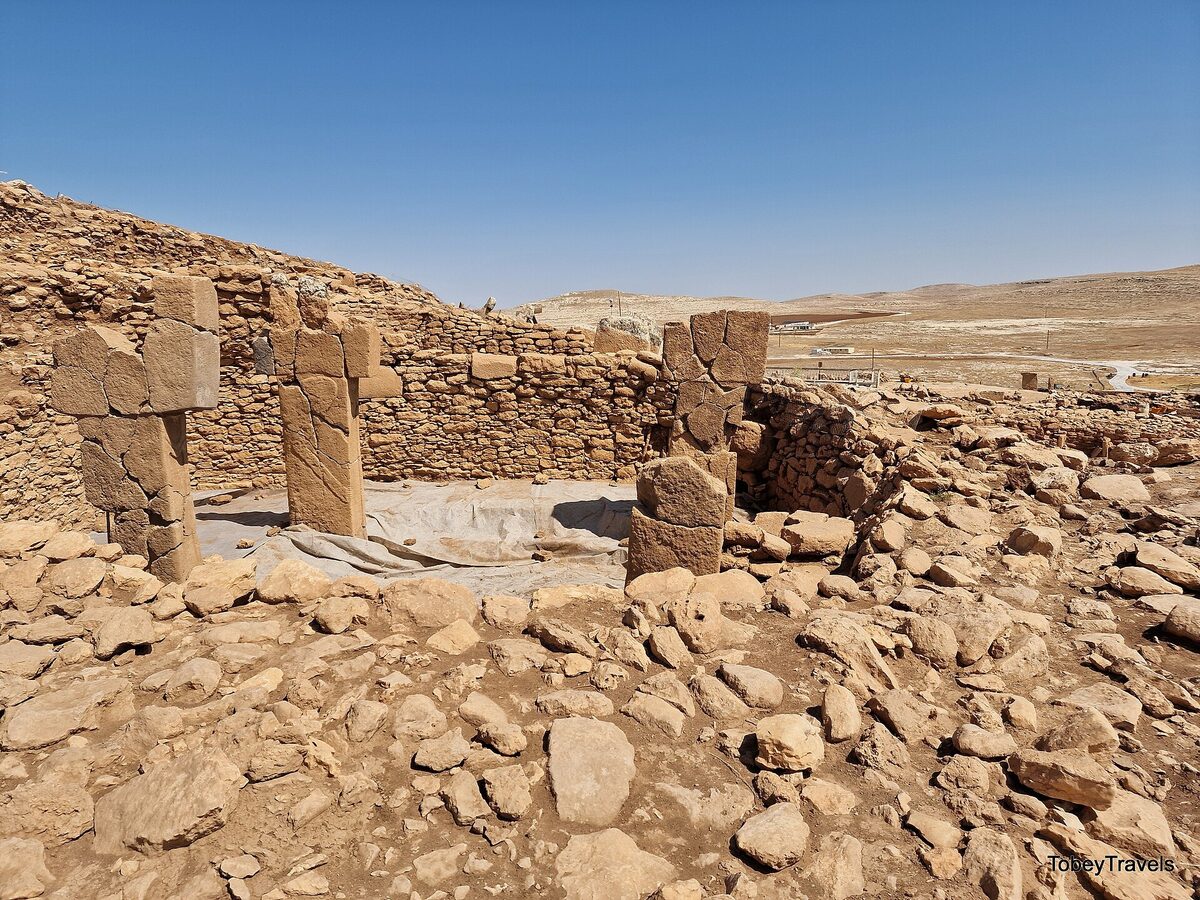
The four large enclosures uncovered in the south-eastern part of the tell were given the letters A, B, C and D, in order of discovery. Their layout follows the same principle. A thick, irregular wall of unworked stone traces a circle or oval 10 to 30 metres across. Set into this wall at regular intervals are T-shaped pillars facing the centre, linked by stone benches. In the middle of the interior space stand two larger pillars, facing each other.2
The two central pillars of Enclosure D, the best preserved, are about 5.5 metres tall and each weighs around ten tonnes. They are set into sockets cut in the bedrock, which itself was carefully levelled. Elsewhere, the floors are made of a kind of polished lime concrete, sometimes compared to Roman terrazzo. The benches running along the walls may have served as seats, as supports for objects or as places to set down offerings.2
One question long divided specialists: were these enclosures roofed? Klaus Schmidt imagined them open to the sky, like sacred circles in the open air. Recent research leans instead towards roofed buildings, whose peripheral pillars supported a timber frame. These structures seem to have collapsed regularly, been swamped by landslides, and then repaired or rebuilt.12 In any case, they were not built in one go: excavations show successive concentric circles, and pillars added, moved or replaced over the generations.
Pillars that are bodies
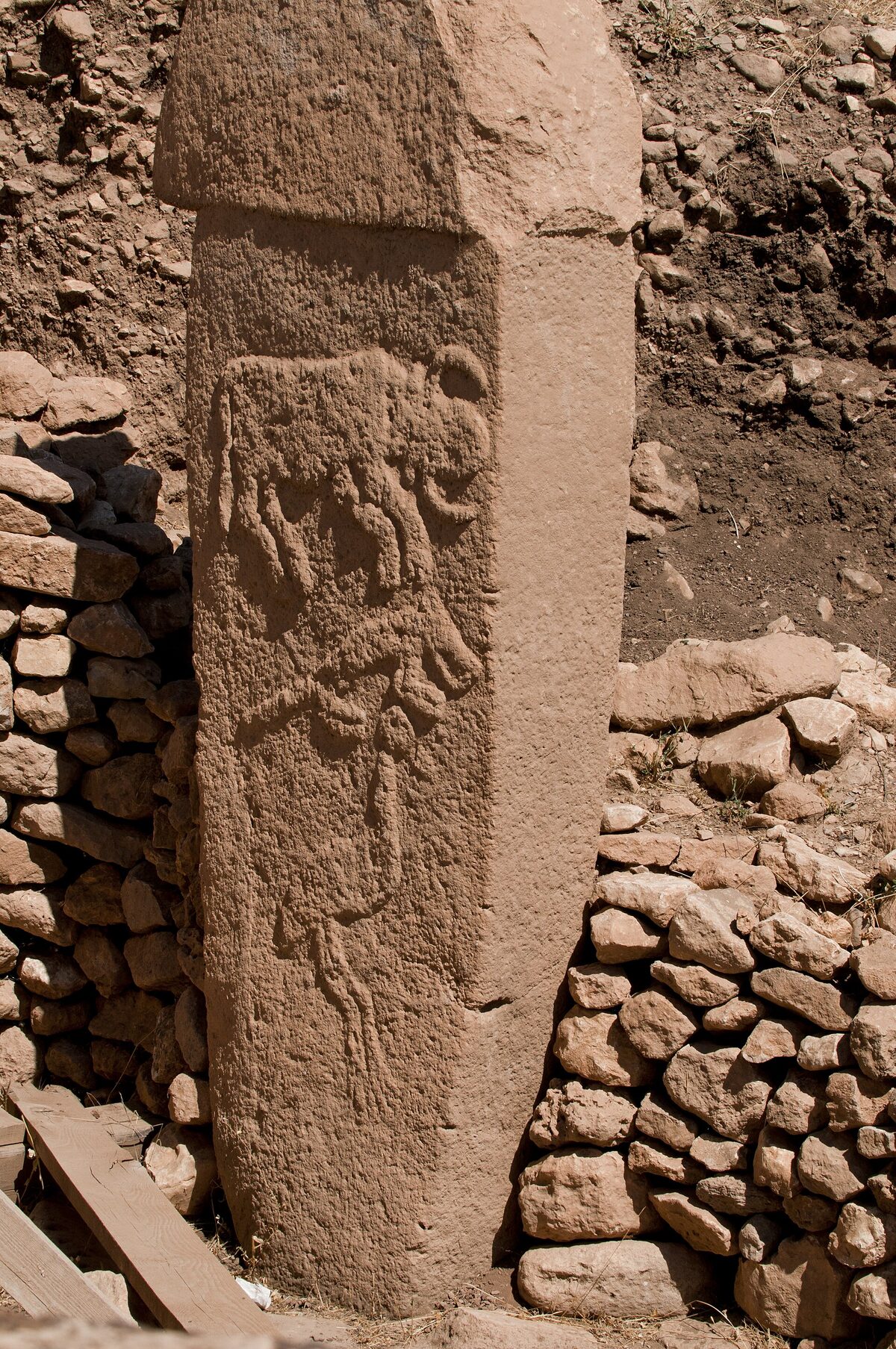
You have to look closely at the great pillars to understand what they represent. On their sides, arms carved in low relief run down from the "cap" of the T. At belly level, long-fingered hands meet on the front face, almost touching. Lower down, a belt decorated with motifs circles the waist, from which hangs a loincloth made of a fox pelt, with its head, legs and tail clearly visible.2
There is therefore no room for doubt: the T-pillars are anthropomorphic beings. The shaft represents the body, the horizontal top the head, seen in profile. But these giants have no faces. They are neither portraits nor individuals, but rather presences: mythical ancestors, guardian spirits, perhaps deities. Their loincloths and belts allow us to say that they are male beings. Klaus Schmidt saw them as the first depictions of gods in human history, gathered in assembly at the centre of each enclosure.4
This human dimension is found at neighbouring sites. At Nevalı Çori as at Karahan Tepe, T-pillars also bear arms and hands. And the smaller pillars, often barely a metre and a half tall, that occupy the centre of some later rectangular rooms, carry the same tradition on a domestic scale.2
Beyond the four enclosures
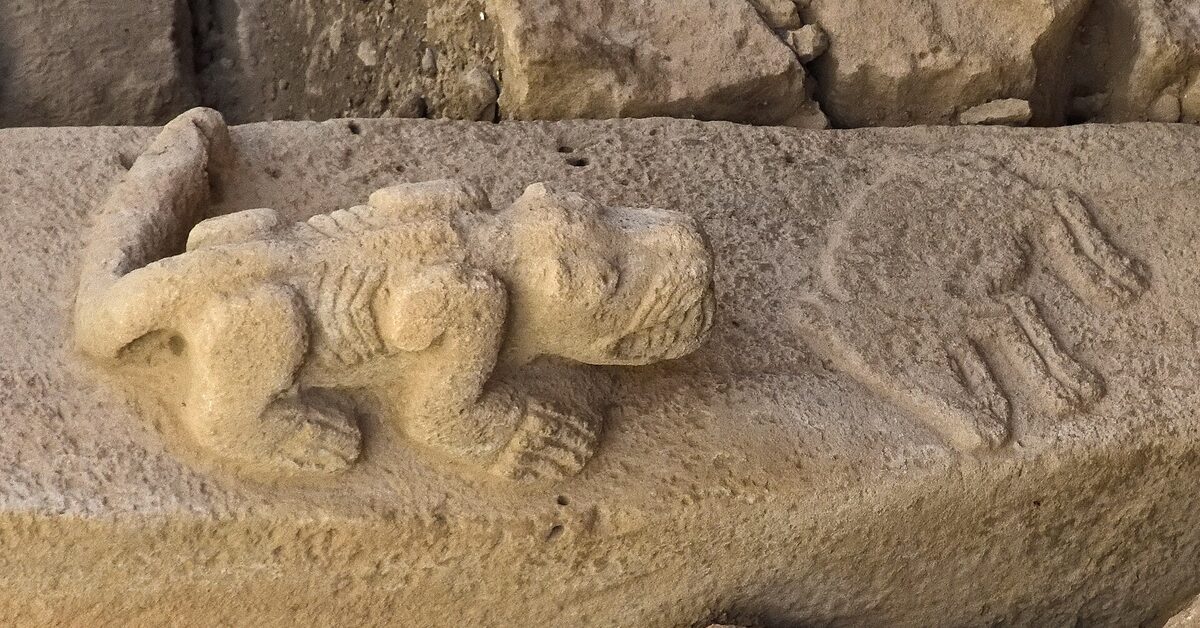
Enclosures A to D are not the only remarkable structures at Göbekli Tepe. On the north-western part of the tell, excavators uncovered a later rectangular building, dated to the Pre-Pottery Neolithic B, known as the "Lion Pillar Building". It owes its name to a pair of pillars decorated with fierce-looking big cats, jaws open, which seem to guard the interior. It was also in this building that one of the very rare female depictions at the site was found, on a slab.2
To the west of the plateau, another structure has long intrigued researchers. Called "Complex E" and sometimes nicknamed the "Temple of the Rock", it is a vast platform cut directly into the limestone, carefully levelled and smoothed, with two sockets that may have held central pillars, as in the great enclosures. Right next to it, two pits cut into the rock resemble cisterns: one of them has a staircase of five steps and a table-high pillar carved from the rock.2
These structures show that the builders' activity was not confined to the great enclosures. The whole plateau was shaped, dug and carved: quarries, cisterns, channels, platforms and basins make up a landscape profoundly transformed by human hands. It becomes easier to understand why archaeologists now speak of a complete settlement rather than a mere sanctuary.
The stone bestiary
If the pillars are bodies, they are also surfaces for images. Across their faces comes alive an extraordinary bestiary, carved in low or high relief: foxes, boars, snakes, aurochs, wild asses, gazelles, cranes, ducks, vultures, scorpions, spiders and big cats. Each enclosure seems to have its dominant animal. In Enclosure A, it is mainly snakes; in Enclosure B, foxes; in Enclosure C, boars; in Enclosure D, a great variety of birds and creatures.2
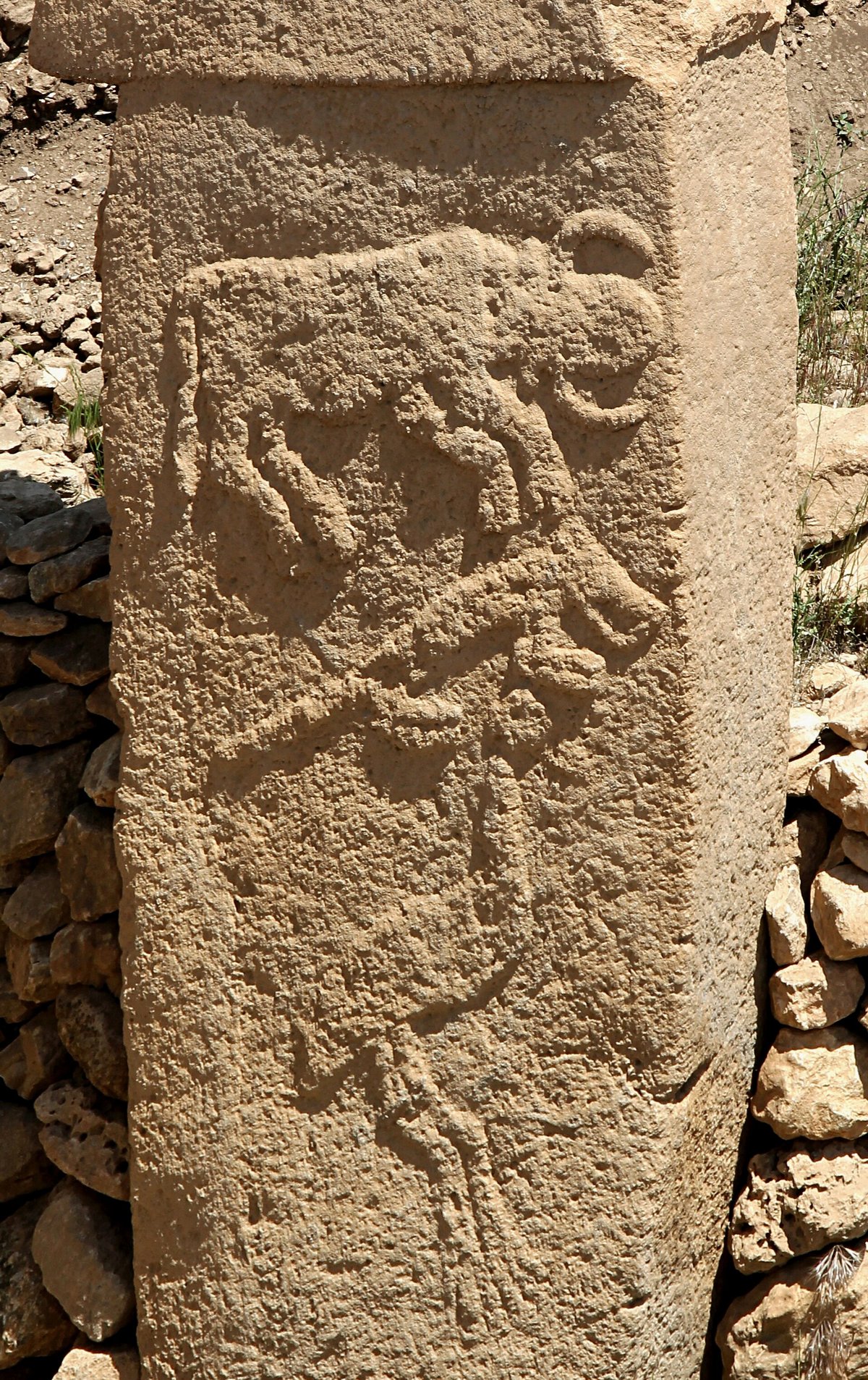
This bestiary is no hunting tableau. The animals depicted are almost always male, often caught in a threatening posture: fangs bared, genitals visible, tail raised, claws forward. Predators and dangerous animals dominate. Conversely, the game the community lived on, gazelle, aurochs and deer, is relatively rare, and no explicit hunting scene has been identified.2 The zooarchaeologist Joris Peters and Klaus Schmidt concluded that these images do not describe the real world but a symbolic universe, perhaps peopled by protective or threatening spirits, clan totems or mythical figures.2
Alongside the animals are abstract signs: H-shaped symbols, upright or lying down, crescents, discs and V motifs. Some have been compared to a form of proto-writingProto-writingNotation systems preceding true writing (tokens, clay envelopes) that encode information without yet transcribing language.→, but no reading has ever been demonstrated. More likely, they belong to a repertoire of symbols shared across the whole region, whose precise meaning eludes us.2
The Vulture Stone and the astronomical mirage
Of all the pillars at Göbekli Tepe, none has generated as much ink as Pillar 43 in Enclosure D, nicknamed the "Vulture Stone". Its main face is covered with a profusion of images: a large vulture with outspread wings holding a disc, a scorpion, birds, a snake, a row of bags or "baskets" in the upper part, and, at the very bottom, a headless man with an erect penis.2
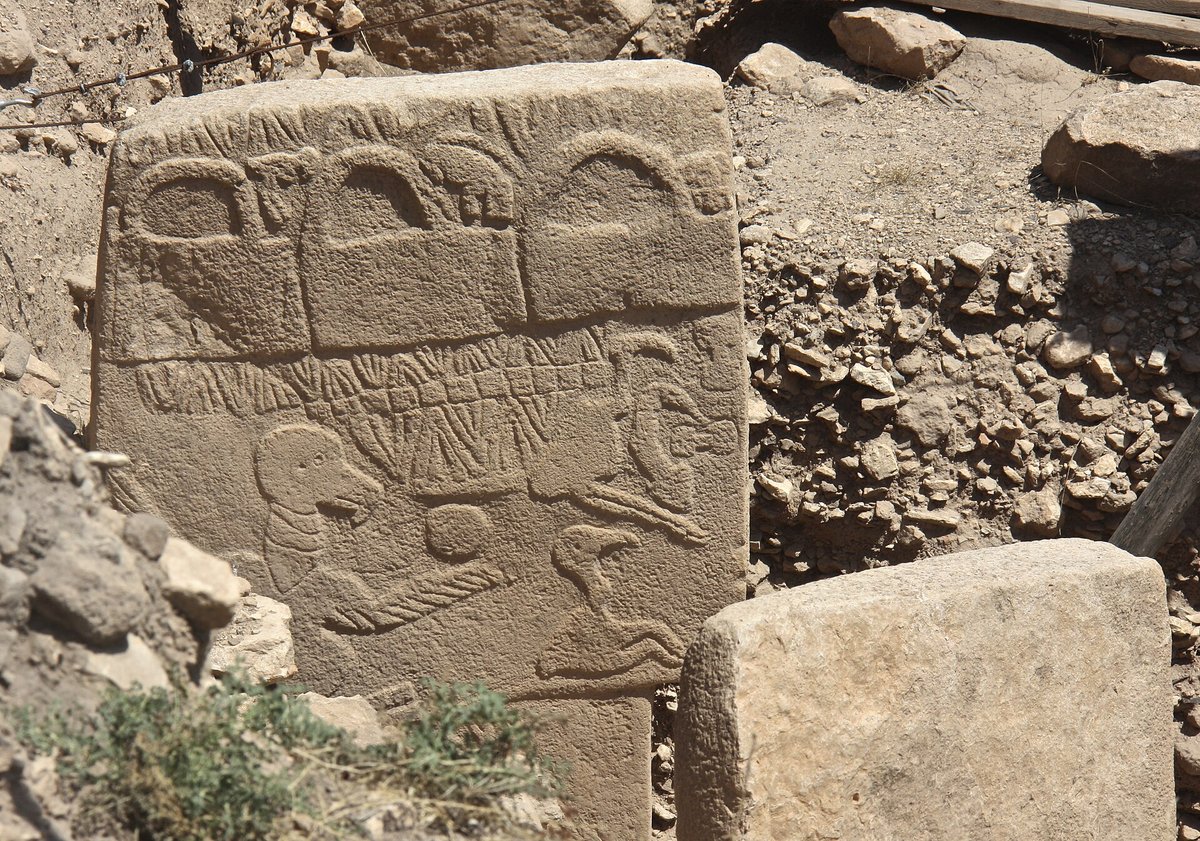
For archaeologists, the scene most probably evokes funerary practices. The vulture, the scavenger par excellence, is associated throughout the Neolithic Near East with the treatment of the dead: at Çatalhöyük, a few millennia later, paintings show vultures swooping down on headless bodies. The disc could represent a human head, and the decapitated man death itself. The image fits what we know of the skull cult in the region.2
But in 2017, two researchers from the University of Edinburgh, Martin Sweatman and Dimitrios Tsikritsis, proposed an entirely different reading. According to them, the animals on Pillar 43 represent constellations, and the whole commemorates a comet impact around 10,900 BCE, a catastrophe that supposedly triggered the abrupt cooling of the Younger Dryas. In 2024, Martin Sweatman went further, claiming that the V motifs on the pillar form a 365-day lunisolar calendar, made up of twelve lunar months and eleven extra days, centred on the summer solstice.9
These hypotheses, widely relayed in the media, have been rejected by the excavation team. In a response published as early as 2017, DAI archaeologists pointed out that Pillar 43 is only one element of an enclosure whose other pillars have nothing astronomical about them, that the links between animals and constellations are arbitrary, that the chronology invoked does not match that of the site, and that the iconography is much better explained by the regional symbolic context.8 The idea of an astronomical observatory is now considered largely unfounded by the specialists working on the site.2
Severed heads and carved skulls
The headless man on the Vulture Stone is not an isolated case. At Göbekli Tepe, the human head seems to have received special attention. Several sculptures depict isolated heads, others show figures holding a head in their hands. Human statues have been found deliberately decapitated. The "totem pole" discovered at the site shows beings clasping human heads.5
In 2017, a study published in Science Advances by the anthropologist Julia Gresky, Juliane Haelm and Lee Clare provided material proof of this cult. Of the 691 human bone fragments recovered up to then, 408 came from skulls. Among them, seven fragments from three adults aged between 20 and 50 bore deliberate modifications: deep grooves carved along the length of the skull, a perforation drilled in the parietal bone, traces of red ochreOchreA red or yellow mineral pigment (iron oxides), used from prehistory for adornment, funerary rites and art.→ and defleshing cut marks. These interventions were made with flint tools shortly after death.5
For the authors, this is a new, previously unknown form of the Neolithic skull cult. Elsewhere in the Near East, at Jericho, Tell Aswad and later Çatalhöyük, skulls were covered with modelled plaster, the famous plastered skullsPlastered skullsHuman skulls whose face was remodelled in lime plaster, sometimes with shells for eyes; a Neolithic funerary practice linked to ancestor worship.→. At Göbekli Tepe, they were carved and drilled, perhaps so that they could be hung up with cords and displayed, much like practices known ethnographically in Oceania or South-East Asia. Were these the skulls of revered ancestors, or of defeated enemies? The question remains open.5
Chronology: from three layers to eight phases
Dating Göbekli Tepe is no simple matter. Klaus Schmidt had proposed a simple three-layer model. Layer III, the oldest, grouped the large circular enclosures of the 10th millennium BCE, attributed to the Pre-Pottery Neolithic APre-Pottery Neolithic A (PPNA)The first phase of the Near Eastern Neolithic (c. 9,600–8,800 BC), predating pottery; at Jericho it corresponds to the construction of the tower and enclosure wall.→. Layer II gathered the small rectangular buildings of the 9th millennium, with their more modest pillars, attributed to the early and middle Pre-Pottery Neolithic B. Layer I, finally, corresponded to surface deposits post-dating the Neolithic.2
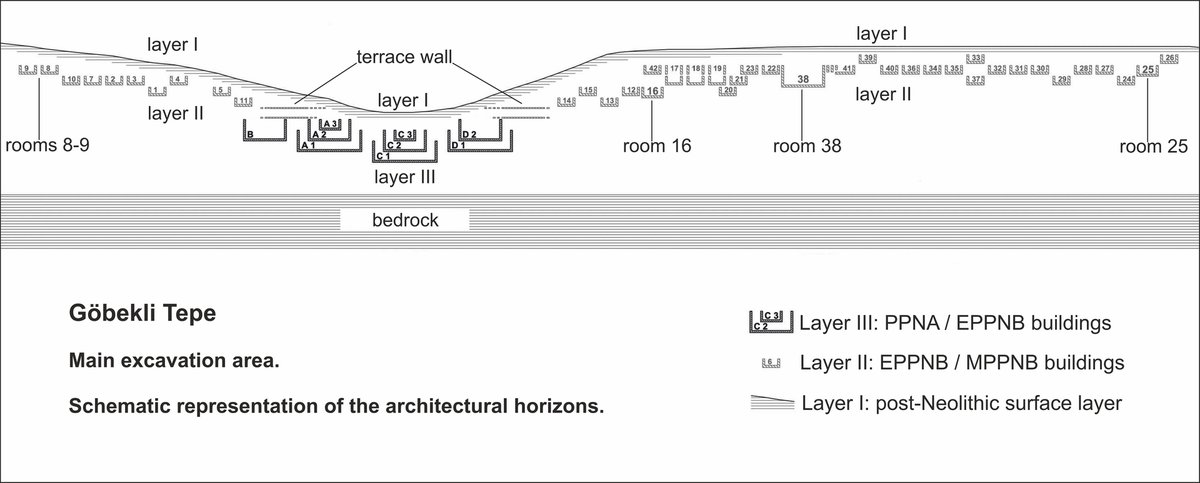
Excavations carried out between 2015 and 2019 shattered this scheme. Deep soundings showed that the circular and rectangular buildings do not belong to two clearly distinct successive periods: they overlap in time. The great enclosures, built around 9500 BCE, continued to be used and modified while rectangular buildings rose around them, until around 8700 BCE, and some phases extend into the middle of the 9th millennium.1
Researchers now propose an eight-phase sequence. In the first, during the second half of the 10th millennium, the first versions of Enclosures A to D appear, along with round or oval houses. In the second, at the beginning of the 9th millennium, the enclosures are modified and the first great monolithic pillars are erected, while rectangular buildings multiply. The following phases see housing spread over the slopes, landslides, stabilisation works, the last rebuilding of Enclosure C and the construction of new buildings such as the Lion Pillar Building. Then activity gradually declines. Around 8000 BCE, or a little later, the site is abandoned, and only a few small dwellings are still built among the ruins.2
These dates rest on dozens of radiocarbonRadiocarbon (carbon-14)A dating method based on the decay of carbon-14, usable back to about 50,000 years.→ measurements made on charcoal, bone and, above all, organic residues contained in the wall plasters. In all, Göbekli Tepe was occupied for at least 1,500 years, more than sixty generations. An immense span of time, which rules out seeing the site as the work of a single people or a single project.12
A village after all
This is undoubtedly the most profound shift in perspective of recent years. For Klaus Schmidt, Göbekli Tepe was a mountain sanctuary, a place of pilgrimage where bands of nomadic hunter-gatherersHunter-gatherersA way of life based on hunting, fishing and gathering wild resources, without farming or herding; it dominated almost the whole of human history.→ from across the region gathered periodically to build, celebrate and feast before dispersing. No one, he thought, lived there permanently. He summed it up in a now-famous phrase: "First came the temple, then the city."4
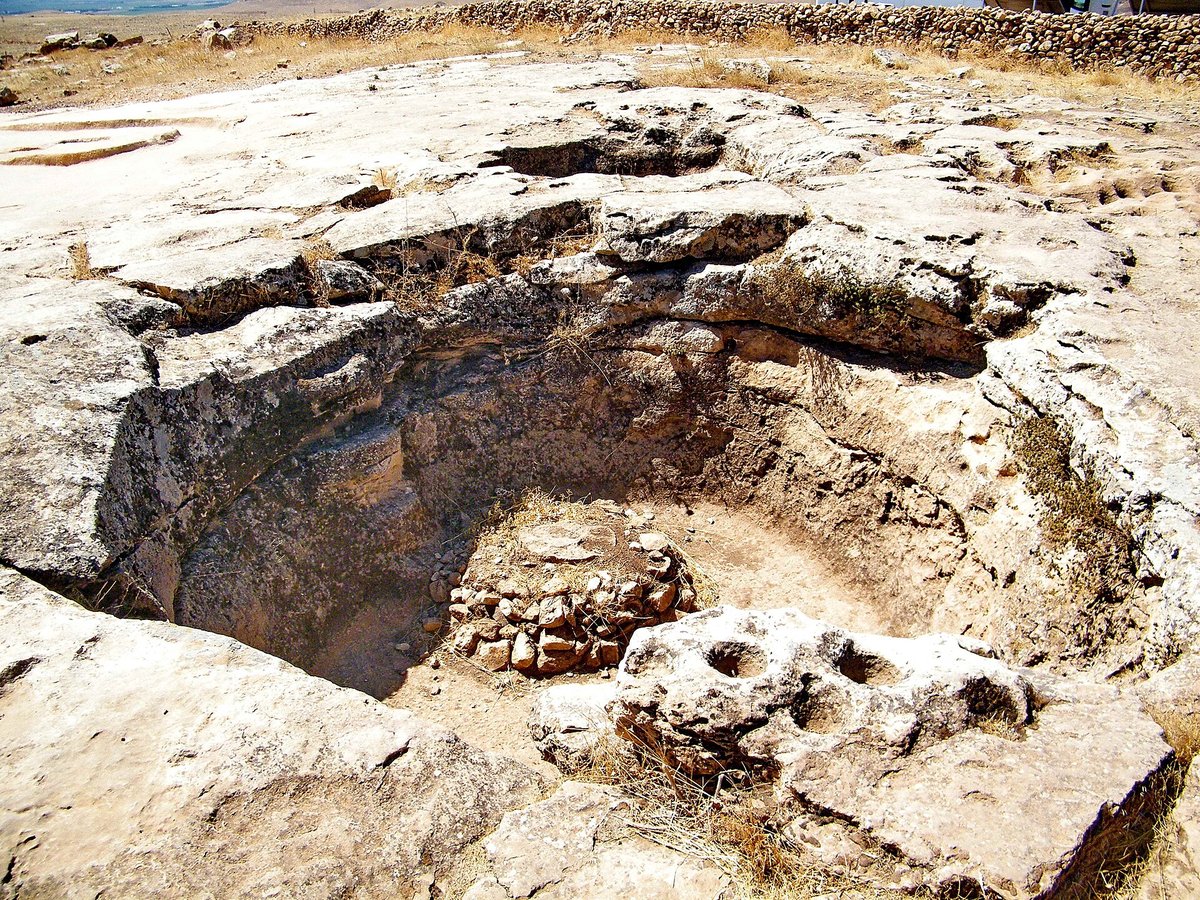
Research by the DAI team led by Lee Clare between 2015 and 2019 profoundly nuanced this picture. Soundings revealed, beneath the rectangular buildings, round or oval houses packed tightly together, dated to the Pre-Pottery Neolithic A, followed by rectangular dwellings of the Pre-Pottery Neolithic B. Domestic occupation was dense. On the plateau, archaeologists identified a water-collection system: channels cut into the rock led rainwater to large cavities carved into the limestone. One of them is eight metres across and 2.80 metres deep. Together, these cisterns could store at least 150 cubic metres of water, enough to meet the needs of a permanent community on a hill with no spring.12
To this can be added burials. A kidney-shaped pit dug beneath the floor of a building contained the remains of at least three individuals. Bone tools are plentiful, as are flint-knappingknappingThe set of operations for fracturing a stone block to extract flakes or blades.→ debris and objects of everyday life.1 The latest seasons confirm this picture. In August 2026, Necmi Karul's team uncovered, in a new 1,500-square-metre area north of the main sector, rectangular buildings of the second phase, with few pillars and an internal layout suggesting housing. "Our first impression is that they were used as dwellings," the archaeologist said.12 Geophysical surveys have meanwhile detected several large buildings whose interior plan suggests residential use, at least at certain periods.13
Göbekli Tepe was therefore not an isolated sanctuary in a human desert, but a settlement where people lived, cooked and buried their dead, and where they also built exceptional structures. As many researchers now put it, the idea of a regional ceremonial centre visited by nomads is giving way to a view closer to what we know of other large Pre-Pottery Neolithic sites, where ritual and everyday functions coexisted.2
Grinding stones, cereals and gazelles: what did people eat on the hill?
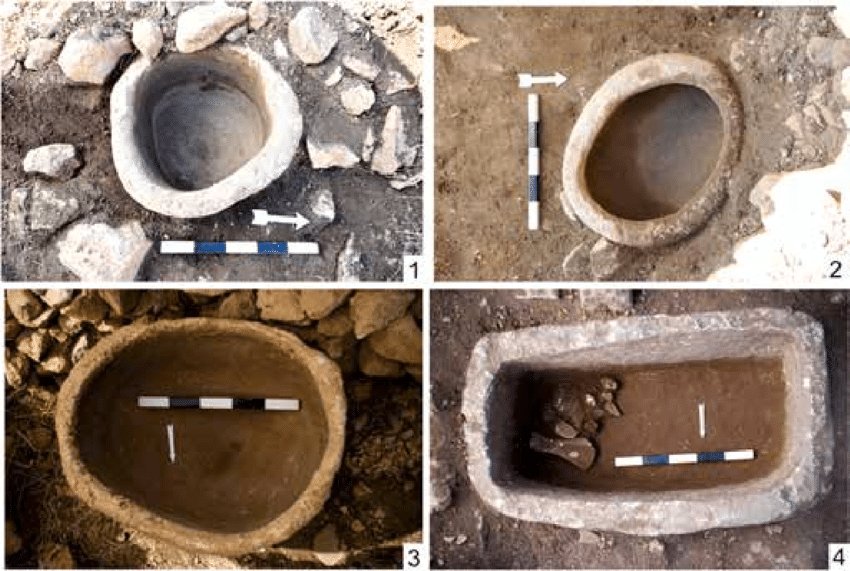
The diet of Göbekli Tepe's inhabitants sheds light on their way of life. Excavations have yielded more than 7,000 grinding slabs, handstones, mortars and pestles. A study published in 2019 in PLOS ONE by Laura Dietrich and colleagues showed, through use-wearuse-wearMicro-traces left on a tool by its use, studied through use-wear analysis to reconstruct its function.→ and phytolith analysis, that these tools were largely used to process cereals: grain was crushed, dehusked and ground to prepare porridges, flatbreads and perhaps fermented drinks.6
The cereals themselves were abundant in the landscape: wild einkorn, wheat and barley grew on the slopes of the region. It is still hard to say whether the people of Göbekli Tepe simply gathered them wild or had begun to cultivate them.2 A striking clue comes from genetics: in 1997, a study published in Science showed that domesticated einkorn descends from wild populations of the Karacadağ, a volcanic massif only about thirty kilometres from Göbekli Tepe.17 One of the very first centres of cereal domestication thus lies on the site's doorstep.
Meat came from hunting. The bones recovered are dominated by goitered gazelle, hunted on a massive scale between midsummer and autumn, when large herds crossed the region on their seasonal migrations. To these are added aurochs, wild ass, wild sheep and goat, boar, deer and many birds. Charcoal reveals that 90% of the fuel came from pistachio and almond trees, whose nuts were no doubt eaten as well.2
This abundance fed the feasting hypothesis. The large stone troughs, able to hold up to 160 litres, and the quantity of food waste led the DAI team to suggest that construction work was accompanied by collective banquets, perhaps washed down with a kind of beer, which would have served to bring together and reward the workforce.18 The idea remains debated, but it is a reminder that in many societies sharing food is the best way to mobilise labour.
Flint, obsidian and exchange networks
Göbekli Tepe was also a huge workshop. As early as the 1963 survey, more than 3,000 knapped tools were collected on the surface, and the excavations have produced hundreds of thousands. The overwhelming majority are made of excellent-quality flint, extracted on site or nearby: cores, blades, flakes, scrapers, burins, borers and projectile points. In a small building next to Enclosure D, "Space 16", nearly 700 tools were found, dominated by retouched pieces, scrapers, borers and blades polished by cutting plants.2
These tools tell of a complete economy: people hunted, butchered, worked hides, wood and bone, and harvested cereals. The very numerous arrowheads testify to the importance of gazelle hunting. Bone tools, needles, awls and spatulas, are also plentiful in the domestic levels.1
Among the thousands of flint tools, a few pieces of obsidian stand out. This volcanic glass is not found in the Şanlıurfa region: it comes from sources several hundred kilometres away, in central or eastern Anatolia. Its presence, even in small quantities, proves that the inhabitants of Göbekli Tepe were part of long-distance exchange networks that moved raw materials, objects and no doubt ideas across the whole Fertile Crescent.2 These networks may explain the remarkable unity of the symbolic repertoire of the Taş Tepeler sites.
Buried or collapsed? The riddle of the fill
When the excavators cleared the great enclosures, they found them filled to the top with dense rubble made up of stones, flint chips, animal bones and fragments of sculpture. Klaus Schmidt saw this as proof of deliberate burialBurialThe intentional deposition of a body, sometimes with offerings; a marker of symbolic behaviour.→: at the end of their use, the enclosures would have been ritually backfilled, "buried" as one buries the dead. This burial would explain their extraordinary state of preservation.4
This interpretation has lost a great deal of ground since 2014. Detailed study of the deposits shows that the fill did not accumulate all at once, but in episodes, and that it contains debris from houses, sediments, burials and domestic refuse that slid down from the upper parts of the tell. The enclosures, built below unstable slopes, would have been overrun several times by landslides. One of them, particularly violent, swamped Enclosure D at the end of the early Pre-Pottery Neolithic B.12
The inhabitants fought against these events. Excavations have uncovered terrace walls meant to stabilise the slopes, repairs and rebuilds. Enclosure C was rebuilt one last time before being abandoned, and a final terrace wall was raised to the north in an attempt to hold back the hillside.2 The image of a monument buried in a solemn ceremony thus gives way to a more prosaic but equally fascinating one: a community grappling with unstable ground, tirelessly repairing its buildings for centuries.
Who built Göbekli Tepe?
How many people did it take to quarry, move and raise pillars weighing several tonnes? Klaus Schmidt estimated that the undertaking was beyond the capacity of a small group and required hundreds of workers, brought together and perhaps directed by a religious elite. He drew on ethnographic comparisons: on Nias, in Indonesia, setting up a megalithMegalithA large stone raised or assembled by humans (menhir, dolmen, stone circle), typical of the Neolithic and Bronze Age.→ had mobilised 525 people for three days in 1917.2
Recent estimates are much more modest. According to calculations based on experimental archaeology, seven to fourteen people would have been enough to move a pillar using ropes, levers and a lubricant, and all the Pre-Pottery Neolithic B buildings uncovered so far could have been built by 12 to 24 people in less than four months, including time spent quarrying stone and preparing food.2 Numbers within reach of an extended family or a village. The monument therefore did not necessarily require a hierarchical society, but a close-knit, organised community with know-how passed down from generation to generation.
That know-how also had an intellectual dimension. In 2020, Gil Haklay and Avi Gopher of Tel Aviv University published in the Cambridge Archaeological Journal a geometric analysis of the layout of the enclosures. They showed that the centres of Enclosures A, B and C form an almost perfect equilateral triangle, and that the central pillars align along coherent axes. For them, these three enclosures were designed together, following an overall plan drawn up in advance, rather than added one after another over time.7 The conclusion is debated, but it suggests unsuspected capacities for architectural planning among hunter-gatherers.
Statues, totem pole, painted boar and a walled-up figure
Beyond the pillars, Göbekli Tepe has yielded a rich group of sculptures in the round: human heads, animals and hybrid beings. They rank among the oldest statues made by humans. Many were found broken or decapitated, perhaps deliberately, which fits the importance given to the head in local beliefs.2
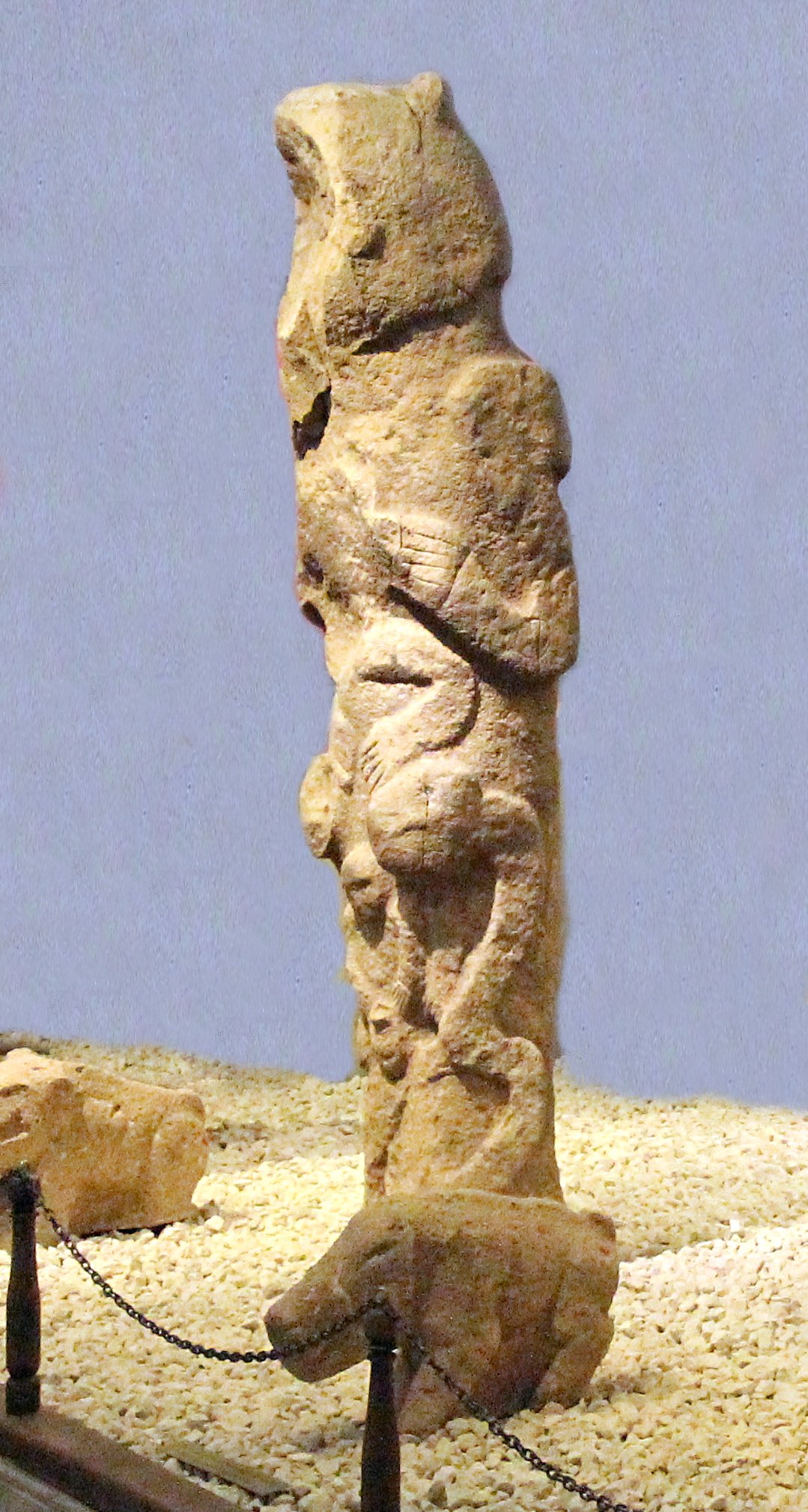
The most astonishing piece is undoubtedly what the excavators called the "totem pole". Standing 1.92 metres tall and 30 centimetres in diameter, this limestone column stacks three figures: at the top, a predator, bear or big cat, whose head is missing but whose neck and human arms can be seen; in the middle, a headless figure with human arms, probably male; at the bottom, a third figure whose head is intact. Snakes undulate along the sides. This mixing of human and animal, this chain of beings embracing one another, evokes mythological stories we can only imagine.2
Recent discoveries have enriched this corpus further. In October 2023, excavators uncovered in Enclosure D a life-size limestone statue of a wild boar that still bore traces of red, white and black pigment. It rested on a bench carved with an H-shaped symbol, a crescent, two snakes and three human faces. It is the oldest known painted statue of the Neolithic, and a reminder that the sculptures and pillars, uniformly grey today, may once have been coloured.10
Finally, in September 2025, the Turkish Minister of Culture announced the discovery, between Enclosures B and D, of a human statue inserted horizontally into a cavity built into the wall of a room. For the archaeologists, this was a deliberate deposit, a votive offering intended to imbue the building with a presence. Comparable deposits have been observed at Karahan Tepe.11 To these finds can be added, some fifteen kilometres away, the "Urfa Man", discovered in 1993 in the heart of Şanlıurfa: nearly two metres tall, with obsidian eyes, it is considered the oldest known life-size human statue.2
Where are the women?
One absence strikes anyone browsing the iconography of Göbekli Tepe: that of women. The pillars are male beings, the animals are males, the human statues represent men, often with explicit genitalia. In the whole corpus, only one certain female depiction is known: a naked woman engraved on a stone slab from the Lion Pillar Building, legs apart. Some researchers see it as a birth scene, others as a sexual or ritual figure.2
This scarcity contrasts sharply with later Neolithic sites such as Çatalhöyük in central Anatolia, where female figurines abound. It has fuelled many interpretations. For some, the symbolic world of Göbekli Tepe belonged to a group of men, perhaps initiates, gathered in the great enclosures for rituals from which women were excluded. For others, this absence reflects only the part of the imagination that was carved in stone, not society as a whole.4
Recent discoveries call for caution. Burials, houses, grinding stones and everyday tools show that Göbekli Tepe was inhabited by whole families, men, women and children. If the images above all celebrate masculinity, power and danger, life on the hill was shared. And we still do not know what role women played in building, maintaining and using the great buildings.
Karahan Tepe, the twin sister
For a long time, Göbekli Tepe seemed to be a unique phenomenon, an anomaly without equal. That is no longer the case. About fifty kilometres to the east, on a hill that locals call Girê Keçel, "the bald hill", lies Karahan Tepe. The site was identified in 1997, but intensive excavations only began in 2019, under the direction of Necmi Karul. They have revealed a complex at least as spectacular as Göbekli Tepe, and roughly contemporary with it.15
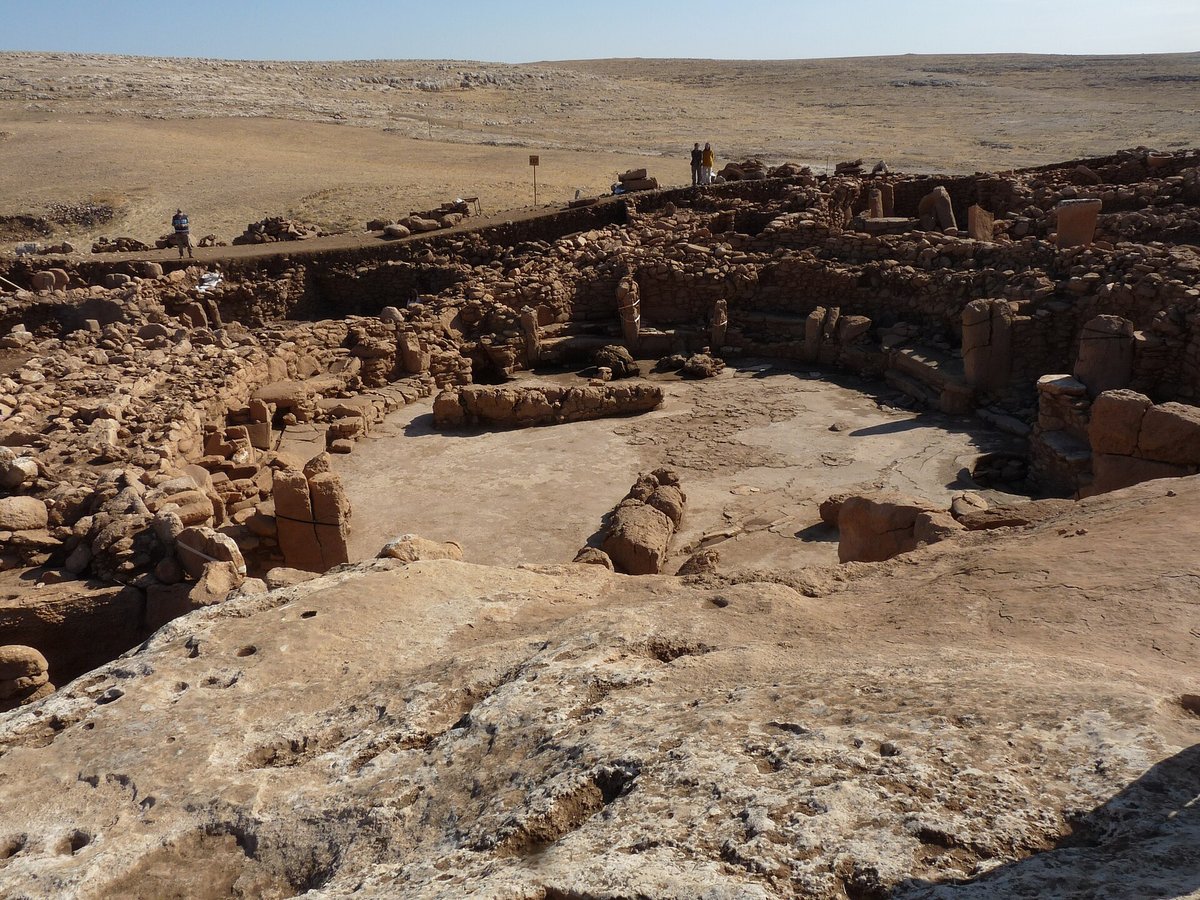
Surveys estimate the number of T-pillars there at more than two hundred. The most famous structure, cut directly into the bedrock, houses about a dozen monolithic phallic pillars, watched over by a carved human head that seems to burst out of the wall. A neighbouring chamber communicates with it through a circular opening. In 2023, excavators uncovered a large statue of a seated man there, carved with striking realism: ribs, spine and shoulder blades are visible, and the man holds his penis in both hands.15
Karahan Tepe shares with Göbekli Tepe the T-pillars, the bestiary and the emphasis on the male body. But it also stands apart: human depictions are more frequent and more realistic there, and rock-cut architecture plays a larger role. Together, the two sites show that this is not an isolated exception, but a genuine regional culture.
Sayburç and the Stone Hills
Göbekli Tepe and Karahan Tepe are only the most famous of a network of sites that archaeologists group under the name Taş Tepeler, the "Stone Hills". Launched in 2021, the research programme of the same name, coordinated by Necmi Karul, involves 36 institutions and more than 220 researchers at a dozen sites in Şanlıurfa province: Nevalı Çori, Hamzan Tepe, Harbetsuvan Tepesi, Sefer Tepe, Taşlı Tepe, Ayanlar Höyük, Çakmaktepe, Sayburç and others.211
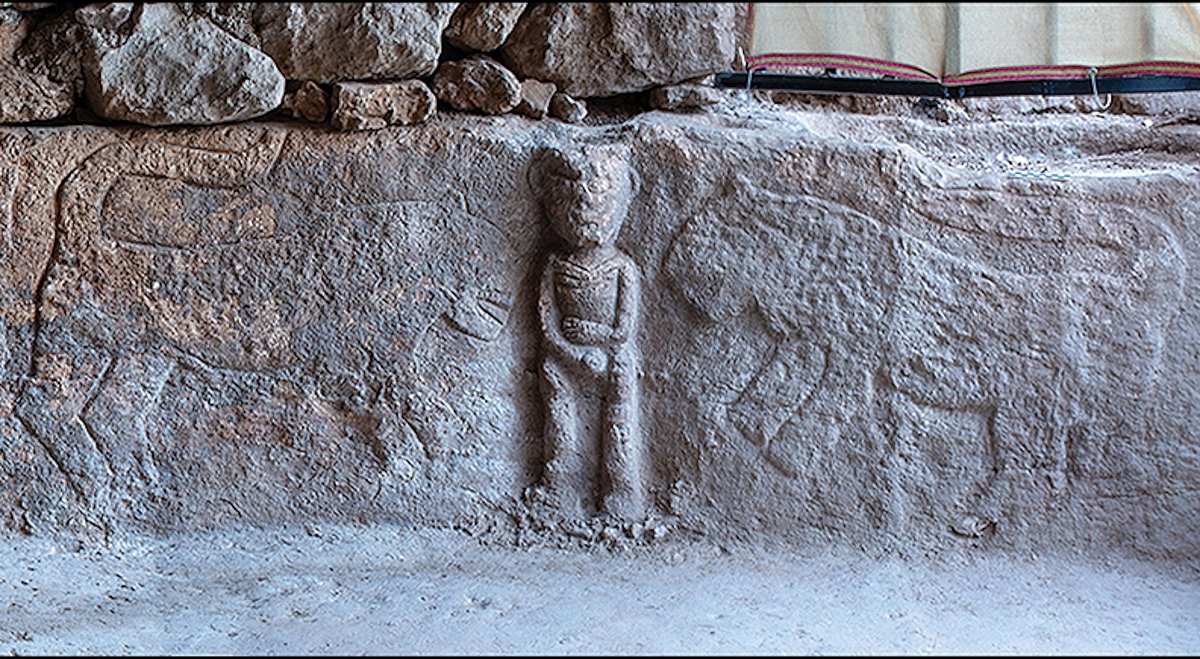
At Sayburç, a present-day village built on a Neolithic site, excavations in 2021 uncovered a communal building whose bench is decorated with an exceptional relief. It shows a man facing forward, holding his penis, between two threatening leopards, and next to them another man in profile facing a bull. Published in 2022 in the journal Antiquity by Eylem Özdoğan, this relief is considered the oldest known narrative scene: for the first time, figures are not simply placed side by side, but interact to tell a story.14
This network has even older roots. Further east, on the Tigris, the site of Körtik Tepe, occupied between about 10,700 and 9250 BCE, has yielded stone vessels decorated with snakes, scorpions and birds that already foreshadow the Göbekli Tepe repertoire.2 We can thus see that potbelly hill did not appear out of nowhere: it belongs to a long cultural tradition in Upper Mesopotamia, at the very origins of the Fertile CrescentFertile CrescentAn arc-shaped region of the Near East (Levant, Mesopotamia) where farming and herding first emerged.→.
Göbekli Tepe and the Neolithic Revolution
Why does Göbekli Tepe fascinate so much? Because it touches on one of the greatest questions in human history: how and why did our ancestors give up the hunter-gatherer life to become farmers? For decades, the dominant scenario, inherited from the archaeologist Vere Gordon Childe, was economic: the invention of agriculture made it possible to produce surpluses, and therefore to feed villages, then towns, elites and temples. Organised religion came afterwards.2
Göbekli Tepe seemed to reverse this sequence. Its monuments, built before fully domesticated agriculture, suggested that the need to gather around shared beliefs could have preceded and even triggered sedentismSedentismThe shift from a nomadic life to lasting settlement in one place, a precondition for the rise of villages.→. To feed the crowds assembled on the hill, people would have had to intensify the harvesting of wild cereals, and gradually to cultivate them. The temple would thus have given birth to the field. Klaus Schmidt championed this idea with flair, and it deeply shaped the debate on the Neolithic RevolutionNeolithic revolutionThe shift from hunter-gatherer societies to farming and settled life (c. 10,000 BCE in the Near East), giving rise to villages and then cities.→.4
Recent discoveries invite a more nuanced reading. Göbekli Tepe was not a sanctuary visited by nomads, but an inhabited place. Its residents ground cereals on a massive scale, perhaps already cultivated. Ritual and daily life were closely intertwined. Rather than a cause-and-effect relationship between religion and agriculture, the site illustrates a global process in which sedentism, intensive plant use, the construction of communal buildings and the development of shared beliefs advanced together, reinforcing one another.12
What remains certain is that Göbekli Tepe has definitively demolished the idea that hunter-gatherers were incapable of great collective achievements. Communities without fully developed agriculture, without metal or writing, were able to design, plan and build complex monuments and maintain them for more than a millennium. That may be the hill's deepest lesson.
Fantasies and appropriations
A site so old and so spectacular could not escape speculation. Göbekli Tepe has been presented in turn as the Garden of Eden, as a remnant of Atlantis, as the work of a lost advanced civilisation, or even of extraterrestrials. The British writer Graham Hancock made it a cornerstone of his theory of a lost Ice Age civilisation, popularised in 2022 by the Netflix series Ancient Apocalypse.2
These stories rest on the same idea: hunter-gatherers could not have built such monuments without knowledge from elsewhere. Yet this is precisely the prejudice that Göbekli Tepe refutes. Nothing in the excavations suggests the intervention of a more advanced civilisation: the tools are flint, the houses dry stone, the food from hunting and gathering, the building techniques within reach of small human groups. The astronomical hypotheses surrounding the Vulture Stone, as we have seen, have been rejected by the site's specialists.8
The real mystery of Göbekli Tepe is not that of a lost technology. It is more human, and more dizzying: that of beliefs, myths and a social organisation of which we see only the stone traces, and which we will probably never be able to reconstruct entirely.
A World Heritage Site in the spotlight
On 1 July 2018, Göbekli Tepe was inscribed on the UNESCO World Heritage List as one of the first manifestations of human-made monumental architecture.3 To protect the remains, vast membrane roofs were installed over the two main excavation areas. The site's fame exploded: more than 400,000 people visited in 2019, and Turkey made it the emblem of its cultural policy, declaring 2019 the "Year of Göbeklitepe".1
These visitor numbers have not been without tension. In 2018, the archaeologist Çiğdem Köksal-Schmidt, Klaus Schmidt's widow, denounced damage caused during the construction of a visitor walkway, an accusation denied by the Turkish Ministry of Culture.2 More recently, under the "Legacy for the Future" programme, Enclosure C was restored: several pillars were returned to their original positions and the walls consolidated with a mortar reinforced with goat hair, following methods inspired by Neolithic techniques identified on site.11
Göbekli Tepe is also exhibited outside Turkey. After a first exhibition in Rome in 2023, the site was at the heart of "Building community. Göbeklitepe, Taş Tepeler and life 12,000 years ago", shown from 6 February to 19 July 2026 at the James-Simon-Galerie on Berlin's Museum Island. Organised by the Vorderasiatisches Museum with the Şanlıurfa Archaeology Museum, Istanbul University and the German Archaeological Institute, it brought together colossal statues, decorated T-pillars and objects of everyday life.16
Milestones: thirty years of research at Göbekli Tepe
From the forgotten survey of 1963 to the excavations of summer 2026, the history of research at Göbekli Tepe has unfolded in several stages, each changing our view of the site.
- 1963: survey by the universities of Istanbul and Chicago; Peter Benedict records Aceramic Neolithic tools and mistakes the pillar tops for medieval graves.2
- 1994-1995: Klaus Schmidt recognises the site's potential and launches excavations with the Şanlıurfa Museum and the DAI.4
- 2014: death of Klaus Schmidt; Lee Clare coordinates the German research.2
- 2015-2019: discovery of houses, cisterns and burials; revision of the chronology and rejection of the deliberate backfilling hypothesis.1
- 2017: publication of the carved skulls in Science Advances.5
- 2018: inscription on the UNESCO World Heritage List.3
- 2019: study of grinding stones and cereal processing in PLOS ONE.6
- 2020: geometric analysis of the enclosure layout by Haklay and Gopher.7
- 2021: launch of the Taş Tepeler programme under the direction of Necmi Karul.2
- 2022: publication of the Sayburç narrative relief in Antiquity.14
- 2023: discovery of the painted boar statue in Enclosure D.10
- 2025: announcement of the walled-up human statue and restoration of Enclosure C.11
- 2026: "Building community" exhibition in Berlin; rectangular buildings interpreted as dwellings uncovered.1216
Each of these stages brought its share of revisions. And nothing suggests that the process is about to stop.
What the hill has yet to tell
Thirty years after Klaus Schmidt's arrival, most of Göbekli Tepe remains to be discovered. Some twenty large enclosures still lie beneath the hill, and each could hold surprises comparable to those of Enclosures A to D. The excavators are advancing slowly and deliberately, leaving much of the site intact for future generations, who will have methods we cannot yet imagine.2
The open questions are many. How many people lived on the hill, and for what part of the year? Were cereals already cultivated there? Who were the beings represented by the great pillars? Why were skulls carved, statues decapitated, human figures walled up? Why was the site abandoned around 8000 BCE, just as agriculture and herding were taking off in the region? Ancient DNADNAThe molecule carrying genetic information, used to reconstruct kinship between species.→Ancient DNAGenetic material preserved in old remains, often degraded, sequenced with cutting-edge techniques.→, still barely exploited here, residue analysis and new excavation seasons may provide answers.
In the meantime, potbelly hill continues to unsettle our certainties. It reminds us that the great transformations of human history are not just a matter of technical inventions, but are also made of stories, gatherings and shared beliefs. Nearly twelve thousand years ago, on a limestone plateau in Anatolia, men and women raised stone giants to give shape to their world. We are only just beginning to learn how to listen to them.
Göbekli Tepe me fascine car il pourrait représenter le premier grand lieu de pèlerinage de l'histoire humaine, bien avant les temples égyptiens ou mésopotamiens. Les enclos en T avec leurs piliers anthropomorphes évoquent une religion ou une cosmologie déjà très élaborée chez des chasseurs-cueilleurs. Ce site relie pour moi la préhistoire et les premières civilisations du Proche-Orient.
Göbekli Tepe a changé tout ce que nous pensions savoir sur l'ordre d'apparition des révolutions néolithiques. Ce site monumental en Turquie, datant de 11 500 ans, a été construit AVANT l'agriculture et la sédentarisation stables. La thèse de Klaus Schmidt selon laquelle le besoin de se rassembler pour des rituels collectifs aurait précédé l'agriculture est séduisante et révolutionnaire.
Depuis ce site, j'ai arrêté les documentaires sensationnalistes. Bien plus fiable et bien plus intéressant.