There are modest places that history has turned into thresholds. The cave of La Mouthe, hollowed into the limestone of a quiet little valley near Les Eyzies, in the Dordogne, is one of them. At first glance, nothing sets it apart from the countless cavities that riddle the cliffs of the Périgord Noir: a dark mouth in the flank of a hillside, a narrow passage sinking into the rock, the damp cold of the depths. And yet it was here, in 1895, that cave art ceased to be a fable and became a scientific fact. It was here that the figures painted and engraved by the hunters of the Ice Age, long dismissed as forgeries or fantasies, wrung from the scholarly community an admission it had refused for sixteen years: yes, the people of prehistory had been able to draw bison and horses on stone, and their hand reached back tens of millennia.
The story of La Mouthe is therefore less the story of a cave than the story of a reversal. To understand it, one must go back to the trauma of Altamira, that Spanish cavern whose magnificent polychrome bison had been met, in 1879, with contempt and suspicion. One must follow the physician and prehistorian Émile Rivière through the corridors of La Mouthe, candle in hand, scraping away the calcite crust that masked the engravings. One must weigh the evidence he managed to assemble, an archaeological layer sealing the images, a sandstone lamp forgotten on the floor, engravings buried under concretions, and grasp why, this time, the demonstration carried conviction. La Mouthe is the cave of rehabilitation: the one that restored to the painters of the Ice Age the dignity of artists that science had denied them.
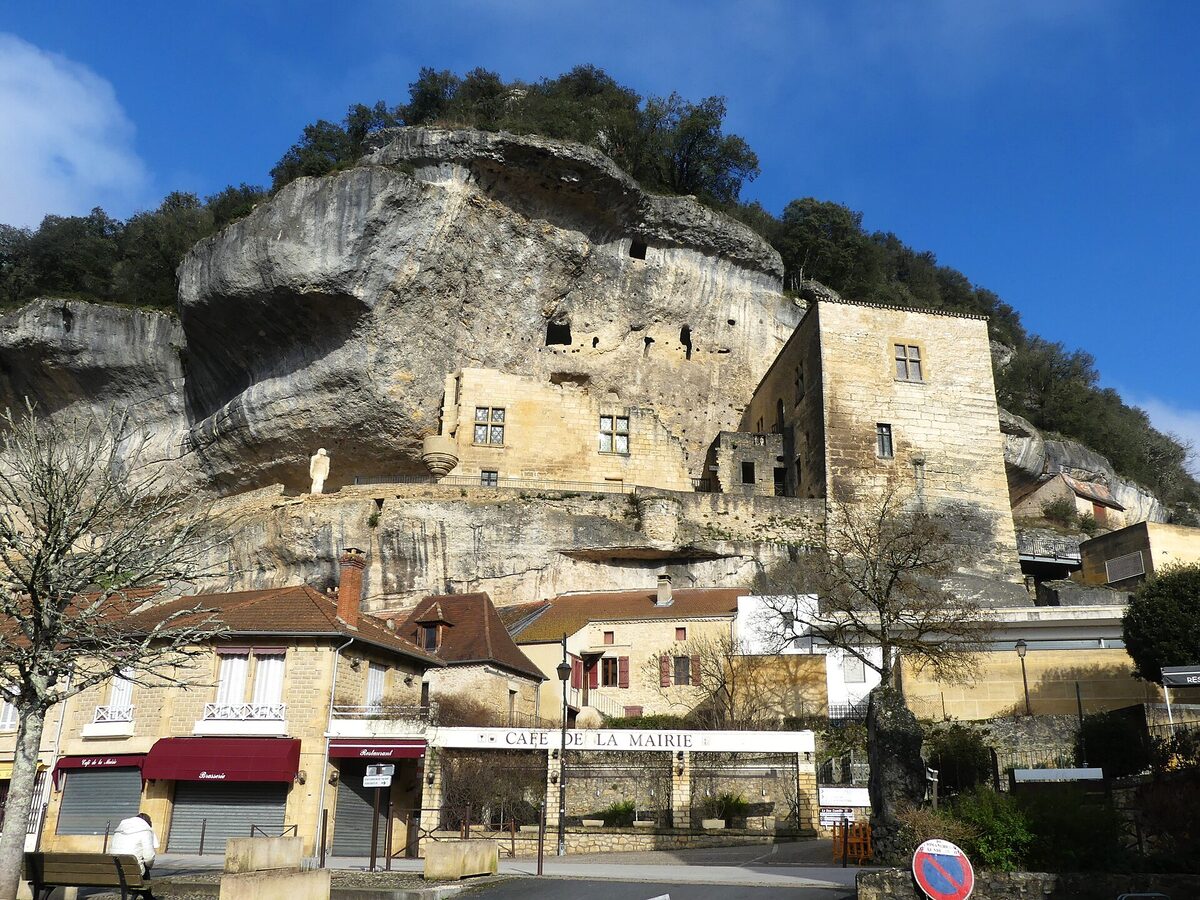
Les Eyzies, "world capital of prehistory"
Before pushing open the door of La Mouthe, the scene must be set. The cave does not open just anywhere: it belongs to a territory that is, in itself, one of the most extraordinary repositories of ancient humanity. The Vézère valley, winding between Montignac and Les Eyzies, concentrates within a few dozen kilometres a density of Palaeolithic sites without equal in the world. Cliffs pierced with rock shelters, decorated caves, open-air deposits: it was here that, since the mid-nineteenth century, the young science of prehistoryPrehistoryThe span of human history before the invention of writingWritingA system of conventional signs used to fix language or information durably; its appearance (c. 3300 BC) marks, by convention, the end of prehistory.→, from the Palaeolithic to the Metal Ages, known mainly through material remains.→ forged its concepts, defined its cultures, and established its chronologies.
The very name of Les Eyzies-de-Tayac is bound up with this intellectual adventure. It was in the immediate vicinity that, in 1868, during the cutting of a railway line at the Cro-Magnon shelter, the skeletons were unearthed that gave their name to "Cro-Magnon man," the human type of the European Upper PalaeolithicPalaeolithicThe oldest and longest period of prehistory (c. 3.3 Ma–12,000 BC), defined by chipped stone tools and a hunter-gatherer way of life.→. It was there, in the shelters of La Madeleine, Laugerie-Haute and Laugerie-Basse, La Ferrassie and Le Moustier, that the nineteenth-century prehistorians, Édouard Lartet and Gabriel de Mortillet foremost among them, isolated the great cultures that still structure our view of the Stone Age. The MagdalenianMagdalenianThe last great Upper PalaeolithicUpper PalaeolithicThe final phase of the Palaeolithic (c. 45,000 to 10,000 years ago), marked by Homo sapiens in Europe, art, ornaments and a succession of cultures (Aurignacian, Gravettian, Solutrean, Magdalenian).→ culture (c. 17,000–12,000 BC), the peak of cave art (Lascaux).→ takes its name from the shelter of La Madeleine, the MousterianMousterianThe stone-tool industry typical of Neanderthals, based on the Levallois flaking technique.→ from the cave of Le Moustier: the very nomenclature of prehistory was born in this landscape.
This concentration is no accident. The Vézère and its tributaries have cut into a soft limestone plateau, the Cretaceous limestone, in which erosion has carved countless cavities and overhangs. These shelters offered groups of hunter-gatherersHunter-gatherersA way of life based on hunting, fishing and gathering wild resources, without farming or herding; it dominated almost the whole of human history.→ a natural refuge, facing south, protected from the wind, overlooking a game-rich valley roamed by reindeer, horses, bison and aurochs. For tens of thousands of years, at the height of the glaciations, people returned season after season, leaving behind occupation layers several metres thick, mille-feuilles of ash, bone and flintFlintA hard, brittle siliceous rock, knapped by prehistoric people to produce blades, points and sharp tools.→ tools. The floor of the Vézère is, in a sense, a book in which each page is a generation.
One cannot overstate how exceptional this accumulation is. Elsewhere in Europe, Palaeolithic remains often survive in tatters, scattered, reworked by erosion or destroyed by the ages. In the Vézère, by contrast, the topography preserved everything: the rock shelters acted as natural strongboxes, sealing deposits away from the weather. The nineteenth-century excavators found sequences of an almost pedagogical clarity, in which one could read, layer after layer, the succession of cultures as one turns the pages of a textbook. It was this legibility that made the region the laboratory of prehistory, the place where the first chronologies of the Stone Age were calibrated. And it was because prehistorians had learned there to read the ground that they knew, at La Mouthe, how to interpret correctly what the layers told them about the engravings.
By the turn of the twentieth century, Les Eyzies was already a place of scholarly pilgrimage. People came from all over Europe to dig, to compare, to argue. It is within this atmosphere of ferment and rivalry that the discovery of La Mouthe is set: not as an isolated stroke of luck, but as the culmination of a long collective familiarity with the Périgord soil. The cave would probably not have had the same resonance had it opened elsewhere; it was because it lay at the heart of the "capital of prehistory," before the eyes of the greatest specialists, that its testimony became irrefutable.
The discovery of 1895: Émile Rivière in the passage
The cave of La Mouthe was known to the locals long before anyone suspected the slightest treasure within it. Its entrance, partly choked with sediment and rubble, served as a cellar or storeroom. It was while clearing this passage, around 1894-1895, that workers opened up a deeper corridor, hitherto inaccessible. Curiosity did the rest: word spread that the walls, at the far end, bore strange figures of animals.
The man who knew how to heed this signal was Émile Rivière (1835-1922). A physician by training, an anthropologist and prehistorian by vocation, he had already made a name for himself by excavating the Grimaldi caves on the Italian border, where he had unearthed Palaeolithic burials. Rivière was no passing amateur: he was a rigorous, methodical scholar, mindful of evidence. When the existence of engravings at the back of La Mouthe was reported to him, he did not cry miracle. He came to see, he measured, he dug.
What he discovered as he pressed into the passage, by the light of his candle, surpassed his expectations. On the walls, more than a hundred metres from the entrance, in a total darkness that had never known daylight, animals were engraved in the rock: bison, horses, ibexes, a rhinoceros, and a curious latticed sign that resembled a hut. Some figures were simply incised with flint; others bore traces of colour. Rivière grasped the stakes at once: if these images were authentically prehistoric, they overturned everything science then accepted about the artistic capacities of Ice Age people.
But Rivière also knew the minefield he was entering. Sixteen years earlier, Altamira had been ridiculed. To claim without proof that prehistoric hunters had decorated caves was to court the same fate. So he chose to proceed as an archaeologist, not as a visionary. He set about excavating the very floor of the cave, in front of and beneath the engraved walls. And it was here that his methodological genius made the difference. He observed that the archaeological layers, the sediment deposits accumulated over the millennia, containing flint tools and bones, pressed up against the base of the engravings, and even, in places, partly covered them. In other words: the images had been traced before those layers were laid down. One could not have engraved a bison beneath a metre of intact sediment. The conclusion was inescapable: the engravings were at least as old as the deposits that sealed them, and therefore Palaeolithic.
Rivière presented his observations to the Academy of Sciences as early as 1895, then in a series of papers. There he stated outright what many still dared not believe: La Mouthe proved the existence of a cave art of the Reindeer Age. The cave thus became, in the history of the discipline, the first in which Palaeolithic cave artCave (parietal) artArt made on the walls of caves and shelters (paintings, engravings), as opposed to portable artPortable artTransportable art objects (figurines, engravings on bone or ivory), such as the Palaeolithic Venuses.→.→ was recognised and accepted on solid scientific grounds.
It is hard to appreciate today the courage such a claim required. Rivière knew he was staking his reputation. To assert in 1895 the existence of a Palaeolithic cave art was to side with the reviled Sautuola, to defy the authorities of the discipline, to risk disgrace. His first papers indeed met with the reserve, even the hostility, of some of his peers. Some contested the authenticity of the engravings, others the value of his stratigraphic observations. But Rivière held firm. He multiplied his visits, had his evidence verified by witnesses, documented his excavations with care. His tenacity eventually paid off: as other decorated caves were discovered and the arguments accumulated, the cause he defended ceased to be an eccentricity and became a shared certainty.
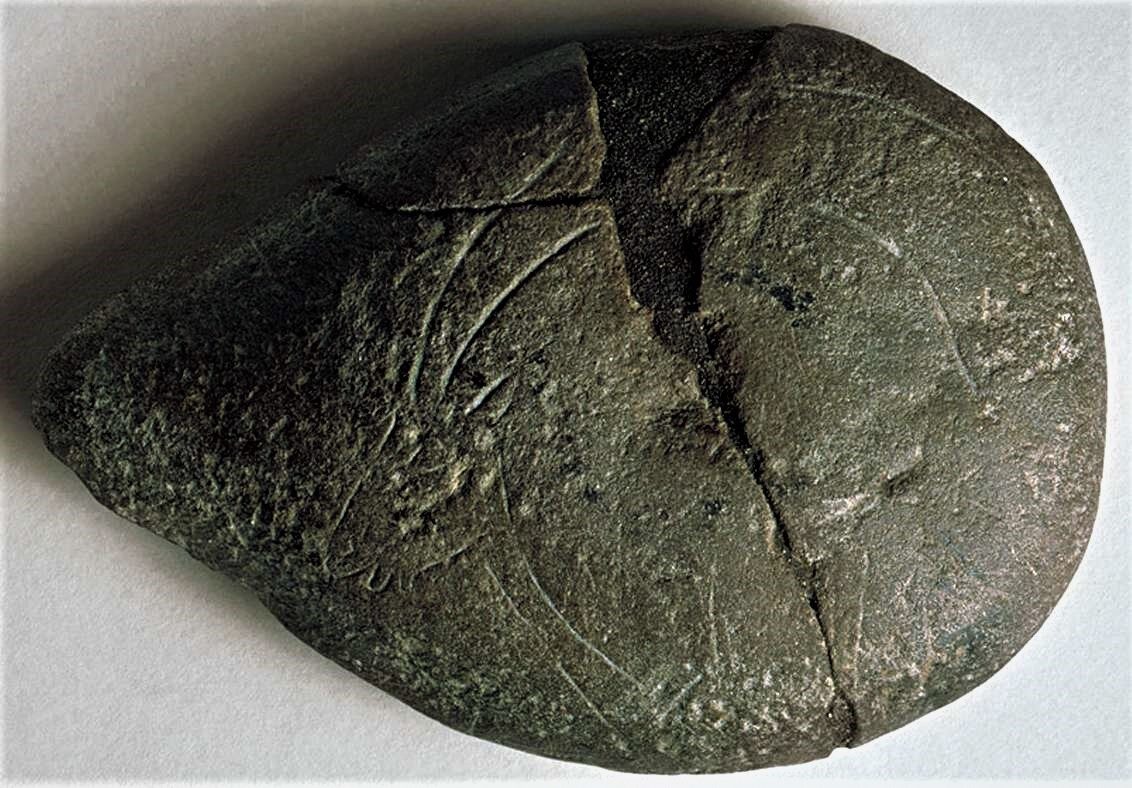
Why cave art was rejected: the trauma of Altamira
To grasp the importance of La Mouthe, one must understand the extraordinary resistance the scholarly community mounted, at the end of the nineteenth century, against the idea of a cave art. This resistance had a name and a date: Altamira, 1879.
That year, in Cantabria, in northern Spain, a landowner and amateur naturalist, Marcelino Sanz de Sautuola, was exploring a cave on his estate. His daughter Maria, aged eight, who was with him, looked up at the low ceiling of a chamber and cried out, so the legend goes: "Papa, oxen!" Above their heads spread one of the absolute masterpieces of prehistoric art: a ceiling covered with polychrome bison, painted in ochreOchreA red or yellow mineral pigment (iron oxides), used from prehistory for adornment, funerary rites and art.→, red and black, modelled with an astonishing sense of relief and movement. Sautuola, who knew the Palaeolithic tools found in the cave floor, made the connection and published, in 1880, the hypothesis that these paintings were the work of Stone Age hunters.
The reaction of the learned world was brutal. The leading lights of French prehistory, who then reigned over the discipline, flatly refused this idea. Gabriel de Mortillet, the dominant figure, and with him most of the specialists, judged the Altamira bison too beautiful, too accomplished, too "modern" to be the work of primitive people. It was insinuated that Sautuola had been duped, or even that he had commissioned a forger, rumour had it that a mute painter, a guest in his house, had executed the frescoes. The evolutionist prejudice of the age had much to do with it: Palaeolithic man was imagined as a coarse brute, barely emerged from animality, incapable of so refined an aesthetic expression. Art, it was believed, was a late conquest of civilisation. How could savages clad in skins have painted like masters?
There was also a major technical obstacle. For images in the open air, or exposed to daylight, one could always suspect a recent hoax. But above all, the very idea that one might have painted in the absolute darkness of caves, hundreds of metres from the entrance, seemed absurd. How would one have lit the way? How would one have worked in the dark? The absence of any answer to these questions fed the scepticism. Sautuola died in 1888, repudiated, accused of fraud, his scientific honesty besmirched. Altamira became the symbol of a discovery too early for its time, a scandal that prehistory wanted to hear no more about.
For fifteen years, then, cave art was a taboo subject. Anyone who claimed to have found prehistoric paintings in a cave knew he was exposing himself to ridicule, to charges of naivety or mystification. It was in this climateClimateThe long-term average atmospheric conditions of a region; its variations (glaciations, aridifications) shaped migrations, agriculture and the collapse of prehistoric societies.→ of distrust that the discovery of La Mouthe occurred. And it is precisely this context that gives it its full greatness: Rivière did not merely announce engravings; he was the first to bring material proof that scepticism could not sweep aside.
La Mouthe carries conviction
What did La Mouthe have that Altamira lacked? The answer lies in a single word: stratigraphyStratigraphyThe study of the superimposed layers (strata) of an archaeological site; each layer corresponds to a phase of occupation and yields a relative chronology.→. At Altamira, the paintings spread across a ceiling; nothing in the floor allowed their age to be proved directly. At La Mouthe, by contrast, the engravings plunged into the archaeological deposit. Rivière was able to demonstrate that layers containing worked flint and bone, indisputably Palaeolithic, masked the foot of certain figures. To engrave the bison, the wall must have been exposed; and for the sediments to accumulate over it, millennia were required. The logic was unanswerable, and it spoke the language prehistorians respected: that of excavation and the superposition of layers.
A second argument reinforced the first: the calcite concretions. In a cave, water seeping from the walls slowly deposits a film of calcite, a mineral veil that forms at the rhythm of the centuries. Now, some of the engravings at La Mouthe were covered by this translucent crust. No modern forger could have manufactured such a patina, whose deposition demands spans of time beyond the reach of a human life. Nature itself certified the antiquity of the images.
Finally, there was the lamp, to which we shall return in detail. Found on the floor of the cave, this sandstone bowl, shaped to burn animal fat, supplied the answer to the objection that had seemed insoluble: how could one have painted and engraved in darkness? Why, with lamps. The proof lay there, beneath the dust of the ages.
The effect of these demonstrations was considerable, but it was not instantaneous. The conversion of minds took several years and a number of converging discoveries. Other decorated caves soon confirmed La Mouthe: Pair-non-Pair in the Gironde, then, in 1901, in quick succession, Les Combarelles and Font-de-Gaume, both near Les Eyzies, whose walls teemed with engravings and paintings. The prehistorian Émile Cartailhac, who had been one of the fiercest detractors of Altamira, then understood his error. In 1902 he published in a scholarly journal a now-famous text entitled "The caves decorated with drawings. The cave of Altamira, Spain. Mea culpa of a sceptic." In it he publicly acknowledged that Sautuola had been right, and that he himself had been wrong. This mea culpa marks the official date of the rehabilitation of cave art. But this rehabilitation, it is often forgotten, had begun seven years earlier, in the dark passage of La Mouthe.
The works: bison, horses and the tectiform "hut"
What, exactly, can one see on the walls of La Mouthe? The cave does not have the spectacular polychrome profusion of Altamira or Lascaux; its art is more sober, dominated by engraving, sometimes heightened with paint. But this very sobriety, joined to the antiquity of certain figures, gives it a place apart in the bestiary of Ice Age art.
The repertoire is the classic one of the great herbivores of the cold steppeSteppeA vast semi-arid, treeless grassland of Eurasia, suited to nomadic herding and the horse; a corridor for the movement of peoples and technologies in later prehistory.→. One recognises bison, with their massive silhouette, pronounced hump and lowered head; horses, with bristling mane and rounded belly, treated with that sense of curve that marks so many Magdalenian works; ibexes with curved horns; and aurochs, those great wild cattle now vanished. The cave also holds, remarkably, the depiction of a woolly rhinoceros, an animal of the great cold whose presence attests to the antiquity of the occupation. A few figures of deer and felines complete this bestiary. The animals are engraved in line, sometimes with a single sure incision, sometimes through reworkings and second thoughts; some outlines are underscored in black or red.
But the most famous, and most enigmatic, figure at La Mouthe is not an animal. It is a geometric sign, a regular lattice that the first observers immediately likened to a structure. It has been named the tectiformTectiformA geometric sign of Palaeolithic cave art resembling a roofed structure (a "roof" or hut), made of lines and parallel strokes. At La Mouthe this motif was long interpreted as the depiction of a dwelling.→, from the Latin tectum, the roof, or, more familiarly, the "hut" or "cabin" of La Mouthe. Rivière and his contemporaries saw in it the depiction of a dwelling: a covered shelter, perhaps a tent or a hut of branches, schematised by a system of lines and uprights. The idea was seductive: it suggested that Palaeolithic people had wished to depict their own domestic environment, and that they had left us, on the wall, the oldest architectural plan in human history.
This interpretation, long popular, is regarded with caution today. Contemporary prehistorians place the tectiform among the many geometric signs of cave art, those abstract motifs (dots, strokes, claviforms, scalariforms, tectiforms) whose meaning largely escapes us. To see in it literally a house may be a projection: we recognise a roof because we know what a roof is. Tectiform signs, found in several caves of the Périgord, notably at Font-de-Gaume, where they are numerous, may carry a symbolic, ritual or identity value that we shall doubtless never decipher. In any case they testify to an elaborate symbolic thought, capable of abstraction, far beyond mere imitation of the real. The tectiform of La Mouthe thus remains one of the great question marks of prehistory: a message clear in its form, opaque in its meaning, cast toward us across the millennia.
It must be stressed how demanding the making of these images was. The deepest figures lie more than a hundred metres from the entrance, in a night that nothing disturbed. To engrave them, the artist had to advance in the dark, carry his light, hold his flint tool in one hand and his lamp in the other, or set it on a ledge of the rock. Each engraved line represents a gesture accomplished under conditions we would struggle to endure. This physical dimension of cave art, the effort, the danger, the darkness, adds to the emotion these works inspire. One did not venture by chance to the back of a freezing cave to engrave a bison; a powerful motivation was needed, whose nature, again, escapes us.
The sandstone lamp: light recovered
Among all the objects La Mouthe has yielded, one alone has the value of a symbol: the lamp. Discovered by Rivière on the floor of the cave, it is one of the oldest known lamps of humankind, and one of the most beautiful. Carved from a block of red sandstone, it takes the form of an oval bowl, carefully hollowed at its centre to hold the fuel, and fitted with a handle by which it could be held or set down. On the underside, an engraving has even been recognised: an ibex incised in the stone, as if the object itself could not escape the figurative impulse that animated its users.
The principle of these Palaeolithic lamps is simple and ingenious. Animal fat or marrow was placed in the bowl, acting as fuel; a plant wick, moss, lichen, fibres, juniper, was steeped in it and, once lit, burned slowly, giving a modest but sufficient flame to light the wall at arm's length. Modern experiments have shown that such a lamp could burn for an hour or more, casting a warm, steady light without excessive smoke. It was by the trembling glow of dozens of these lamps that the frescoes and engravings of the deep caves were executed.
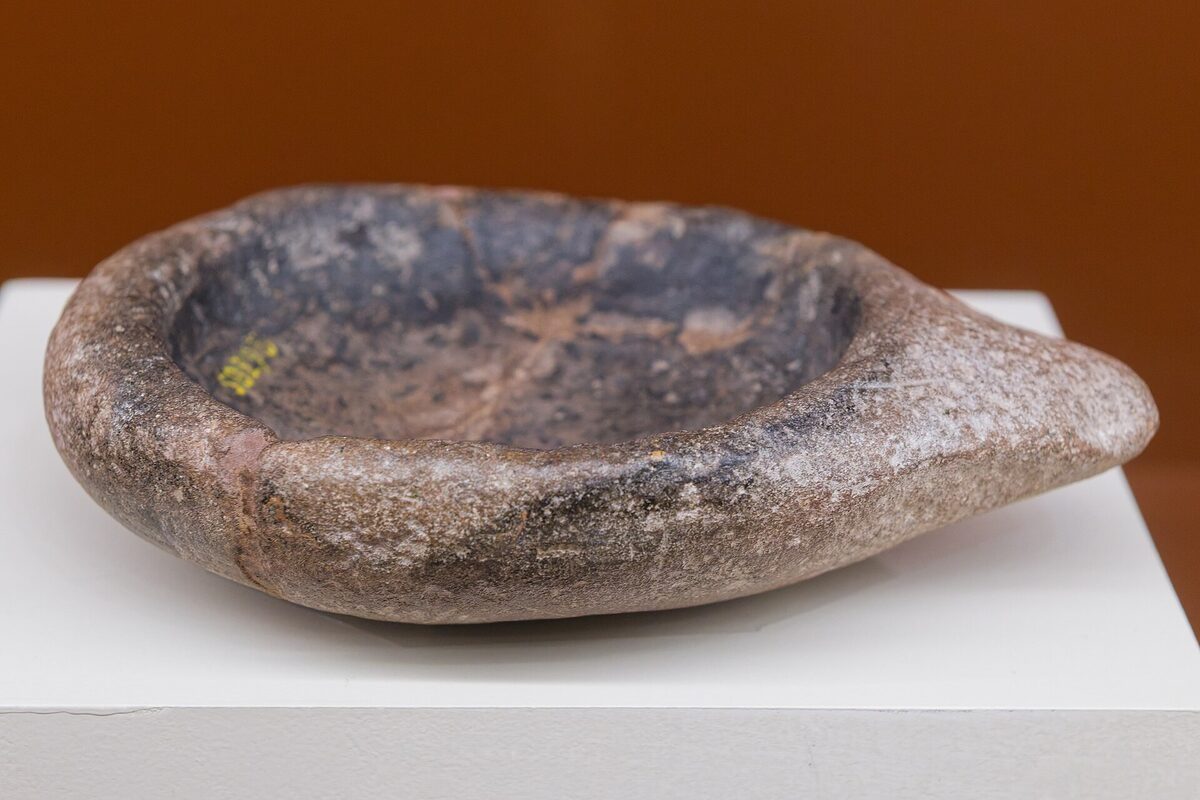
One must imagine the scene this object makes possible. At the deepest point of the cave, a man crouched before the wall, the sandstone lamp set beside him on a ledge or held by a companion. The flame dances, and with it the shadows dance; under this shifting light, the natural relief of the rock seems to come alive, and the artist marries it, underscores it, redirects it, as if the bison were already there, prisoner of the stone, waiting to be released with a single line. Many prehistorians have noted that the Ice Age painters played upon the accidents of the wall, working a bulge, a fissure, a hollow into the anatomy of their figures. This collaboration between the hand and the rock was possible only by the glow of a raking flame, precisely the one produced by the fat lamp. Lighting was therefore not a mere technical accessory: it took part in the creative act itself.
The importance of the La Mouthe lamp far exceeds its beauty. In terms of scientific argument, it constitutes a key piece. Recall the chief objection of the Altamira sceptics: one could not have painted in the total darkness of caves, for want of any conceivable lighting. The lamp answered this objection directly. It proved that Palaeolithic people did indeed possess a means of portable lighting, designed specifically to penetrate and work in the underground darkness. Found on the spot, in the decorated cave itself, it materially linked light to art: here is how, and with what, the bison had been illuminated.
This lamp, one of the few shaped and decorated Palaeolithic lamps known, is now kept at the National Archaeology Museum in Saint-Germain-en-Laye, where it ranks among the major pieces of the prehistoric collections. It has acquired the status of an icon: it is reproduced in textbooks, exhibited as the emblem of a skill and an intelligence that the nineteenth century stubbornly refused to grant the hunters of the Ice Age. The little red sandstone bowl of La Mouthe did not merely light a wall; it lit, figuratively, an entire science.
Dating and attribution: the Magdalenian age
When were these works made? The question of dating cave art is notoriously difficult. An engraving in the rock contains, in itself, no directly datable material; radiocarbon can be applied to it only if it includes an organic pigment such as charcoal, which is not always the case. Prehistorians have therefore long dated cave art by indirect methods: stratigraphy, style, association with datable objects found in the same context.
For La Mouthe, it was precisely Rivière's stratigraphy that supplied the first framework. The archaeological layers that sealed the engravings contained an industry of flint and bone attributable to the Upper Palaeolithic, and more precisely to the MagdalenianMagdalenianThe last great Upper Palaeolithic culture (c. 17,000–12,000 BC), the peak of cave art (Lascaux).→, that great culture which flourished, in Western Europe, between roughly 17,000 and 12,000 years before our era. The Magdalenian is the apogee of Ice Age art: it is the time of Lascaux, of Altamira, of Font-de-Gaume and Les Combarelles; the time of the reindeer hunters who left, on walls and objects, the masterpieces we admire. The sandstone lamp, by its form and context, also belongs to this Magdalenian horizon.
That said, La Mouthe may well hold works older still. The bestiary and the style of certain engravings, the presence of the rhinoceros, the execution of several figures, have led some specialists to envisage earlier phases of the Upper Palaeolithic, even origins reaching back to the cultures that precede the Magdalenian. Like many decorated caves, La Mouthe was no doubt frequented and decorated repeatedly, over visits spread across millennia. Its walls are not a page written in a single sitting, but a palimpsest, an accumulation of gestures sometimes separated by generations.
It is worth pausing on what this kind of indirect dating implies for our confidence in the results. A stratigraphic argument is only as strong as the integrity of the deposit on which it rests: if the layers have been disturbed, mixed or eroded, the sealSealA small engraved object (often steatite) used to stamp a mark in clay; the Indus seals, bearing animals and signs, attest to administration and trade, though their script remains undeciphered.→ that guarantees antiquity loses its force. This is why Rivière's care in recording the exact relationship between sediment and engraving mattered so much, and why later researchers returned to such sites to verify, refine and sometimes correct the first observations. The dating of cave art has remained, ever since, a patient dialogue between the wall and the ground, between the image one cannot date directly and the deposits one can. La Mouthe stands at the very beginning of that dialogue, and its lesson, that a picture on stone can be anchored in time through the archaeology of the floor beneath it, has lost none of its relevance.
The Magdalenian attribution nonetheless remains the dominant reference for most of the works and for the famous lamp. It places La Mouthe within the great family of decorated sanctuaries of the Périgord, contemporary with one another, which together sketch a veritable artistic province of the last Ice Age. To date La Mouthe is also to set it back within this network of caves and shelters where, for five millennia, one and the same figurative tradition was transmitted, enriched and renewed.
The scientific significance: the recognition of Palaeolithic art
Beyond its bison and its lamp, La Mouthe occupies a singular position in the history of science: it is the site of a paradigm shift. Before it, the scholarly community denied the existence of a prehistoric cave art; after it, that existence became an established fact, the foundation of a new field of research. Few caves can claim to have, by themselves, moved an intellectual frontier.
This significance owes as much to the method as to the discovery. What Rivière bequeathed to prehistory is not only engravings, but a demonstration. He showed that the antiquity of a cave work could be proved by field archaeology: by excavation, by the reading of layers, by the analysis of concretions, by the associated finds. He turned a question of opinion, are these images so beautiful as to be suspect?, into a question of fact, are these images, yes or no, sealed by Palaeolithic deposits? This shift, from aesthetic judgement to stratigraphic proof, is one of the founding acts of modern prehistoric method.
The recognition of Palaeolithic art had immense consequences for our view of ancient humanity. It definitively ruined the image of cave man as an uncultured brute. If these hunters could observe nature closely enough to render the curve of a horse or the mass of a bison, if they mastered line, colour and composition, if they invented abstract signs, then they possessed a mental, symbolic and spiritual life of unsuspected richness. Cave art thus pushed back by tens of millennia the origin of symbolic thought, of the imagination, perhaps of religion. It made the Palaeolithic Homo sapiensHomo sapiensThe present-day human species, which emerged in Africa around 300,000 years ago, the only surviving human lineage after the extinction of Neanderthals and Denisovans.→ a fully human being, endowed with an inner life, a culture, a need to represent the world.
One must also do justice to those who, in this affair, were right too soon. The rehabilitation of cave art is inseparable from a rehabilitation of persons: that of Sautuola, who died dishonoured for telling the truth, and whom Cartailhac's mea culpa came to vindicate, alas posthumously; and that, more discreet, of Rivière, whose name remains less famous than it deserves. The history of science loves solitary heroes and sudden revelations; reality is made of patience, of quarrels, of evidence slowly accumulated. La Mouthe teaches us that scientific truth does not impose itself by its mere self-evidence, but at the end of a long labour of persuasion, in which the rigour of the method counts for as much as the brilliance of the discovery.
La Mouthe, in opening this breach, also inaugurated a discipline. In its wake, researchers such as the abbé Henri Breuil, later nicknamed the "pope of prehistory", would record, draw and methodically study the decorated walls, founding the iconography of cave art. The Périgord cave is in this sense the matrix of a research tradition that continues to this day, with physico-chemical dating, multispectral photography and pigment analysis. All of this begins, symbolically, in the passage of La Mouthe, on the day a stubborn physician decided to excavate the floor rather than be content to admire the wall.
The cave today: conservation and closure
What remains of La Mouthe for today's visitor? The cave was listed as a historic monument as early as 1910, an early sign of the official recognition of its value. But, like most decorated caves, it pays the price of its fragility. The microclimatic balance of underground cavities is delicate: human visitation, through the heat, humidity and carbon dioxide it introduces, can be enough to break that balance and trigger the growth of micro-organisms, the alteration of pigments, the formation of calcite veils that mask the works or, conversely, their degradation.
The history of Lascaux, closed to the public in 1963 after colonies of algae and bacteria, the famous "green sickness," then the "white sickness", threatened its frescoes, served as a lesson to the whole profession. From then on, conservation took precedence over display. Many decorated caves of the Périgord can now be visited only in trickles, or not at all, and facsimiles have multiplied, Lascaux II, III and IV, the Chauvet replica, to offer the public the emotion of the works without endangering the originals.
La Mouthe falls within this logic of protection. The cave, in private ownership, has known only limited tourist visitation and today remains of very restricted access, subject to the imperatives of conservation. Its engravings, more discreet and harder to read than the great frescoes of Lascaux, demand no less attentive surveillance. The passing visitor to Les Eyzies will probably not enter the historic passage; but at the National Museum of Prehistory overlooking the village, and at the National Archaeology Museum of Saint-Germain-en-Laye where the lamp rests, the legacy of the cave can be measured.
This final discretion has something fitting about it. La Mouthe was never a spectacular cave: its greatness was first scientific and historical, not touristic. That it now fades behind more monumental sites in no way diminishes its place. It remains the cave of the threshold, the one through which science entered the age of cave art. And the silence that now envelops it resembles, in a sense, the silence in which its bison were engraved, a silence laden with meaning, which one must know how to hear.
Conclusion: the threshold crossed
The story of the cave of La Mouthe is the story of a turning point. In a few years, at the hinge of the nineteenth and twentieth centuries, humanity changed its view of its own past. What it had held to be impossible, that hunters of the Ice Age might have been artists, became self-evident, and that self-evidence recoloured everything: the image we form of our ancestors, the depth we accord to human culture, the dignity we recognise in peoples without writing. La Mouthe is the discreet pivot of this revolution.
There is a lesson in this story, and it reaches beyond prehistory. The scandal of Altamira, the rejection of Sautuola, the contempt of the scholarly authorities remind us how prejudice can blind the very people who believe themselves the guardians of reason. For fifteen years, eminent men refused a truth because it clashed with their picture of the world. It took the patience of an excavator, the rigour of a stratigraphic demonstration, the humble testimony of a sandstone lamp, for science at last to consent to see what children, like little Maria, had recognised by instinct: bison on the stone, and behind them, fully human beings.
Today, when cave art is invoked, Lascaux, Chauvet, Altamira, Font-de-Gaume, the modest little valley of Les Eyzies where it all began is often forgotten. But without La Mouthe, without Émile Rivière sinking into the darkness candle in hand, these prestigious names might never have been recognised for what they are: the oldest testimonies of human creation, an achievement still celebrated as a cornerstone of the region's heritage3. The cave of La Mouthe is the threshold that prehistory crossed in order to become, at last, a history of the mind as much as of tools. It is on this account, more than any other, that it deserves to remain in the memory of science.
Le côté gestion de ressources et déplacements de la préhistoire m'intéresse particulièrement.
La Mouthe fait partie des sites fondateurs de la connaissance de l'art paléolithique et mérite une plus grande notoriété. La concurrence avec Lascaux, Font-de-Gaume et Les Combarelles lui fait de l'ombre alors qu'elle offre des témoignages rupestres tout aussi précieux. Un petit documentaire retraçant l'histoire de sa découverte et de son authentification serait une belle production.
La grotte de La Mouthe dans la Dordogne est l'une des premières grottes ornées à avoir été reconnue comme authentiquement paléolithique, à la fin du XIX e siècle. Avant elle, la communauté scientifique refusait de croire que des humains préhistoriques avaient pu créer un art aussi élaboré. Cette histoire de la découverte de l'art préhistorique est aussi passionnante que l'art lui-meme.