Between the seventeenth and twelfth centuries BCE, a major power dominated Asia Minor and much of the Near EastNear EastA region of western Asia (Levant, Mesopotamia, Anatolia, Iran), cradle of the Neolithic revolution, agriculture, the first cities and writing.→: the Hittite EmpireHittite empireA great Anatolian power of the Late Bronze Age, centred on Hattusha; in the 13th century BCE its great kings arbitrated the affairs of their Syrian vassal kingdoms.→. Founded in central Anatolia on the plateau corresponding to modern Turkey, this empire rivalled Egypt under Ramesses II, clashed with the Assyrians and forged the earliest known laws protecting slaves. Yet for centuries the HittitesHittitesBronze Age people who founded a powerful empire in central Anatolia in the 2nd millennium BC, skilled in rock-cut architecture and defence.→ were almost entirely forgotten by history. Only in the late nineteenth century did archaeologists begin to recover them from oblivion, and only in 1915 did linguist Bedrich Hrozny decipher their language - Hittite, the earliest known written Indo-European language. Today, their capital Hattusa and the rock sanctuary of Yazilikaya are listed as UNESCO World Heritage Sites and continue, excavation after excavation, to yield secrets about a civilisation as sophisticated as it is little known.
The Hittites were an Indo-European people who settled in Anatolia around 2000 BCE, probably from the Pontic-Caspian steppes, like other Indo-European peoples at the same time. They absorbed the local population (the Hattians, from whom they borrowed part of their name and mythology) and gradually founded a centralised state whose capital, Hattusa, stood on a fortress plateau 1,000 metres above sea level, surrounded by cyclopean stone ramparts and monumental gates guarded by stone lions and sphinxes.
Origins: from city-state to empire
Hittite history is conventionally divided into three periods. The Old KingdomOld KingdomThe first great period of unified pharaonic Egypt (c. 2700-2200 BC, 3rd-6th Dynasties), the golden age of the great pyramids and of a strongly centralised state.→ (c.1700-1500 BCE) is a period of formation and local expansion. King Hattusili I was the first to bear the title of "Great King" and to lead military campaigns into northern Syria. His successor Mursili I pushed as far as Mesopotamia and sacked Babylon around 1595 BCE, ending the first Babylonian dynasty - an act that overturned the balance of power in the ancient Near East[1].
The Middle Kingdom (c.1500-1380 BCE) was a troubled period, marked by succession wars, tensions with the Hurrians (the kingdom of Mitanni) and a deep crisis that nearly destroyed the empire. It was only with the New Kingdom (c.1380-1180 BCE) that the Hittites reached their zenith. Under Suppiluliuma I (c.1344-1322 BCE), the empire stretched from the Aegean to the Euphrates, dominating Syria and ending Mitanni's hegemony. Even Egypt was forced to negotiate.
Qadesh and the first peace treaty in history
The most celebrated confrontation in Hittite history is the Battle of Qadesh (c.1274 BCE), pitting PharaohPharaohThe title of the ruler of ancient Egypt, regarded as a living god guaranteeing cosmic order (Maat), supreme head of state, army and worship.→ Ramesses II against Muwatalli II on the banks of the Orontes in modern Syria. The battle is one of the first great chariot battles in history: the two armies are estimated to have fielded several thousand war chariots combined. Its outcome is disputed - both sides claimed victory - but its consequences are clear: neither empire crushed the other. Sixteen years later, around 1259 BCE, kings Hattusili III and Ramesses II signed the Treaty of Qadesh[2]. It is the oldest known international treaty, preserved in both Egyptian (on the walls of the temple of Karnak) and Hittite versions (on cuneiformCuneiformThe oldest known writing, born at Uruk; its signs, impressed into clay with a reed stylus, are wedge-shaped (from Latin cuneus).→ tablets). A copy has stood since 1970 at United Nations headquarters in New York, a symbol of the most ancient diplomacy known.
Hattusa: a capital in stone
The Hittite capital Hattusa, excavated since the late nineteenth century and listed as a UNESCO World Heritage Site in 1986, is one of the best-preserved monumental complexes of the Bronze AgeBronze AgeA protohistoric period following the Neolithic, defined by bronze metallurgy (a copper-tin alloy) and the rise of the first cities and states; in Egypt it corresponds to the age of the first pyramids.→. The German excavations of the Deutsche Orient-Gesellschaft, ongoing since 1906, have uncovered a city of more than 180 hectares, surrounded by 6 kilometres of stone and mud-brick ramparts. Guard posts, towers, and monumental gates decorated with sculptures (the Lion Gate, the Sphinx Gate, the King's Gate) structure an urban space organised around an upper citadel and a lower city.
In the citadel archives nearly 30,000 cuneiform tablets were discovered, written in Hittite but also in Akkadian (the diplomatic language of the ancient Near East), Hurrian, Luwian and other languages. These archives constitute the primary source of information on Hittite civilisation: administration, law, mythology, diplomatic correspondence, religious rituals. They include vassal treaties, law codes (the Hittite Code, remarkable for its use of fines rather than mutilations), and mythological texts some of which may have influenced Greek and Mesopotamian mythology[3].
Hittite religion: a thousand gods
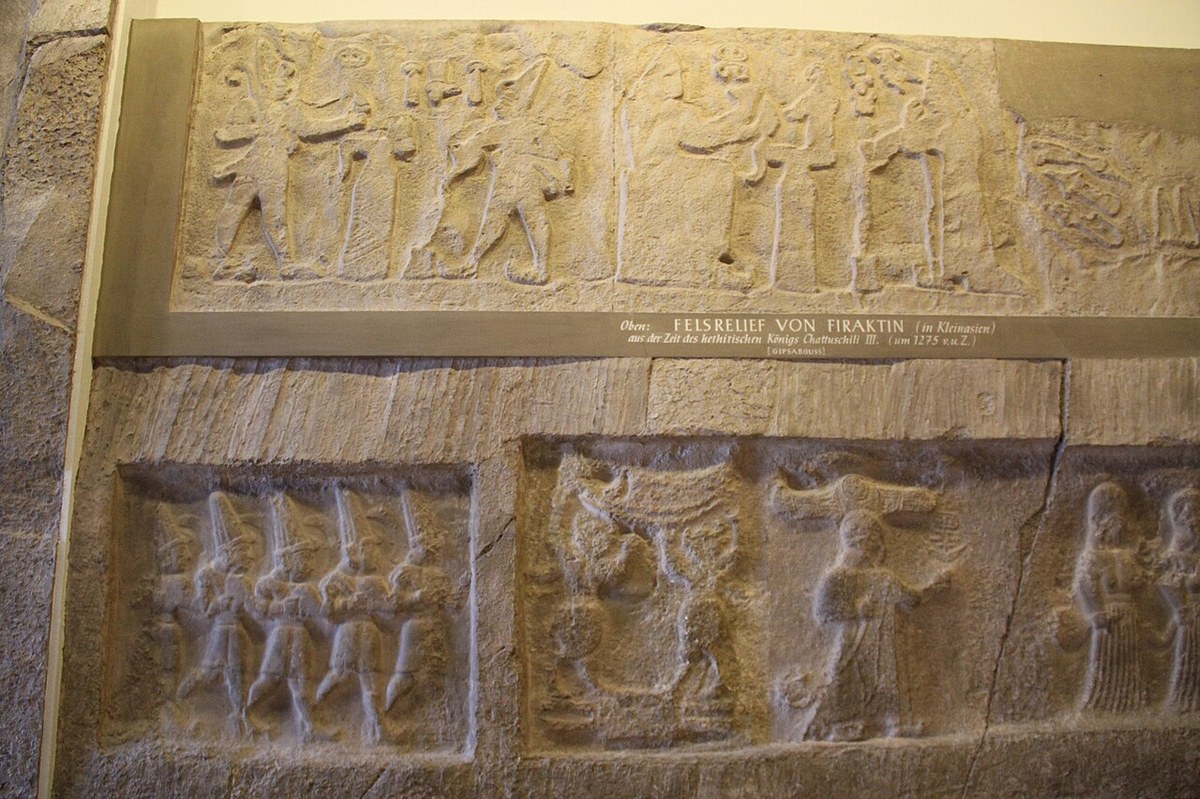
The Hittites described themselves as "the people of a thousand gods." Their pantheon, the product of centuries of syncretism between Hattian, Hurrian, Mesopotamian and Luwian traditions, is indeed exceptionally rich. The Storm God (Teshub in Hurrian, Taru in Hattian) and the Sun Goddess of Arinna occupy the summit of the pantheon. The rock sanctuary of Yazilikaya, a few kilometres from Hattusa, is the most impressive monument of Hittite religion: two galleries cut into the rock, whose walls are decorated with a procession of over 90 deities carved in relief, some bearing cosmic emblems or warrior attributes. The great gallery represents a procession of the entire Hittite pantheon - a unique iconographic document on Bronze Age religion[4].
Iron and technical innovation
One of the Hittites' most enduring contributions to technical history is their early mastery of iron metallurgyMetallurgyThe techniques of extracting and working metals (copper, bronze, gold); its rise in the Eneolithic and Bronze Age transformed tools, weapons and social hierarchies.→. By the late second millennium, they were producing iron objects of higher quality than bronze and jealously controlled their diffusion. Diplomatic letters preserved in the Hattusa archives show other kings - including the king of Assyria - begging the Hittite king to send them iron, which was at the time more precious than gold[1]. This technical monopoly was not enough, however, to prevent the empire's collapse.
The Bronze Age collapse and the end of the Hittites
Around 1180 BCE, the Hittite Empire vanished abruptly. Hattusa was burned and abandoned. The New Kingdom collapsed within a few decades, at the same time as other great eastern Mediterranean civilisations - Mycenae, UgaritUgaritA wealthy Bronze Age merchant city-kingdom on the Syrian coast (Ras Shamra); its cuneiform archives and alphabet make it a major source on the ancient Near East.→, the kingdom of Cyprus. This Bronze Age collapse, one of the most catastrophic civilisational events in ancient history, is attributed to a combination of factors: earthquakes, prolonged droughts, raids by the "Sea Peoples," and internal strife. The Hittites survived only through small Neo-Hittite states in northern Syria and south-eastern Anatolia, which perpetuated certain artistic and linguistic traditions until the eighth century BCE before being absorbed by the Assyrian empire.
Rediscovered by archaeologists and deciphered by linguists, the Hittite empire reminds us that the history of the ancient Near East has a richness and complexity that Egyptian and Mesopotamian accounts alone cannot exhaust. These "people of a thousand gods," masters of iron and diplomacy, weighed heavily on the balances of the ancient world - before disappearing so completely that humanity forgot them for two millennia.
No comments yet. Be the first.