Some 1.9 million years ago, across the savannas and gallery forests of eastern AfricaAfricaThe cradle of humankind: the continent where the first hominins appeared, then Homo sapiens around 300,000 years ago, before the expansion to the rest of the world.→, a population of hominins crossed a decisive evolutionary threshold. Their brains exceeded one litre in volume for the first time. Their bodies, in their proportions, resembled our own. And their gaze extended, for the first time in the history of life, toward horizons that no other homininHomininMember of the subtribe Hominina, comprising the human lineage (Homo, Australopithecus, Paranthropus…) but excluding orangutans and gibbons. The term progressively replaces "hominid" in its narrow sense.→ had yet dreamed of exploring. Homo erectusHomo erectusAncient human species, the first hominin to leave Africa and the maker of the earliest Acheulean handaxes.→ had arrived.
The species that bears this name is one of the longest-lived and most fascinating in the entire human lineage. For nearly 1.8 million years - six times the current lifespan of our own species - Homo erectus inhabited the plains of Africa, traversed the forests of South-East Asia, colonised the steppes of northern China, and perhaps set foot in Europe. It invented the AcheuleanAcheuleanLower Palaeolithic technical culture characterised by hand axes, present across three continents.→ lithic industry, knapped the first large bifacial handaxes, tamed fire, hunted large mammals in coordinated groups, and led a complex social life across three continents. Its skeleton holds up a mirror to what we were before we became ourselves.
Understanding Homo erectus means understanding the moment at which the human lineage first truly began to resemble what it would become. It also means measuring the enormous gap that still separates us from it, and asking vertiginous questions about a species that survived for nearly two million years before vanishing. This dossier retraces that odyssey in detail: from the first excavations in Java to the skulls of DmanisiDmanisiA site in Georgia yielding Homo erectus skulls about 1.8 million years old, among the oldest known adults outside Africa.→, from the Acheulean handaxe to the fires of Wonderwerk Cave, from the shores of Lake Turkana to the last survivors of Java. A story of conquest, adaptation, and nascent humanity.
The Discovery: From Java to Peking, a Species Emerges from the Earth
It was in 1891, on the bank of the Solo River near Trinil (Java, Indonesia), that a Dutch military physician named Eugene Dubois unearthed the first remains of what would be called Homo erectus. He recovered a flattened skullcap with pronounced supraorbital ridges, then a remarkably modern femur. Convinced he had found the "missing link" predicted by Darwin and Haeckel, Dubois named his discovery Pithecanthropus erectus, the upright ape-man. The scientific community greeted the news with scepticism, even ridicule. Decades would pass before the paleoanthropological reality was accepted: Pithecanthropus was indeed a human ancestor.
Dubois was deeply wounded by this rejection. He hid his fossils under the floorboards of his house for years, refusing to show them to researchers. Only in the early twentieth century, as further discoveries confirmed the existence of ancient hominins in Asia, did scientific opinion begin to shift. The posthumous recognition eventually granted to Dubois remains one of the most dramatic stories in the history of natural science - a reminder of how radically new discoveries can outpace the conceptual frameworks of their time.
The second great discovery came in China, at Zhoukoudian, a cave about fifty kilometres south-west of Beijing. Between 1923 and 1937, excavations led by Davidson Black and then Franz Weidenreich yielded the remains of more than forty individuals: skulls, mandibles, teeth, and some post-cranial bones. The species was named Sinanthropus pekinensis, Peking Man. The excavations were interrupted by Japan's invasion of China; the original fossils, entrusted to the Americans for safekeeping, disappeared mysteriously in 1941 and have never been recovered. Only casts and photographs remain. This theft or loss represents one of the greatest tragedies in the history of palaeontologyPalaeontologyThe science that studies past life from fossils, in order to reconstruct the history of life and ecosystems.→, and its mystery has never been resolved despite numerous investigations over eight decades.
In 1950, the ornithologist and taxonomist Ernst Mayr proposed grouping all these African and Asian forms under a single name: Homo erectus. The proposal gradually prevailed. Since then, further specimens have been found in eastern Africa (Kenya, Tanzania, Ethiopia), North Africa (Casablanca, Sidi Abderrahmane), Georgia, Vietnam, Indonesia, and China. Homo erectus is today the best-represented fossil species of the genus Homo, with hundreds of specimens, and one of the best-dated, thanks to radiometric and palaeomagnetic dating methods.1
The species' nomenclature remains an active subject of debate. Some researchers maintain the distinction between Homo ergasterHomo ergasterThe early African form of Homo erectus, contemporary with Paranthropus robustus and recognized for making stone tools.→ (African specimens) and Homo erectus sensu stricto (Asian specimens), citing real morphological differences in skull and facial shape. Others favour specific unity, emphasising the continuity and normal variability of a single species across multiple continents over two million years. In this dossier, we use Homo erectus in its broad sense, noting regional distinctions where relevant.
Anatomy of a World Conqueror
What sets Homo erectus apart from its predecessors, Homo habilis and the earliest Homo, is both immediately visible and rich in evolutionary implications. The Homo erectus skull is larger, flatter on top, with a low and thick vault, a receding forehead, and massive supraorbital ridges (tori) that give its face an unmistakable appearance. Cranial capacity ranges between 750 and 1,250 cc depending on the specimen and the period, with a clear progression over time: early African specimens (H. ergaster) average around 850 cc, while late Chinese specimens approach 1,100-1,200 cc. Homo habilis, by comparison, rarely exceeded 550-600 cc, and Australopithecus afarensis barely reached 430-500 cc.
The skull base is thick, with a pronounced nuchal crest for the attachment of powerful neck muscles. Prognathism (the forward projection of the lower face) is less marked than in australopithecines but still notable. The teeth are smaller than those of earlier hominins, especially the canines and premolars, reflecting a dietary shift toward foods requiring less intensive crushing mastication. This trend toward dental reduction would continue through to Homo sapiensHomo sapiensThe present-day human species, which emerged in Africa around 300,000 years ago, the only surviving human lineage after the extinction of Neanderthals and Denisovans.→, reflecting the increasing importance of food processing and cooking before consumption.
Homo erectus also left traces of sophisticated collective behaviour at mass butchery sites. At Olorgesailie (Kenya), pits filled with tools and bones of gelada baboons attest to repeated group hunts over hundreds of thousands of years. At Castel di Guido (Italy, ~300,000 years), an elephant femur knapped into a percussion tool testifies to intensive exploitation of large mammal carcasses. These remains suggest H. erectus was capable of organising complex logistical operations, perhaps involving a division of labour between group members, with some knappingknappingThe set of operations for fracturing a stone block to extract flakes or blades.→ tools while others butchered carcasses. This advanced social organisation prefigures the societies of modern hunter-gatherersHunter-gatherersA way of life based on hunting, fishing and gathering wild resources, without farming or herding; it dominated almost the whole of human history.→.
The study of growth signatures in Homo erectus teeth has provided valuable information about the species' pace of life. Retzius lines, microscopic lines visible on dental enamel that form at regular intervals like tree rings, have been analysed in several specimens. Results suggest a faster rate of dental growth than in Homo sapiens, consistent with an accelerated developmental schedule. This information contributes to a fuller portrait of Homo erectus: a species faster in its maturation, probably shorter in its individual lifespan, but remarkably efficient in adapting to very diverse environments across multiple continents over geological timescales.
The question of maritime transport is one of the most debated recently. Discoveries on the island of Crete (Plakias site, tools dated to ~130,000 years ago) and other eastern Mediterranean islands suggest that Homo erectus, or a related species, may have been capable of crossing small bodies of water. On the island of Flores, the presence of hominins more than one million years ago, in a geological context where the island was never directly connected to the Asian mainland, necessarily implies some capacity for water crossing, however rudimentary. If confirmed, this would place maritime navigation among the oldest behaviours in our lineage, far predating any previous estimates.
But it is perhaps the post-cranial skeleton that is most revealing. In its bodily proportions, Homo erectus is nearly indistinguishable from a modern Homo sapiens. Its legs are long and slender, its arms relatively short, its hips narrow, its waist pronounced. These characteristics signal an animal adapted to long-distance running under a tropical savanna sun, capable of covering great distances through active sweating - something its long-armed, short-limbed predecessors could not do as efficiently. This morphology reflects a profound change in ecological niche: Homo erectus was no longer a forest opportunist but an open-country hunter-gatherer, capable of pursuing prey across great distances in persistence hunts until the animal collapsed from exhaustion. This strategy, which exploits the human capacity for sustained low-speed running in the heat, is still used by San hunters of the Kalahari.
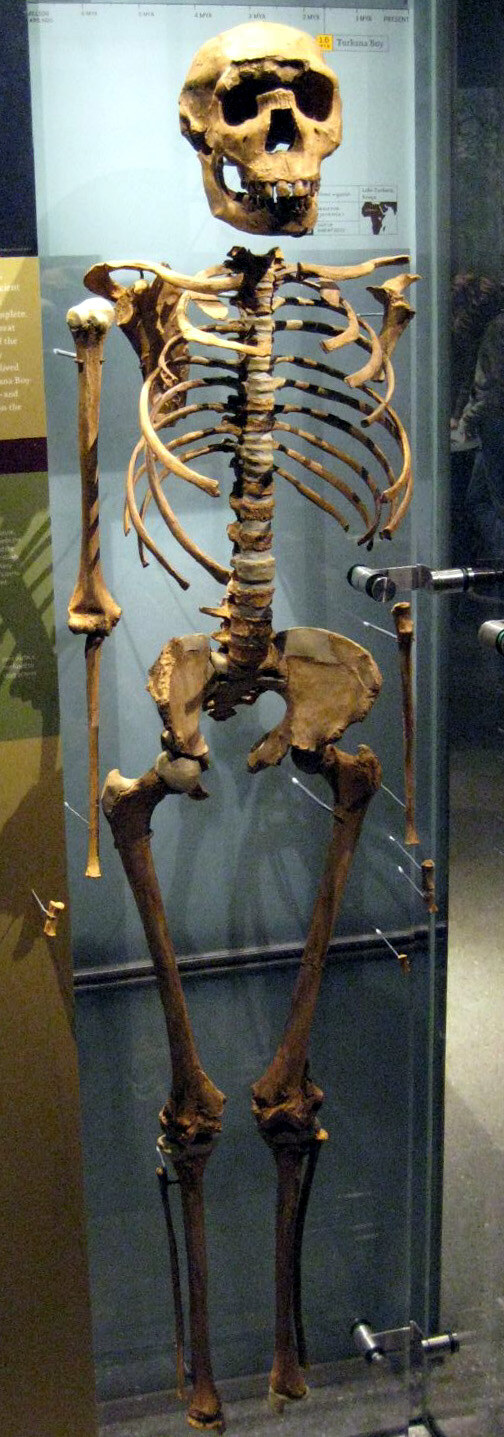
The most celebrated and complete specimen illustrating this anatomy is the so-called "Nariokotome Boy", catalogue number KNM-WT 15000. Discovered in 1984 on the shore of Lake Turkana (Kenya) by Kenyan fossil preparator Kamoya Kimeu, it is preserved to nearly 80% despite its 1.6 million years. It was a juvenile male, aged approximately 8 to 11 years based on dental study, yet already about 1.60 m tall - with an estimated adult height exceeding 1.80 m. Its ribcage is wide and conical like that of a great ape, not barrel-shaped as ours. Its spinal canal is narrower than that of Homo sapiens, suggesting that its respiratory control - crucial for articulate speech - remained less elaborated than ours.
The Nariokotome Boy's growth pattern has been studied intensively through analyses of dental development and long bone histology. His teeth suggest a maturation rate faster than that of modern children, closer to the pattern of great apesgreat apesThe family of great apes (Hominidae) comprising orangutans, gorillas, chimpanzees, bonobos and humans.→. This implies a shorter childhood, a briefer period of maternal dependence, and perhaps a social organisation in which intergenerational cultural transmission was less central than in Homo sapiens. These conclusions are debated - some researchers argue that taphonomic interpretation difficulties distort the results - but they underscore how deeply different Homo erectus remained from us in its life history and probably in its social organisation, despite its remarkably modern body proportions.2
The Acheulean Revolution: The Handaxe, Humanity's First "Designed" Tool
While the predecessors of Homo erectus already used stone tools (the OldowanOldowanThe oldest known stone-tool industry (c. 3.3–1.7 Ma), characterised by flaked pebbles (choppers) and basic flakes. Named after Olduvai Gorge (Tanzania).→ industry, mode 1, dated to 3.3 to 2.6 Ma), Homo erectus inaugurated an unprecedented technical revolution: the Acheulean industry, or mode 2. The Acheulean handaxe, or coup-de-poing, is a bifacially worked tool in the shape of an almond or teardrop, knapped on both faces, with remarkable symmetry and a continuous cutting edge running all the way around the tool. Its manufacture requires advanced manual dexterity, three-dimensional spatial vision, and multi-step planning capacity found nowhere else in the animal world outside hominins. To fashion a handaxe, one must select a flake or block of flintFlintA hard, brittle siliceous rock, knapped by prehistoric people to produce blades, points and sharp tools.→ of adequate size and shape, mentally anticipate the desired final form, and execute a sequence of ten to several dozen strikes in a precise order, adjusting each blow based on the result of the previous one.
The oldest confirmed handaxes are dated to approximately 1.76 million years ago, at the site of Kokiselei 4 in the Lake Turkana region (Kenya), in a study published in Nature in 2011 by Christopher Lepre and colleagues. They are associated with Homo erectus (or H. ergaster) fossils and represent a spectacular technological leap over the raw flakes of the Oldowan. Within a few hundred thousand years, this technology spread across all of sub-Saharan AfricaSub-Saharan AfricaThe part of Africa south of the Sahara; cradle of Homo sapiens, long thought hostile to ancient-DNA preservation because of heat.→, then reached North Africa, the Near EastNear EastA region of western Asia (Levant, Mesopotamia, Anatolia, Iran), cradle of the Neolithic revolution, agriculture, the first cities and writing.→, the Caucasus, and Europe.
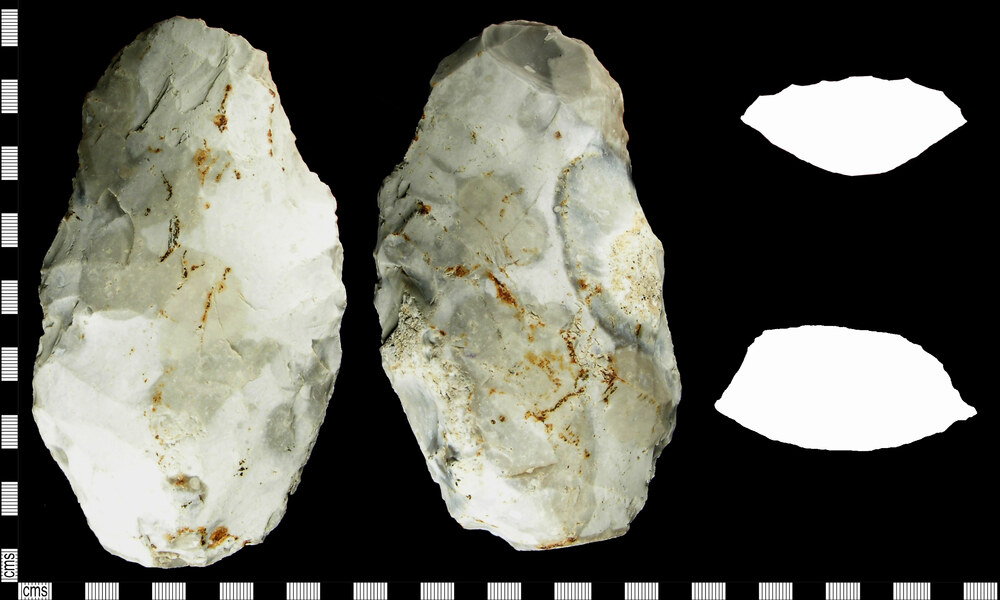
Curiously, the Acheulean industry is absent from eastern Asia (China, Java, Korea, Japan) - a phenomenon known as the "Movius Line" since Hallam Movius's 1948 study. This cultural or biogeographic boundary separates western Acheulean populations from Asian populations probably equipped with bamboo and wooden tools that have not survived the millennia. The Movius Line does not necessarily reflect cognitive inferiority in Asian populations: bamboo is an excellent material for making sharp, firmly hafted, lightweight tools, abundantly available in South-East Asian forests. The absence of flint handaxes therefore does not imply the absence of an elaborate material culture, but simply its invisibility in the archaeological record.
The longevity of the Acheulean industry is striking: it was produced for more than one million years with virtually no significant variation. This stability was long interpreted as evidence of limited innovative capacity, even of near-instinctive "automatic" behaviour. More recent research nuances this picture: the Acheulean in fact conceals considerable local variability, and some sites show clear regional adaptations to available raw materials, prey hunted, and environmental constraints. The standardisation of the handaxe is not the rigidity of instinctive behaviour but the stability of a cultural skill transmitted across generations over geological timescales that defy the imagination.3
Mastering Fire: The Decisive Turning Point
The question of Homo erectus's domestication of fire is one of the most debated in paleoanthropology. The earliest direct and uncontested evidence of fire use comes from Wonderwerk Cave in South Africa, where infrared spectroscopy and Raman spectroscopy detected burnt plant remains and calcined bones in layers dated between 1.0 and 1.8 million years ago, in a study published in PNAS in 2012 by Francesco Berna and colleagues. These data are compatible with fire use by Homo erectus or one of its immediate predecessors.
Other African sites provide ambiguous but suggestive evidence. At Chesowanja (Kenya, ~1.4 Ma), baked clays in stratigraphic position confirm intense heat, but natural lightning fires cannot be entirely ruled out. At SwartkransSwartkransA fossil-bearing cave in the Cradle of Humankind, South Africa, rich in remains of Paranthropus robustus and early tools.→ (South Africa, ~1.5-1.0 Ma), darkened and calcined bones in suspicious proportions have been interpreted as traces of repeated fires in an inhabited space. Similar results at GnJh-03 in the Omo Valley (Ethiopia) and at Koobi Fora (Kenya) suggest that opportunistic use of fire - maintaining a naturally occurring fire rather than deliberately producing one - may go back more than 1.5 million years.
In Asia, the site of Zhoukoudian (China) yields the most complete evidence of fire management by a Homo erectus population: ash layers, burnt bones and seeds in apparently recurrent hearths, dated between 780,000 and 400,000 years ago. Layer 10 at Zhoukoudian contained ash accumulations over one metre deep, suggesting near-permanent fire use over extended periods. Other Near Eastern sites such as Qesem Cave in Israel (~300,000-800,000 years), and European sites such as Beeches Pit in Britain (~400,000 years) and Terra Amata in France (~380,000 years), suggest that fire was used with competence and regularity long before the appearance of Homo sapiens.
The consequences of this mastery of fire are incalculable. Biologist Richard Wrangham, in his book Catching Fire (2009), advanced the hypothesis that cooking food is the primary cause, not consequence, of human brain expansion: cooked foods are easier to chew, require less energy to digest, and release more bioavailable calories to fuel an energetically costly brain. The theory remains debated, but it points to an incontestable fact: Homo erectus ate cooked food, which transformed its morphology (smaller teeth, shorter intestine) and likely its social life. Fire protects at night, repels predators, gathers groups, and creates conditions for richer socialisation. It also extends the active day beyond sunset, creating conditions for nocturnal social life and the oral transmission of knowledge to which Homo sapiens owes so much.4
Out of AfricaOut of AfricaThe dispersals of Homo sapiens out of Africa, including a major expansion c. 70,000 to 60,000 years ago and earlier exits.→: The First Conquest of the World
One of the most remarkable facts in the natural history of Homo erectus is that it left Africa long before anyone imagined possible. Until the 1990s, scientific consensus placed the first out-of-Africa dispersal at around 1.0 million years ago. The discovery of the Dmanisi fossils in Georgia overturned this timeline dramatically and durably.
Dmanisi is a medieval site in Georgia where hominin fossils were discovered in volcanic sediments dated to approximately 1.85 million years ago. Five individuals have been identified, including a complete skull (D4500, known as "the skull of the lord") combined with a mandible (D2600) in 2013 by David Lordkipanidze and colleagues, published in Science. This complete skull, with a cranial capacity of just 546 cc - the lowest ever found for a Homo outside Africa - belongs to an individual who nevertheless reached adulthood, as attested by dental wear and cranial suture fusion. It suggests that the first African emigrants were physically modest individuals, with brains smaller than the average H. erectus, yet capable of crossing the Caucasus and settling in what is now Georgia 1.85 million years ago.
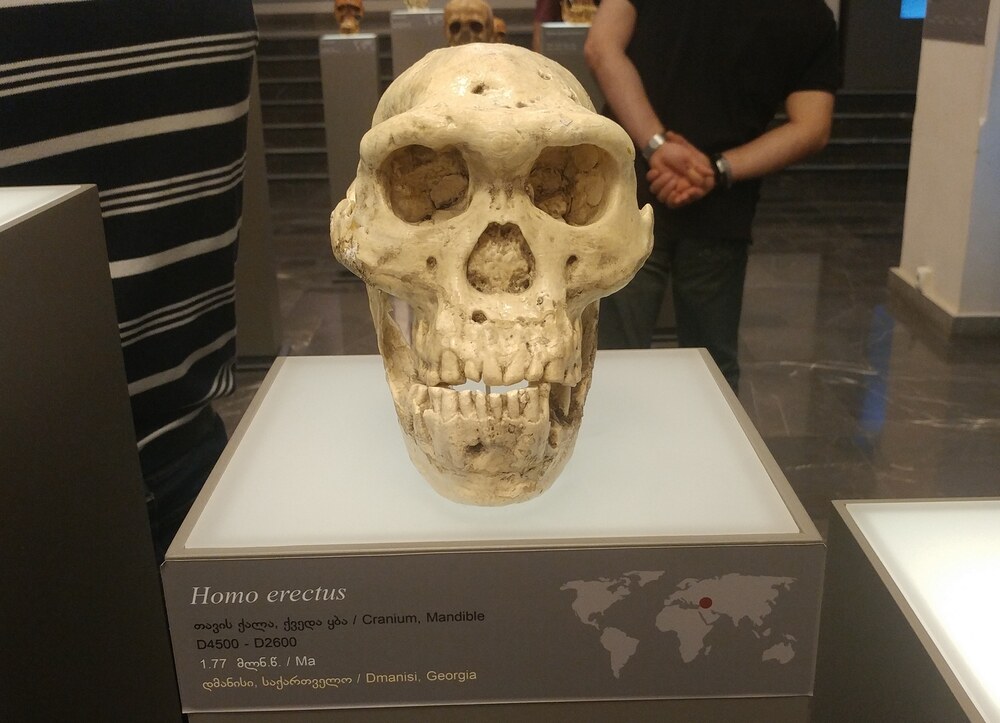
The morphological variability observed among the five Dmanisi individuals is remarkable: had these five fossils been found on five different sites, researchers would probably have classified them as five different species. This observation led David Lordkipanidze to propose that the diversity seen among early Homo, often presented as evidence for multiple species, may instead reflect the normal intraspecific variability of a single species: Homo erectus sensu lato. This "lumping" hypothesis is not accepted by all, but it has profoundly renewed the taxonomic debate and urged caution in describing new species on the basis of single fossils.
The dispersal of Homo erectus beyond Africa then proceeded in several directions and several waves over time. In the Near East, the site of Ubeidiya (Israel) yields Acheulean tools dated to ~1.5 Ma, probably produced by groups in transit toward Asia. In South-East Asia, numerous Java sites (Sangiran, Trinil, Ngandong) span from ~1.6 million years ago to a remarkably recent date: the Ngandong (Solo Man) specimens were redated in 2019 to between 108,000 and 117,000 years ago, in a Nature study by Yan Rizal and colleagues. H. erectus thus survived in Java until close to 100,000 years before our era, contemporary with the first Homo sapiens already present in Africa and the Near East. In China, Peking Man (Zhoukoudian, 780,000-400,000 years), the Lantian specimens (~1.15 Ma), and Hexian (~250,000 years) document a long and dense colonisation of eastern China, with several phases of population arrival. Whether Homo erectus reached Europe remains open: some tools and isolated teeth suggest an early presence, but direct fossil evidence before 800,000 years ago is rare.5
Behaviour, Society and Cognition
Beyond technology and geography, what do we know of Homo erectus's behaviour? Direct data are rare, but several lines of evidence allow us to sketch a coherent and nuanced portrait.
Hunting and diet: the faunal assemblages associated with Homo erectus at Zhoukoudian include remains of deer, rhinoceros, hyenas, horses, and even bears - a varied and often large-bodied fauna. The fragmentation of bones and cut marks on skeletal elements suggest repeated and organised access to large prey carcasses. Whether H. erectus was an active hunter or an opportunistic scavenger remains debated in the specialist literature, but evidence for cooperative hunting is growing. In Africa, butchery traces at Olorgesailie (~1.2 Ma) and the Kilombe assemblages (Kenya, ~1 Ma) suggest systematic exploitation of large fauna. Recent taphonomic studies at several African sites show that H. erectus had access to carcasses before carnivores, arguing strongly for active hunting rather than secondary scavenging.
Social life: one of the most moving pieces of direct evidence for Homo erectus's social organisation comes from Dmanisi. Individual D3444 had lost all its teeth years before death, as shown by the complete resorption of the alveolar bone in both jaws. This individual could not have chewed solid food alone. It was therefore fed by its companions for several years, perhaps receiving pre-chewed or cooked food - perhaps the oldest documented evidence of deliberate care for a debilitated group member in the human lineage. This observation, published by Lordkipanidze in Nature in 2005, predates similar examples in NeanderthalsNeanderthalsA fossil humanity of Eurasia, robust and cold-adapted, extinct around 40,000 years before present.→ at La Chapelle-aux-Saints by more than one million years.
Cognition and symbolism: was Homo erectus capable of language? The question remains open and divides researchers. The configuration of its spinal canal - narrower than ours - suggests a finer respiratory control was lacking, potentially incompatible with complex articulate speech. However, brain size, tool complexity, and traces of symbolic behaviourSymbolic behaviourA set of practices (adornment, pigments, art, burial) reflecting symbolic thought; long ascribed to Homo sapiens alone, now attested for Neanderthals too.→ suggest advanced cognitive abilities. The Trinil engraving on a Pseudodon shell, ~500,000 years old, discovered by Wil Roebroeks in 2014, is considered the oldest known trace of potentially symbolic behaviour in the genus Homo. Shells perforated and coloured with ochreOchreA red or yellow mineral pigment (iron oxides), used from prehistory for adornment, funerary rites and art.→ at Koobi Fora (Kenya, ~285,000 years) may represent the earliest known personal ornaments in the human lineage, long before these practices became systematic in Homo sapiens.6
The vocal communication question deserves further attention. Studies of the hyoid bone - the small horseshoe-shaped bone supporting the tongue, crucial for speech production - found in Neanderthal specimens have shown a structure close to ours. For Homo erectus, this bone is rarely preserved, but known specimens suggest an intermediate morphology compatible with more elaborate vocal abilities than those of living great apes. When we combine this with brain size, the social complexity implied by care for debilitated individuals, and the coordination required for cooperative large-game hunting, it becomes difficult to deny that some form of elaborated vocal communication - even if very different from modern human language - was probably present in at least the later populations of Homo erectus. This proto-communication would have played a crucial role in coordinating hunting groups, transmitting lithic techniques across generations, and maintaining the social cohesion of nomadic bands crossing thousands of kilometres of unfamiliar terrain.
The study of growth signatures in Homo erectus teeth has provided valuable data on the species' pace of life. Retzius lines, microscopic incremental lines visible on dental enamel that form at regular intervals like growth rings in wood, have been analysed in several specimens. Results suggest a faster rate of dental growth than in Homo sapiens, consistent with an accelerated developmental schedule. This information adds texture to our portrait of Homo erectus: a species faster in its maturation, probably shorter in individual lifespan, but extraordinarily efficient in adapting to environments as different as the equatorial forests of Java and the temperate steppes of northern China over geological timescales. It is this combination of biological flexibility and cultural innovation, not brute physical superiority, that explains the species' unparalleled success across two million years of Earth history.
Homo erectus's capacity for geographic range expansion also reveals striking ecological adaptability. Unlike most large primates, which are tied to specific biomes, H. erectus thrived in tropical forests, open savannas, temperate woodlands, and semi-arid environments. This plasticity, rare in the hominin lineage before H. erectus, was almost certainly enabled by the combination of fire use, cooperative hunting, and flexible dietary strategies. The ability to cook food, in particular, dramatically expanded the range of edible resources available: roots, tubers, seeds, and animal products that would otherwise be toxic or indigestible became nutritious and safe once subjected to heat. This dietary flexibility was probably the single most important factor in H. erectus's extraordinary geographic success, allowing groups to colonise new environments far from their ancestral African homeland without waiting for the slow pace of genetic adaptation.
The Ancestor of Ancestors: Homo erectus and Its Descendants
Homo erectus is not only a fascinating species in its own right: it is the starting point for all the human species that followed. The question of its replacement and descendants is among the most complex in paleoanthropology, and the debates are far from closed.
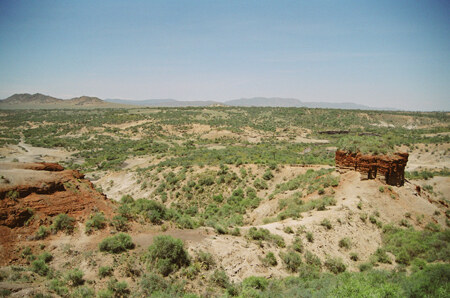
In Africa, Homo erectus (in its African form sometimes designated H. ergaster) appears to transform progressively, between 800,000 and 300,000 years ago, into an intermediate species: Homo heidelbergensisHomo heidelbergensisMiddle Pleistocene human species, often seen as the common ancestor of Neanderthals and our own species.→, displaying a larger brain (1,100-1,400 cc), a less prognathic face, and more elaborate technology including the Levallois techniqueLevallois techniqueA Middle Palaeolithic flint-knapping method: a core is prepared so a flake of predetermined shape can be struck off in one blow; a hallmark of Neanderthal skill.→ of core preparation. It is probably African H. heidelbergensis that is the direct ancestor of Homo sapiens, which appeared around 300,000 years ago in Morocco at Jebel IrhoudJebel IrhoudA prehistoric site in Morocco, west of Marrakesh, which yielded the oldest known Homo sapiens fossils, dated to about 300,000 years ago.→, according to Jean-Jacques Hublin's landmark 2017 Nature study. The European lineage of H. heidelbergensis leads to Neanderthals and Denisovans, whose genomes reveal separation from the sapiens lineage approximately 550,000-765,000 years ago according to the most recent molecular clock estimates.
In eastern Asia, the fate of Homo erectus is more complex and even more surprising. Its disappearance in China around 400,000 years ago coincides with the arrival of more advanced populations, but late specimens persist in Java until ~108,000 years ago. Some researchers propose that the H. erectus populations of Java gave rise, through successive insular dwarfismInsular dwarfismReduction in the body size of an animal species due to island isolation, where resources are limited and predators absent. Explains the small stature of Homo floresiensis.→ during periods of isolation on Flores, to Homo floresiensis - the celebrated "hobbit" of Flores (60,000-100,000 years ago), whose cranial capacity does not exceed 400 cc. This hypothesis remains debated but is one of the most credible for explaining the origins of this enigmatic being, whose anatomy blends very primitive traits (wrist bones, shoulder morphology) with adaptations specific to island life.7
Finally, the question of Homo erectus's relationship to megafaunal extinctions is increasingly studied. In several regions of Asia, the disappearance of certain large herbivore species (woolly rhinoceroses, stegodons, large bovids) coincides with periods of Homo erectus expansion. While it is difficult to disentangle human responsibility from the climatic changes of the PleistocenePleistoceneThe geological epoch of the great ice ages (c. 2.6 Ma–11,700 BP), spanning most of human prehistory.→ in these extinctions, some researchers propose that intensive hunting by H. erectus groups may have exerted significant pressure on large mammal populations, foreshadowing the devastating role Homo sapiens would play on global megafaunaMegafaunaThe very large animals (mammoths, giant ground sloths, etc.) of the Pleistocene, most of which became extinct at the end of the last ice age.→ after its dispersal from Africa.
The study of Homo erectus's geographic range also reveals a striking capacity for ecological adaptability. Unlike most large primates, which are tied to specific biomes, H. erectus thrived in tropical forests, open savannas, temperate woodlands, and even semi-arid environments. This plasticity, rare in the hominin lineage before H. erectus, was almost certainly enabled by the combination of fire use, cooperative hunting, and flexible dietary strategies. The ability to cook food, in particular, dramatically expanded the range of edible resources available: roots, tubers, seeds, and animal products that would otherwise be toxic or indigestible became nutritious meals once subjected to heat. This dietary flexibility was probably the single most important factor in H. erectus's extraordinary geographic success.
One of the most remarkable and underappreciated aspects of Homo erectus's story is its sheer persistence. One point eight million years is a duration almost impossible to grasp in human terms. For perspective: the entire history of our own species, Homo sapiens, from its emergence in Morocco 300,000 years ago to the present day, represents less than one-sixth of the time Homo erectus spent on Earth. During those 1.8 million years, our planet experienced dozens of glacial and interglacial cycles, sea levels rose and fell by hundreds of metres, entire mountain ranges were uplifted, and vast forests became deserts and back again. Through all of this, Homo erectus survived and in many periods thrived, adjusting its behaviour and range in response to environmental pressures without the benefit of the writingWritingA system of conventional signs used to fix language or information durably; its appearance (c. 3300 BC) marks, by convention, the end of prehistory.→, agricultureAgricultureThe cultivation of plants and production of food by working the soil, which emerged in the Neolithic in the Near East and independently elsewhere; it radically transformed human societies.→, or global communication networks that help Homo sapiens navigate change.
The disappearance of Homo erectus is itself an intriguing puzzle. In Africa, it seems to have transformed gradually into Homo heidelbergensis. In China, it was apparently replaced by more advanced populations. But in Java, the latest dates of 108,000-117,000 years ago suggest it survived in relative isolation - potentially alongside Homo sapiens, which had already reached the Near East - before finally vanishing. The reasons for its final disappearance in South-East Asia remain unclear. ClimateClimateThe long-term average atmospheric conditions of a region; its variations (glaciations, aridifications) shaped migrations, agriculture and the collapse of prehistoric societies.→ change, competition with more cognitively advanced hominins, or simply the accumulated demographic pressures of an island population with no connection to continental gene pools may all have played roles. The story of Homo erectus does not end with a dramatic extinction event but with a quiet fading, on a tropical island, of the lineage that once straddled three continents.
Understanding Homo erectus is, in the end, understanding what it means to be human at its most fundamental: a curious, adaptable, socially bonded creature capable of crossing deserts and oceans, caring for its vulnerable, and passing its knowledge to the next generation across the geological deep of time.
Open Questions
More than a century after Dubois's discovery, Homo erectus continues to pose questions science has not yet fully answered. The first and most fundamental concerns the delimitation of the species itself: one species or several? The morphological variability between early African specimens, Asian specimens, the Dmanisi individuals, and late Javanese specimens is very large. Cranial capacity alone varies by a factor of two (from 546 to 1,250 cc), exceeding the variability observed in many living primate species. Some researchers maintain the specific unity of H. erectus, emphasising the normal intraspecific variability illustrated by Dmanisi. Others prefer to retain the distinction between H. ergaster (Africa) and H. erectus (Asia), or to recognise several distinct species based on precise craniometric differences.
The second major question concerns the relationship between Homo erectus and Homo antecessor, a species described in 1997 from the Gran Dolina fossils (AtapuercaAtapuercaA complex of archaeological sites in the Sierra de Atapuerca (Burgos, Spain), a UNESCO site, yielding an exceptional sequence of human fossils, including the Sima de los Huesos and Homo antecessor.→, Spain), dated to approximately 800,000 years ago. Homo antecessor shares modern traits with Homo sapiens not found in H. erectus sensu stricto, particularly in sub-nasal facial morphology. Was it the common ancestor of Neanderthals and Sapiens, as proposed by its describers Jose Maria Bermudez de Castro and Eudald Carbonell? A lateral descendant of European H. erectus? PalaeoproteomicspalaeoproteomicsThe study of ancient proteins preserved in fossils; more resistant than DNA, they allow remains to be identified where the genome has vanished.→ analyses published in Nature in 2020 by Welker and colleagues suggest that H. antecessor is a basal taxon relative to Neanderthals and Sapiens, further complicating an already complex phylogenetic tree.
The third question concerns the nature of the first out-of-Africa. The Dmanisi fossils show that morphologically modest individuals were capable of colonising the Caucasus 1.85 million years ago. But is Dmanisi representative of the whole phenomenon, or does it represent a particularly adventurous population from a contact zone between Africa and Eurasia? Near Eastern sites (Ubeidiya, Israel, ~1.5 Ma) and Java (~1.6 Ma) suggest multiple dispersal waves occurred, not necessarily linked to one another. The exact route taken also remains debated: the Nile corridor, the Sinai isthmus, the Indian Ocean coastal route? Ancient DNAAncient DNAGenetic material preserved in old remains, often degraded, sequenced with cutting-edge techniques.→ cannot yet answer these questions, as no genetic material has been preserved in fossils this old from Africa or tropical Asia.
Finally, the possible relationship between Homo erectus and Homo floresiensis remains genuinely open. If the hobbit of Flores is a dwarfed descendant of H. erectus, then the legacy of our ancient ancestor extends further than we imagined, across the island chains of South-East Asia, to a world that H. sapiens barely reached before these last survivors disappeared. Homo erectus, in that scenario, would be not just our ancestor but the ancestor of an entire parallel branch of humanity, extinguished less than 100,000 years ago while modern humans were already painting caves in Europe. The full implications of that possibility are only beginning to be understood.7
No comments yet. Be the first.