On 28 October 2004, the journal Nature published two articles that would overturn global palaeoanthropologyPalaeoanthropologyThe science that studies human evolution from the fossil remains of hominins (bones, teeth, footprints) and their context, to reconstruct our biological origins.→. Excavations conducted in the Liang Bua Cave on the island of Flores in Indonesia had just yielded the bones of an adult female homininHomininMember of the subtribe Hominina, comprising the human lineage (Homo, Australopithecus, Paranthropus…) but excluding orangutans and gibbons. The term progressively replaces "hominid" in its narrow sense.→ aged around thirty, standing no more than 106 centimetres tall, with a brain volume of approximately 380 cm3 -- comparable to that of a chimpanzee. The species was named Homo floresiensis. The press immediately gave it the nickname "Hobbit", a reference to Tolkien's small humanoids, and the main specimen was designated LB1, for Liang Bua 1. Twenty years later, Homo floresiensis remains one of the most astonishing and debated paleoanthropological discoveries of the 21st century.1
Liang Bua Cave: an exceptional site
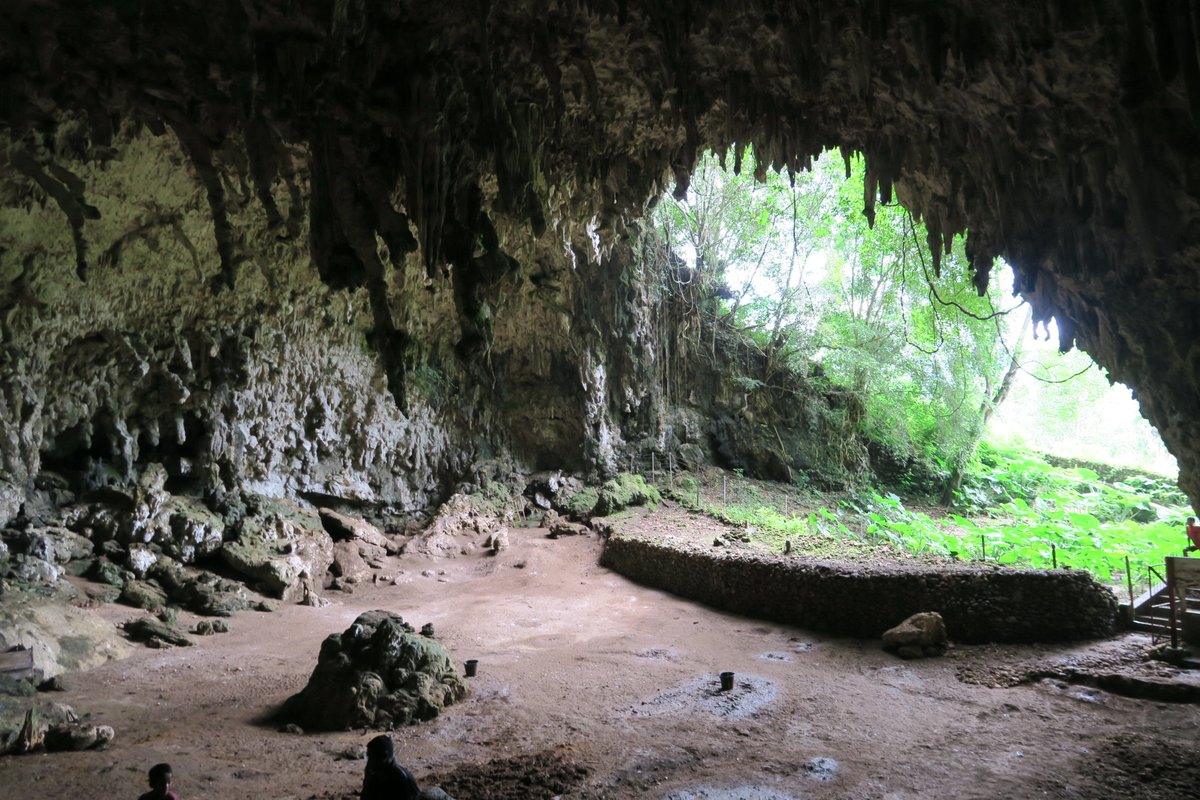
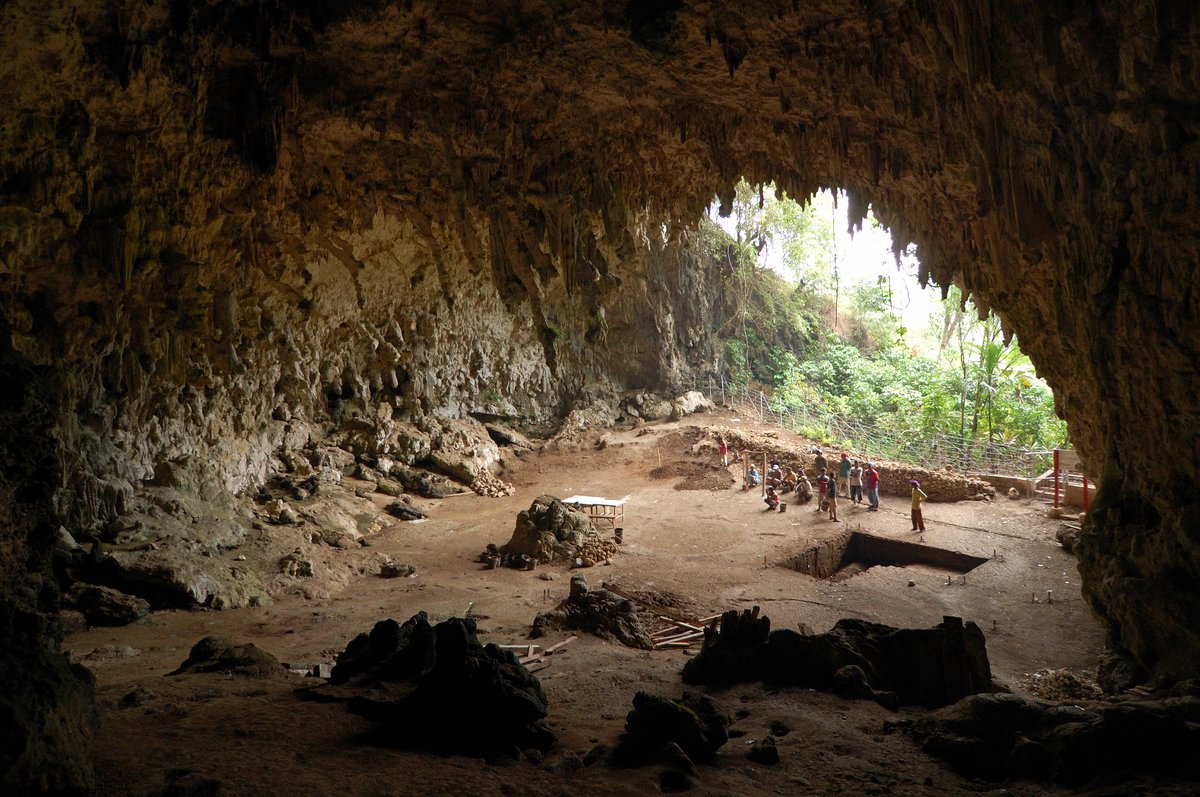
Liang Bua ("cool cave" in the local language) is a large cavern carved into a limestone massif in western Flores, about 14 kilometres north of the town of Ruteng. Long known to local inhabitants, it had already been the subject of exploratory excavations in the 1950s and 1970s under the direction of Father Theodor Verhoeven, a Dutch priest and amateur archaeologist who reported the presence of fossil bones and stone tools in its sediments. The systematic excavations resumed from 2001 by an Australian-Indonesian team led by Mike Morwood (University of New England) and Radien Soejono (National Archaeological Research Centre of Indonesia) would prove extraordinarily rich.2
The cave is excavated on several levels. Its sedimentary deposits, accumulated over tens of millennia, contain a succession of well-stratified archaeological and palaeontological layers, allowing a precise reading of successive occupations. It was in levels dated to between approximately 100,000 and 60,000 years ago (later revised -- see below) that the bones of Homo floresiensis were unearthed, associated with stone tools, faunal remains and, in a more recent level, traces of fire. The preservation of the bones, protected by moist sediment and carbon dioxide naturally concentrated in the cave, is remarkable for fossils of this age in a tropical environment.
The anatomy of LB1: an extraordinary hominin
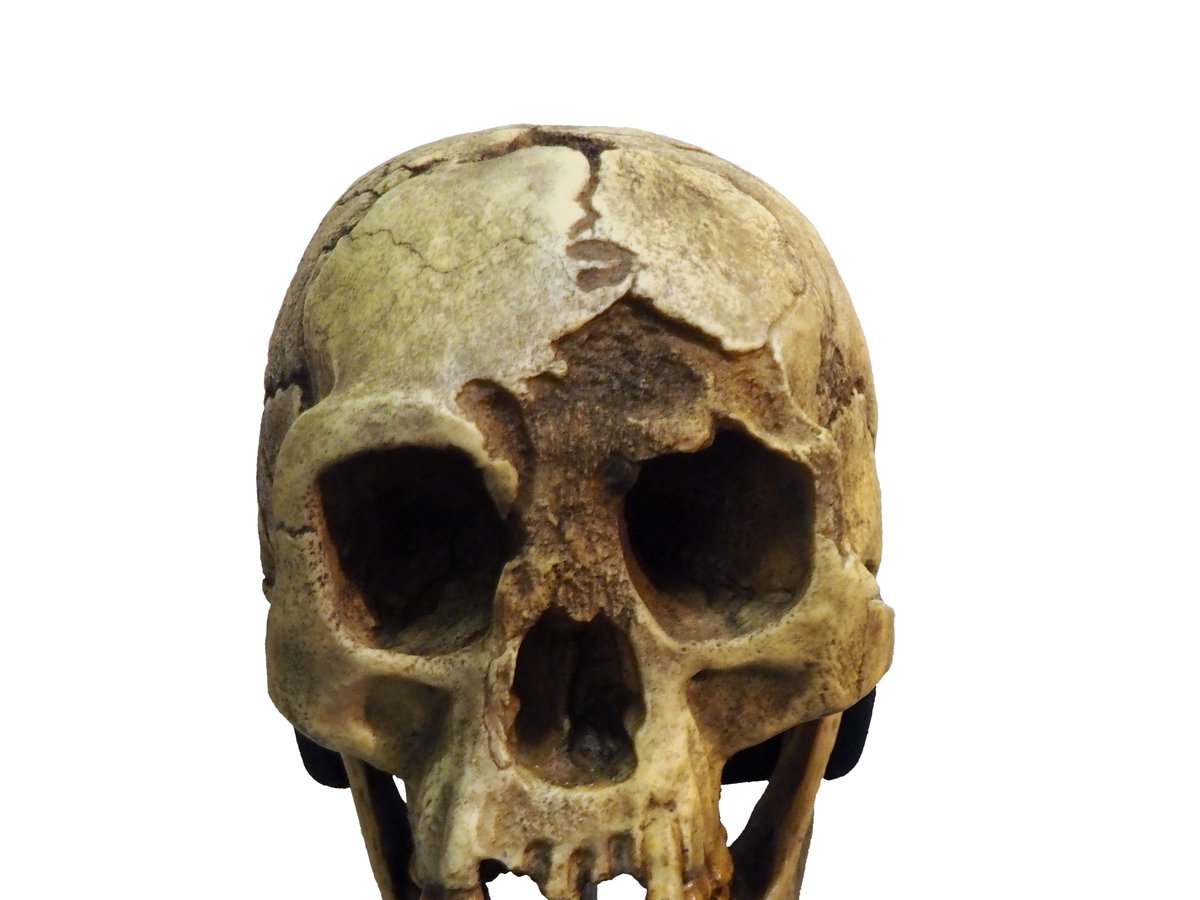
Specimen LB1 is remarkably well preserved for a tropical fossil: it comprises an almost complete skull, a mandible, fragments of upper and lower limbs, hip bones and foot bones. Other less complete individuals have been identified in the cave (LB2 through LB9 among others), confirming that LB1 is not an aberrant individual but a typical representative of a population.
The anatomical characteristics of LB1 are extraordinary in several respects. Adult stature is estimated at 106 cm, well below the known variability of any adult Homo, including African Pygmies. The cranial volume of 380 cm3 is lower than most Australopithecus and close to that of Homo habilis. The brow ridges are reduced. The face is relatively flat. The skull is globally rounded but with a receding forehead. The limb bones are robust relative to body size but gracile in absolute terms. The pelvis is flared, more analogous to that of Homo erectus than to that of Homo sapiensHomo sapiensThe present-day human species, which emerged in Africa around 300,000 years ago, the only surviving human lineage after the extinction of Neanderthals and Denisovans.→.3
The study of the endocranium (internal cast of the skull) by Dean Falk and colleagues, published in Science in 2005, reveals that despite its reduced volume, LB1's brain presents a complex architecture with developed temporal lobes and a frontal lobe displaying certain advanced evolutionary features. This miniaturised brain is not simply a scaled-down ape brain: it has its own organisation that distinguishes it from human microcephalics and chimpanzees.4
Island dwarfism: Foster's rule in action
How can an adult hominin weigh 25 to 30 kg and measure less than 1.1 metres? The key to the enigma lies in insularity. The phenomenon of island dwarfism, formalised by biologist J. Bristol Foster in 1964 under the name the "island rule", is well documented in the animal kingdom: on islands, large species tend to reduce their size over long periods, while small species tend to increase. The mechanism is linked to selective pressures specific to island environments: limited and fluctuating food resources, absence of certain predators, reduced intraspecific competition.
Classic examples of island dwarfism include the dwarf elephant of Cyprus (Palaeoloxodon cypriotes), the dwarf mammoth of Crete and the Mediterranean islands, the dwarf mammoth of Wrangel Island in Siberia (which survived until 4,000 years ago, contemporary with the first Egyptian pyramids), and the dwarf rhinoceros of Flores. Flores itself provides a spectacular example with its Stegodon florensis insularis, an elephantid whose size decreased over insular time to represent less than a third of the size of its continental ancestors.5
For primates, island dwarfism is attested in both fossil and living species. The hypothesis that the ancestors of Homo floresiensis underwent this process is therefore biologically plausible. A Homo erectus averaging 60 to 70 kg on the continent could have had insular descendants who reduced their body mass by half or more over a hundred thousand years -- a few thousand generations -- a very short timespan at an evolutionary scale but not impossible if selective pressures were strong.
The probable ancestor: Homo erectus or an older lineage?
Which species gave rise to Homo floresiensis? This is one of the most debated questions since the discovery. The first hypothesis, defended by Morwood and his team, identified Homo erectus as the most probable ancestor. Homo erectus is attested on Java from at least 1.5 million years ago (Sangiran site), and Flores could be reached from Java via accidental or intentional sea crossings over short distances, even during glaciations when sea levels were lower (the Flores Sea retained deep channels between the islands).6
The 2016 discovery by Van den Bergh and colleagues of hominin fossils at the Mata Menge site, in central Flores, dated to approximately 700,000 years ago, shed new light on the matter. These fossils, represented by a tooth and mandible fragments, belong to a hominin of even smaller size than LB1, pushing the appearance of dwarfism back to a much earlier period. The authors conclude that the ancestors of Homo floresiensis were probably already small-bodied shortly after their arrival on the island. The rapidity of the dwarfism process is surprising and suggests strong selective pressure.7
In 2017, Argue et al. published in the Journal of Human Evolution a cladistic analysis of 133 anatomical characters of LB1 compared with those of 11 hominin species. Their surprising results place Homo floresiensis at the base of the genus Homo, as a sister species of Homo habilis, rather than as a derivative of Homo erectus. If confirmed, this would imply that an archaicArchaicRefers to an ancient, now-extinct human population or form (Neanderthals, Denisovans, ghost lineages), as opposed to anatomically modern humans.→ hominin population -- the common ancestor of Homo habilis and later species -- colonised South-East Asia much earlier than thought, and that Homo floresiensis is the surviving insular representative of this very ancient dispersal.8
Stone tools: a cognitive paradox?
One of the most puzzling characteristics of Homo floresiensis is the relative sophistication of its toolmaking compared with the smallness of its brain. The Liang Bua tools, dated from the same stratigraphic levels as the bones, include stone flakes, scrapers, points and retouched-edge tools, made primarily from local limestone and chert. Their manufacturing technique, while not Levallois, involves multi-step planning and fine motor control.9
These tools are associated with burned and fractured Stegodon bones, suggesting active hunting or systematic carcass exploitation, and with Komodo dragon (Varanus komodoensis) bones that could represent prey or a hazard. The ability to hunt or process animals as large as a dwarf elephantid with stone tools, for a hominin the size of a six-year-old child, implies sufficient social coordination and communication to organise such an enterprise.
Even older tools have been identified on Flores itself, at the Wolo Sege site, dated to 1.02 million years ago, and at Mata Menge (700,000 years). These tools predate LB1's fossils by several hundred thousand years and show that human presence on the island is much older than the initial results suggested. The Mata Menge tools, published by Brumm et al. in Nature in 2016, display a technology comparable to that of Lower PleistocenePleistoceneThe geological epoch of the great ice ages (c. 2.6 Ma–11,700 BP), spanning most of human prehistory.→ Homo erectus tools from South-East Asia, reinforcing the erectus ancestry hypothesis.10
The 2016 chronological revision
The initial chronology of Homo floresiensis, published in 2004, placed the species' presence in the cave between 95,000 and 12,000 years before present -- an exceptionally late range implying coexistence with modern Homo sapiens on the island (the earliest evidence of modern human presence on Flores is dated to approximately 11,000 to 46,000 years ago). In 2016, Sutikna et al. published in Nature a radical revision of this chronology after several years of re-analysis of sediments and dates.11
The new analyses, using multiple methods (optically stimulated luminescence, uranium series, radiocarbon), revealed that all Homo floresiensis fossils are confined to layers dated between 100,000 and 60,000 years before present. Previous dates younger than 20,000 years corresponded to sedimentary reworking: bones and tools had been disturbed by geological processes (floods, slumping) and were found in more recent stratigraphic levels without being primary in those levels. This revision eliminates direct coexistence between Homo floresiensis and Homo sapiens at Liang Bua, though it does not exclude it elsewhere on the island or in other caves not yet excavated. It also leaves open the question of the causes of the species' disappearance.
The pathology controversy
As early as 2006, a team led by Teuku Jacob (Gadjah Mada University, Yogyakarta), an Indonesian anthropologist of authority who had temporarily confiscated the original fossils for his own study, published in PNAS the hypothesis that LB1 was a modern Homo sapiens affected by microcephaly, a congenital cranial malformation producing a small brain often associated with growth retardation. This hypothesis was taken up and diversified by other researchers who proposed alternatively endemic cretinism (iodine deficiency from Flores' volcanic soils), Down syndrome, congenital hypothyroidism or Laron syndrome (growth hormone insensitivity).12
These pathological hypotheses have been systematically refuted along several lines of evidence. First, the presence of at least twelve individuals in the cave, all displaying the same miniaturised anatomical characteristics, excludes a pathological individual case: a pathology cannot affect an entire population in a coherent manner. Second, the endocranial analyses of LB1 show a cerebral organisation distinct from that observed in all known clinical cases of microcephaly. Third, the limb proportions of LB1 do not correspond to pathological growth retardation profiles. Fourth, comparison with the contemporary Flores population reveals no endemic dwarfism related to cretinism or other deficiencies.13
The fauna of Flores: a unique island ecosystem
The island of Flores, whose Portuguese name evokes the flowers of its coastal trees, is a volcanic island of 14,000 km2 located east of Bali and west of Timor. It is separated from its neighbours by deep straits that were never crossed on foot, even during the low sea-level periods of glaciations. This isolation produced an extraordinary Pleistocene fauna, documented since Verhoeven's excavations in the 1950s.14
The fauna associated with Homo floresiensis in the Liang Bua layers includes Stegodon florensis insularis, an elephantid whose shoulder height did not exceed 1.2 metres -- the size of a large buffalo (the ancestral subspecies, Stegodon florensis, measured about 2 metres at the shoulder). It also includes giant rats (Floresomys, Hooijeromys) the size of rabbits or small pigs, giant tortoises, giant flightless birds (strigopids related to kakapo parrots), and of course the Komodo dragon (Varanus komodoensis), the world's largest living lizard, whose ancestors colonised Flores approximately 4 million years ago from Australia. This assemblage reflects the classic rules of island evolution: gigantism in small vertebrates (rats), dwarfism in large vertebrates (Stegodon), diversification of flightless birds in the absence of terrestrial mammalian predators.
Extinction and folk memory
The reasons for the disappearance of Homo floresiensis remain unknown. The 2016 chronological revision placing the last fossils at 60,000 years before present coincides with a phase of intense volcanism on Flores: the cave presents a tephraTephraA generic term for all the solid fragments (ash, lapilli, pumice, blocks) ejected into the air by a volcanic eruption. Tephra layers serve as precise chronological markers (tephrochronology) across vast regions.→ layer (volcanic ash deposit) dated to approximately 60,000 years ago, which marks the end of Homo floresiensis presence in the Liang Bua stratigraphyStratigraphyThe study of the superimposed layers (strata) of an archaeological site; each layer corresponds to a phase of occupation and yields a relative chronology.→. A major volcanic eruption could have devastated the local fauna and flora to the point of ending the population of an already numerically fragile species on its sole island.
Another hypothesis is the arrival of Homo sapiens on the island, whose oldest traces on Flores are dated to approximately 46,000 years ago. If Homo floresiensis populations had survived beyond the 60,000 years documented at Liang Bua (in other caves not yet excavated, for example), direct or indirect competition with modern humans could have precipitated their extinction.
What makes the question even more fascinating is the existence, in the oral traditions of Flores populations, of a creature called Ebu Gogo (literally "grandmother who eats everything" in the local language). Described as a small bipedal being, covered in hair, with large eyes, speaking an unintelligible language and repeating human words like a parrot, the Ebu Gogo occupies a place in local mythology comparable to that of the Yeti in the Himalayas or Bigfoot in North America. Accounts mention it as late as the 18th century, surviving in forest caves in the interior and making incursions into villages to steal food. Mike Morwood and other researchers suggested that these traditions might preserve a distant cultural memory of coexistence with Homo floresiensis, surviving culturally across millennia after the biological disappearance of the species. The hypothesis is compelling but unverifiable.
A mirror on our own evolution
The discovery of Homo floresiensis had considerable impact beyond paleoanthropology alone. It reminded the scientific community that the human fossil record is profoundly incomplete, that entire species may have existed without our having the slightest evidence, and that insular South-East Asia, long neglected in favour of AfricaAfricaThe cradle of humankind: the continent where the first hominins appeared, then Homo sapiens around 300,000 years ago, before the expansion to the rest of the world.→ and Europe, almost certainly harbours further major surprises. It also raised fundamental questions about the relationship between brain size and behavioural intelligence: a hominin with a 380 cm3 brain manufactured tools and hunted large animals, challenging implicit assumptions about correlations between cranial volume and cognitive capacity.
The Denisovans, discovered in 2010 in a Siberian cave, and the recent evidence of archaic human presence in the Philippines (Homo luzonensis, 2019) have shown that Homo floresiensis is not an isolated case but one of the representatives of a human diversity in insular South-East Asia far greater than previously imagined. The image of a linear human evolution, from a single migratory flow, has definitively given way to a picture of diversification, isolations, contacts and multiple extinctions whose complexity we are only beginning to perceive.15
No comments yet. Be the first.