There are fossils that confirm what we thought we already knew, and others that unsettle the entire edifice. Homo naledi belongs firmly to the second category. Unearthed from 2013 onward in the almost inaccessible depths of a South African cave system named Rising Star, its bones make up one of the richest assemblages of homininsHomininHomininMember of the subtribe Hominina, comprising the human lineage (Homo, Australopithecus, Paranthropus…) but excluding orangutans and gibbons. The term progressively replaces "hominid" in its narrow sense.A member of the human lineage in the broad sense, including modern humans, their ancestors and related great apes. ever recovered on the African continent. And yet, the more they are studied, the more they resist any clear classification. A small brain the size of an australopithecineAustralopithecineA genus of bipedal hominins from Africa (c. 4.2–1.9 Ma) with a brain still close to that of great apes (400–550 cm³) but walking upright. Lucy (<em>Au. afarensis</em>) is the most famous specimen.'s, but a hand capable of fine manipulation; the shoulders of an arboreal climber, but a foot almost identical to our own; and, in a dizzying surprise, a date that places them not in the remote reaches of our genealogy, but a mere few hundred thousand years from ourselves. Homo naledi is, in short, an impossible creature: a living mosaic of ancient and modern traits, surfacing from an age in which it should not have existed.

This article sets out to retrace the scientific and human adventure surrounding this baffling species: the spectacular discovery of the Dinaledi chamber by a team of excavators chosen for their slight build, the anatomical portrait of a being cut out for two worlds, the shockwave of an unexpected date, the burning debate over deliberate burials and engravings, and finally the most recent revelations of palaeoproteomicsPalaeoproteomicsThe study of ancient proteins preserved in fossils (bone, tooth enamel); can reveal species or sex when DNA is gone., which suggest that the studied skeletons may all be female. So many threads which, knotted together, make Homo naledi not an answer but a magnificent and inexhaustible question posed to the human family tree.

The discovery: Rising Star, Lee Berger and the extreme cavers

It all begins in the autumn of 2013, in the "Cradle of Humankind," that limestone region some forty kilometres north-west of Johannesburg, in South AfricaAfricaThe cradle of humankind: the continent where the first hominins appeared, then Homo sapiens around 300,000 years ago, before the expansion to the rest of the world., listed as a World Heritage Site for the exceptional density of its fossil deposits. Two amateur cavers, Rick Hunter and Steven Tucker, are exploring the Rising Star underground network when they squeeze through an extremely narrow vertical chute, later nicknamed the "Dragon's Back", a natural chimney whose tightest passage measures little more than eighteen centimetres across. At the end of this acrobatic descent, they emerge into a small isolated chamber strewn with bones. Aware of the possible importance of their find, they bring photographs back to palaeoanthropologist Lee Berger, a professor at the University of the Witwatersrand.

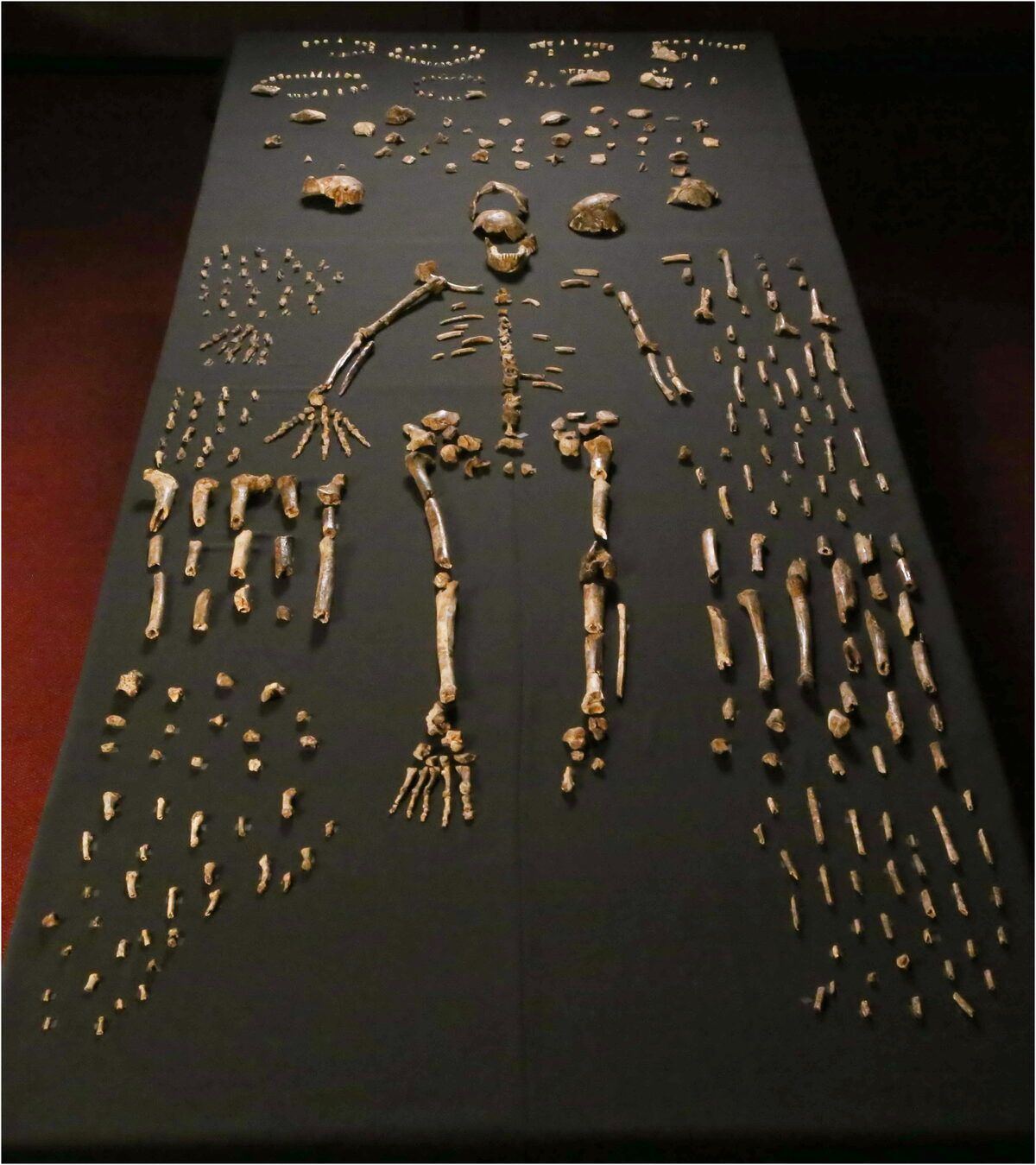
Skeletal specimens of Homo naledi displayed on a black background
A selection of Homo naledi specimens from the Dinaledi chamber: skulls, mandibles and long bones that make up one of the richest hominin assemblages in Africa., Source: Lee Roger Berger research team, CC BY 4.0 (Wikimedia Commons)

Berger immediately understands that he may be holding something exceptional. But a sizeable problem arises: no adult of his stature, nor even of that of most seasoned researchers, can hope to pass through the slot leading to the chamber. He then launches, in an unprecedented move, an appeal on social media to recruit scientists meeting a singular set of requirements: training in archaeology or palaeontology, caving experience, and above all a build slight enough to slip through an eighteen-centimetre fissure. Within days, applications pour in from around the world. Six women are selected, Marina Elliott, Becca Peixotto, Hannah Morris, Elen Feuerriegel, Alia Gurtov and Lindsay Hunter. The media will nickname them the "underground astronauts" or the "caving archaeologists," so closely does their mission, excavating a cramped, hostile space by the light of headlamps alone, resemble an extreme expedition.

The excavation operation, named the Rising Star Expedition, takes place in November 2013 and then in March 2014, watched over by a surface team that follows in real time, by camera and radio link, every gesture of the excavators. Within a few weeks, more than 1,500 bone fragments are brought up into the daylight, belonging to at least fifteen individuals of all ages, from infant to elder. Never before, in Africa, had a site yielded so many remains of a single hominin species in so short a time. The chamber is named Dinaledi, a word meaning "the stars" in Sesotho, echoing the name of the cave. And the species it reveals receives, in 2015, in a resounding announcement, the name Homo naledi, "naledi" also meaning star in that same language.

The initial publication, appearing in the open-access journal eLife, strikes minds as much by its content as by its method. Berger has chosen to play the card of open and rapid science: a description published less than two years after the discovery, scan data made available to all, a vast team of young researchers associated with the analysis. Some hail a salutary democratisation of palaeoanthropologyPalaeoanthropologyThe science that studies human evolution from the fossil remains of hominins (bones, teeth, footprints) and their context, to reconstruct our biological origins.; others worry about haste at the expense of rigour. The debate over how the science of naledi ought to be done will, from then on, only intensify.

One must also stress how much this discovery owes to chance and to the passion of enlightened amateurs. Without the dogged curiosity of two cavers willing to wriggle into a crack where no sensible being would venture, the Dinaledi chamber might have stayed sealed for centuries. Palaeoanthropology, a learned science par excellence, here owes one of its finest harvests to volunteer explorers driven by nothing but a taste for the unknown. This element of fortune, of an improbable meeting between field and laboratory, recalls that knowledge of the human past often advances along byways, and that great finds are born as much of luck as of method.

The material conditions of the dig, too, deserve a pause. To work in the Dinaledi chamber is to lie down in the dust, to crawl through passages where the whole body must make itself thin, to operate for hours by headlamp light, in constant communication with a team left on the surface. Each fragile bone had to be freed with extreme delicacy, photographed in situ, mapped in space, then brought up intact along the perilous route. The expedition was at once a classic archaeological excavation and an athletic feat, and it demanded a logistical coordination worthy of a scientific mission in an extreme environment. It is this meeting of protocol's rigour and adventure's daring that allowed a scientific treasure of unprecedented scale to be saved from oblivion.

A mosaic anatomy: small brain, modern hand and foot

What strikes one first, on examining the skeleton of Homo naledi, is its apparent incoherence. The species seems to assemble, on a single body, parts borrowed from epochs separated by millions of years. Anatomists speak of a "mosaic" morphologyMosaic morphologyThe combination, in a single organism, of primitive and derived anatomical traits, as if the body assembled parts of different ages.: a combination of primitive characters, inherited from distant ancestors, and derived characters, close to those of the evolved genus Homo, or even of our own species.

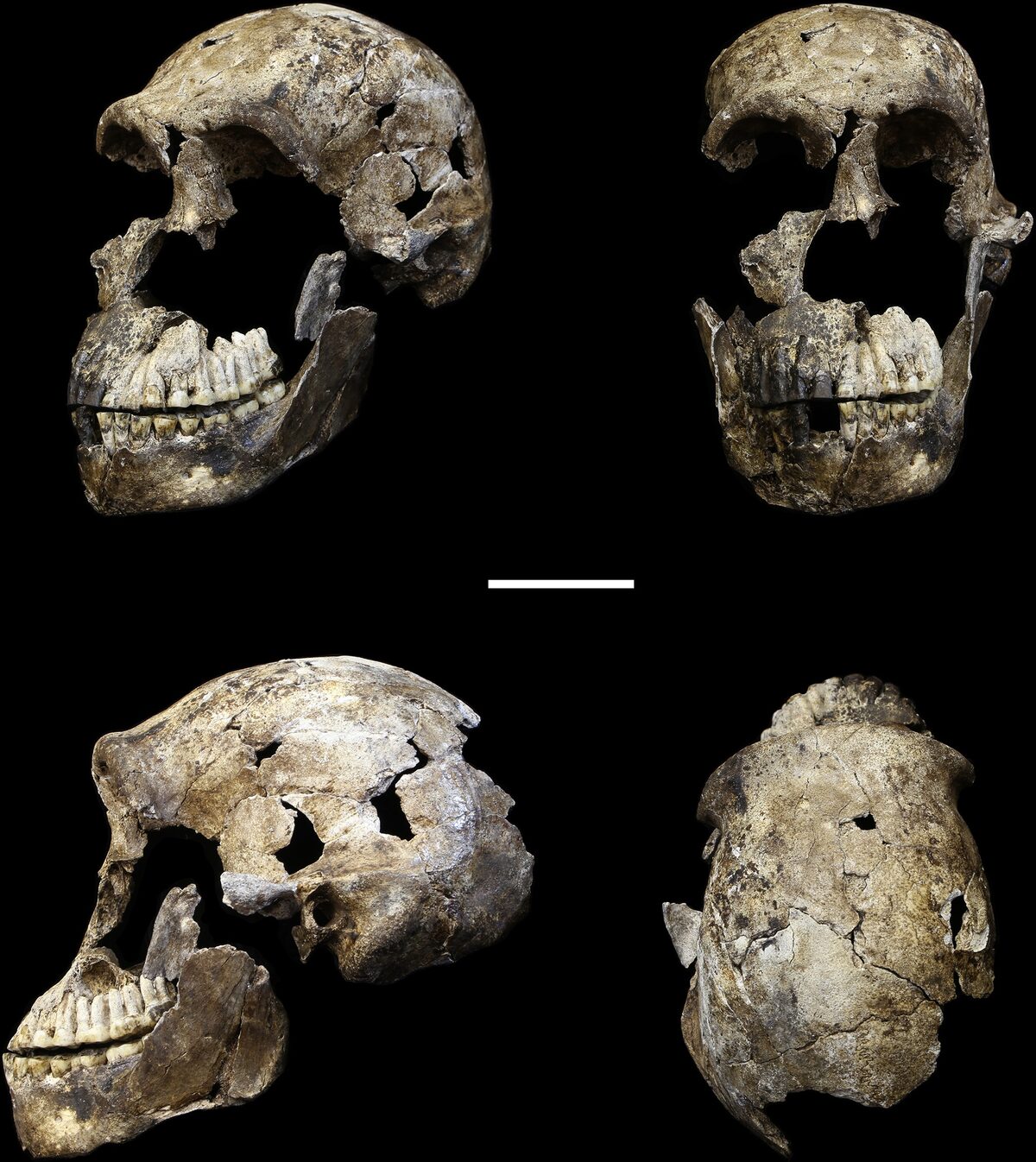
Let us begin with the skull. The braincase of Homo naledi is disconcertingly small: its endocranial volume is estimated at between 460 and 610 cubic centimetres depending on the individual, scarcely more than that of an australopithecine such as the famous Lucy, and roughly a third of the brain of a present-day human. A brain so modest, in raw size, evokes the most archaicArchaicRefers to an ancient, now-extinct human population or form (Neanderthals, Denisovans, ghost lineages), as opposed to anatomically modern humans. hominins, those that peopled Africa two or three million years ago. And yet the shape of this small brain, as it can be reconstructed from the imprints left on the inner wall of the skull, presents reliefs and asymmetries reminiscent of the cerebral organisation of more recent Homo. Size, then, is not everything: architecture counts too, and that of naledi blurs the trail.

Reconstruction of the Neo skull of Homo naledi
The skull nicknamed "Neo," one of the most complete of Homo naledi, illustrates the smallness of the braincase, less than 600 cm³, combined with resolutely modern facial features., Source: John Hawks, Marina Elliott, Peter Schmid et al., CC BY 4.0 (Wikimedia Commons)

The hand, next, tells yet another story. The fingers of Homo naledi are long and markedly curved, like those of a primate used to gripping branches and climbing. This evidently primitive trait suggests that the species had not renounced arboreal life, or at least retained its anatomical legacy. But the wrist, the thumb and the palm tellTellAn artificial mound formed by the accumulation of successive layers of settlement remains at the same spot, typical of the Near East. Each destruction-rebuilding event adds a stratum. the opposite tale: their structure is remarkably human, endowed with an opposable thumb and a robustness compatible with the making and handling of tools. A single hand, then, both to climb trees and, perhaps, to knap stone. This functional duality is one of the most striking paradoxes of the species.

The foot, finally, is almost entirely modern. Its architecture, plantar arch, alignment of the big toe, ankle joints, makes it practically indistinguishable from that of Homo sapiensHomo sapiensThe present-day human species, which emerged in Africa around 300,000 years ago, the only surviving human lineage after the extinction of Neanderthals and Denisovans.. Homo naledi was therefore a walker, an accomplished biped, capable of covering long distances on the ground on two legs. The elongated lower limbs, the pelvis, the ankles confirm this ease in walking. The picture that emerges is that of a creature of two worlds: human enough to stride the savannahs upright, archaic enough still to climb, and crowned with a strikingly small brain. No living species, no well-known fossil presents exactly this combination. Homo naledi is a being without equivalent, a singular evolutionary experiment.

To this mosaic are added details that heighten the strangeness. The dentition is small, with molars whose crowns are complicated by supernumerary cusps, a rare trait. The shoulders are high and upwardly oriented, a configuration favourable to suspension beneath branches. The rib cage, flaring downward, evokes ancient hominins more than modern humans with their cylindrical trunk. Each region of the body, taken in isolation, delivers a different verdict on the antiquity or modernity of the species. It is the whole, in its very contradiction, that constitutes the identity of naledi.

How is such a mosaic to be interpreted? Two broad readings compete. According to the first, these contradictory characters would be the vestiges of a complex evolutionary history, in which ancient traits were conserved while others modernised, according to the selective pressures peculiar to the species' way of life. According to the second, the mosaic would result from a mosaic evolution itself, that is, from an uncoordinated development of the body's different parts, each responding to distinct constraints. Whatever the case, Homo naledi demonstrates that evolution does not proceed in a block: an organism can associate, within a surface functional coherence, anatomical solutions of very different ages and origins.

This lesson holds beyond the case of naledi alone. It invites us to mistrust overly smooth reconstructions, in which every fossil species would be a perfect intermediate between the preceding and the following one. The reality of human evolution is made of tinkering, of compromises, of disparate inheritances assembled into viable beings. Homo naledi offers the most spectacular illustration of this: a body that seems stitched together from bits and pieces, and which nonetheless functioned, walked, climbed, lived. Nature does not optimise according to our categories; it composes with what it has at hand.

It is worth dwelling for a moment on the broader significance of mosaic anatomy for how we picture our own origins. We tend, almost instinctively, to imagine ancestral species as coherent wholes, neatly arranged on a ladder of increasing modernity. Homo naledi shatters that comfortable image. Here was a creature in which the hand seemed to belong to one era, the foot to another, the brain to a third, and yet all of it worked together in a single, breathing organism. Such a being forces us to abandon the search for a tidy missing link and to embrace instead a far messier, more honest picture of the deep human past, one in which the pieces rarely line up the way our textbooks would prefer.

A date that overturns everything: 335,000 to 236,000 years

For the first two years, one question remained in suspense, and no minor one at that: how old were these bones? Morphological logic invited caution, even a wager on great antiquity. A brain the size of an australopithecine's, climber's hands, an archaic rib cage: all of this spontaneously evoked a species two or three million years old, contemporary with the first representatives of the genus Homo, or even earlier. Many specialists, on the sight of the fossils alone, would have bet on such a date. They were gravely mistaken.

When the results of the analyses come in, in 2017, they cause a genuine commotion. By combining several independent methods, uranium-series dating on the calcite concretions, electron spin resonance on tooth enamel, sediment analysis, the researchers arrive at a stunning range: Homo naledi would have lived only 335,000 to 236,000 years ago. In other words, not in the remote times of the australopithecines, but in a recent epoch, that of the late Middle PleistocenePleistoceneThe geological epoch of the great ice ages (c. 2.6 Ma–11,700 BP), spanning most of human prehistory., when Africa already harboured large-brained hominins, and when the first forms heralding Homo sapiens were perhaps beginning to emerge on the same continent.

A species with the brain of an australopithecine was therefore living in Africa at the very moment when other lineages with brains three times as voluminous were thriving there. Homo naledi was not a distant ancestor: it was an improbable contemporary.

This late date has considerable implications. It means that Homo naledi is not a primitive stage on the road leading to modern humanity, but a parallel lineage, long surviving, having retained an archaic anatomy until a date at which it was no longer expected. It demonstrates that a small brain was not a crippling handicap condemning its bearer to early extinction: naledi persisted, and perhaps for a long time. It also ruins the stubborn idea that an increase in brain size would be a linear and universal march of human evolution. In southern Africa, at the same period, several ways of being human coexisted, some of them with a modest braincase.

From a methodological standpoint, the episode is also a lesson in humility. It recalls how perilous it is to date a fossil from the reading of its anatomy alone, and how indispensable absolute chronologies, founded on the physics of radioactive decay or on the luminescence of sediments, are to avoid the traps of intuition. Without these measurements, Homo naledi might have been wrongly classed among the most ancient hominins. Science did not err because it knew how to measure rather than presume.

This date also throws new light on the question of naledi's contemporaries. In the Middle Pleistocene, southern Africa probably harboured other human forms, including the first representatives of the lineage leading to Homo sapiens. That large-brained populations and small-brained populations could have shared the same landscapes, during the same period, opens dizzying perspectives. Did they meet? Did they exchange, compete, ignore one another? These questions, for want of direct evidence, remain suspended, but their mere formulation suffices to gauge how far the dating of naledi has overturned our picture of the human peopling of Africa.

The deposition of the bodies: accident, predators or deliberate act?

There remains, then, an enigma which, perhaps more than any other, has set the debates alight: how did so many bodies come to be in a chamber so deep, so hard to reach, so dark? The Dinaledi chamber lies at the end of an underground route several hundred metres long, behind passages of fearsome narrowness, in absolute darkness. No natural light penetrates it. Even today, it takes lighting equipment and a good dose of courage to reach it. How can one explain the presence, in this remote place, of the remains of at least fifteen individuals?

Several hypotheses compete. The first, the most prosaic, invokes accident: the individuals would have lost their way in the network, fallen into a pit or a natural shaft, and died trapped at the bottom. But the configuration of the place and the absence of any sign of a gaping opening through which one might have fallen make this scenario awkward. The second hypothesis brings in predators or scavengers that would have dragged the carcasses there. Yet the bones bear none of the marks of biting, fracturing or digestion that one would expect from an accumulation by carnivores. The third possibility would be transport by water, an underground flood that would have washed the bodies in. But the sedimentology of the chamber hardly pleads in favour of inundations capable of such displacement.

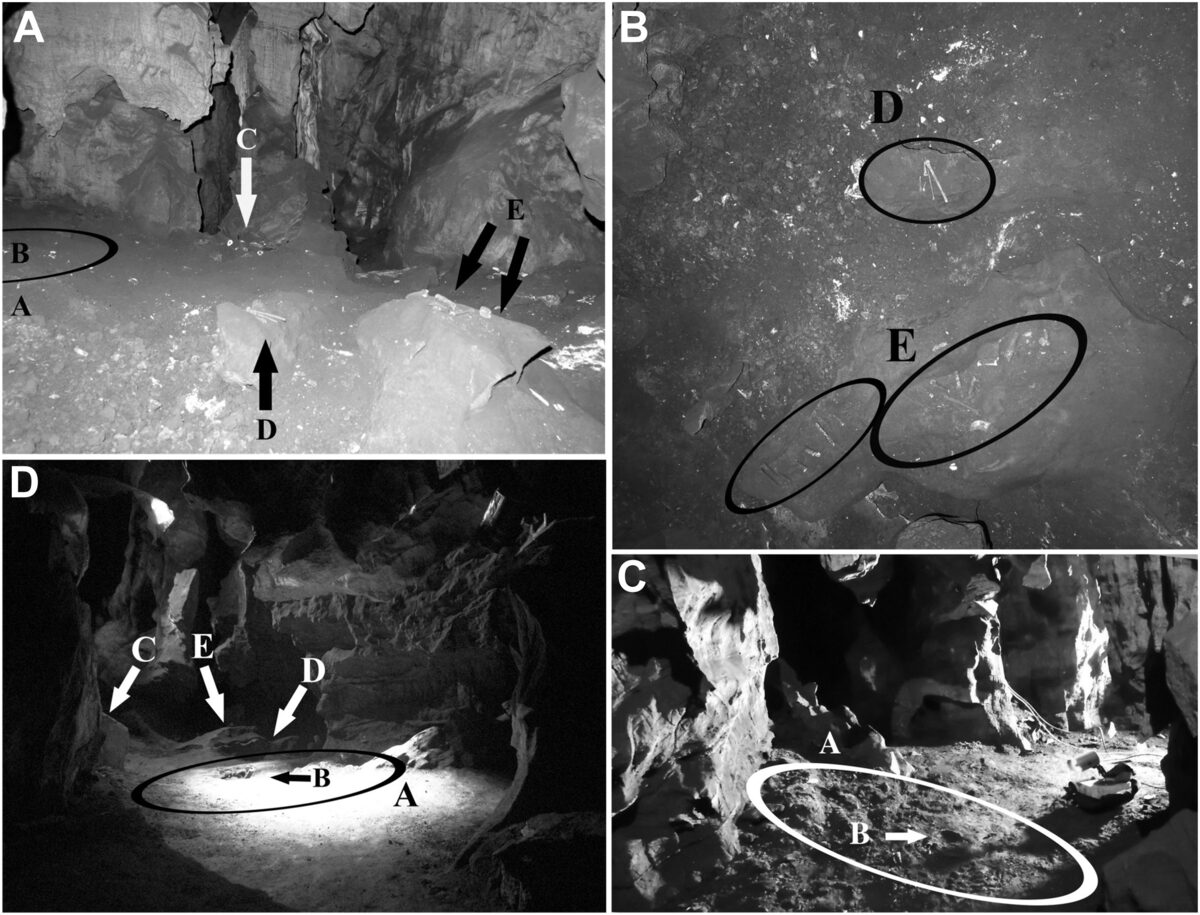
Narrow, dark passages of the Rising Star underground network
The galleries of the Rising Star karstKarstA limestone landscape shaped by rock dissolution, rich in caves and passages; its sediments can preserve bone and DNA over long timespans. system: a maze of cramped passages plunged into total darkness, which makes access to the Dinaledi chamber extraordinarily difficult., Source: Paul H. G. M. Dirks et al., CC BY 4.0 (Wikimedia Commons)

It is here that Lee Berger's team advances the boldest, and the most controversial, hypothesis: Homo naledi would have deliberately deposited its dead in this chamber. In other words, the species would have practised a form of intentional funerary deposition, carrying its dead through the underground maze to abandon them there, sheltered from view and from scavengers. If it were proven, such a practice would constitute symbolic behaviour of an unexpected sophistication in a being with such a small brain. It would, moreover, push back by several hundred thousand years the appearance of funerary gestures thought to be reserved for large-brained humans, Neanderthals and Homo sapiens.

The stakes are immense, for burialBurialThe intentional deposition of a body, sometimes with offerings; a marker of symbolic behaviour., the intentional deposition of a dead body, is traditionally regarded as one of the cardinal markers of symbolic thought, of awareness of death, even of a form of spirituality. To attribute it to Homo naledi is to dissociate behavioural complexity from brain size, and to upset a deeply rooted assumption: the idea that a large braincase is needed to access the symbol. One understands that the hypothesis aroused as much enthusiasm as scepticism.

To support this interpretation, the defenders of the funerary hypothesis advance several arguments. First, the very difficulty of access: it seems implausible that so many individuals should have made their way, by accident, into so remote and dangerous a place. Next, the absence of remains of other animals mingled with the human bones, which rules out a natural trap that ought to have captured indiscriminately all sorts of creatures. Finally, the concentration of the deposits and the state of certain skeletons, sometimes relatively complete, would suggest an intentional input rather than a fortuitous scattering. Each of these arguments, taken in isolation, can be disputed; it is their convergence that, in the team's eyes, argues for a deliberate act.

The opponents, for their part, retort that the "by default" argument is fragile: by ruling out one by one the natural explanations judged improbable, one comes to favour the most extraordinary hypothesis for want of better, which does not amount to a positive demonstration. They recall that, in science, the implausibility of the other scenarios does not prove the truth of the one that remains. To carry conviction, direct and unambiguous evidence of voluntary transport would be required, and that is precisely what is missing. The debate, so framed, pits two conceptions of proof against one another as much as two readings of the facts.

Beneath this disagreement lies a question that haunts all of palaeoanthropology: at what point does a pattern of bones become evidence of a mind? A scattering of remains is, on its own, silent. To read intention into it is to make an inferential leap, and the size of that leap is exactly what the two camps cannot agree upon. For the defenders of the funerary hypothesis, the cumulative weight of the clues makes the leap reasonable; for the sceptics, no accumulation of indirect signs can substitute for a single decisive proof. This is less a dispute about naledi than about the very limits of what archaeology can hope to know about the inner lives of vanished beings.

Fire and engravings: the announcements of 2023 to 2025

In 2023, Lee Berger and his colleagues take a new step, more resounding still. In a series of publications and during a heavily publicised communication, they announce not only having confirmed the existence of intentional burials, bodies deposited in dug-out pits and covered over, but also having spotted, engraved on the cave walls, geometric motifs: crossed lines, hatchings, angular forms evoking hashtags or ladders. These engravings, if they were the work of naledi, would be among the oldest known intentional graphic manifestations, far predating the cave art of the European Upper PalaeolithicPalaeolithicThe oldest and longest period of prehistoryPrehistoryThe span of human history before the invention of writing, from the Palaeolithic to the Metal Ages, known mainly through material remains. (c. 3.3 Ma–12,000 BC), defined by chipped stone tools and a hunter-gatherer way of life..

To these two claims is added that of the use of fire: the discovery, in the network, of traces of combustion, charcoal residues, blackened surfaces, fragments of burnt bone, would suggest that Homo naledi mastered lighting by fire, a practically necessary condition for venturing and working in such total darkness. How, indeed, could one carry bodies, dig pits or engrave walls without a source of artificial light? The use of fire, if it were demonstrated, would buttress the whole scenario by supplying its indispensable technical condition.

But these announcements, formulated first in preprints not yet validated by peer review, triggered a storm. Many specialists judged the evidence insufficient, the interpretations hasty, the communication premature. Are the "pits" really dug-out hollows, or simple natural depressions of the floor where sediments accumulated? Are the "engravings" authentic intentional tracings, or fissures, striations of natural origin, even more recent marks? Are the traces of fire contemporary with naledi, or later? Every piece of the file was contested, dissected, called into question. The debate, lively and at times harsh, illustrates the difficulty of proving symbolic behaviour from such tenuous remains, in so complex a context.

Between 2023 and 2025, the controversy never ceased to rebound, through publications, replies and counter-replies. Some defend a conceptual revolution; others demand more solid data, direct dating of the supposed engravings, rigorous taphonomic analyses of the alleged pits. This scientific joust, beyond its intensity, has at least the merit of posing the question head-on: how far can one read, in stone and bone, the intention of a vanished mind?

Palaeoproteomics and the enigma of the "all-female" skeletons

While the battle over burials and engravings was raging, another approach, more discreet but of considerable import, came to illuminate Homo naledi in an unprecedented light: palaeoproteomics. Where ancient DNAAncient DNAFragments of DNA preserved in old remains (bones, sediment); their sequencingSequencingReading the order of the bases (A, T, G, C) of a DNA molecule; high-throughput sequencing reads millions of fragments in parallel. identifies species and traces vanished lineages. degrades quickly and resists warm climates poorly, which makes its extraction very arduous on ancient African fossils, proteins, being more robust, can survive far longer, notably in tooth enamel, the most resistant tissue of the body. By analysing these fossil proteins, researchers can now access information that DNA no longer delivers.

One such piece of information is the biological sex of the individual. Tooth enamel indeed contains proteins coded by genes located on the sex chromosomes. The protein amelogenin, in particular, exists in two forms: one coded by a gene carried on the X chromosome, the other by a gene carried on the Y chromosome. Detecting the presence of the "Y" form signals a male individual; its absence, in the presence of the "X" form alone, points toward a female individual. It is this molecular signature that palaeoproteomics is now able to flush out in the enamel of fossil teeth.

Now, when this method was applied to a sample of Homo naledi teeth, the result published in a study in the journal Cell came as a surprise: the individuals tested all proved to be female. No male among the specimens analysed. This uniformity, if it were confirmed on a larger sample, would raise a fascinating question. Why would the Dinaledi chamber harbour only women? Is it a sampling accident, tied to the small number of teeth tested? Or must one see in it the reflection of a social reality, a choice, a particular organisation of the group in the face of death?

If the Dinaledi chamber held only women, then the deposition of the bodies would not be a random event, but the expression of a logic, social, ritual or demographic, whose meaning still escapes us.

The interpretations remain open and cautious. A reduced sample does not allow one to conclude that all fifteen individuals of Dinaledi were women; it indicates only that those who could be sexed by their proteins were. But the hypothesis deserves consideration. In many human and animal societies, sexually differentiated behaviours exist in the face of death, of care, of places. That naledi, too, might have treated its dead differently according to sex is in no way implausible, and would, here again, complicate the image of a being whose behaviour was far more elaborate than the size of its brain would lead one to guess.

Cultural or biological: the question of the AMELY gene

The episode of sexing by proteins invites a methodological caution that touches on the AMELY gene, that is, the amelogenin gene carried on the Y chromosome. The determination of sex by palaeoproteomics rests on the detection or the absence of the protein issued from this gene. But this absence can have two quite distinct meanings, which must be carefully untangled.

The first meaning, the most direct, is biological: if the protein coded by AMELY is absent, it is because the individual possessed no Y chromosome, and was therefore female. This is the interpretation adopted to conclude that the Dinaledi skeletons are female. The second meaning, more insidious, is of a technical or taphonomic order: the protein might have been present originally, but have been degraded, lost, or simply not detected owing to the limits of the method or to differential preservation. An absence of signal does not always prove a real absence. One must therefore make sure that the non-detection of the male marker truly reflects a biological absence, and not an artefact of preservation or analysis.

This nuance is no mere detail. It conditions the validity of the entire "all-female" conclusion. If the male proteins had simply disappeared in certain individuals for reasons of preservation, one might wrongly class them as female, and invent a social mystery where there would be only a bias of sampling or degradation. This is why researchers strive to multiply controls, to verify the coherence of the signals, to make sure that other sexually informative proteins confirm the verdict. The boundary between the cultural, a choice by the group to inter only its women there, and the biological or the technical, a mere effect of the chemistry of preservation, must be drawn with the greatest rigour. Such is the whole art, and the whole difficulty, of palaeoproteomics applied to questions of behaviour.

What naledi unsettles in the human tree

At the end of this journey, one better gauges why Homo naledi disturbs so much. The species undermines several received ideas that structured, sometimes implicitly, our representation of human evolution. The first of these ideas is that of a linear and continuous progression: a primitive small-brained ancestor, then intermediate forms, then the large-brained modern human, each stage erasing the preceding one. Naledi breaks this fine straight line. It shows that, on the contrary, several very different human lineages coexisted, some retaining ancient traits until recent dates, in a bushy branching rather than in a single march.

The second idea shaken is the equation between brain size and behavioural complexity. For a long time, it was held as a given that a large brain was the necessary condition of symbolic thought, of elaborate language, of funerary practices, of art. If Homo naledi, with its braincase of barely 500 cubic centimetres, really deposited its dead, engraved signs and mastered fire, then this equation shatters. Complexity would not be a simple function of cerebral volume, but might emerge from different neural architectures, from configurations that the mere measurement of the skull does not capture. This invites great modesty as to what we think we know of the relations between brain and behaviour.

The third idea unsettled concerns the place of Africa and human diversity in the Middle Pleistocene. Naledi confirms that the African continent, far from having been the theatre of a simple, univocal evolution toward Homo sapiens, knew a mosaic of human populations with varied morphologies, sometimes very archaic, coexisting and perhaps rubbing shoulders. This richness, long underestimated, sketches an African prehistory far more teeming than was imagined, in which our own species emerged not in solitude, but within a veritable concert of humanities.

Finally, Homo naledi poses the delicate question of its exact place in the human genealogy. Is it a distant cousin, issued from an early branch of the genus Homo and long surviving? A descendant of an ancient form that retained primitive traits through a kind of mosaic evolution? Did it cross paths with other lineages, exchange genes, in episodes of hybridisationHybridisationCrossing between two distinct species or lineages, such as Homo sapiens and Neanderthals, leaving a trace in the genome. of which we have as yet no trace? For want of usable DNA, these questions remain largely open. Naledi occupies, in the human tree, an uncertain position, a twig whose existence one can sense without being able to fasten it firmly to the trunk.

Controversies: between enthusiasm and scepticism

It would be dishonest to present Homo naledi without insisting on the intensity of the controversies that surround it. Few recent discoveries have so divided the scientific community, in substance as in form. In substance, first: the most spectacular claims, burials, engravings, fire, rest on fragile clues, whose interpretation is contested. The detractors stress that depressions in the floor can form naturally, that marks on the rock can result from geological processes, that traces of combustion can postdate the occupation by naledi. They demand direct evidence, targeted dating, independent analyses, before crediting conclusions so heavy with consequences.

In form, next: the way Lee Berger and his team communicated their results has often preceded, even short-circuited, the normal process of peer review. Media announcements, documentaries, preprints have at times outpaced the validated publication, exposing the hypotheses to the general public before they had been submitted to the critical scrutiny of the profession. For some, this strategy of "open" and "rapid" science is a breath of fresh air that democratises research and accelerates the sharing of knowledge. For others, it endangers rigour, conflates communication and demonstration, and casts a risk over the credibility of the discipline.

One must, however, beware of reducing the affair to a quarrel of persons or of method. The disagreements over naledi reflect a real epistemological difficulty: proving an intention, a symbolic behaviour, from mute remains is intrinsically arduous. Taphonomy, the study of what happens to remains after death, conceals innumerable traps, and distinguishing the voluntary gesture from natural chance demands an argument of extreme solidity. In this sense, the naledi controversy is healthy: it forces each party to make its criteria explicit, to refine its methods, to take nothing for granted. Science advances by this very friction.

Whatever the outcome of these debates, one thing is certain: Homo naledi has already transformed palaeoanthropology, if only by obliging the discipline to reconsider its certainties. Whether the burials are confirmed or not, whether the engravings are validated or refuted, the species will remain a textbook case, an intellectual goad, a salutary reminder of the inexhaustible complexity of the human past.

Conclusion: a star that illuminates our uncertainties

Homo naledi bears its star-name well. Like a distant heavenly body whose light reaches us laden with enigmas, it shines in the sky of prehistory, letting us guess, without ever fully revealing, what it was. Small brain and skilful hand, climber and walker, archaic and recent, it escapes our categories and resists our classifications. Its late date overturned our expectations; the hypotheses of burials, engravings and fire set our debates ablaze; the palaeoproteomic revelation of skeletons perhaps all female reopened the field of the possible. At each step, naledi has outwitted simplicity in favour of complexity.

Perhaps that is its greatest lesson. Homo naledi reminds us that human evolution was not a triumphant and solitary ascent toward consciousness, but a teeming, hesitant, plural exploration, made of gropings and coexistences. It teaches us that the modesty of a brain does not prejudge the richness of a behaviour, and that the Africa of the Middle Pleistocene was the theatre of a human diversity we are only beginning to glimpse. It invites us, finally, to welcome uncertainty not as a failure, but as the very horizon of research.

The bones of the Dinaledi chamber will continue, for a long time yet, to nourish the controversies, the analyses and the reveries of researchers. Each new technique, refined dating, perfected proteomics, perhaps one day DNA wrested from the enamel, will bring its share of answers and, inevitably, its share of fresh questions. Homo naledi is not a closed case; it is an open worksite, a star still high in the sky, which illuminates less our certainties than our magnificent uncertainties about what it means, at bottom, to be human.