In August 1856, limestone quarry workers were blasting through rock in the Neander Valley, a few kilometres from Dusseldorf in Germany. In the small Feldhofer cave, they unearthed bones they initially mistook for those of a cave bear. Johann Carl Fuhlrott, a schoolteacher with a passion for natural history, recognised their human character and their great antiquity. Thus began the history of Homo neanderthalensis, one of the most fundamental discoveries in the science of human origins.
For nearly a century and a half, NeanderthalsNeanderthalsA fossil humanity of Eurasia, robust and cold-adapted, extinct around 40,000 years before present.→ were portrayed as primitive brutes, hunched and grunting. That image is radically wrong. The paleoanthropology of the past fifty years, reinforced by modern genomics, reveals fully human beings: skilled hunters, craftspeople mastering sophisticated techniques, capable of nursing their injured, burying their dead, and adorning themselves with jewellery. From approximately 400,000 to 40,000 years ago, they inhabited Europe and the Near EastNear EastA region of western Asia (Levant, Mesopotamia, Anatolia, Iran), cradle of the Neolithic revolution, agriculture, the first cities and writing.→, leaving an indelible mark on our own genetic heritage.
The Discovery of 1856 and the Birth of a Species
The official story of the discovery begins in August 1856, three years before the publication of Darwin's On the Origin of Species. In the Neander Valley (Neanderthal in German), a narrow limestone gorge carved by the Dussel River, workers dynamited the Feldhofer cave and sent bones tumbling into the rubble. Fuhlrott recovered a skullcap, two femora, three right arm bones, two left arm bones, an ilium and a fragment of scapula.1
Hermann Schaaffhausen, an anatomist in Bonn, examined the remains and concluded they belonged to a very ancient human race. Rudolf Virchow, Germany's greatest pathologist, refuted this interpretation: in his view, the bones belonged to a modern Homo sapiensHomo sapiensThe present-day human species, which emerged in Africa around 300,000 years ago, the only surviving human lineage after the extinction of Neanderthals and Denisovans.→ afflicted with rickets, severe arthritis and old head injuries. This controversy illustrates the difficulty of conceiving, before Darwinian evolutionism, that another human species could have existed.
In 1864, Irish geologist William King proposed the scientific name Homo neanderthalensis, making the Feldhofer skullcap the holotype of the species. Since then, more than 400 sites have yielded Neanderthal remains, from the Atlantic coast of Spain to the foothills of the Siberian Altai, and from England to the shores of the eastern Mediterranean.2
Anatomy: A Robust Human Adapted to Cold
The Neanderthal skeleton differs from that of Homo sapiens through a consistent combination of morphological traits, reflecting a long evolutionary adaptation to the rigours of glacial Europe. These features do not reflect cognitive inferiority, but a distinct evolutionary trajectory spanning several hundred thousand years.
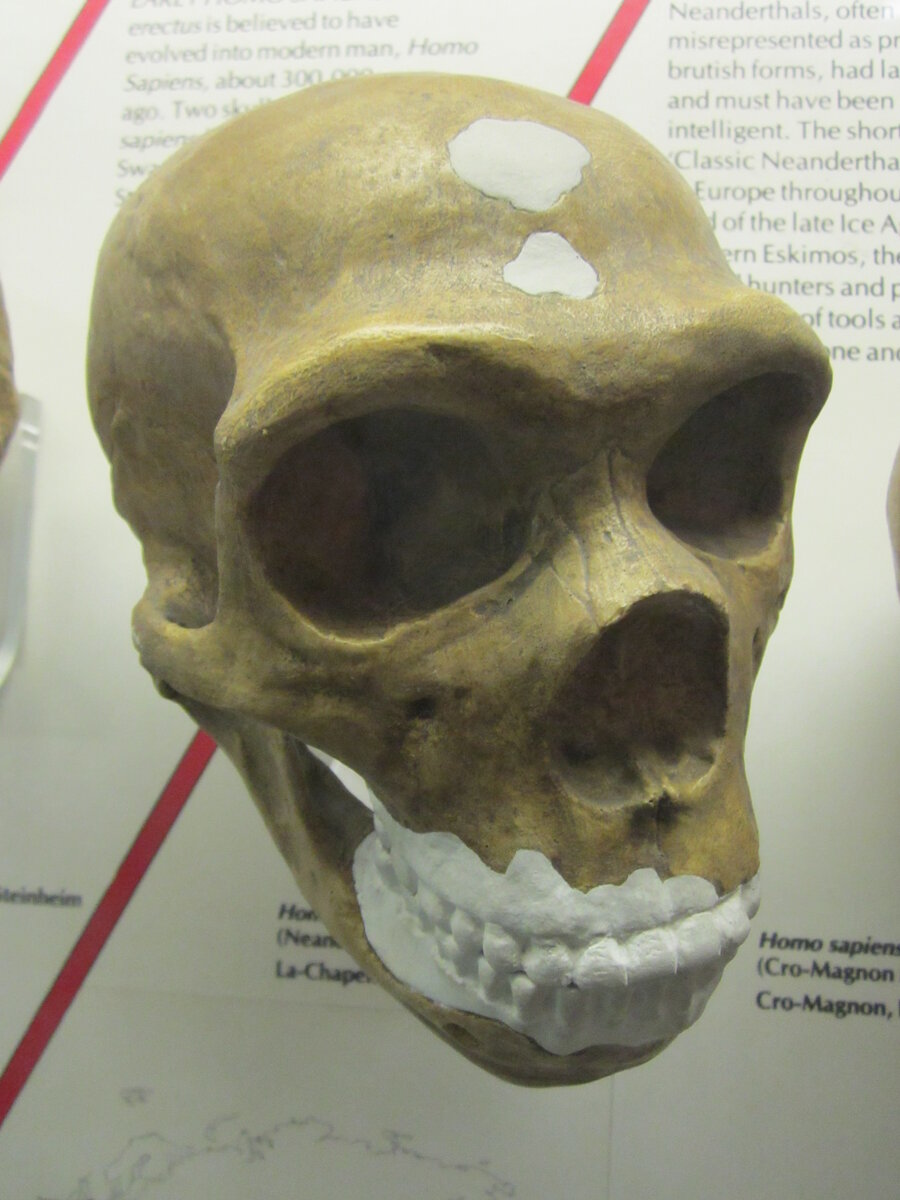
The Neanderthal braincase is large, with a cranial capacity ranging from 1,200 to 1,750 cm3, on average greater than that of Homo sapiens (around 1,350 cm3).3 Its shape, however, is different: more elongated, lower, with an occipital bun at the back of the skull, massive browridges forming a continuous torus, and a face projected forward. The absence of a projecting chin is a defining character that distinguishes Neanderthals from our own species.
The postcranial skeleton is equally telling. The limbs are short relative to the trunk, in accordance with Allen's rule: in cold climates, short extremities reduce heat loss. The rib cage is barrel-shaped, housing large lungs. Bones are extremely robust, with pronounced muscle attachments testifying to considerable physical strength. Fossils frequently show healed trauma, notably to the upper limbs and joints, patterns that resemble injuries seen in modern rodeo riders, suggesting close-quarters engagement with large prey.4
Geographic and Temporal Distribution
Neanderthal origins trace back to Homo heidelbergensisHomo heidelbergensisMiddle Pleistocene human species, often seen as the common ancestor of Neanderthals and our own species.→ populations in Europe, approximately 400,000 to 500,000 years ago. The Sima de los HuesosSima de los HuesosA natural shaft at Atapuerca (Spain) that yielded over 6,500 bones of at least 29 Homo heidelbergensis individuals dated to −430,000: the largest Middle Pleistocene human fossil assemblage.→ pit in the Sierra de AtapuercaAtapuercaA complex of archaeological sites in the Sierra de Atapuerca (Burgos, Spain), a UNESCO site, yielding an exceptional sequence of human fossils, including the Sima de los Huesos and Homo antecessor.→ (Spain) has yielded more than 6,500 bones belonging to at least 28 individuals dated to around 430,000 years ago. Analysis of their ancient DNAAncient DNAGenetic material preserved in old remains, often degraded, sequenced with cutting-edge techniques.→ in 2016 showed they cluster with Neanderthals on the human family tree, making Atapuerca one of the oldest known proto-Neanderthal sites.5
At their maximum extent, Neanderthals occupied a vast territory: from western Spain (Zafarraya, Gibraltar) and Portugal to Central Asia (Teshik-Tash, Uzbekistan), and from southern Siberia (Okladnikov cave, Altai) to the eastern Mediterranean coast (the caves of Tabun, Kebara, and Qesem in Israel). Major sites are distributed across Europe: La Chapelle-aux-Saints and La Ferrassie in the Dordogne (France), Spy in Belgium, Krapina in Croatia, Vindija (Croatia, key site for DNADNAThe molecule carrying genetic information, used to reconstruct kinship between species.→ sequencingSequencingReading the order of the bases (A, T, G, C) of a DNA molecule; high-throughput sequencing reads millions of fragments in parallel.→), Feldhofer (Germany) and Swanscombe (England).
The species spans from approximately 400,000 to 40,000 years ago, an occupation of some 360,000 years, far longer than Homo sapiens has inhabited Europe to date. The last Neanderthals appear to have survived until about 40,000 years ago in Gibraltar, in Gorham's Cave, retreating to the tip of Europe as Homo sapiens advanced southward and westward.6
The MousterianMousterianThe stone-tool industry typical of Neanderthals, based on the Levallois flaking technique.→ Industry and Levallois TechniqueLevallois techniqueA Middle Palaeolithic flint-knapping method: a core is prepared so a flake of predetermined shape can be struck off in one blow; a hallmark of Neanderthal skill.→
Neanderthals are the primary makers of the Mousterian, a technocultural complex extending from approximately 300,000 to 30,000 years ago. The Mousterian is characterised by a diverse range of flake tools: scrapers, points, denticulates, and natural-backed knives. These tools were produced mainly from flintFlintA hard, brittle siliceous rock, knapped by prehistoric people to produce blades, points and sharp tools.→, quartzite and other siliceous rocks, using precise and well-planned knappingknappingThe set of operations for fracturing a stone block to extract flakes or blades.→ techniques.
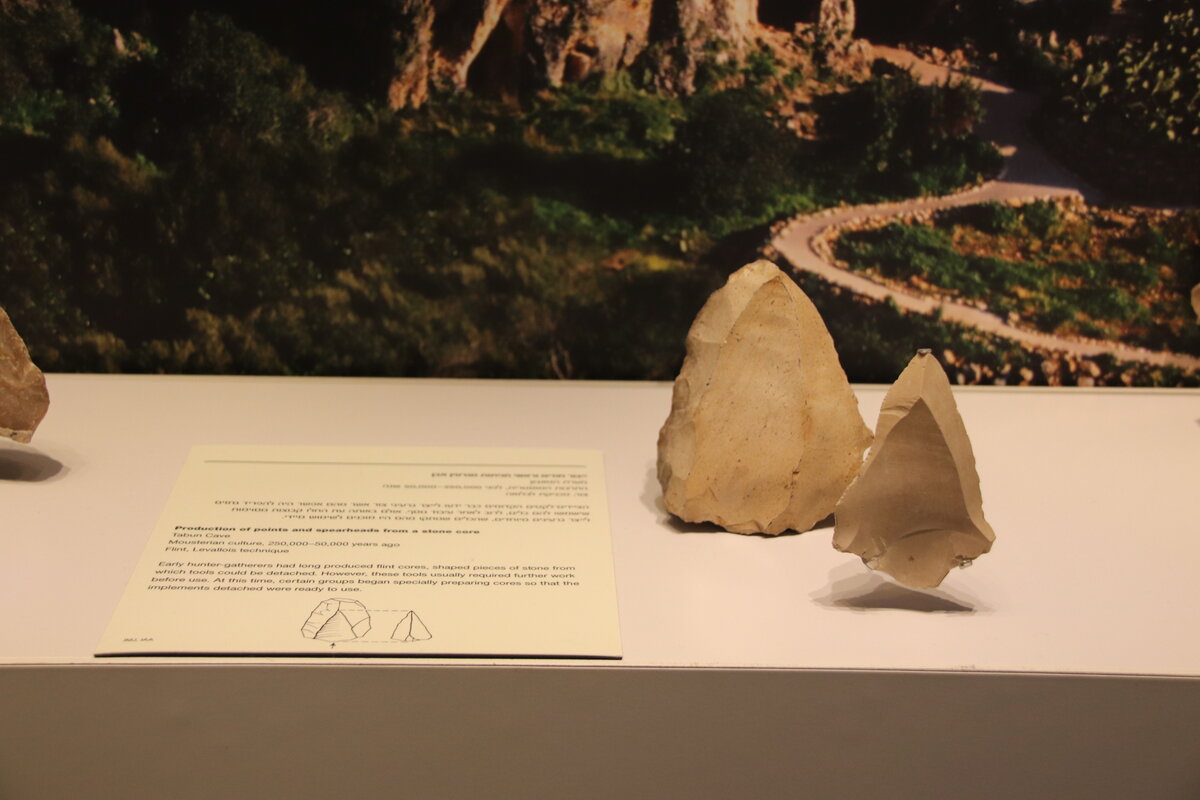
The Levallois technique, a hallmark of the Mousterian, is a striking example of advanced cognitive planning. The knapper first carefully prepares a flint core into a tortoise-shell shape, removing flakes around its perimeter to create a perfectly controlled convex surface. A single, precisely aimed blow can then detach a flake of predetermined shape and size.7 This method requires mentally visualising the final product before any knapping begins, an ability that directly contradicts the image of an archaicArchaicRefers to an ancient, now-extinct human population or form (Neanderthals, Denisovans, ghost lineages), as opposed to anatomically modern humans.→ homininHomininMember of the subtribe Hominina, comprising the human lineage (Homo, Australopithecus, Paranthropus…) but excluding orangutans and gibbons. The term progressively replaces "hominid" in its narrow sense.→ incapable of abstraction.
Some researchers long assumed that Neanderthals simply copied Homo sapiens technology. Discoveries over recent decades have overturned that view. The Chatelperronian, a transitional industry sometimes attributed to Neanderthals in western Europe, combines thin blades with personal ornaments. Even setting aside these debated industries, classic Mousterian technology demonstrates elaborate technical mastery, transmitted across generations over thousands of years through social learning.8
Formidable Hunters and Flexible Omnivores
The thesis of the "scavenging Neanderthal" has been abandoned. Zooarchaeological and isotopic analyses paint the portrait of active, efficient hunters specialising in large prey. At Salzgitter-Lebenstedt (Germany), Neanderthals killed hundreds of reindeer during seasonal migrationsMigrationsLong-distance movements of populations; a major driver of human history (the exit from Africa, the peopling of continents, Neolithic and steppe expansions).→ in what appears to have been a coordinated, planned collective hunt. At La Cotte de St. Brelade (Jersey), bones from at least 20 woolly mammoths and 5 woolly rhinoceroses were found piled against a cliff, suggesting hunting by driving herds over or near the edge.9
Stable isotopesStable isotopesNon-radioactive forms of an element (carbon, nitrogen, oxygen) whose ratios in bone and teeth reveal an individual's diet, mobility and geographic origin.→ in bone collagen reveal that in northern Europe, Neanderthals sat at the very top of the food chain, subsisting almost exclusively on large herbivores: woolly mammoth, woolly rhinoceros, bison, musk ox, reindeer, and horse. In temperate zones and the Near East, their diet included tortoises, rabbits, shellfish, and plants. Analysis of dental calculus (tartar) shows the consumption of tubers, grasses, fungi, and even medicinal plants.10
Control of fire is attested from at least 250,000 to 300,000 years ago. Hearths found in Neanderthal caves include ash, burnt bone, and evidence of systematic cooking, a practice that increases nutritional value and reduces chewing time. Recent research suggests that some Neanderthals could actively produce fire rather than simply maintaining natural embers.
Burials and Care for the Dead
Few questions have exercised paleoanthropologists more than Neanderthal burialBurialThe intentional deposition of a body, sometimes with offerings; a marker of symbolic behaviour.→. The idea that "primitive" beings deliberately buried their dead implies an awareness of death and perhaps a symbolic dimension. Successive discoveries have progressively confirmed this reality.
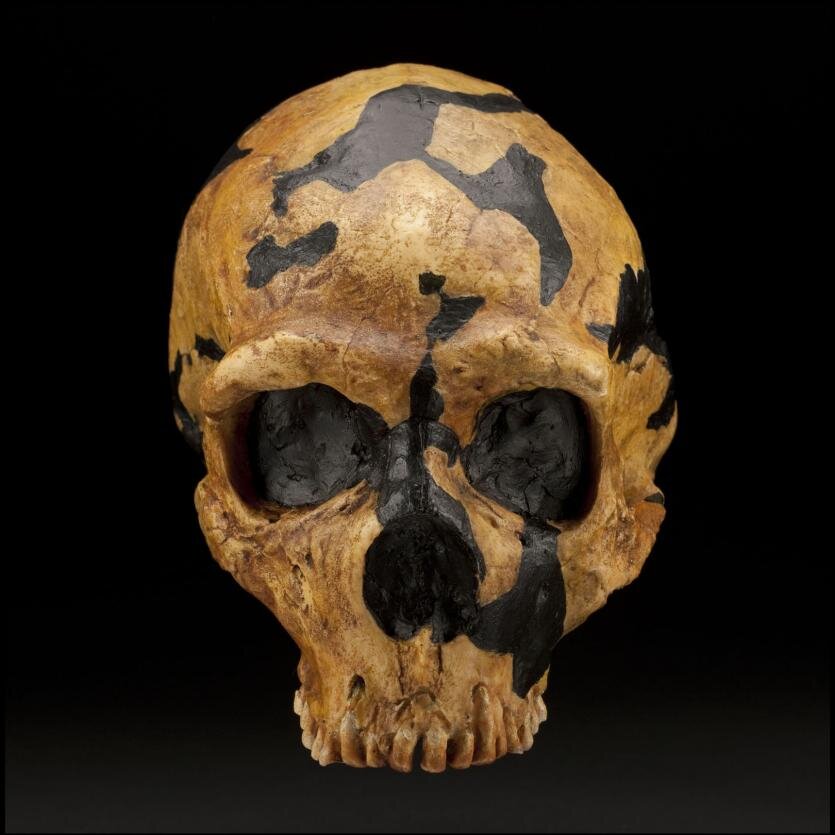
La Chapelle-aux-Saints (Correze, France) is the most emblematic case. In 1908, the Bouyssonie brothers and Bardon exhumed the skeleton of an elderly Neanderthal man at the bottom of a pit carved into the cave floor. The old Neanderthal of La Chapelle, toothless and arthritic, had survived for many years after losing nearly all of his teeth: someone had been caring for him, preparing his food, looking after him. This prolonged disability is among the oldest known evidence of social care in human history.11
La Ferrassie (Dordogne) yielded the remains of six individuals, including two adults and four children or infants, some associated with small pits dug into the cave floor and blocks placed over the bodies. Spy (Belgium), Kebara (Israel), Amud (Israel), Roc-de-Marsal (France): the list of sites where intentional burial is argued continues to grow. Shanidar Cave (Iraq, Solecki excavations 1957-1961) yielded 10 individuals, including Shanidar 1, a middle-aged man with multiple ancient healed injuries (an amputated or atrophied right arm, an eye injury, severe arthritis) who had survived long despite these disabilities. An initial pollen analysis suggested flowers had been placed on the body, but this finding remains contested (pollen may have been introduced by burrowing rodents). In 2020, a new excavation at Shanidar revealed an additional individual in a flexed position, in a configuration consistent with deliberate burial.12
Symbolic BehaviourSymbolic behaviourA set of practices (adornment, pigments, art, burial) reflecting symbolic thought; long ascribed to Homo sapiens alone, now attested for Neanderthals too.→: An Aesthetic Sensibility
For a long time, art and personal ornamentation were considered exclusive markers of the "behavioural modernity" of Homo sapiens. Discoveries over the past twenty years have demolished this certainty. Neanderthals adorned themselves, used pigments, and may even have painted cave walls.
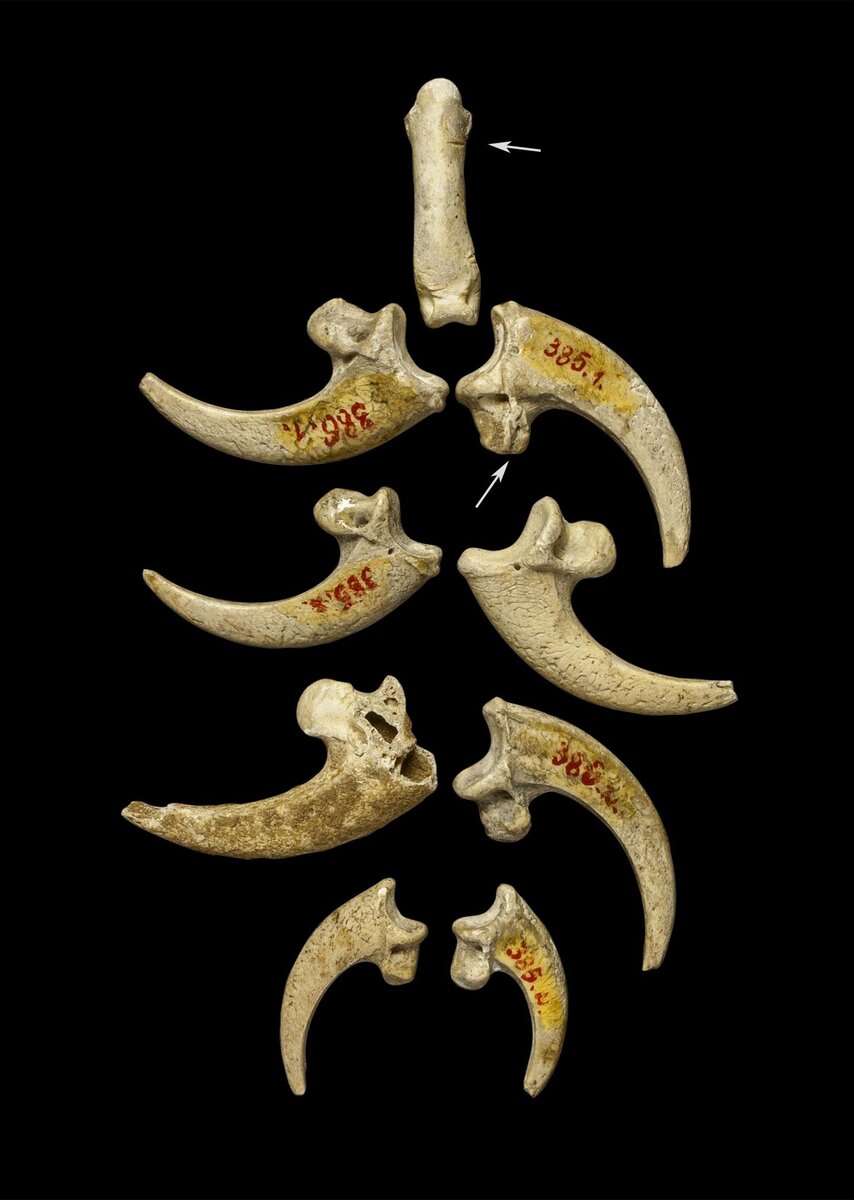
The most spectacular discovery regarding Neanderthal ornamentation comes from Krapina (Croatia): eight perforated and polished golden eagle claws dated to approximately 130,000 years before present, well before the arrival of Homo sapiens in Europe.13 These objects, published in 2015 by David Frayer and colleagues, bear perforation marks and wear patterns consistent with prolonged use as a bracelet or necklace. In 2020, a similarly perforated eagle talon dated to approximately 90,000 years was recovered at Foradada (Spain).
The question of pigment use is equally significant. Red ochreOchreA red or yellow mineral pigment (iron oxides), used from prehistory for adornment, funerary rites and art.→ and black manganese blocks have been found at numerous Neanderthal sites in western Europe, showing evidence of use with scraped and rubbed surfaces. At Pech de l'Aze (Dordogne), ochre blocks 200,000 to 250,000 years old have been regularly worked. At Maastricht-Belvedere (Netherlands, 250,000 years), ochre blocks represent one of the earliest records of systematic pigment collection by any hominin.14
More controversial is the question of Neanderthal cave art. In 2018, a team led by Dirk Hoffmann published uranium-thorium (U/Th) dates directly on calcite overlying painted motifs in three Spanish caves: Ardales, La Pasiega, and Maltravieso. Some dates reached 65,000 years, more than 20,000 years before the first Homo sapiens arrived in Europe.15 These motifs, red dots, hand stencils, and geometric shapes, are thus attributable to Neanderthals. A half-dozen pierced and coloured shells from Cueva de los Aviones (Spain), dated to at least 115,000 years, point in the same direction: Neanderthal ornaments predating the African dispersal of Homo sapiens by more than 50,000 years.
Language and Cognitive Capacity
Were Neanderthals capable of articulate speech? The question remains open, but several lines of biological evidence converge in favour of developed vocal abilities. The most striking anatomical clue is the Kebara 2 hyoid bone.
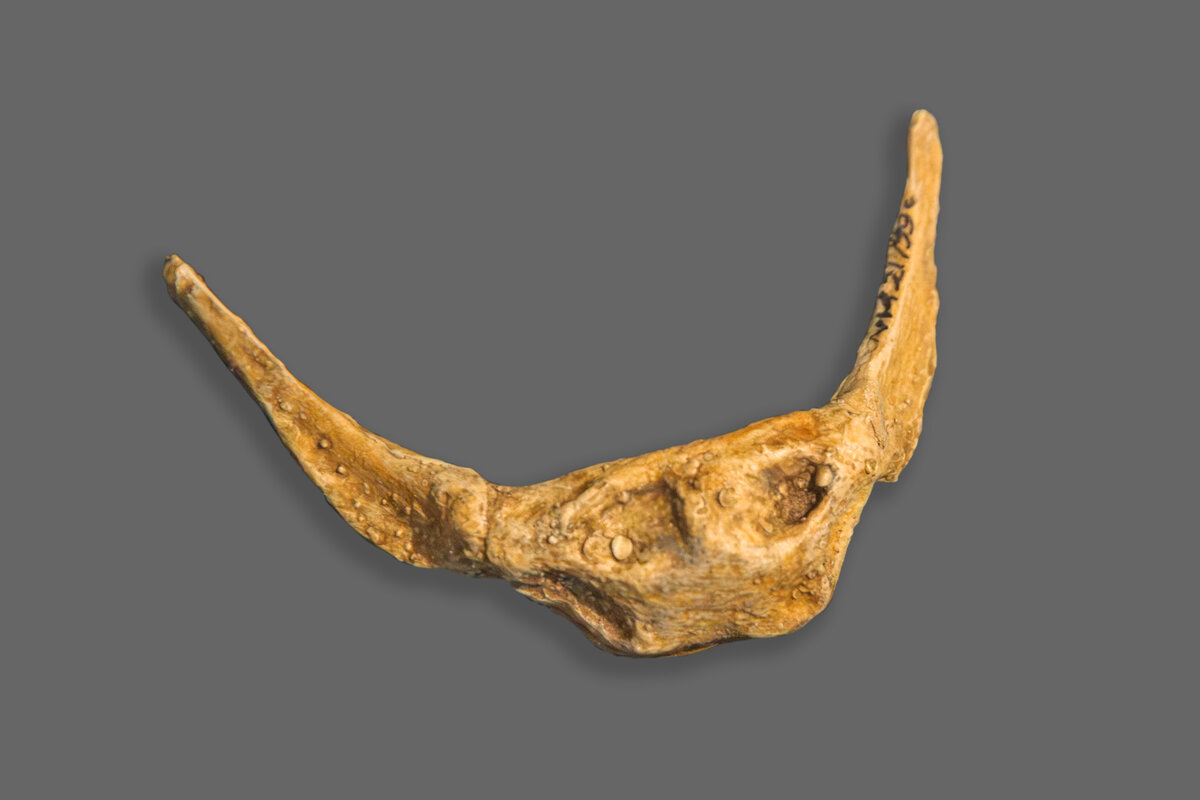
The hyoid, a small U-shaped bone at the base of the tongue that anchors phonation muscles, is extremely rare in the fossil record. The hyoid of Kebara 2 (Israel, approximately 60,000 years old) is morphologically identical to that of Homo sapiens, strikingly different from those of great apesgreat apesThe family of great apes (Hominidae) comprising orangutans, gorillas, chimpanzees, bonobos and humans.→ and earlier hominins. Micro-CT analyses have shown that its internal structure is also similar to ours, suggesting equivalent biomechanical properties for the production of speech sounds.16
Genetics provides a crucial complement. Ancient DNA analyses of Neanderthal genomes have revealed the presence of the FOXP2 gene, whose mutations in modern humans are associated with severe language and speech disorders. The Neanderthal version of FOXP2 is identical to ours, unlike the versions carried by chimpanzees and other primates. This result does not prove that Neanderthals spoke, but it rules out a major genetic difference at this key gene.17
The morphology of the Neanderthal inner ear, studied by 3D CT scanning, is moreover closer to that of Homo sapiens than to that of chimpanzees, with enhanced sensitivity to frequencies of 2 to 4 kHz, the typical range of human speech. All of this draws the portrait of a hominin endowed with the anatomical and genetic predispositions for complex vocal communication, even if the exact nature of Neanderthal "language" escapes us.
Extinction: A Debate Still Unresolved
Around 40,000 years ago, Neanderthals vanish from the fossil record. This extinction coincides with the arrival of Homo sapiens in Europe, but the causal link is complex. Several hypotheses, often combined, have been advanced.
Competition with Homo sapiens is most commonly invoked. The two species certainly coexisted in Europe and the Near East for at least 10,000 to 15,000 years, as Denny the hybrid (discovered at Denisova Cave) provides direct genetic proof. But competition for resources, especially during climatic stress, may have favoured the larger social networks and blade technology of Homo sapiens. Historical experience of technologically asymmetric population encounters gives some sense of how quickly a group can be marginalised or absorbed.
The climatic fluctuations of Marine Isotope Stage 3 (MIS 3, 60,000 to 27,000 years ago) subjected Europe to rapid and severe temperature oscillations. These changes disrupted ecosystems and therefore the prey on which Neanderthals depended. The Campanian IgnimbriteignimbriteCompact volcanic rock formed from pyroclastic flows, harder than tuff, forming the protective caps of the fairy chimneys.→ eruption (approximately 39,000 to 40,000 years ago), a super-eruption in southern Italy, may have sent a "volcanic winterVolcanic winterA prolonged global cooling of the climate caused by the injection of sulfate aerosols and ash into the stratosphere during a large eruption, which reflect sunlight and lower temperatures for several years.→" over eastern Europe precisely when Neanderthal populations were most vulnerable.18
Pathogen transmission from Homo sapiens to a population with no adapted immunity, analogous to the introduction of European diseases to the Americas in the 16th century, constitutes another hypothesis, difficult to test directly on fossils. It is likely that the Neanderthal extinction resulted from a convergence of causes, some more local and others global, and that their legacy partially survived through hybrid offspring.
The Genomic Legacy: They Live in Us
One of the most astonishing revelations of 21st-century paleoanthropology is this: Neanderthals did not truly die out. Their DNA circulates in the genome of every non-African human alive today, at an average of 1 to 4 per cent.
In 2010, Svante Paabo and colleagues at the Max Planck Institute for Evolutionary Anthropology (Leipzig) published in Science the first draft of the Neanderthal genome, assembled from DNA extracted from three bone fragments from Vindija Cave (Croatia).19 Comparison with modern human genomes revealed the striking finding: Europeans, Asians, Oceanians and Indigenous Americans share more genetic variants with Neanderthals than do sub-Saharan Africans, who carry almost no Neanderthal DNA. The conclusion was inescapable: interbreedingInterbreedingGenetic mixing between human populations or species; between Neanderthals and Homo sapiens it left 1 to 2% of Neanderthal DNA in non-Africans.→ had taken place, probably in the Near East some 50,000 to 70,000 years ago, when Homo sapiens left AfricaAfricaThe cradle of humankind: the continent where the first hominins appeared, then Homo sapiens around 300,000 years ago, before the expansion to the rest of the world.→ and encountered Neanderthals.
These Neanderthal DNA fragments are not neutral in our genomes. Some were positively selected because they conferred adaptive advantages in extra-African environments. Neanderthal variants are implicated in skin and hair pigmentation, keratin (structural protein of skin and nails), lipid metabolism, and above all immunity. Alleles of the innate immune system (HLA and TLR genes) inherited from Neanderthals likely provided better resistance to local European and Asian pathogens to which Neanderthals had been adapted for hundreds of thousands of years.20
The most striking and recent example concerns COVID-19. In 2020, a team led by Hugo Zahringer and Svante Paabo identified a haplotype on chromosome 3, significantly increasing the risk of severe COVID-19, as being of Neanderthal origin. This haplotype is common in South Asia (60 per cent of Bangladeshis) but very rare in Africa. Conversely, a second Neanderthal haplotype on the LZTFL1 gene confers relative protection against the same disease. These discoveries illustrate the permanence and ambivalence of the Neanderthal legacy: genes that may have helped our ancestors establish themselves in Eurasia can become a burden in the face of new pandemics.
The individual nicknamed Denny, discovered in 2016 at Denisova Cave, represents an extreme and unique case of this interbreeding: a young girl whose mother was Neanderthal and whose father was DenisovanDenisovanAn extinct human population, cousin of the Neanderthals, identified in 2010 from the DNA of remains in Denisova Cave (Siberia).→. This specimen, whose DNA was analysed in 2018, is the first direct evidence of a first-generation hybrid between two distinct human groups, illustrating the reality of the genetic exchanges that marked the recent prehistoryPrehistoryThe span of human history before the invention of writing, from the Palaeolithic to the Metal Ages, known mainly through material remains.→ of our species.21
Conclusion: Rehabilitating Homo neanderthalensis
The verdict is clear: Homo neanderthalensis was a fully human being in every meaningful sense. Endowed with a large brain, master of sophisticated technology, a formidable hunter, a carer of the sick, a burier of the dead, an adorner of jewellery and pigment, and perhaps a painter of cave walls, Neanderthals shared far more with us than we imagined even forty years ago.
Their extinction some 40,000 years ago was not total. Through interbreeding with our direct ancestors, Neanderthals transmitted to all non-African humanity a fraction of their genome, including precious adaptations to new environments. The boundary between them and us proves far less clear than a simple species distinction would suggest. In our bodies, in our immune biology, in our capacity to survive the infections that killed so many nomadic Homo sapiens setting out to explore an unknown world, the Neanderthals continue, silently, to exist.
No comments yet. Be the first.