A skull discovered in a Levantine cave bears a wound that has changed our understanding of ancient human behavior. Dating to approximately 100,000 years ago, it displays a penetrating lesion on the facial bones, interpreted by specialists as the trace of intentional violence - a blow delivered by a pointed implement at close range. It represents one of the oldest known direct pieces of evidence for interpersonal violence in Homo sapiensHomo sapiensThe present-day human species, which emerged in Africa around 300,000 years ago, the only surviving human lineage after the extinction of Neanderthals and Denisovans.→, and it redraws the portrait of our most distant ancestors.1
The region around the Sea of Galilee and Mount Carmel in Israel yielded, during the twentieth century, human fossils of cardinal importance. The caves of Skhul and QafzehQafzehA cave in Lower Galilee (Israel) yielding Homo sapiens and some of the oldest known burials outside Africa.→ contain the remains of anatomically modern Homo sapiens dated between 80,000 and 130,000 years ago - the oldest representatives of our species found outside AfricaAfricaThe cradle of humankind: the continent where the first hominins appeared, then Homo sapiens around 300,000 years ago, before the expansion to the rest of the world.→. Among the dozens of individuals exhumed, several show bony anomalies that have sparked long debate: simple accidents, disease, or consequences of violence between individuals?
Skhul and Qafzeh Caves: The First Homo sapiens Outside Africa
Qafzeh Cave, excavated from the 1930s by René Neuville and later by Bernard Vandermeersch, has yielded at least 27 individuals. Several were buried intentionally, with evidence of deliberate interment: bodies in flexed positions, red ochreOchreA red or yellow mineral pigment (iron oxides), used from prehistory for adornment, funerary rites and art.→ scattered over bones, deer skulls placed on top of the deceased. These complex funerary practices testify to a developed social and symbolic life, far beyond what was once attributed to humans so ancient.2
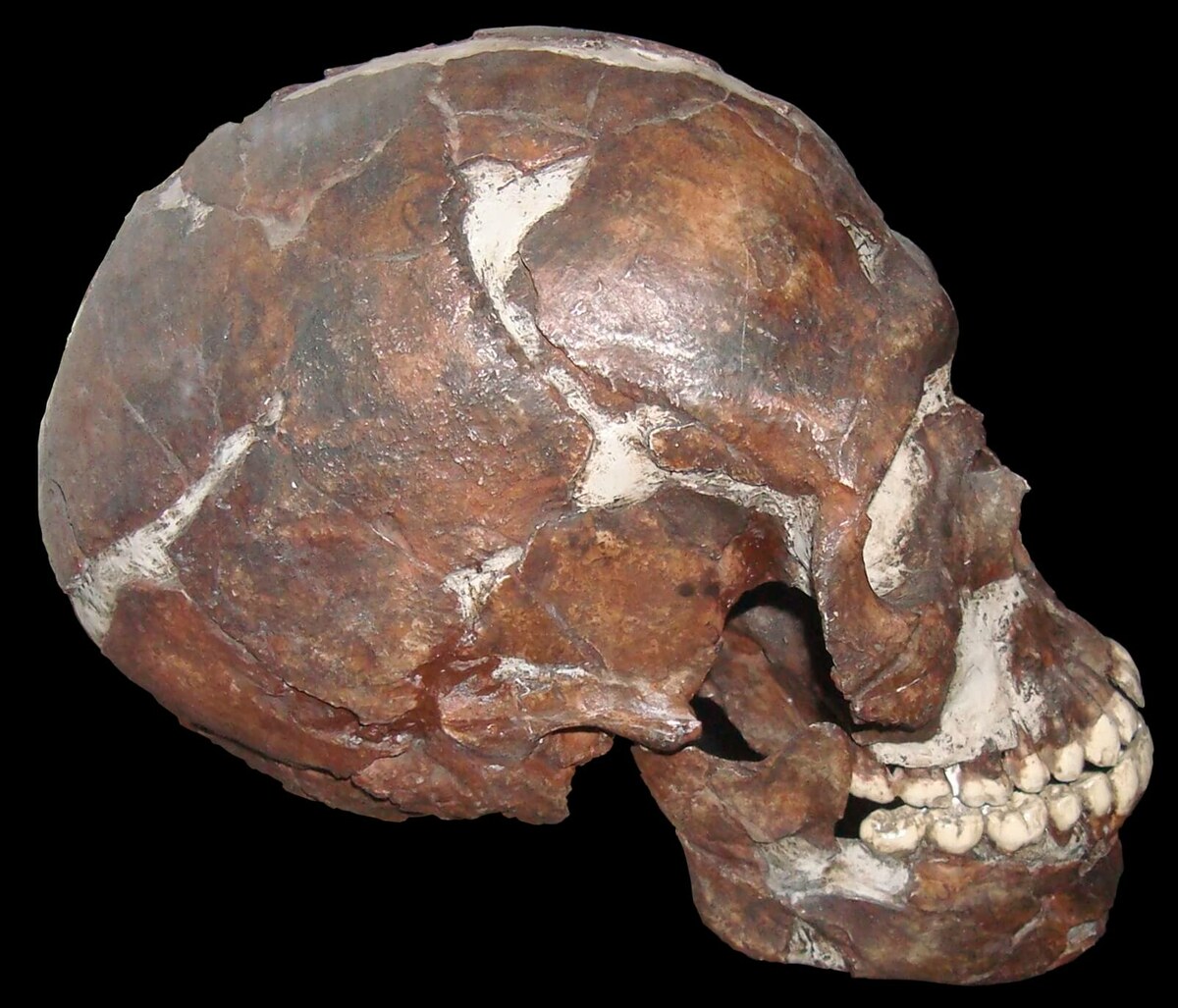
It is in this context that the facial lesion takes on its full significance. The zygomatic bone (cheekbone) of an adult individual bears a perforation with clean, slightly beveled edges, whose morphology is incompatible with an accidental fall or animal bite. Electron microscope analysis reveals a perimortem fracture - sustained at or close to the time of death - with radiating micro-cracks characteristic of a high-velocity impact on living bone.
The angle of penetration and the force required to produce such a lesion correspond to those of a thrown projectile or hafted point used in a direct blow. Ballistic experiments on fresh bone allowed refinement of this model: the wound is consistent with a lithic flake or bone point penetrating at approximately 30-40 degrees relative to the frontal plane.
The Wound: A Deliberate Attack
The interpretation of this lesion as evidence of interpersonal violence rests on several converging arguments. First, the absence of any bone healing indicates the wound was fatal or near-fatal: the bone had no time to cicatrize. Second, the location of the wound - at the center of the face - makes an accidental origin implausible. Third, no carnivore tooth matches the morphology of the perforation.3
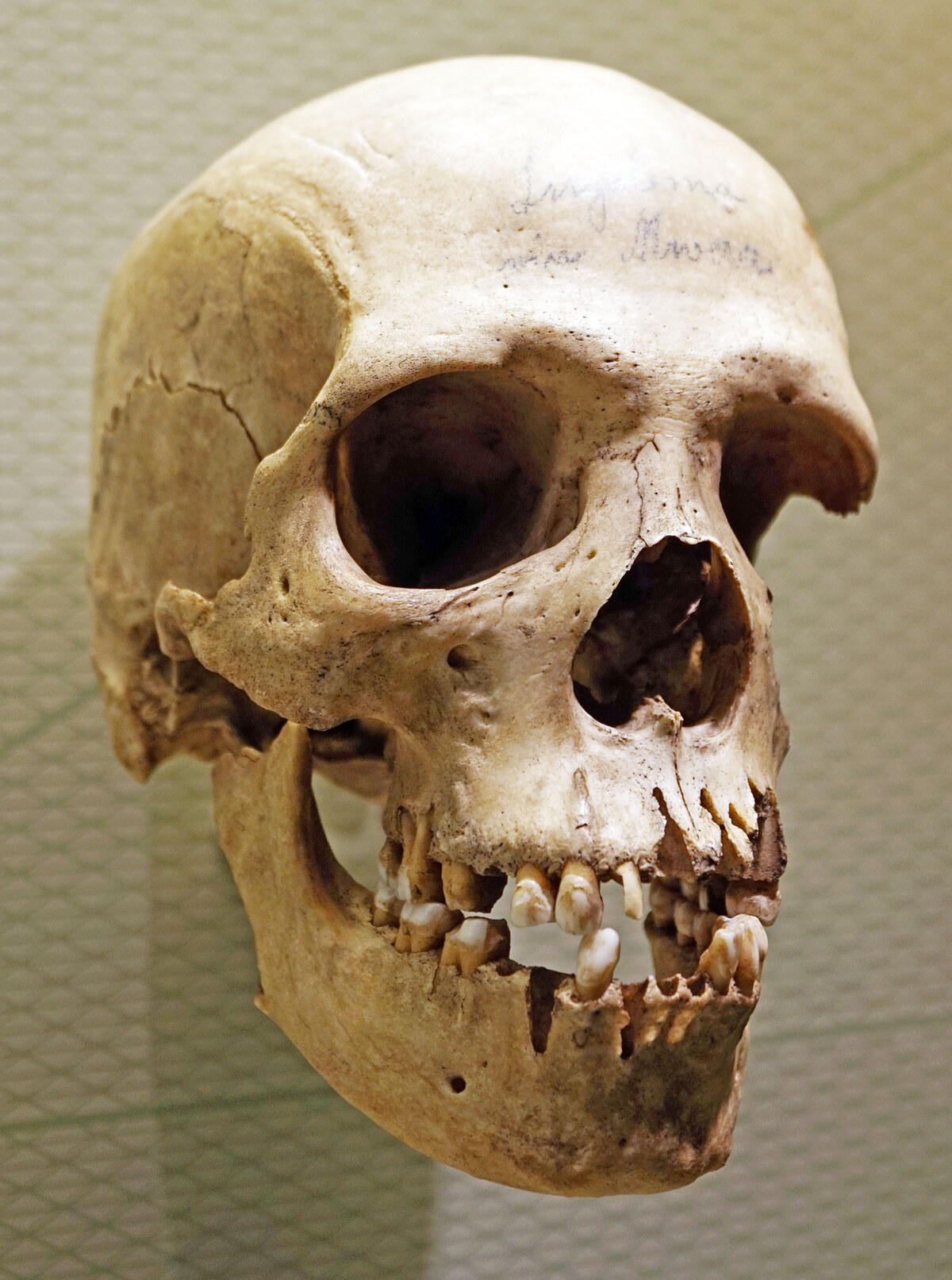
This is not the first case of physical violence documented in human prehistoryPrehistoryThe span of human history before the invention of writing, from the Palaeolithic to the Metal Ages, known mainly through material remains.→. Neanderthal fossils from Krapina (Croatia), dated to around 130,000 years, bear traces of intentional defleshing. At AtapuercaAtapuercaA complex of archaeological sites in the Sierra de Atapuerca (Burgos, Spain), a UNESCO site, yielding an exceptional sequence of human fossils, including the Sima de los Huesos and Homo antecessor.→ (Spain), a skull of Homo heidelbergensisHomo heidelbergensisMiddle Pleistocene human species, often seen as the common ancestor of Neanderthals and our own species.→ 430,000 years old presents two premortem fractures of violent origin. But the Qafzeh case is exceptional for two reasons: the individual is an anatomically modern Homo sapiens, and its dating makes it one of the oldest known examples of intraspecific violence in our species.
The implications for our understanding of prehistoric societies are profound. If such violence existed 100,000 years ago, it cannot be attributed to the stress provoked by sedentarization or agricultureAgricultureThe cultivation of plants and production of food by working the soil, which emerged in the Neolithic in the Near East and independently elsewhere; it radically transformed human societies.→, which did not yet exist. It suggests instead that interpersonal conflicts, and perhaps intergroup conflicts, are a deeply rooted behavioral trait in the human species.
Prehistoric Violence: Universal or Marginal Behavior?
The Qafzeh discovery reignites a fundamental debate: is organized violence a biological characteristic of our species, or a cultural phenomenon that appeared with complex societies? Two schools compete. The first, inspired by Thomas Hobbes, sees in war and violence anthropological constants. The second, Rousseauian, views them as late inventions linked to competition for resources in denser societies.4
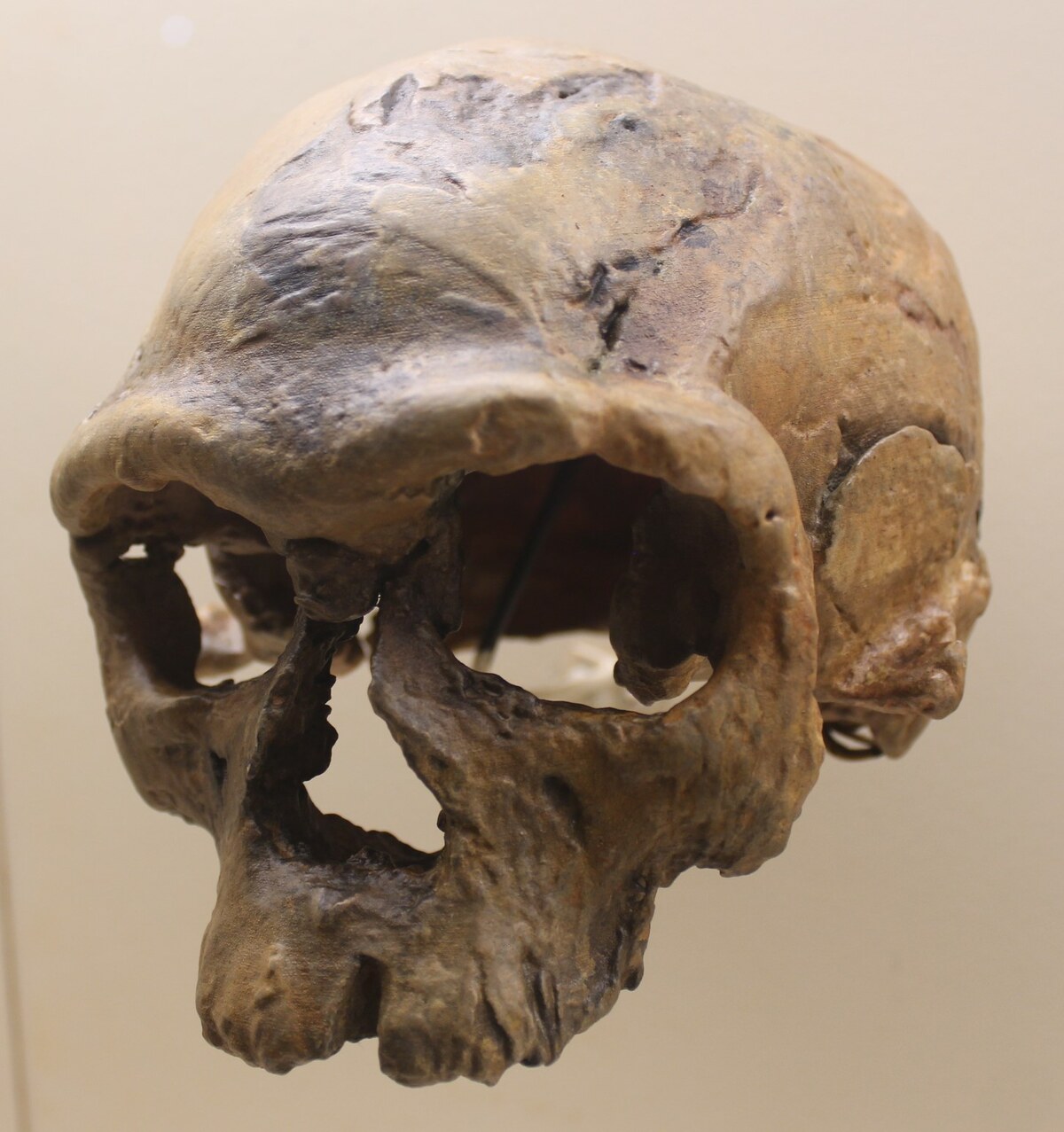
Recent archaeological data tends to invalidate the idyllic vision of a violence-free PalaeolithicPalaeolithicThe oldest and longest period of prehistory (c. 3.3 Ma–12,000 BC), defined by chipped stone tools and a hunter-gatherer way of life.→. Sites such as Crow Creek (South Dakota, 13th century), Talheim, and Asparn-Schletz (European NeolithicNeolithicThe "New Stone Age": a period marked by farming, herding, settlement and pottery, from around 10,000 BC.→) testify to collective massacres. But these examples remain clustered in the Neolithic and beyond. The Qafzeh case, at 100,000 years old, pushes far back in time the first documented occurrence of lethal violence between modern humans.
It would be wrong, however, to extrapolate from a single individual. One injured bone does not prove endemic warfare. What Qafzeh reveals is that the capacity for interpersonal violence was already present in the first Homo sapiens outside Africa, and that it may have played a role - alongside disease, climateClimateThe long-term average atmospheric conditions of a region; its variations (glaciations, aridifications) shaped migrations, agriculture and the collapse of prehistoric societies.→, and resource fluctuations - in the complex demographic dynamics that eventually led to the disappearance of NeanderthalsNeanderthalsA fossil humanity of Eurasia, robust and cold-adapted, extinct around 40,000 years before present.→ and the expansion of Homo sapiens across the entire planet.
No comments yet. Be the first.