There is, in the Jordan Valley, a hill that resembles nothing else: a mound of brown earth, roughly four hectares wide, set in the hollow of an arid plain more than two hundred metres below sea level. Nothing in its silhouette suggests that it shelters one of the most extraordinary concentrations of human history on the planet. This mound bears an Arabic name, Tell es-Sultan, and a name that the whole memory of the West knows without always being able to place it: Jericho. Beneath its slopes sleep, stacked one upon another, more than twenty layers of occupation spanning some eleven thousand years. And at the very bottom, near the bedrock, lie the most arresting remains of all: a stone tower and an enclosure wall dating to around nine thousand years before our era, at the precise moment when humanity, for the first time, ceased to wander and began to put down roots.
Jericho has become, in the collective imagination, the "world's oldest fortified town." The phrase deserves to be weighed, debated, sometimes corrected, and that is the purpose of this feature. Yet it states a robust truth: at Tell es-Sultan, human beings built, at the dawn of agricultureAgricultureThe cultivation of plants and production of food by working the soil, which emerged in the Neolithic in the Near East and independently elsewhere; it radically transformed human societies.→, stone works of an ambition until then unheard of, and they did so at a time when, everywhere else, people still lived by hunting and gathering in ephemeral camps. To understand why this precise point on the Earth concentrated such a density of innovations, sedentismSedentismThe shift from a nomadic life to lasting settlement in one place, a precondition for the rise of villages.→, neolithisationNeolithicThe "New Stone Age": a period marked by farming, herding, settlement and pottery, from around 10,000 BC.→, the first monumental architecture, the oldest known funerary portraits, we must begin with the setting.
A tell, an oasis
A tellTellAn artificial mound formed by the accumulation of successive layers of settlement remains at the same spot, typical of the Near EastNear EastA region of western Asia (Levant, Mesopotamia, Anatolia, Iran), cradle of the Neolithic revolution, agriculture, the first cities and writing.→. Each destruction-rebuilding event adds a stratum.→ is not a natural hill. It is an accumulation: the raised trace of thousands of years of superimposed human habitation. Throughout the Near East, ancient villages were built of unbaked mud brick, a cheap and abundant but perishable material. When a house collapsed, its rubble was not carted away: the heap was levelled, tamped down, and built over. Generation after generation, the floor level of these villages rose by a few centimetres a year, then by several metres a century. After several millennia, the settlement had ended up perched on its own history, raised atop an artificial mound that archaeologists call a tell. Tell es-Sultan is the archetype: a knoll more than twenty metres thick in debris, each stratum of which is a slice of time.
What fixed people to this spot, rather than another, comes down to a single word: water. At the foot of the tell rises a perennial spring, Ain es-Sultan, which tradition also calls "Elisha's spring." In a region where rainfall is scarce and evaporation fierce, this resurgence yields a considerable flow, on the order of several hundred, even a thousand litres per minute, that never runs dry. Around it spreads an oasis: an island of dense greenery, date palms, orchards and gardens, springing from the desert like a promise. Jericho owes its nickname, the "city of palms," to this hydrological anomaly. The spring explains everything: without it, no crops, no stores, no settled population, no Jericho.
The site enjoys other advantages. The Jordan depression, one of the lowest emerged lands on the globe, enjoys a mild climateClimateThe long-term average atmospheric conditions of a region; its variations (glaciations, aridifications) shaped migrations, agriculture and the collapse of prehistoric societies.→ in winter that made it a pleasant refuge when the surrounding plateaus were cold and windswept. The alluvial soils, regularly moistened by the spring, were fertile. Finally, Jericho's position, at one of the few convenient crossing points of the valley, made it a natural crossroads between the banks of the Jordan, the Judaean desert and the routes of the LevantLevantA region of the eastern Mediterranean Near East (Israel, Lebanon, Syria, Jordan), a major crossroads of the first human migrations out of Africa.→. Everything conspired to make this point a magnet for human groups. It remains to understand how, from a mere hunters' halt, it became a town.
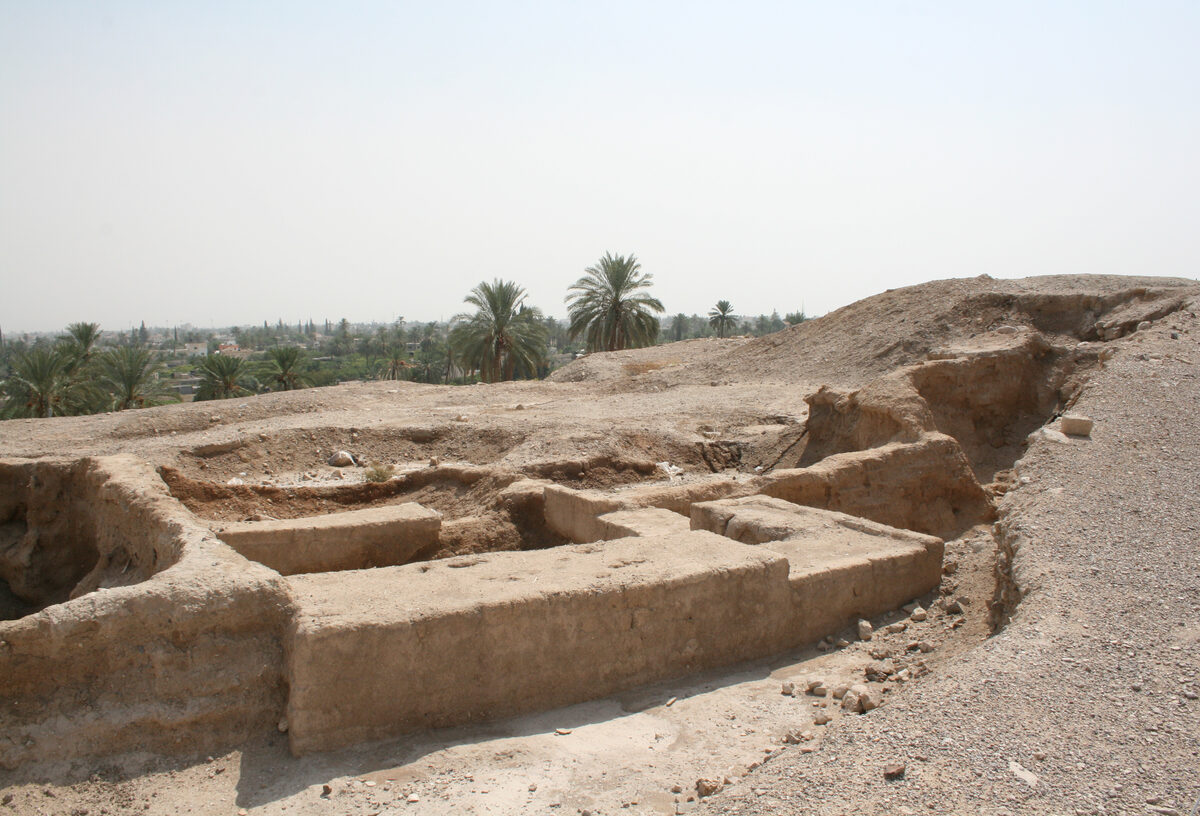
It is worth dwelling for a moment on the scale of this gift of nature, for it conditioned everything that followed. A perennial spring in a desert is not merely a convenience; it is the very possibility of permanence. Nomadic hunter-gatherersHunter-gatherersA way of life based on hunting, fishing and gathering wild resources, without farming or herding; it dominated almost the whole of human history.→ move because resources move, game migrates, wild plants ripen here then there, water holes dry up. A spring that never fails breaks this logic: it allows people to stay, to store, to build, to bury their dead nearby and return to them. Around Ain es-Sultan, the predictability of water freed human energy for purposes other than the perpetual search for the next camp. In that sense, the spring of Jericho is not just a backdrop to the story; it is one of its protagonists, the silent engine of the first great human settling-down.
The excavations: from Garstang to Kathleen Kenyon
The scientific rediscovery of Jericho came in several waves, and each tells as much about the state of archaeology in its time as about the site itself. As early as the late nineteenth century, explorers and clergymen fascinated by Biblical Jericho probed the tell, in search of the famous walls toppled by Joshua. The first methodical excavations were carried out between 1907 and 1909 by an Austro-German mission led by Ernst Sellin and Carl Watzinger, who uncovered fortifications but struggled to date them for want of reliable chronological tools. At that time, the archaeology of the Levant still read the ground through Scripture more than through stratigraphy.
In the 1930s, the British archaeologist John Garstang took up the dig. He brought to light imposing ramparts, which he believed he could link to the Biblical episode of the city's fall, and proposed a chronology that caused a great stir. Garstang worked seriously, but his interpretive framework remained deeply marked by the desire to find, in the earth, confirmation of the Biblical narrative. His dates would later be substantially revised. His considerable merit was to have recognised the exceptional antiquity of the deepest layers and to have sensed that Jericho harboured a past far older than the Bronze AgeBronze AgeA protohistoric period following the Neolithic, defined by bronze metallurgy (a copper-tin alloy) and the rise of the first cities and states; in Egypt it corresponds to the age of the first pyramids.→.
It was the third campaign, conducted from 1952 to 1958, that changed everything. At its head was a woman: Kathleen Kenyon (1906–1978), one of the greatest archaeologists of the twentieth century. Trained in the rigorous school of Mortimer Wheeler, Kenyon applied to Jericho an excavation method revolutionary for the Near East: the so-called "Wheeler-Kenyon" method, which consists of digging in squares separated by baulks, partitions of earth left in place, whose vertical faces offer a continuous reading of the stratigraphyStratigraphyThe study of the superimposed layers (strata) of an archaeological site; each layer corresponds to a phase of occupation and yields a relative chronology.→. Instead of clearing broad surfaces horizontally, one slices the tell vertically, like a cake, to read the stacking of the layers in the order in which they were laid down. Every centimetre becomes datable, every object replaced within its sequence.
This rigour paid off beyond all expectation. Descending beneath the Bronze Age levels, beneath those of the ChalcolithicChalcolithicThe "Copper Age": a transition between the Neolithic and the Bronze Age, marked by the first copper objects (Ötzi's era).→, beneath the Neolithic villages too, Kenyon reached layers of astounding antiquity, and there discovered the stone tower and the wall. Above all, she demonstrated, through stratigraphy and the first radiocarbon dates (the method had just been invented), that these works went back to about eight or nine thousand years before our era. The result was staggering: Jericho became, at a stroke, the oldest known fortified settlement, and one of the oldest permanent villages in the world. Kenyon also rendered Garstang a nuanced justice: the rampart he attributed to Joshua was in reality far older, and nothing allowed it to be read as the Biblical episode. Science had just replaced legend, without, however, erasing its prestige.
Kathleen Kenyon's legacy, moreover, extends beyond Jericho alone. By imposing a millimetric excavation, attentive to every lens of ash and every trampled floor, she profoundly renewed the archaeology of the Near East and trained an entire generation of researchers. Her notebooks, her drawn sections and her publications remain references. Since then, more recent missions, notably Italo-Palestinian ones, have resumed the study of Tell es-Sultan with contemporary methods, refined dating, sediment analysis, archaeobotany, confirming the essentials of her conclusions while sharpening the chronology. Research on Jericho is therefore far from closed: it continues, cautious and cumulative, on the foundations she laid.
The tower and the wall of the PPNA
Jericho's jewel belongs to a phase that prehistorians call the Pre-Pottery NeolithicPre-Pottery NeolithicThe first phase of the Neolithic (c. 9,600–6,900 BC), before the invention of pottery.→ APre-Pottery Neolithic A (PPNA)The first phase of the Near Eastern Neolithic (c. 9,600–8,800 BC), predating pottery; at Jericho it corresponds to the construction of the tower and enclosure wall.→, or PPNA, that is, the first Neolithic period of the Near East, predating the invention of pottery, extending roughly from 9,600 to 8,800 BC. It was during these decisive centuries that the inhabitants of Jericho built two works without equivalent: an enclosure wall and, abutting it, a tower.
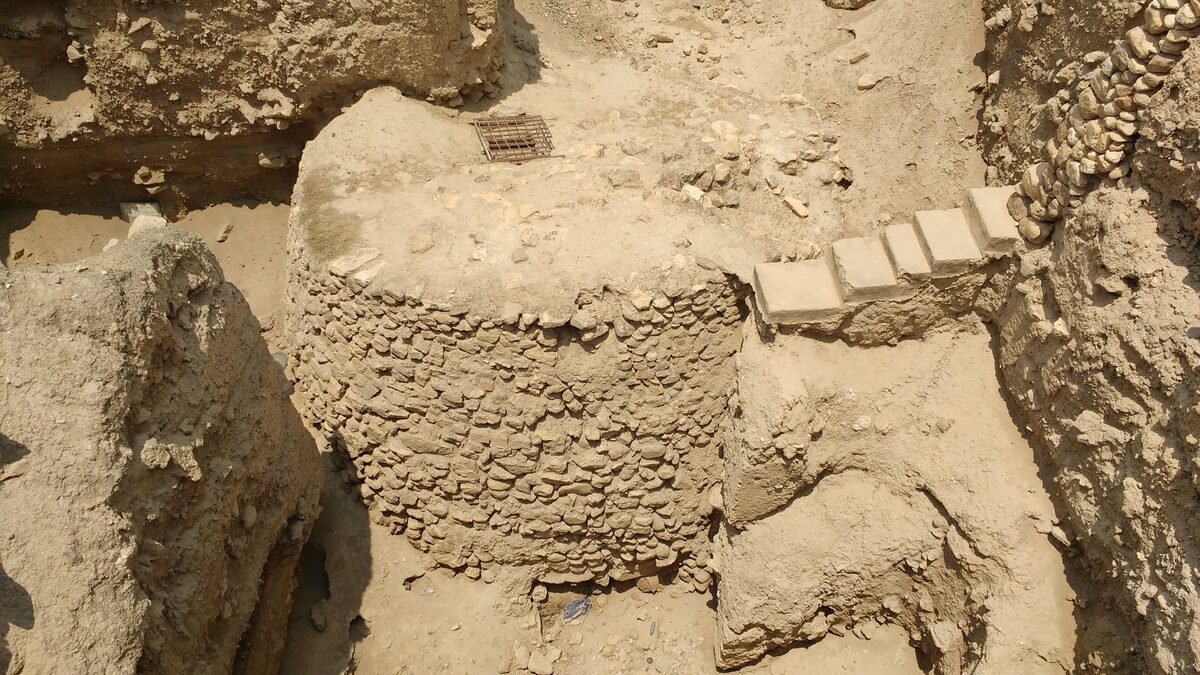
The tower of Jericho is a mass of dry stone, almost perfectly circular. It measures about eight and a half metres in diameter at the base and rises, as it was found, to a little over eight metres in height, it may have been taller originally. Its masonry is made of rough stone blocks, carefully assembled without mortar. But its most astonishing feature is hidden within: a staircase! Twenty-two steps of smooth stone, cut from slabs, pierce the heart of the tower and lead from the ground to the summit through a narrow covered passage. It is one of the oldest known staircases of humanity, preserved almost intact under eleven millennia of sediment. To build it required collective organisation, a division of labour, the moving of hundreds of tonnes of stone and an architectural vision far surpassing anything known for that period.
The tower did not stand alone. It was set against a stone enclosure wall that girdled at least part of the settlement. This wall, about one metre eighty thick and several metres high, followed the contour of the village. Beside it, or in front of it depending on the sector, runs in places a ditch carved into the rock, wide and deep, hewn with stone tools into the bedrock. The whole, ditch, wall, tower, represents a colossal construction effort. It has been estimated that it could have mobilised tens of thousands of working days. For communities of a few hundred, perhaps a few thousand individuals, who knew neither metal, nor the wheel, nor the draught animal, it is a feat that commands respect.
The raising of these works poses a dizzying question: how could people without metal, without writingWritingA system of conventional signs used to fix language or information durably; its appearance (c. 3300 BC) marks, by convention, the end of prehistory.→ and without beasts of burden conceive and coordinate such a project? Everything was done by the strength of arms and with tools of stone and bone. The peripheral ditch, dug into a hard rocky substrate, required extracting and removing hundreds of cubic metres of rock. The wall and the tower consumed thousands of blocks that had to be selected, transported sometimes over notable distances, fitted and stacked. Such an undertaking presupposes planning, the transmission of know-how, and above all the capacity of a community to mobilise a large workforce over a sustained period for a common goal, beyond mere daily survival. It is perhaps there, even more than in the stone, that the true revolution of Jericho lies: the invention of organised collective labour on a large scale.
What area was protected by these works? Estimates vary, but the PPNA settlement probably covered on the order of two to four hectares, and housed a population that researchers assess, according to hypothesis, at between a few hundred and two or three thousand inhabitants. Even at the low end of this range, it is, for the ninth millennium before our era, an unprecedented human concentration: a "town" before its time, in the sense that it brought together, in a single place, a density, a permanence and a collective organisation unknown to the world of hunter-gatherers.
Why fortify so early? The debates
The great question, the one that has stirred prehistorians since Kenyon, is simple to formulate and formidable to resolve: why? Why did nascent Neolithic communities devote an enormous share of their energy to building a tower and a wall? Against what, against whom were they protecting themselves? Kathleen Kenyon's answer, faithful to Garstang's intuition, was military: Jericho was a fortified town, its walls served for defence, its tower was a work of war. From this comes the consecrated phrase "world's oldest fortified town." But this interpretation, long dominant, is today seriously contested.
First objection: it is hard to see what enemy would have threatened Jericho in the ninth millennium. At that time, populations were sparse, the art of organised warfare is attested nowhere, and no trace of assault, of combat fire or of collective violence has been found in the relevant layers. Building a fortification presupposes a peril; yet this peril remains invisible. Second objection, more technical: the tower stands inside the wall, and not along its line, which is strange for a defensive tower, one would expect to see it project outward, command a glacis, flank a gate. Here, nothing of the sort.
Researchers have therefore proposed other explanations. The most appealing concerns the wall itself: it may have served not to stop people, but to stop water and mud. Jericho is built at the mouth of small wadis which, during storm rains, pour out mudflows and sudden floods. A well-placed wall and ditch would have protected the village against these inundations and silting, a hydraulic function and not a military one. As for the tower, several leads coexist. Some see in it a granary or a raised storage point; others, an observation post; others still, and this is the most debated hypothesis, a monument with a strong symbolic or ritual charge.
A celebrated study proposed that the tower had a cosmological function: its shadow, at the setting of the sun at the summer solstice, would have been cast exactly onto the village from the neighbouring mountain, making the edifice a marker of time and an instrument of social cohesion, intended perhaps to induce the nascent community to accept the effort and discipline of settled life. The presence, at the base of the tower, of human skeletons deposited intentionally reinforces the idea of a symbolic dimension. None of these hypotheses is definitively proven, and it is likely that the truth is composite: a single work may, over the centuries, have fulfilled in turn or simultaneously defensive, hydraulic, economic and ritual functions. The debate, far from closed, illustrates the interpretive richness of a site that resists any simple reading.
It must also be recalled that the tower and the wall were not built all at once nor on exactly the same date: excavations show successive phases of construction, repair and heightening, spread over several centuries. The tower, for example, was used, modified, then finally decommissioned and even partly filled with burials before being covered by new constructions. This eventful history further complicates interpretation: a single edifice may have changed meaning across the generations, passing perhaps from a practical use to a commemorative or sacred status. Archaeology does not read a fixed intention, but a long sequence of reappropriations. It is this temporal thickness, proper to tells, that forbids univocal explanations and invites caution: at Jericho, every overly simple answer sooner or later collides with the complexity of the ground.
The longest continuously inhabited town
If there is one title that Jericho can claim without much contestation, it is that of the most anciently and most continuously inhabited locality in the world. The phrase requires precision. Jericho is not the oldest trace of human occupation, humanity has camped almost everywhere for hundreds of thousands of years. Nor is it, strictly speaking, the first "city" in the sense that Mesopotamia would later understand it, with its temples, its palaces and its writing. What distinguishes Jericho is continuity: on the same geographical point, people have lived, almost without interruption, from the end of the last ice age to the present day. The modern town of Jericho extends, a few hundred metres away, the ancient tell. Eleven thousand years of unbroken habitation: no other site can say as much with such stratigraphic clarity.
This continuity makes Tell es-Sultan a history book leafed through in reverse. Descending into the tell, one travels back in time: beneath Ottoman Jericho, Crusader Jericho; beneath it, Roman and Byzantine Jericho; lower down, the towns of the Iron AgeIron AgeThe last period of protohistory (from c. 1200 BC in Europe and the Near East), marked by iron metallurgy and the first kingdoms.→ and the Bronze Age, precisely those evoked by the Bible; lower still, the villages of the Chalcolithic, then those of the Pottery Neolithic; and at the very bottom, the Pre-Pottery Neolithic, with its tower and its wall. Each civilisation trod the rubble of the preceding one. For the archaeologist, it is an unparalleled windfall: nowhere else can one follow, in a single place, the evolution of human habitation over so long a span, from the hunters' hut to the modern town.
Should one therefore speak of a "town" as early as the Neolithic? The word invites debate. A town, in the classical sense, presupposes a marked social hierarchy, a specialisation of trades, institutions, an administration. Nothing of the sort is clearly attested at Jericho in the ninth millennium: we are dealing with a very large village, strongly agglomerated, but probably still egalitarian and without visible centralised power. This is why many specialists prefer to speak of a "proto-town" or a "fortified village." But the stakes go beyond the quarrel of words: Jericho shows that human concentration, the permanence of habitation and collective architecture preceded, by several millennia, the appearance of the state and of writing. The town, in short, was born before urban civilisation.
This stacked record is also why Jericho became, paradoxically, a school for archaeology itself. Because the layers are so numerous and so clearly superimposed, the site forced researchers to think rigorously about sequence, about what comes before and after, about how a culture transforms into the next. Many of the principles now taken for granted in field archaeology were sharpened, if not invented, on tells like this one. To read Tell es-Sultan correctly is to learn to read time in the ground, and that lesson, learned at Jericho, has since travelled to excavations the world over.
Plastered skulls and the cult of the ancestors
If the tower is Jericho's architectural face, the plastered skullsPlastered skullsHuman skulls whose face was remodelled in lime plaster, sometimes with shells for eyes; a Neolithic funerary practice linked to ancestor worship.→ are its human face, literally. During a somewhat later phase, the Pre-Pottery Neolithic B (about 8,800 to 6,500 BC), the inhabitants of Jericho developed a funerary practice of overwhelming intensity. When a relative died, they first buried him, often beneath the very floor of the house. Then, after a time, they exhumed the skull, detached it from the skeleton, and undertook to give it back a face. On the bare bone, they modelled lime plaster to reconstruct the cheeks, the forehead, the nose, the lips. In the eye sockets they sometimes placed shells, split sea cockles, that imitated the half-closed eyes of the deceased. Some skulls bore traces of pigment, of painted hair, even of a moustache.
These plastered skulls are, to this day, among the oldest human portraits we know. They are not imaginary effigies: they are the real remains of individuals, re-humanised by the gesture of the living. Several dozen have been discovered across the Levant, at Jericho, at Ain Ghazal, at Tell Ramad, in other contemporary villages, and the most famous of them, exhumed by Kathleen Kenyon, is now kept in the British Museum in London. Its modelled face, with its shell eyes, has gazed at visitors for almost ten thousand years, with an almost unbearable presence.
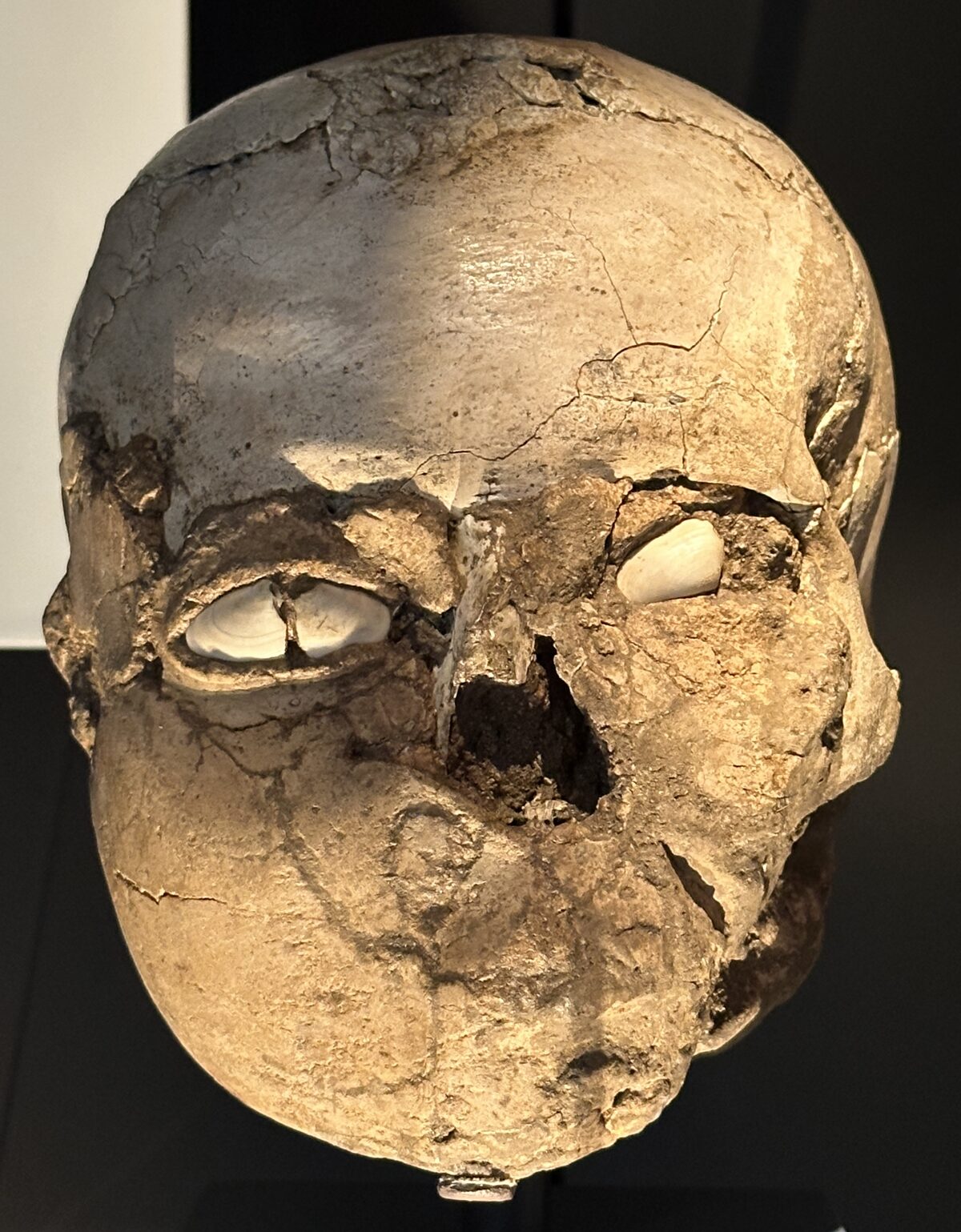
What did this practice signify? The most widely accepted interpretation is that of a cult of the ancestors. To keep the skull of a dead person, to give it back a face, to keep it in the house or to bury it in a group beneath the domestic floor, is to maintain a presence, to prolong a bond, to anchor the community in a lineage. In a world that had just invented sedentism, where one was born, lived and died in the same place, generation after generation, the dead became the guardians of the place. The plastered skull materialises this memory: it makes of the deceased a permanent member of the household, an intermediary perhaps between the living and the beyond, a guarantor of the continuity of the group. This elaborate and codified secondary burialBurialThe intentional deposition of a body, sometimes with offerings; a marker of symbolic behaviourSymbolic behaviourA set of practices (adornment, pigments, art, burial) reflecting symbolic thought; long ascribed to Homo sapiens alone, now attested for Neanderthals too.→.→ testifies to a spiritual life of great complexity, a thousand leagues from the crude image one sometimes forms of "cave men."
It has been noted that these skulls belonged mostly, but not exclusively, to adults, and that the care brought to the modelling varied, a sign perhaps of differentiated social status, or simply of unequal skill. The practice lasted for centuries, spread over a vast area, then declined. It remains one of the most moving testimonies of prehistoryPrehistoryThe span of human history before the invention of writing, from the Palaeolithic to the Metal Ages, known mainly through material remains.→: at Jericho, from the eighth millennium, men and women already refused to let their dead disappear entirely, and invented, with plaster and shells, the art of the portrait to ward off oblivion.
From the NatufianNatufianAn Epipalaeolithic culture of the Levant (c. 12,500–9,500 BC) that preceded farming: its populations harvested wild grains and lived in semi-permanent villages. Direct precursors of the Neolithic.→ to the Neolithic
To grasp what was at play at Jericho, one must go back upstream of the tower, to the most ancient occupants of the site: the NatufiansNatufianA culture of semi-sedentary hunter-gatherers of the Levant (c. 12,500-9,500 BC) harvesting wild cereals and building the first round houses; it prepares the Neolithic.→. This culture, which flourished throughout the Levant between about 12,500 and 9,500 BC, marks a decisive tipping point. The Natufians were still hunter-gatherers, but hunter-gatherers of a new kind: semi-sedentary. Taking advantage of the abundance of wild cereals, barley, einkorn, emmer, that grew spontaneously in the Fertile CrescentFertile CrescentAn arc-shaped region of the Near East (Levant, Mesopotamia) where farming and herding first emerged.→, they no longer needed to move constantly to follow game. They settled for long seasons, even year-round, in stable camps, where round semi-buried houses have been found, querns for grinding grain, flintFlintA hard, brittle siliceous rock, knapped by prehistoric people to produce blades, points and sharp tools.→ sickles whose edge still bears the characteristic gloss of the sawing of grass stems.
At Jericho, the Natufian levels, at the base of the tell, show that the site was already frequented at that time, attracted by the spring and by the richness of the oasis. The Natufians harvested the wild cereals there, perhaps protected them, perhaps already began to sow them. It is this phase, known as proto-agriculture, that prepares the great rupture. For the Neolithic does not fall from the sky: it is the outcome of a long mutual taming between humans and certain plants. By dint of harvesting, sorting, resowing the largest and most easily detached seeds, the communities of the Levant had, without being aware of it, selected domestic varieties, cereals whose ear no longer breaks off on its own at maturity and which henceforth depend on humans to reproduce. The domestication of plants, then that of animals (goat, sheep), radically transforms the relationship to the world.
At the heart of this process, Jericho occupies a privileged place. The transition from the Natufian to the Pre-Pottery NeolithicNeolithicThe "New Stone Age": a period marked by farming, herding, settlement and pottery, from around 10,000 BC.→ is legible there in the stratigraphy, layer after layer: one sees the seasonal hunters' halt become a permanent farmers' village, the round stone houses multiply, the population grow, and finally the great collective works, tower, wall, ditch, arise. This transition, sometimes called the "Neolithic revolutionNeolithic revolutionThe shift from hunter-gatherer societies to farming and settled life (c. 10,000 BCE in the Near East), giving rise to villages and then cities.→," is one of the major turning points of human history, as decisive as the invention of writing or of industry. It did not happen in a day, nor in a single place, but the Levant, and Jericho at its heart, was one of its principal hearths. Here, more than elsewhere, one can almost touch the moment when man became a farmer.
This transformation did not come without trade-offs. Settled life, while it offered food security and relative comfort, also imposed new constraints: increased promiscuity, the appearance of diseases linked to human concentration and contact with animals, dependence on harvests vulnerable to climatic hazards, and a heavier daily workload. The study of Neolithic skeletons sometimes reveals poorer health than that of the last hunter-gatherers, more mobile and with a more varied diet. Jericho illustrates this founding paradox: the Neolithic revolution was an immense collective gain, rising demography, accumulation of surplus, birth of villages, paid for at a certain individual cost. To understand this tacit bargain, accepted at the dawn of history, is to grasp the ambivalence of our entire material civilisation, born of a choice whose consequences the inhabitants of Tell es-Sultan were among the very first to experience.
What is striking, in this history, is the precocity of Jericho. At the moment when the tower was being built there, the vast majority of humanity still knew nothing of agriculture and settlement. It would take millennia for neolithisation to win, step by step, Anatolia, Europe, Asia. Jericho is, in this sense, a vanguard: a laboratory where, very early, the way of life that would end up becoming that of almost the whole species was experimented with. To understand Jericho is to understand how and why we ceased to be nomads.
Jericho between imagination and archaeology
No prehistoric site bears a name so heavy with resonance. Before being an object of science, Jericho is a myth: the town whose walls, in the Biblical book of Joshua, collapse at the seventh circuit of the trumpets of the Hebrew people. This image, the walls that fall at the sound of trumpets, has shaped the Western imagination to the point that, for a long time, Jericho was excavated less to understand prehistory than to verify the Bible. Garstang himself believed he had found the walls of Joshua. It was precisely the work of Kathleen Kenyon that untangled the misunderstanding.
Archaeology has indeed established that the Jericho of the Biblical episode, situated in the Late Bronze AgeLate Bronze AgeThe final phase of the Bronze Age in the Near East (c. 1550 to 1200 BCE), an age of great empires and international diplomacy, ended by a general collapse.→ (around 1,400 BC), presented, in its corresponding layers, neither the powerful fortifications expected, nor the traces of a destruction matching the narrative. At that period, the site even seems to have been modestly occupied, or largely abandoned. The spectacular ramparts attributed to the epic of Joshua belonged in reality to far older phases, Neolithic or Early Bronze Age. In other words, the Biblical account of the fall of Jericho does not find, in the ground, the material confirmation long sought. This in no way diminishes the value of the text as a literary and religious document; it merely recalls that myth and history obey different logics.
The paradox is delicious: in seeking the Jericho of the trumpets, archaeologists found an infinitely more extraordinary Jericho, that of the Neolithic tower, the plastered skulls, the first villagers of the world. Archaeological reality surpassed the legend. The true wonder of Jericho is not the fall of its walls, but their erection, nine thousand years earlier, by communities who were inventing there, for the first time, the town and architecture. The "world's oldest fortified town" does not need Joshua to exist; it amply suffices unto itself.
This interweaving of imagination and archaeology also makes for the fragility of the site. A highly symbolic place, claimed by multiple religious traditions and national narratives, Jericho has been and remains a stake of memory. The role of archaeology there is all the more precious: to substitute, for inherited certainties, the patience of stratigraphy; for imaginary walls, real walls; for legend, a verifiable history. This is what science accomplished at Tell es-Sultan, and this is what the inscription of the site on the World Heritage List recognises, in its own way.
The 2023 UNESCO listing
In September 2023, the World Heritage Committee of UNESCO, meeting in Riyadh, inscribed Tell es-Sultan / Ancient Jericho on the World Heritage List. This consecration, long awaited, recognises the outstanding universal value of the site: at once as one of the oldest permanent human settlements on the planet, as a major milestone in the transition to settled life and agriculture, and as a stratigraphic archive of incomparable richness. The inscription underlines in particular the importance of the remains of the Pre-Pottery Neolithic, the tower, the wall, the dwellings, and of the funerary practices of the first villagers, among them the plastered skulls1.
The inscription file highlights several criteria. First, the exceptional testimony that Jericho constitutes on the first stages of sedentism and the birth of villages in the Near East: nowhere else is this transition documented with such temporal depth and such continuity. Next, the architectural and technical value of the PPNA works, which rank among the oldest monumental constructions of humanity. Finally, the emblematic character of the site in the history of the archaeological discipline itself, from the pioneers of the early twentieth century to the methodological revolution of Kathleen Kenyon1.
Beyond scientific recognition, the 2023 inscription commits the international community to the long-term protection of a fragile site. Tell es-Sultan is exposed to erosion, to the pressure of the modern urbanisation of the town of Jericho, and to the hazards of a sensitive political context. World Heritage status implies a management plan, conservation measures and heightened vigilance over the integrity of the tell and its environment. It also consecrates Jericho as a property belonging to all of humanity, beyond borders and allegiances, a message which, for a place so laden with history, is far from trivial. International scientific institutions, from heritage committees to the great museums that hold the objects of Jericho, unanimously underline the singular place of this site in the narrative of the origins of urban life2.
Conclusion
At the end of this journey, Jericho appears for what it truly is: less a "town" in the sense we understand it than a threshold, a tipping point at which humanity crossed, almost without knowing it, one of its deepest frontiers. On this modest hill of the Jordan Valley, hunter-gatherers became farmers, camps became villages, and villages, for the first time, raised toward the sky a tower of stone. Everything that would later make urban civilisation, density, permanence, collective architecture, the memory of the ancestors, is already present there, in germ, nine thousand years before our era.
The phrase "world's oldest fortified town" will remain attached to Jericho, even if specialists debate its terms: town or proto-town, fortification or hydraulic work, the debate remains lively and so much the better, for it testifies to the vitality of a site that has not yielded all its secrets. What is beyond doubt, on the other hand, is the exceptional antiquity and continuity of human occupation at Tell es-Sultan, the grandeur of the Pre-Pottery Neolithic works, and the emotion still aroused, behind a museum case, by the plastered faces of the first villagers.
From Garstang to Kathleen Kenyon, from the Biblical legend to patient stratigraphy, from the spring of Ain es-Sultan to the 2023 World Heritage inscription, Jericho condenses in a single place the whole history of our relationship to the past: the share of myth and the share of proof, the desire to believe and the demand to know. And if one image were to be retained, it would be that of this staircase of twenty-two steps, buried for eleven thousand years at the heart of the tower, patiently climbing the darkness, a staircase that human hands carved at the dawn of our history, and that archaeology, in its turn, has known how to bring back toward the light.
Les premières formes d'expression humaine me fascinent. Cet article nourrit vraiment ma réflexion.
Je montre toujours cet article à mes élèves de Terminale pour illustrer la révolution néolithique. Jéricho est parfaite pour comprendre comment la sédentarisation a transformé les sociétés humaines : murs, tours de guet, stockage de nourriture. Cela permet de discuter des avantages et des inconvénients de la vie en communauté fixe.
Jéricho est souvent associée à la Bible mais son histoire archéologique est bien plus ancienne et fascinante. C'est l'une des plus anciennes agglomérations humaines connues, avec des traces d'occupation remontant à 10 000 ans avant notre ère. Les fameuses tours rondes préhistoriques montrent une organisation sociale déjà très structurée.