On the banks of the Nile, several hundred kilometres south of the modern Sudanese-Egyptian border, stood a prosperous capital over four millennia ago: Kerma. For nearly a thousand years, from the 3rd to the middle of the 2nd millennium BCE, this city served as the centre of a powerful state that the Egyptians called Kush. Long neglected by Western scholarship, the remains of Kerma testify to an original, complex and militarily formidable civilization.1
A City on the Nile: Sub-Saharan AfricaSub-Saharan AfricaThe part of Africa south of the Sahara; cradle of Homo sapiens, long thought hostile to ancient-DNA preservation because of heat.→'s First Urban Centre
Kerma is often described as the oldest city in sub-Saharan Africa whose remains have been precisely documented. Excavations carried out since the 1970s by a University of Geneva mission, under the direction of Charles Bonnet, have uncovered a structured urban plan: residential districts, monumental granaries, cult spaces, pottery workshops and a palace. The city was surrounded by a massive wall, a clear sign of a state organisation capable of mobilising considerable human resources.
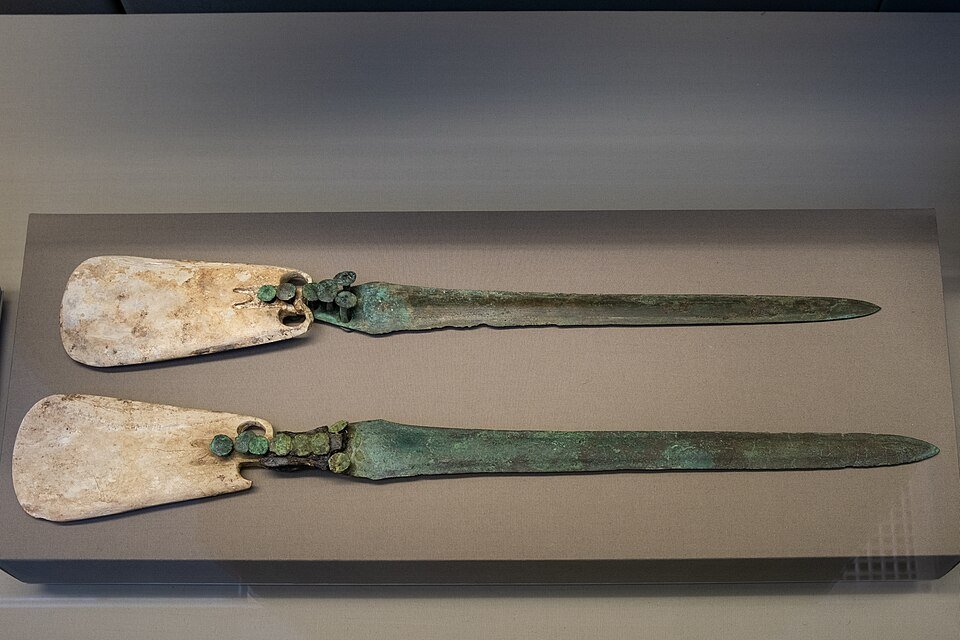
The city occupied a strategic position at the third Nile cataract, at a convergence of trade routes from the heart of AfricaAfricaThe cradle of humankind: the continent where the first hominins appeared, then Homo sapiens around 300,000 years ago, before the expansion to the rest of the world.→ and river routes leading up to Egypt. Ivory, animal skins, ebony, gold and enslaved people passed through Kerma, enriching its elites and sustaining a sophisticated redistributive economy. Egypt's rulers, aware of this growing power, built numerous military forts downstream to control their southern frontiers.
Kerma Pottery: A Unique Art Form
Among the most characteristic features of Kerma civilisation is its pottery, of exceptional quality and considered by specialists to be among the finest of ancient Africa. Kerma potters mastered a firing technique that produced vessels with a brown or black body and a bright red lip, with remarkably thin walls. This chromatic duality was achieved by partially burying the pieces during firing.
These vessels, sometimes as thin as porcelain, were deposited by the hundreds in the tombs of important individuals. They are found in burialBurialThe intentional deposition of a body, sometimes with offerings; a marker of symbolic behaviour.→ mounds throughout the region, often accompanied by weapons, gold jewellery and sacrificed animals. Kerma pottery circulated across wide territories, demonstrating active exchange networks with neighbouring populations.2
Giant Burial Mounds and Funerary Rituals
It is perhaps in its funerary practices that Kerma civilisation distinguishes itself most spectacularly. The rulers of Kerma were interred beneath circular earthen mounds reaching up to eighty metres in diameter and several metres high. These royal tumuli rank among the largest ever constructed in sub-Saharan Africa.
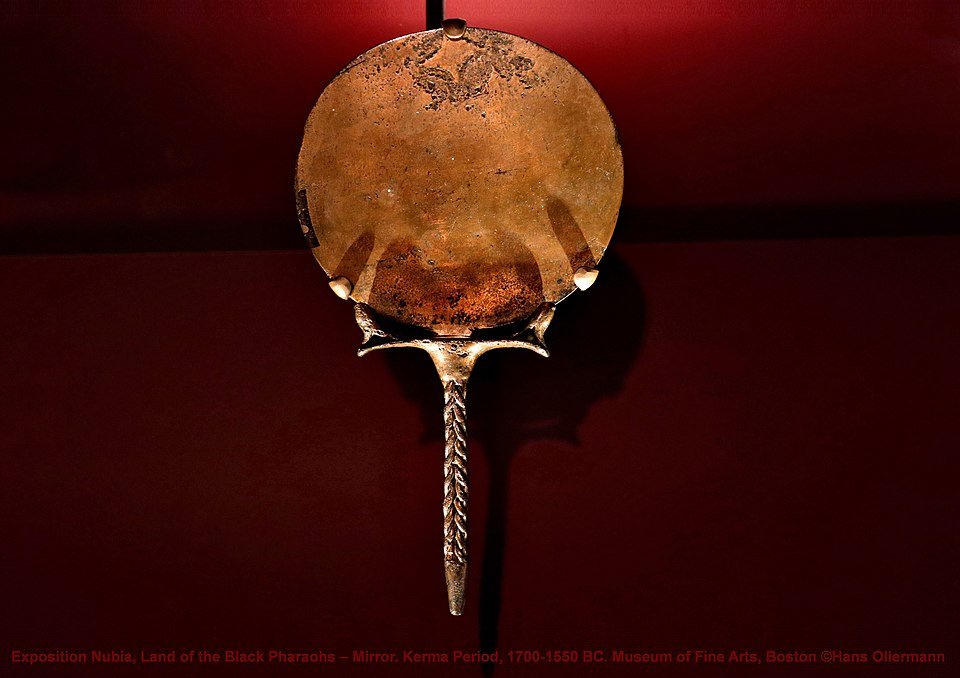
What makes these burials particularly striking is the scale of human sacrifice that accompanied them. Osteological analyses of Kerma royal mounds have revealed hundreds of adult skeletons arranged around the central body, probably sacrificed at the time of the funerals to accompany the ruler into the afterlife. During the burial of a great king, several hundred people could thus lose their lives. This practice, unique in eastern Africa, testifies to the absolute power of Kerma's rulers and the profoundly hierarchical nature of their society.
The Deffufas, meanwhile, are mud-brick structures without architectural equivalent. The Western Deffufa, partially preserved, rose to over ten metres in height and covered several hundred square metres. It probably served as the religious centre of the city, a place of worship and offerings around which the kingdom's spiritual life was organised.
Confrontation with Egypt and the Fall of the Kingdom
Relations between Kerma and Egypt alternated between commercial, diplomatic and military phases. During the Second Intermediate Period (c. 1650-1550 BCE), when Egypt was weakened by the Hyksos invasion from the north, Kerma took advantage of the situation to extend its influence into Upper Egypt, sometimes allying with the Asian invaders against the Theban pharaohs.
But Egypt's reunification under New Kingdom rulers brought this expansion to a brutal end. Around 1550 BCE, PharaohPharaohThe title of the ruler of ancient Egypt, regarded as a living god guaranteeing cosmic order (Maat), supreme head of state, army and worship.→ Ahmose I reconquered Nubia and systematically destroyed the great Kushite cities. Kerma was razed and an Egyptian city rose on its ruins. The kingdom disappeared as an independent political entity, absorbed into the Egyptian empire that exploited its resources for five centuries.3
Paradoxically, Nubian culture survived, and it was precisely in these regions that the kingdom of Napata, and later Meroe, was born. Their Kushite pharaohs would go on to conquer all of Egypt in the 8th century BCE. The history of Kerma is therefore the first chapter of a long Nubian saga, too often overshadowed by Western Egyptomania.
No comments yet. Be the first.