There is one image everyone has already seen, at least once, and most often hundreds of times: a procession of silhouettes lined up from left to right, opening with a stooped ape on all fours and closing with a modern human, upright, proud, striding toward the future. Between the two, intermediate creatures gradually straighten up, grow taller, shed their fur, swap the stick for the spear. This frieze has become the universal symbol of human evolution, reproduced on T-shirts, textbook covers, advertisements, cartoons and even on the pictograms of vending machines. It is so obvious, so clear, that we accept it without thinking. Yet it is deeply wrong, and its wrongness is not a matter of detail: it is the very idea it conveys that contradicts what science knows about evolution1. This dossier tells where this icon comes from, why it took hold, what it distorts, and how to picture the true history of humanity differently, not a triumphant march, but a teeming bush, shot through with chance, dead ends and forgotten kinships.
The most famous image in science
Few scientific illustrations have known a comparable fate. The "March of Progress", sometimes called the "march of evolution", belongs to that small group of images that have left the pages of books to become autonomous cultural objects. It works like an ideogram: no caption needed, no text needed. A row of profiles is enough to say "evolution". This visual efficiency explains its fortune. The human brain loves ordered sequences, clear progressions, narratives where one thing gives rise to another until it reaches a culmination. The frieze offers exactly that: a beginning (the beast), an end (the human) and, in between, a continuous ascent2.
Its popularity also rests on its plasticity. It has been parodied a thousand times: in place of the final human, people have put a figure slumped in front of a computer, a runner, a musician, a consumer, a robot. Every parody relies on the same visual grammar, which proves how deeply the original structure is anchored. But this omnipresence comes at a cost: from being seen so often, the image has become the intuitive definition of evolution for millions of people. Now a false definition, repeated millions of times, becomes an almost ineradicable belief. That is the whole problem with this frieze: it does not illustrate evolution, it caricatures it, and the caricature has replaced the concept.
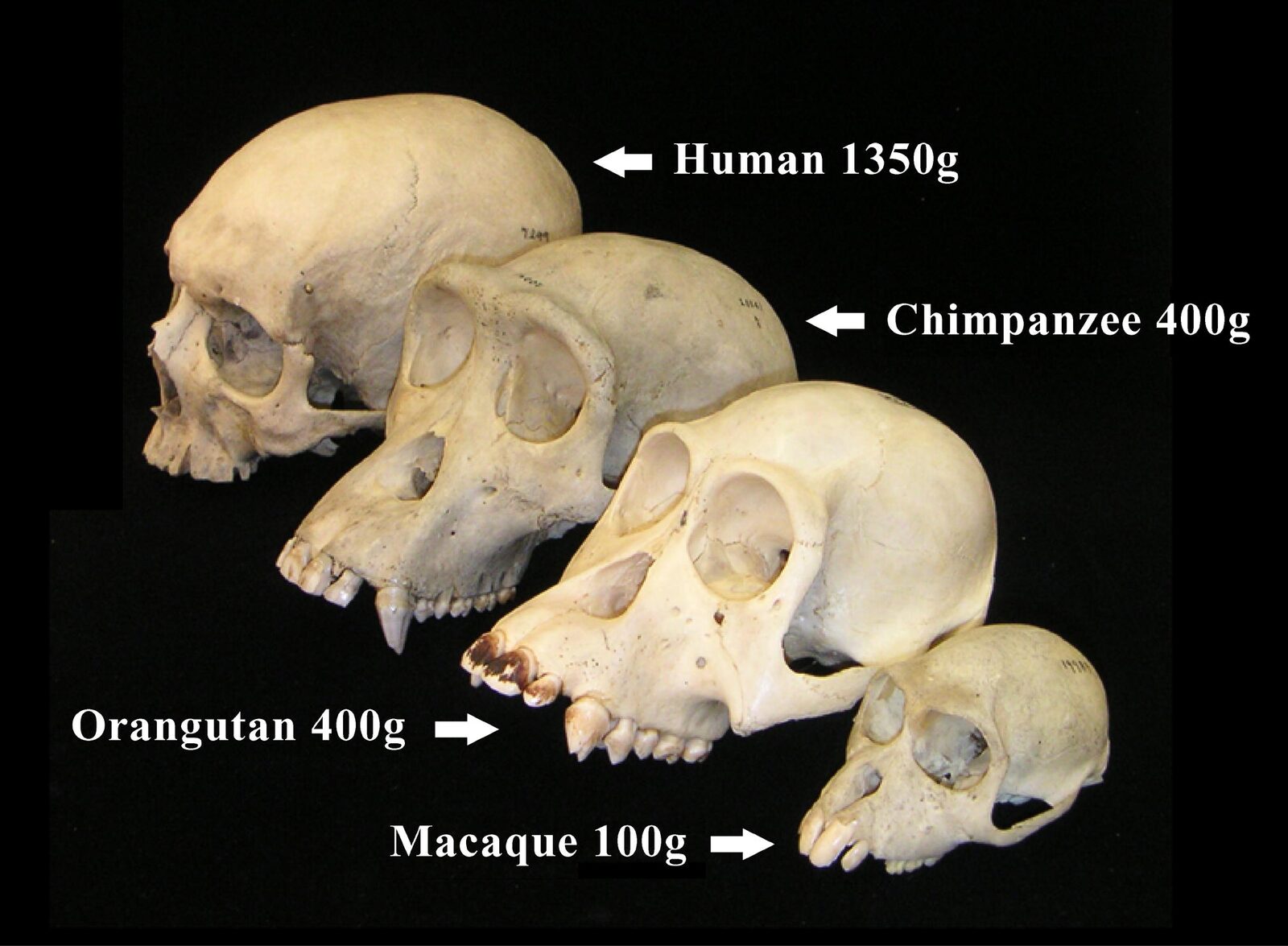
Its origin: Rudolph Zallinger, 1965
Contrary to what one might imagine, the "March of Progress" is neither an old scientific illustration nor the fruit of an academic consensus. It was born in 1965, in a popular-science volume of the Time-Life series titled Early Man, written by the anthropologist Francis Clark Howell. The illustration, spread across a fold-out double page, is the work of the painter Rudolph Zallinger, already famous for his great dinosaur murals. Zallinger had received a precise commission: to depict about fifteen species of hominids and ancestral primates in chronological order, from the oldest to the most recent. For reasons of layout, these silhouettes had to fit on a narrow horizontal strip, he arranged them in a line, in profile, all walking in the same direction2.
The original title of the plate was not, in fact, "the march of progress" but The Road to Homo SapiensHomo sapiensThe present-day human species, which emerged in Africa around 300,000 years ago, the only surviving human lineage after the extinction of Neanderthals and Denisovans.→. Howell himself, in the text, warned that this alignment should not be read as a direct, linear descent. But text weighs nothing against an image. The fold-out was detached from the book, reproduced, cropped, simplified. The warnings were dropped, the procession kept. Within a few years the illustration had become autonomous and acquired the status of an icon. It is one of the finest examples of how a graphic constraint, aligning figures for layout reasons, can give birth to a worldwide scientific misconception.
Zallinger did not draw a theory: he solved a layout problem. The world read into it a law of nature.
It should be added that Zallinger's figures were, for their time, carefully documented: each silhouette rested on known fossils and on the reconstructions accepted in the 1960s. The problem, then, is not the accuracy of each link taken in isolation, but the order and continuity that the arrangement suggests. By placing the species in single file, the image turns a gallery of cousins into a linear genealogy. It is the relationship between the figures, not the figures themselves, that lies.
The spread of the icon also owes much to the format of the Time-Life series. These volumes, sold by subscription, reached a mass audience at a time when colour photography and illustration were still rare in everyday publishing. A fold-out plate, polished, at once educational and spectacular, was made to impress and to be kept. Many readers held onto nothing of the book but that fold-out, pinned up or stored separately, detached from its argued context. Thus a cautious nuance, expressed in the body of the text by Howell, evaporated while the image itself prospered. The story of the "March of Progress" is also a lesson in science communication: a strong but ambiguous image almost always wins, in collective memory, over an accurate but dry text.
One often-forgotten detail: the original plate contained more figures than the popularised version, and some of them did not even belong to the direct human line but to lateral branches clearly presented as such. The successive cropping of the image, over the course of its reproductions, eliminated these nuances to keep only the most "readable" sequence, the one that rose without detour from ape to human. Each copy simplified the original a little more, until it produced the minimal frieze we know today. The icon, in short, became falser as it spread: it ended up more wrong than the 1965 plate itself.
It is striking, moreover, that Zallinger himself, like Howell, never claimed to illustrate a linear descent. The author of the frieze was a rigorous artist, aware of the limits of his exercise; the misunderstanding did not arise from their intention, but from the use others made of it. This distinction matters, for science is sometimes accused of having "invented" the march of progress. In reality, science provided data; it was popular culture that recomposed them into a myth. The case is exemplary of how an image breaks away from its authors and takes on a life of its own, indifferent to the precautions of those who conceived it.
Why it is wrong
The "March of Progress" in fact accumulates several distinct errors, which reinforce one another. Untangling them helps explain why specialists judge it not merely inaccurate but actively harmful to the understanding of evolution1.
The error of direction
The frieze is read from left to right, like a sentence, and installs the idea of a direction, an arrow of time that would necessarily point toward "higher" and "better". But evolution has no privileged direction. It does not "climb": it branches. A population transforms generation after generation under the effect of natural selection, genetic drift, migration and the chance of mutations, and these transformations respond to local, momentary conditions, not to a course set in advance. Depending on circumstances, a lineage may become larger or smaller, more complex or simpler, gain an organ or lose one. There is no internal compass orienting life toward the human.
The error of purpose
By placing modern man at the far right, in the position of culmination, the image suggests that this whole history tended toward us, as if humanity were the programmed end of a process. This is what is called a teleological, or finalist, view of evolution. Nothing in biology justifies it. Homo sapiens is not the goal of primate evolution any more than the oak is the goal of plant evolution. We are one result among countless other possible ones, and largely a product of contingency: had this or that climatic episode turned out differently, had this or that population vanished earlier, the tree of life would bear other branches and we might not appear on it at all.
The error of hierarchy
The procession implicitly ranks beings from "least evolved" to "most evolved". This scale has no biological meaning. All species living today have exactly the same evolutionary antiquity: each is the provisional endpoint of an unbroken lineage since the origin of life. A chimpanzee today is not a frozen stage on the road to humans; it is a fully contemporary species, as "evolved" as we are, simply adapted to a different way of life. To speak of "lower" or "higher" animals stems from a prejudice inherited from the old scala naturae, the medieval ladder of beings, not from modern science. Nature does not rank; it diversifies.
The error of descent from the chimpanzee
A fourth misunderstanding, perhaps the most widespread: the idea that "man descends from the ape", and more precisely from the chimpanzee. The frieze, by having a great ape open the procession, sustains this confusion. But we do not descend from chimpanzees. Chimpanzees and humans share a common ancestor, an extinct species that lived about seven million years ago in AfricaAfricaThe cradle of humankind: the continent where the first hominins appeared, then Homo sapiens around 300,000 years ago, before the expansion to the rest of the world.→, from which two sister lineages arose: one leading to today's chimpanzees and bonobos, the other to the hominidsHomininHomininMember of the subtribe Hominina, comprising the human lineage (Homo, Australopithecus, Paranthropus…) but excluding orangutans and gibbons. The term progressively replaces "hominid" in its narrow sense.→A member of the human lineage in the broad sense, including modern humans, their ancestors and related great apesgreat apesThe family of great apes (Hominidae) comprising orangutans, gorillas, chimpanzees, bonobos and humans.→.→ and then to us. The chimpanzee is not our grandfather, it is our cousin. It has its own evolutionary history, seven million years long as well, and it has remained "primitive" in nothing. Confusing cousin with ancestor is one of the most stubborn sources of misunderstanding about evolution.
The family image can be extended to grasp the nuance. If one climbed the family tree of the human and that of the chimpanzee, one would see two distinct series of ancestors that would eventually meet, some seven million years ago, in a pair of common ancestors. Before that junction the history is shared; after it, it splits into two parallel, independent stories. During those seven million years, the branch leading to the chimpanzee did not stand still waiting for the human to appear: it evolved too, accumulating its own adaptations, losing certain traits, gaining others. Today's chimpanzee is therefore the product of an evolutionary adventure as long and as original as ours. To take it for a "primitive" version of the human is to forget half the story, its own.
This confusion between cousin and ancestor is so widespread that it pervades everyday language. People readily say "man descends from the ape" as they would say "the son descends from the father". But the word "ape" designates a vast set of living species, all contemporary with us; none is our forebear. The exact formulation would be: humans and the other apes descend from common ancestors, themselves primates now extinct. The nuance may seem pedantic; it is in fact decisive, for it is what distinguishes a linear genealogy from a branching bush.
Evolution is a bush: the coexistence of species
If the correct image is neither a line nor a ladder, what is it? Palaeontologists speak of a bush, or a dense tree. From the root spring branches that divide in turn, again and again. Most of these twigs stop short: these are the extinct species, that is, the vast majority of those that ever existed. Only a few twigs reach the top, the present. Homo sapiens is one of them, today the only surviving human twig, but this solitude is recent and exceptional3.
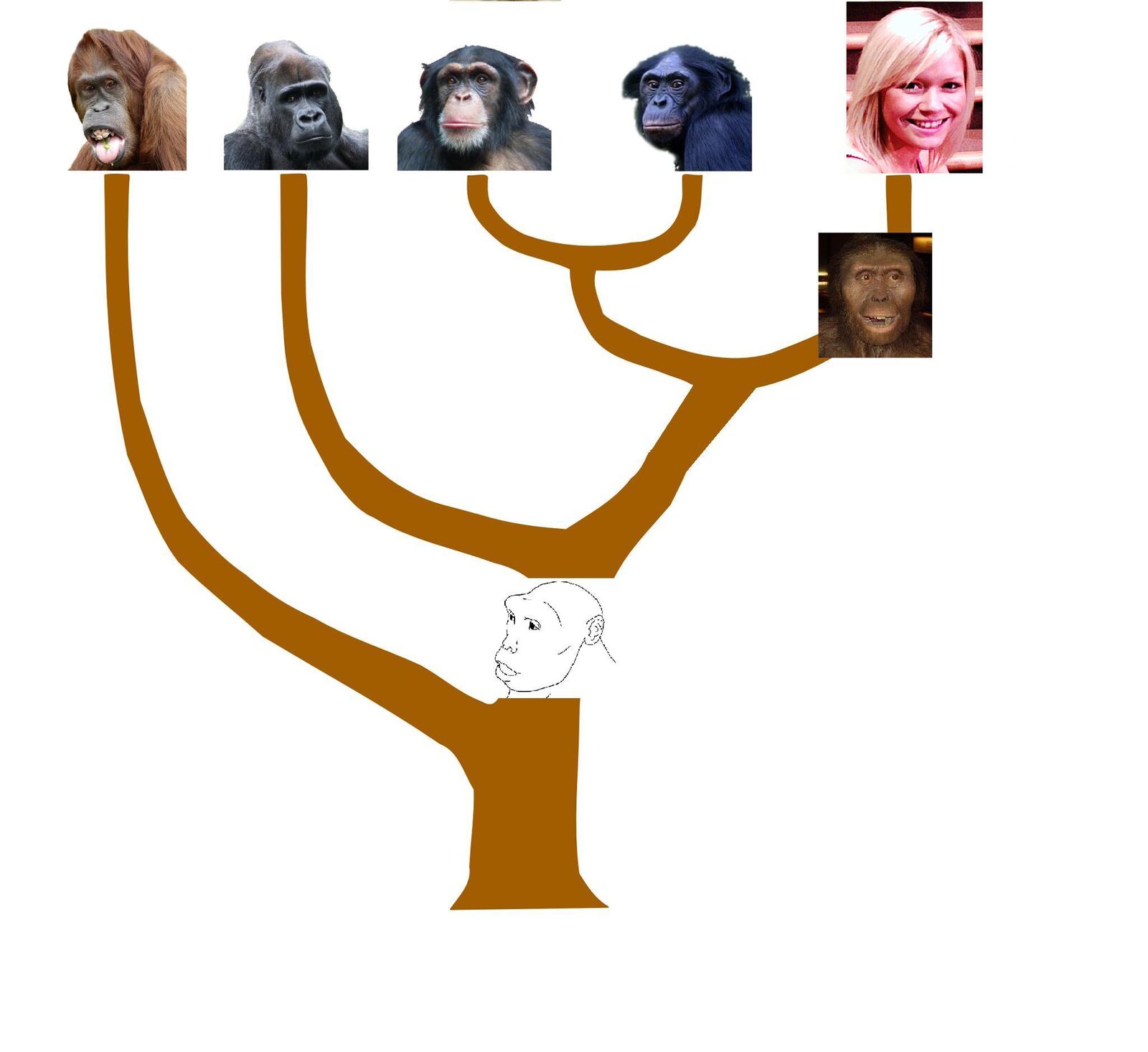
For the great lesson of the last decades of research is that humanity has almost never been alone on Earth. For nearly the whole of our history, several human species lived at the same time, sometimes on the same territories. Zallinger's frieze, by lining them up as successive stages, completely conceals this major fact: coexistence.
The NeanderthalsNeanderthalsA fossil humanity of Eurasia, robust and cold-adapted, extinct around 40,000 years before present.→ (Homo neanderthalensis) populated Europe and western Asia for hundreds of thousands of years, perfectly adapted to cold climates, making elaborate tools, burying their dead, mastering fire. They were not a "draft" of us: they were a humanity in their own right, who lived alongside Homo sapiens when the latter arrived in Eurasia, and who became extinct only about 40,000 years ago.
The DenisovansDenisovanAn extinct human population, cousin of the Neanderthals, identified in 2010 from the DNADNAThe molecule carrying genetic information, used to reconstruct kinship between species.→ of remains in Denisova Cave (Siberia).→, identified only in 2010 from a tiny bone fragment from Denisova Cave in the Altai, are another humanity, long known by its genome alone before other fossils confirmed it. They occupied Asia, from the mountains of Siberia to the high Tibetan plateau, and probably much further south. Their existence, revealed by palaeogeneticsPalaeogeneticsThe study of ancient DNA extracted from remains (bones, teeth, sediments, walls) to reconstruct the past of populations.→, shows how incomplete our family tree remains: whole branches were discovered through the hybridisationHybridisationCrossing between two distinct species or lineages, such as Homo sapiens and Neanderthals, leaving a trace in the genome.→ they left in our genes, even before being seen in bone.
Homo floresiensis, nicknamed "the hobbit", lived on the Indonesian island of Flores. Barely a metre tall, with a tiny brain, it nevertheless made tools and hunted until a surprisingly recent date. Its small size, probably the result of insular dwarfismInsular dwarfismReduction in the body size of an animal species due to island isolation, where resources are limited and predators absent. Explains the small stature of Homo floresiensis.→, shows that human evolution is not a march toward the "bigger" or the "larger brain": depending on the constraints of the environment, it can also shrink.
Homo naledi, discovered in South Africa in the Rising Star underground system, mixes ancient and modern traits in a disconcerting way, and may have deposited its dead deep in a cave hard to access. Here too, an unexpected twig, that fits into no linear file.
And of course Homo sapiens, our species, which appeared in Africa at least 300,000 years ago. For tens of thousands of years it shared the planet with all the preceding ones. Fifty thousand years ago, a traveller crossing the Old World could have met Neanderthals in Europe, Denisovans in Asia, hobbits on Flores and sapiens nearly everywhere. Humanity was not a lone runner on a track, but a large family, of which we are the only survivor, by accident as much as by merit.
This present solitude of our species is, on the scale of time, a recent anomaly. For millions of years, the "genus Homo" counted several simultaneous species, exactly as there are today several species of big cats or canids. That we are now alone distorts our intuition: we take this uniqueness for the norm, whereas it is the exception. Had a few of the other humanities survived, the question "what is a human?" would arise in radically different terms, and the idea of a linear frieze culminating in us could never have been born. It is partly because we have remained alone that we believe ourselves the culmination of everything.
Coexistence, moreover, was not only geographical but also biological and cultural. Where these humanities met, they sometimes exchanged techniques, territories, and genes. The tools, the ornaments, the funerary practices of some Neanderthal populations testify to a rich symbolic life, long wrongly denied. To reduce these species to steps of a staircase toward sapiens is not only to choose the wrong model, it is also to commit an injustice toward humanities that had their own history, their own successes and their own end.
The notion of common ancestor
To fully understand why the line is misleading, we must dwell on the key notion of evolution: the common ancestor. When two species share a common ancestor, it does not mean that one descends from the other, but that both descend from a third, older one, now extinct. Imagine two cousins: they do not descend from one another, they descend from the same grandparent. This is exactly the relationship that unites human and chimpanzee, but also human and gorilla, and further away human and all other forms of life.
This logic has an important consequence: one cannot, by looking at a living species, take it for the "ancestor" of another living species. The chimpanzee is not what we were; it is what the other branch became, in parallel with ours, over the same span of time. Many traits shared by human and chimpanzee are plesiomorphicPlesiomorphicDescribes an ancestral (primitive) anatomical character inherited from a common ancestor, as opposed to recent derived traits.→ characters, that is, inherited from the common ancestor and conserved on both sides, and not stages that one crossed before the other. Distinguishing what is inherited from the ancestor from what is an innovation specific to a lineage is precisely the work of evolutionary systematics, and it is this work that the frieze makes impossible by suggesting a simple succession.
A concrete example helps grasp the stakes. The opposable thumb, which allows fine grasping, is not a recent human invention: it already existed in our primate ancestors, and we share it with many other species. Conversely, certain peculiarities of our hand, our pelvis or our skull are novelties that appeared late in our lineage alone. Drawing the boundary between the inherited and the new requires methodically comparing many species, fossil and living, and reconstructing the order in which characters appeared. The file, by stacking them like landings, abolishes this analysis: it presents as a single ascent what is in reality a mosaic of gains and losses spread across the whole bush.
Palaeogenetics has, in recent years, enriched this picture with further complexity. The human lineages, far from being watertight branches that split and then ignore one another, sometimes crossed back. Present-day genomes carry the trace of episodes of hybridisationHybridisationCrossing between two distinct species or lineages, such as Homo sapiens and Neanderthals, leaving a trace in the genome.→ between sapiens, Neanderthals and Denisovans: part of the human populations outside Africa retains a small percentage of Neanderthal DNA, and some populations of Asia and Oceania a fragment of Denisovan DNA. The tree, then, is not even a perfectly branching tree: in places, its branches touch and exchange genes. One sometimes speaks of a "network" rather than a tree. Suffice to say that the single file, already false, is light-years from this tangled reality.
These gene exchanges also dismantle a tidy notion the frieze takes for granted: that of a clean, sealed succession of species, each replacing the last. The boundaries between human populations were porous; what we call distinct species sometimes interbred and produced fertile descendants whose traces we still carry. A part of who we are, biologically, comes from lineages the procession would have us regard as obsolete predecessors. Far from being superseded steps, the Neanderthals and Denisovans live on, in fragments, within us, a fact that no single-file image could ever express, and that turns the very idea of a relay race on its head.
No "missing link" and no finality
The frieze has popularised another misleading notion, that of the famous "missing link". If evolution were a linear chain, then there should exist, somewhere, an exact intermediate link between ape and human, which one would only need to discover to complete the series. This idea, inherited from the nineteenth century, is doubly false. First because there is no chain, hence no single link to find: there is a bush of forms, many of which present mosaics of characters. Second because all known fossils are, in a sense, transitional forms: each combines old traits and new ones, for evolution does not proceed by leaps from one finished type to another, but by gradual, mosaic modifications.
To look for "the" missing link is therefore to ask the wrong question. The right question is not "what is the perfect intermediate?" but "how did the various characters, bipedalismBipedalismA mode of locomotion on two hind limbs, the defining trait of the human lineage, appearing over 7 million years ago. Visible in the anatomy of the pelvis, femur and foramen magnum.→, brain size, hand shape, dentition, appear, in what order, in which lineages?". And the answer, again, draws a bush, not a line. Some so-called human characters appeared very early, others very late, sometimes several times independently, sometimes only to disappear afterward. No overall plan presides over all this: there is neither finality, nor design, nor guaranteed progress. Only populations that transform according to the pressures of their environment.
This absence of plan is perhaps the hardest point to accept, because it runs against our deepest habits of thought. We are accustomed to seeing intention behind order, purpose behind change. Yet the order of the living world is produced without a designer, by the blind interplay of variation and selection over immense stretches of time. What looks, in hindsight, like a march toward us is only the trail left by the branches that happened to survive, projected backward as if it had been a goal. Remove that backward projection, and the march dissolves into what it always was: a bush, growing in every direction at once, pruned by extinction, with no top and no front.
Bipedalism is not a straight line
The best example of this complexity is surely the upright stance, bipedalism, which the frieze stages precisely as the great gradual straightening of the back. The reality is quite different. Bipedalism is not the last acquisition of a long ascent toward the human: on the contrary, it is one of the oldest characters of our lineage. HominidsHomininA member of the human lineage in the broad sense, including modern humans, their ancestors and related great apes.→ were already walking upright, at least in part, more than four million years ago, when their brain was still the size of a chimpanzee's. In other words, our ancestors stood upright well before becoming "intelligent": the big head is not the cause of walking, it came long after.
What is more, bipedalism itself did not follow a single path. Several hominid species combined ground walking with an ability to climb, with varied anatomies of the pelvis, femur and foot. There were probably several "ways" of being bipedal, tried out by different lineages, some of which became extinct. The famous Lucy, Australopithecus afarensis, walked upright while keeping arms suited to climbing. Far from the rising ramp of the frieze, we are dealing with an evolutionary tinkering, made of compromises and partial solutions, shaped during the PalaeolithicPalaeolithicThe oldest and longest period of prehistoryPrehistoryThe span of human history before the invention of writing, from the Palaeolithic to the Metal Ages, known mainly through material remains.→ (c. 3.3 Ma–12,000 BC), defined by chipped stone tools and a hunter-gatherer way of life.→ and well before it. The gradual, inevitable straightening of the back, from the stooped ape to the upright human, is an elegant graphic fiction with no correspondence in the fossils.
Why, then, did our ancestors stand up? The hypotheses are many and probably complementary: to free the hands for carrying food or young, to better regulate body temperature under the sun of the savanna, to save energy over long distances, to see further over tall grasses. None of these reasons presupposes a project of "humanisation": these are local advantages, in a given environment, at a given moment. Bipedalism was not chosen because it led to humans; it spread because it was useful, here and now, to populations that had no idea what they would become. It is the very opposite of a march oriented toward a goal.
This early appearance of bipedalism overturns the order suggested by the frieze. In the procession, the upright stance arrives last, as the final acquisition, the sealSealA small engraved object (often steatite) used to stamp a mark in clay; the Indus seals, bearing animals and signs, attest to administration and trade, though their script remains undeciphered.→ of humanity. In the fossils, it comes first, long before the enlargement of the brain, the refinement of tools or the emergence of language. Our lineage walked before it thought. This single inversion is enough to ruin the logic of the file, which lines up characters as if they had been acquired in a fixed order, each preparing the next. Real evolution assembled its features in a scattered order, across different lineages and different epochs, with no concern for the tidy choreography of the frieze.
Why the icon persists: cognitive biases
If the image is false, and if specialists have been saying so for decades, why does it survive? Because it fits several deep inclinations of the human mind. The first is our taste for narratives: we understand the world through stories, with a beginning, a middle and an end, a hero and a quest. The frieze tells exactly that, the epic of humanity rising toward itself. The second is our tendency to see progress everywhere, to interpret change as improvement. The third is what psychologists call the bias of anthropocentrism: we spontaneously place ourselves at the centre and the summit of all things, and an image that installs us there is immediately satisfying.
Add to this the force of repetition. An image seen a thousand times acquires an obviousness that no reasoning possesses. It becomes a reflex, a mental automatism. When the word "evolution" is uttered, it is the procession that springs up, before any thought. Dislodging this installed image requires a conscious effort, and most of the time the effort is not made, for lack of any reason to doubt. That is why the teaching of evolution must not only teach the right model, but actively unlearn the wrong one, by showing why it seduces and how it misleads.
Surveys of the public and even of science students confirm the tenacity of these representations. Many accept the principle of branching intellectually but continue, as soon as they are questioned concretely, to reason in terms of scale, progress and hierarchy. Misleading expressions survive in the vocabulary: people speak of "higher animals", of "more evolved" species, of the human as the "summit" of evolution. Now language shapes thought. As long as these words circulate uncorrected, the image of the file will have the means to reconstitute itself, for it is, at bottom, the visual translation of a flawed vocabulary. Reforming the image therefore also means reforming the words.
There is also an emotional dimension to the persistence of the icon. The frieze is reassuring: it tells us that everything has led to us, that we are the point of the story, that the long ascent had a meaning and that meaning is humanity. To renounce it is to accept a less flattering and less comfortable view, in which we are a late and fragile branch, survivors among the extinct, the result of a long series of accidents that could easily have turned out otherwise. This humility is harder to bear than the pride of the procession. That the false image is also the more pleasant one is no small part of its tenacity: we cling to it not only because it is simple, but because it consoles.
The stakes: creationism and scientific racism
One might think this is a quarrel about images without consequence. That would be to underestimate the power of representations. The "March of Progress" has in fact served, in spite of itself, two heavy distortions.
The first is paradoxical: the frieze has supplied ammunition to creationism. By presenting evolution as a linear sequence of clearly succeeding species, it has allowed the theory's opponents, ironically, to demand "the missing link", and to cry scandal whenever a supposed intermediate happened to be lacking. A caricature of evolution is easier to attack than the real theory. By conveying a naive and linear version, the icon has involuntarily weakened the cause it claimed to illustrate, and provided a convenient scarecrow for those who reject the very idea of evolution.
The second distortion is even more serious. The idea of a ladder of beings, from "less" to "more" evolved, long nourished scientific racism. In the nineteenth and twentieth centuries, some extended the frieze beyond the species, ranking human populations themselves on a supposed scale of perfection, arbitrarily placing their own group at the summit. This pseudo-science served to justify slavery, colonisation, eugenics and the worst crimes. The image of a hierarchical, oriented evolution is not neutral: by its very structure, it lends itself to readings in which some beings would be "ahead" and others "behind". Understanding that evolution is a bush without hierarchy, in which all living forms are equally contemporary and equally "successful", is therefore also an ethical and political stake, not merely a scientific one.
It is worth stressing that biologists themselves have had to fight against these intuitions, which are not the preserve of the uninformed. The history of palaeoanthropologyPalaeoanthropologyThe science that studies human evolution from the fossil remains of hominins (bones, teeth, footprints) and their context, to reconstruct our biological origins.→ is full of attempts to arrange fossils into a single line, to designate a "main trunk" and "side branches", to crown one species as the direct ancestor and demote the others to evolutionary dead ends. Each new discovery has tended to complicate these neat schemes, multiplying the branches and blurring the boundaries. The lesson has been learned slowly, and at a cost: the bush model is not an obvious starting point but a hard-won conclusion, repeatedly forced upon researchers by fossils that refused to fit the line.
Representing evolution better
How, then, can we correctly depict the history of life? Biologists use phylogenetic trees: branching diagrams in which each node represents a common ancestor, and each branch a lineage. On such a tree, the human occupies no privileged position: it is one tip among thousands of others, all situated on the same line of the present. Living species form a "canopy" of equal contemporaries; extinct species are branches that stop in the past. No arrow, no summit, no crowning.
For the general public, several metaphors are better than the file. That of the bush, already mentioned, is the most accurate: a tangle of stems, most of which break off. That of the tree, provided one does not draw it with a single trunk pointing toward the human. That, more modern, of the network or the braided river, which accounts for the hybridisations between lineages. One can also stress coexistence by showing, at a given date, the plurality of humanities living together, as a snapshot rather than a procession. All these images share one virtue: they make visible diversity, branching and chance, where the frieze imposed uniqueness, linearity and necessity.
Some museums and some textbooks have begun to adopt these corrected representations, replacing the procession with explicit trees, coexistence timelines or maps showing, at different periods, which human species peopled which regions. The pedagogical effect is notable: faced with a tree where several lineages live side by side, the visitor more easily abandons the idea of a relay. Still, the image must be accompanied by a clear narrative, for a poorly explained tree can also be reread as a staircase by a mind accustomed to the file. The right representation is not enough: it must be commented, put into words, connected to concrete examples of kinship and coexistence.
The most important thing is perhaps not the chosen image, but the renunciation of one idea: that evolution is going somewhere. Once it is accepted that it goes nowhere in particular, that it explores at random the space of possible forms and provisionally keeps what works in a given context, everything becomes clearer, and, in many respects, more dizzying. We are not the summit of an ascent; we are a surviving twig of an immense bush, of which almost all the other branches have disappeared.
Conclusion
The "March of Progress" was born of a layout constraint in 1965 and turned into a planetary myth. Its strength lies in its simplicity, and it is precisely this simplicity that makes it false. It invents a direction where there is only branching, a goal where there is only contingency, a hierarchy where all forms are contemporary, a direct descent where there is only kinship. It erases the Neanderthals, the Denisovans, the hobbits of Flores, Homo naledi, all that plural humanity that shared the Earth with our ancestors. It wipes out coexistence, hybridisations, dead ends and chance, that is, the essence of the true story.
To give up this image is not to lose something, it is to gain an infinitely richer story. Understanding that Homo sapiens is a surviving twig among others, and not the crowning of nature, does not diminish us: it places us, more accurately, within the living world. Behind a frieze that is too tidy lies a teeming bush, full of forgotten cousins and roads not taken. It is that story, dense, contingent and fascinating, that we must now learn to see, and to draw differently.
La rigueur de présentation me rappelle un bon rapport d'ingénierie : hypothèse, données, conclusion.
Je montre systématiquement l'image de la marche du progrès à mes élèves pour leur expliquer pourquoi elle est incorrecte. C'est un excellent point d'entrée pour discuter des représentations culturelles de l'évolution et de leur impact sur la compréhension populaire de la science. Nos manuels scolaires sont encore trop souvent illustrés avec ce type d'iconographie erronée.
La métaphore de la marche du progrès, avec cette file de singes se redressant progressivement vers l'homme moderne, est l'une des représentations les plus tenaces et les plus fausses de l'évolution. Cet article fait un travail utile en déconstruisant ce mythe. L'évolution est un buisson aux branches multiples dont nous ne sommes qu'une pousse, pas la finalité.