An Egyptian-Italian archaeological mission operating at Gabal El Tier, in the Minya Governorate of Upper Egypt, has uncovered a previously unknown Old KingdomOld KingdomThe first great period of unified pharaonic Egypt (c. 2700-2200 BC, 3rd-6th Dynasties), the golden age of the great pyramids and of a strongly centralised state.→ necropolisNecropolisA large organised burial ground, a "city of the dead", often spanning several periods.→ comprising several mastabas decorated with paintings and hieroglyphic inscriptions. Dated to around 2700-2500 BCE, during the reigns of pharaohs of the 4th and 5th Dynasties, these tombs belong to senior officials of the royal administration whose names were not previously known to Egyptology1. The discovery opens a new window onto the bureaucracy and society of the upper administration in the province of Old Kingdom Egypt.
Gabal El Tier, a forgotten provincial centre
The site of Gabal El Tier, located on the eastern bank of the Nile in the Minya region, was known from ancient sources as a regional administrative centre during the Old Kingdom. But systematic archaeological investigation in this area had until now been limited, with most efforts concentrated on the great necropolises of Memphis, Giza, and Saqqara. The new mission, directed jointly by the University of Bologna and the Supreme Council of Antiquities of Egypt, engaged in 2022 a geophysical surveyGeophysical surveyTechniques (magnetometry, radar) detecting buried structures underground without digging, by measuring physical anomalies.→ programme that revealed buried structures of unexpected extent.
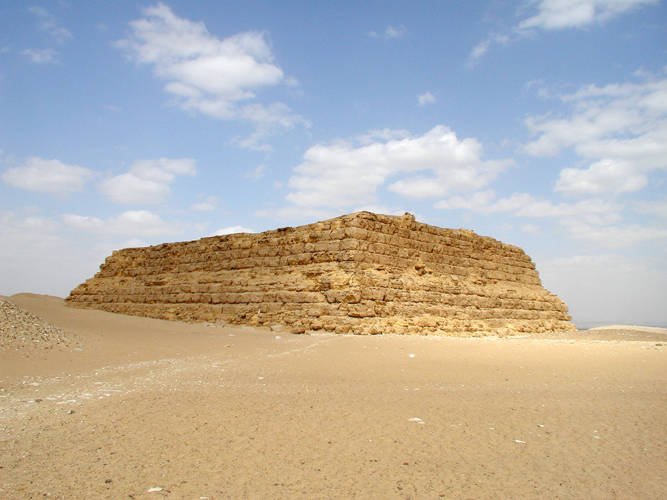
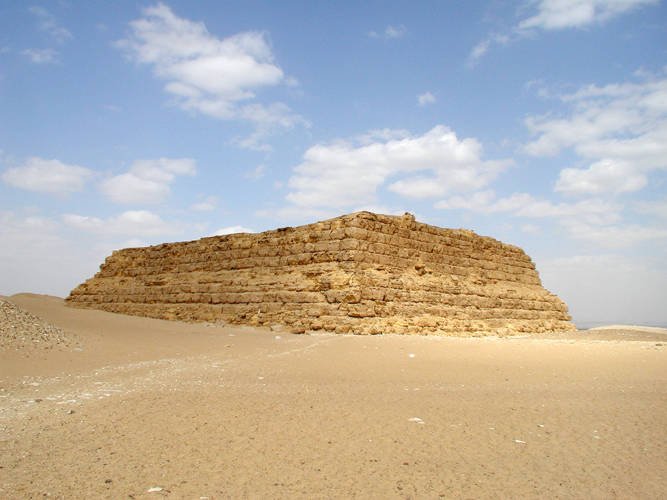
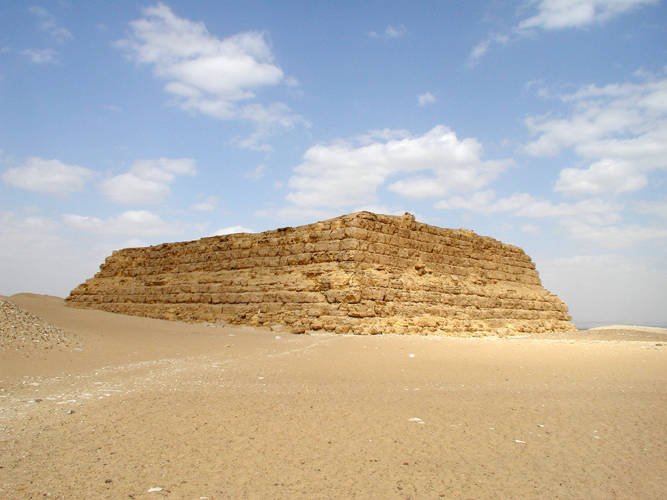
The best-preserved mastabaMastabaAn early Egyptian flat-roofed tomb with sloping sides, the architectural ancestor of the pyramid.→ in the complex belongs to an official identified in the inscriptions as "Overseer of the Granaries under the Majesty of Menkaure" (the pharaohPharaohThe title of the ruler of ancient Egypt, regarded as a living god guaranteeing cosmic order (Maat), supreme head of state, army and worship.→ who built the smallest of the Giza pyramids, around 2530-2510 BCE). This mastaba's superstructure measures 12 by 18 metres and retains its funerary chapel in a remarkable state of preservation2. The reliefs carved on the chapel walls represent agricultural scenes, hunting in the marshes, and a funerary feast, in keeping with the standard iconographic programme of the Old Kingdom.
Burial chambers with intact paintings
The true treasure of the Gabal El Tier discoveries lies in the underground burial chambers, accessible via vertical shafts. While the mummies themselves had been disturbed in antiquity by tomb robbers, the funerary equipment placed in wall niches survived largely intact3. The archaeologists uncovered alabaster canopic jars intended to receive the deceased's organs, ceramic vessels, painted wooden servant figurines (forerunners of shabtis), and copper tools that may represent the owner's implements of office.
The wall painting preserved in the burial chambers is of exceptional quality. Pigments, protected by sediments that sealed the underground rooms shortly after their ancient robbing, retain all their vividness. The red ochreOchreA red or yellow mineral pigment (iron oxides), used from prehistory for adornment, funerary rites and art.→, Egyptian blue, and limestone white of the underworld scenes allow us to appreciate the pictorial craftsmanship of the Old Kingdom in its full sophistication. Sequences from the Pyramid Texts, normally reserved for royal tombs, appear on some walls, suggesting that the owners of these mastabas enjoyed exceptional status within the provincial elite.
New names in the Old Kingdom pantheon
One of the most significant contributions of the Gabal El Tier discovery is the documentation of previously unknown historical figures. The hieroglyphic inscriptions in the mastabas mention six names of high-ranking men and women for whom no trace had previously been found in Old Kingdom archives or monuments. These names enrich the prosopographic repertoire of the period, allowing Egyptologists to better understand the structure of the royal higher administration in provinces distant from the Memphite capital.
The titles held by the mastaba owners reveal a more complex provincial administrative hierarchy than had been supposed for this period. Among them are a "Chief of the Province", a "Controller of Royal Works in the Nome", a "Scribe of the Land Register", and a "Responsible for the Cattle Count". This functional diversity confirms that the pharaonic administration had a sophisticated bureaucratic infrastructure in the provinces as early as the 4th Dynasty, not only from the 6th or 7th Dynasties as sometimes thought.
The presence of wives and daughters mentioned in some inscriptions, with their own honorary titles and ritual functions, enriches our knowledge of the status and role of elite women in Old Kingdom society. These inscriptions confirm that high-ranking women could exercise important priestly functions, particularly related to the cult of Hathor, goddess of fertility, beauty and protection of the dead.
The Gabal El Tier excavations will continue until at least 2028 according to the programme established by the archaeological mission. The initial geophysical survey revealed further anomalies suggestive of buried structures in areas not yet excavated. If these structures correspond to additional tombs of comparable rank, the Gabal El Tier necropolis may prove to be one of the most important Old Kingdom discoveries in several decades.
No comments yet. Be the first.