Between 780,000 and 130,000 years ago, the Earth passed through a series of increasingly intense glaciations whose cycles had now reached 100,000 years. In this shifting landscape, alternating between tundras scattered with stunted spruce and open savannahs where woolly rhinoceroses, mammoths and cave lions roamed, hominins underwent an acceleration without precedent in their evolutionary history. Homo erectus gradually gave way to forms with more complex brains: first Homo heidelbergensisHomo heidelbergensisMiddle Pleistocene human species, often seen as the common ancestor of Neanderthals and our own species.→, then the first direct ancestors of the NeanderthalsNeanderthalsA fossil humanity of Eurasia, robust and cold-adapted, extinct around 40,000 years before present.→ and of Homo sapiensHomo sapiensThe present-day human species, which emerged in Africa around 300,000 years ago, the only surviving human lineage after the extinction of Neanderthals and Denisovans.→. This period, less familiar to the general public than the Upper PalaeolithicUpper PalaeolithicThe final phase of the Palaeolithic (c. 45,000 to 10,000 years ago), marked by Homo sapiens in Europe, art, ornaments and a succession of cultures (Aurignacian, Gravettian, Solutrean, Magdalenian).→ that follows it, is nonetheless one of the great crossroads of human prehistoryPrehistoryThe span of human history before the invention of writing, from the Palaeolithic to the Metal Ages, known mainly through material remains.→.1
An oscillating world: the climatic context of the Middle PleistoceneMiddle PleistoceneGeological subperiod (about 770,000 to 126,000 years ago) marked by growing behavioural complexity among hominins.→
The beginning of the Middle Pleistocene is marked by the Brunhes-Matuyama magnetic reversal, approximately 780,000 years ago: the Earth's magnetic field flipped, with the magnetic north pole taking the place of the south. This geological event, invisible to the hominins who lived at the time, is today one of the most valuable stratigraphic markers available to archaeologists and geologists, since it is recorded in rock sequences worldwide and allows finds from different continents to be synchronised.
The most structurally important feature of the Middle Pleistocene, however, is climatic. From around 650,000 years ago, glaciations ceased to follow 41,000-year cycles (driven by the tilt of Earth's axis) and instead adopted 100,000-year cycles driven by the shape of Earth's orbit around the Sun. These glaciations also became deeper, and interglacials shorter. Marine Isotope Stages (MIS) allow us to trace them precisely: the Middle Pleistocene encompasses stages MIS 19 to MIS 6, covering around fifteen successive glaciations, some of which blanketed up to 30% of the Earth's land surface in continental ice.2
For hominins, these upheavals were not mere weather variations: they fragmented habitats, shifted resources, created natural barriers (seas, glaciers, deserts) and, conversely, sometimes opened migration corridors over long distances. The English Channel did not yet exist, and what is now England was connected to the continent by a vast alluvial plain crossed by a proto-Thames. The Black Sea was sometimes a freshwater lake. The Sahara alternated between "green" fertile phases and ultra-arid phases that severed sub-Saharan AfricaSub-Saharan AfricaThe part of Africa south of the Sahara; cradle of Homo sapiens, long thought hostile to ancient-DNA preservation because of heat.→ from the rest of the world.
Homo antecessor: the predecessor
At AtapuercaAtapuercaA complex of archaeological sites in the Sierra de Atapuerca (Burgos, Spain), a UNESCO site, yielding an exceptional sequence of human fossils, including the Sima de los Huesos and Homo antecessor.→ in Spain, in the gallery known as Gran Dolina, excavations conducted since the 1990s by an international team unearthed skeletal remains attributed to a distinct species: Homo antecessor, dated to around 800,000 years ago. This species, known almost entirely from these fragmentary remains, is particularly interesting because it combines modern traits (a sub-vertical face resembling that of Homo sapiens) with an overall archaicArchaicRefers to an ancient, now-extinct human population or form (Neanderthals, Denisovans, ghost lineages), as opposed to anatomically modern humans.→ anatomy closer to Homo heidelbergensis. Some palaeontologists see in it the common ancestor of Neanderthals and modern humans; others consider it a lateral lineage without direct descendants.3
Whatever its evolutionary position, the Gran Dolina excavations yielded another critical piece of information: homininHomininMember of the subtribe Hominina, comprising the human lineage (Homo, Australopithecus, Paranthropus…) but excluding orangutans and gibbons. The term progressively replaces "hominid" in its narrow sense.→ bones bearing systematic defleshing marks identical to those left by tools on hunted animal bones. These are the earliest direct evidence for cannibalism in human prehistory. Whether this behaviour was a funerary practice, a ritual act, or simple dietary necessity remains debated.
The date of Gran Dolina coincides almost exactly with the Brunhes-Matuyama boundary, and the Atapuerca hominins provide a unique window onto this pivotal moment. The tools found in the associated layers belong to the early AcheuleanAcheuleanLower Palaeolithic technical culture characterised by hand axes, present across three continents.→: massive handaxes, chopping-tools, minimally retouched flakes. The Acheulean of Gran Dolina is still far from the sophistication this technological tradition would reach 300,000 years later.
Homo heidelbergensis: the common ancestor
The Mauer mandible, found near Heidelberg (Germany) in 1907 and dated to around 600,000 years ago, is the type specimen of Homo heidelbergensis. Robust, chinless, with enormous molars, this jaw belongs to the species that, according to current consensus, constitutes the last common ancestor of Neanderthals and Homo sapiens before their genetic separation, now estimated at between 500,000 and 700,000 years ago.4
Homo heidelbergensis has been found across Europe (Mauer, Boxgrove, Swanscombe, Bilzingsleben, Caune de l'Arago, Petralona) and AfricaAfricaThe cradle of humankind: the continent where the first hominins appeared, then Homo sapiens around 300,000 years ago, before the expansion to the rest of the world.→ (Bodo, Broken Hill / Kabwe, Ndutu). Its presence in Asia is probable but harder to delimit. Morphologically, it differs from Homo erectus in having a larger brain (between 1,100 and 1,400 cm3, compared with 750 to 1,100 cm3 for erectus) and cranial features that foreshadow, depending on the region, either Neanderthal morphology (in Europe) or archaic Homo sapiens morphology (in Africa).
At Boxgrove (West Sussex, England), dated to around 500,000 years ago, excavations yielded a tibia and two incisors of Homo heidelbergensis, associated with a remarkable accumulation of Acheulean handaxes and animal bones. Taphonomic analysis indicates that these hominins were killing large herbivores: horses, rhinoceroses, giant deer. Cut marks on bones that precede carnivore gnawing suggest they were first at the carcasses, implying organised hunting, very likely cooperative.
The Sima de los HuesosSima de los HuesosA natural shaft at Atapuerca (Spain) that yielded over 6,500 bones of at least 29 Homo heidelbergensis individuals dated to −430,000: the largest Middle Pleistocene human fossil assemblage.→: a 430,000-year-old enigma
Some one hundred metres beneath the surface of a limestone hill at Atapuerca, at the bottom of a natural 13-metre shaft called the Sima de los Huesos (Pit of Bones), lay the remains of 29 individuals, commingled within a matrix of reddish-brown clay. Uranium-series dating gives an age of approximately 430,000 years. These individuals are European Homo heidelbergensis, but their cranio-facial anatomy already bears many "pre-NeanderthalPre-NeanderthalMiddle Pleistocene human populations (c. 300,000 to 130,000 years ago) already showing incipient Neanderthal traits, at the hinge between Homo heidelbergensis/erectus and classic Neanderthals.→" traits: occipital bun, massive sutures, pronounced supraorbital tori.5
The question of how they came to be at the bottom of the shaft is one of the most debated in palaeoanthropologyPalaeoanthropologyThe science that studies human evolution from the fossil remains of hominins (bones, teeth, footprints) and their context, to reconstruct our biological origins.→. The only explanation consistent with all the data is that these bodies -- or these bones -- were intentionally deposited in the pit by other hominins. If this interpretation is correct, it would represent the oldest known organised funerary behaviour, a direct precursor to Neanderthal burials. A quartzite handaxe, red in colour and dubbed "Excalibur", found among the bones and of no obvious practical purpose, has been interpreted by some researchers as a possible grave offering, though this reading remains highly contested.
Mitochondrial DNADNAThe molecule carrying genetic information, used to reconstruct kinship between species.→ extracted from several specimens places the Sima individuals within the Neanderthal clade, confirming that this European lineage was already well separated from the African lineage leading to Homo sapiens by this date. A nuclear DNA analysis published in 2016 additionally detected affinities with the Denisovans, suggesting that Asian and European populations shared a common genetic background before their final split.
The mastery of fire: toward a complete conquest
Fire transformed human history not only because it enabled the cooking of food and dramatically increased its digestibility and caloric yield, but also because it reconfigured social space, extended active time beyond sunset, offered protection from predators, and made it possible to exploit colder environments for longer periods. Its mastery was therefore a major selective advantage.
The earliest evidence for fire use goes back to roughly 1.5 to 1 million years ago (Wonderwerk Cave, South Africa), but these are fragile and isolated clues. It is during the Middle Pleistocene that fire becomes truly ubiquitous in European and African archaeological records. At Gesher Benot Ya'aqov (Israel, ~780,000 years ago), charred seeds and wood in association with Acheulean tools constitute one of the oldest controlled-fire evidence in the LevantLevantA region of the eastern Mediterranean Near East (Israel, Lebanon, Syria, Jordan), a major crossroads of the first human migrations out of Africa.→. At Beeches Pit (England, ~400,000 years) and Bilzingsleben (Germany, ~400,000 years), hearths are well documented.6
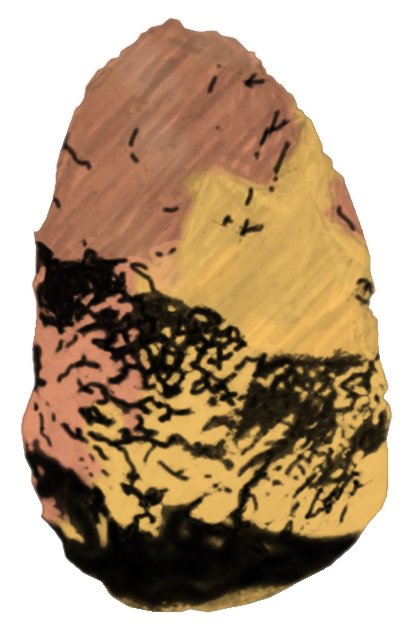
The systematic cooking of food may have had direct biological consequences: reduction in tooth and jaw-muscle size, release of digestive energy to the benefit of the brain, shortening of the gut. These anatomical changes are indeed observable during the Middle Pleistocene, though establishing a direct causal link remains methodologically difficult. What is clear is that the transition from opportunistic fire use to deliberate mastery -- including the ability to ignite fire from scratch -- represents one of the deepest cognitive leaps in human prehistory.
The Schöningen spears: hunting as collective strategy
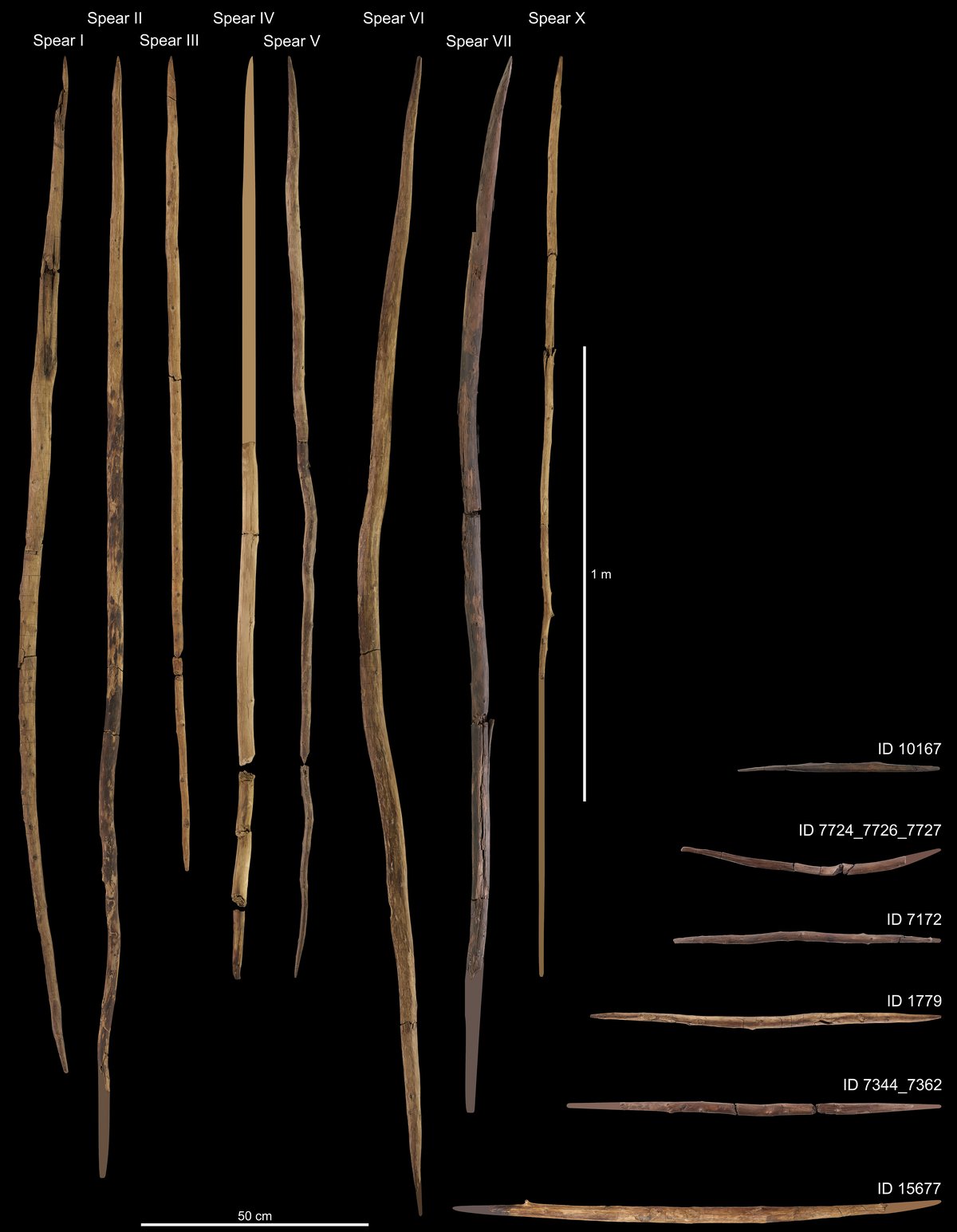
Between 1994 and 1999, in a former lignite mine near Schöningen (Lower Saxony, Germany), Hartmut Thieme's excavations uncovered extraordinarily well-preserved wooden artefacts, dated to roughly 300,000 to 400,000 years ago. Among them, eight complete spears and several half-products in spruce or ash wood, whose dimensions and shape closely resemble modern competition javelins: 1.80 to 2.50 metres long, with a centre of gravity located at the first quarter of the total length -- precisely where it must be for optimal throwing range.7
The Schöningen spears were not poles for warding off predators or digging sticks. Their aerodynamic design proves that their makers projected them over distance to hunt moving prey. Associated with the butchered bones of nearly twenty horses, these objects attest to planned cooperative hunting of large game, a possible division of labour within the group, and a capacity for mental projection -- anticipating the trajectory of a moving target and adjusting the throwing gesture accordingly -- that implies sophisticated cognitive abilities.
The Schöningen spears forced the scientific community to profoundly revise the image of a Lower PalaeolithicLower PalaeolithicFirst and longest period of prehistory, marked by the earliest knapped stone tools and the first hominins outside Africa.→ dominated by scavenging. Homo heidelbergensis did not wait for lions to abandon their kills: they organised coordinated drives and attacked at range. This is a major conceptual breakthrough in our understanding of the social and cognitive behaviours of hominins during this period.
The flourishing of the Acheulean: technology and cognition
The Acheulean industry, named after the site of Saint-Acheul (Somme, France), originated in Africa around 1.76 million years ago and persisted until approximately 200,000 to 100,000 years ago depending on the region. The Middle Pleistocene is its apogee. The handaxe, the hallmark of this tradition, is a tool knapped on both faces to produce a regular, peripheral cutting edge, useful for butchery, digging or percussion. Its manufacture implies anticipating the final shape, the ability to correct knappingknappingThe set of operations for fracturing a stone block to extract flakes or blades.→ errors mid-sequence, and the memorisation of long gestural sequences -- capacities that, in a modern frame, would involve spatial reasoning and working memory.
Over the course of the Middle Pleistocene, handaxes became considerably more refined. From massive and irregular, they became progressively thinner, more symmetrical, and more carefully finished. Some handaxes from the end of the Lower Palaeolithic, such as pieces from Swanscombe (England, ~400,000 years) or La Micoque (Dordogne, France), achieve a formal regularity that goes beyond simple functional necessity. Researchers such as Thomas Wynn have proposed that these perfectly symmetrical handaxes may also have had a social or sexual signalling function, advertising cognitive and motor competence, though this hypothesis remains contested.8
Around 300,000 to 250,000 years ago, a major technological shift gradually emerged in Africa and Europe: the Levallois knapping technique. Rather than shaping a handaxe on a block, hominins prepared a dome-shaped or turtle-shaped core from which they then detached, with a single precise blow, a flake of predetermined shape. This technique represents a cognitive leap: one must visualise in advance the shape of the flake within the volume of the core and organise the knapping sequence accordingly -- a form of multi-step planning and abstract spatial thinking more demanding than anything that preceded it.
Social life and group organisation
Reconstructions of Middle Pleistocene social life remain fragmentary, but several lines of evidence converge to suggest groups more complex than those of earlier periods. Demographic analyses of the Sima de los Huesos individuals indicate a mixed group (men, women, adolescents, children) with high juvenile mortality and a life expectancy that rarely exceeded 35 to 40 years for surviving adults. Some individuals bear traces of severe pathologies: healed fractures, dental enamel hypoplasias (signalling childhood nutritional stress), skulls already remodelled after trauma -- implying that weakened individuals were cared for by the group for weeks or even months.9
Group sizes cannot be measured directly, but demographic modelling and energetic arguments (resource space, caloric needs) suggest bands of 25 to 50 individuals, with broader exchange networks between groups. Raw materials such as flint or quartzite are sometimes found tens of kilometres from their geological source, implying deliberate transport or regular inter-group contacts.
The transition to the Middle PalaeolithicMiddle PalaeolithicA Palaeolithic period (c. 300,000 to 40,000 years ago) associated mainly with Neanderthals and early Homo sapiens, marked by Levallois tools.→: the birth of the Levallois techniqueLevallois techniqueA Middle Palaeolithic flint-knapping method: a core is prepared so a flake of predetermined shape can be struck off in one blow; a hallmark of Neanderthal skill.→
The boundary between the Lower and Middle Palaeolithic is not a sharp break but a gradual continuum, whose date varies by region between 300,000 and 150,000 years ago. In Europe, it broadly coincides with the emergence of the MousterianMousterianThe stone-tool industry typical of Neanderthals, based on the Levallois flaking technique.→ complex (associated with Neanderthals); in Africa, with the Middle Stone AgeMiddle Stone AgeA long phase of African prehistory (c. 300,000 to 40,000 years ago), the African equivalent of the Middle Palaeolithic, marked by the rise of symbolic behaviour.→ (associated with archaic Homo sapiens). The common denominator is a shift towards prepared-core flake technologies rather than massive handaxes.
This technological transition was accompanied by anatomical changes: the skulls of European hominins became progressively more "Neanderthal-like" -- increasingly pronounced occipital buns, supra-iniac fossae, receding cheekbones that accentuated the forward projection of the nose and face. In Africa, archaic hominins moved towards a more "pre-sapiens" morphology -- a less receding forehead, a flatter face. The two lineages followed separate evolutionary trajectories, but both were heirs to the same Middle Pleistocene humanity.10
The lost megafaunaMegafaunaThe very large animals (mammoths, giant ground sloths, etc.) of the Pleistocene, most of which became extinct at the end of the last ice age.→ of the Middle Pleistocene world
The Middle Pleistocene was also a time of faunal diversity we can barely imagine today. In Europe, Homo heidelbergensis coexisted with Merck's rhinoceros, the European cave lion (considerably larger than the modern African lion), the cave hyena, the earliest forms of the cave bear, the giant deer (Megaloceros), and elephants of the genus Palaeoloxodon, some individuals reaching five metres at the shoulder. In Africa, faunal assemblages were equally spectacular, with bovids, suids and equids sometimes twice the size of their modern equivalents.
These megafaunas are studied not only in their own right, but because they constitute the ecological context in which hominins evolved, hunted, moved and organised their subsistence. The progressive disappearance of part of this megafauna during the Late PleistocenePleistoceneThe geological epoch of the great ice ages (c. 2.6 Ma–11,700 BP), spanning most of human prehistory.→ and HoloceneHoloceneThe current geological epoch, begun about 11,700 years ago at the end of the last ice age; the setting of all post-glacial history.→, often linked to the expansion of Homo sapiens, has roots that are partially earlier: some species disappeared during the most intense glaciations of the Middle Pleistocene, independently of any direct human pressure.
What this period tells us about ourselves
The Middle Pleistocene is fundamental to understanding what we are. It is here that the definitive separation plays out between the lineage leading to Neanderthals and the one that will give rise to Homo sapiens. It is here that the human brain crossed a threshold of size and complexity making long-term planning, symbolic communication and technological innovation possible. And it is here, finally, that the first gestures resembling what we might call "cultural behaviour" -- treating the dead with consideration, knapping tools whose beauty exceeds necessity, hunting in organised groups -- appear in the archaeological record.
The period remains under-represented in museums and in the prehistoric imagination, overshadowed by the Upper Palaeolithic with its decorated caves and Homo sapiens individuals we immediately recognise as "us". Yet without Homo heidelbergensis, without the hearths of Gesher Benot Ya'aqov, without the Schöningen spears and without the bodies of the Sima de los Huesos, the cognitive leap of the Upper Palaeolithic could not have taken place. The Middle Pleistocene is the great engine room of humanity: invisible from the deck, but without which the voyage would not have been possible.
No comments yet. Be the first.