The Giza plateau is one of the most photographed sites in the world, but Khufu's Great Pyramid is only the most visible part of it. Surrounding it spreads a funerary complex of unsuspected richness: the pyramids of Khafre and Menkaure, the Great Sphinx, valley temples, solar barques, and courtiers' cemeteries. And beneath the sand, excavations continue to yield their secrets.1
The pyramid of Khafre, son of Khufu, rises 136 meters and still retains part of its original white polished limestone casing at its summit - a remnant of the original splendor shared by all these monuments. Its burialBurialThe intentional deposition of a body, sometimes with offerings; a marker of symbolic behaviour.→ chamber, cut into the bedrock below the pyramid itself, still houses the pharaohPharaohThe title of the ruler of ancient Egypt, regarded as a living god guaranteeing cosmic order (Maat), supreme head of state, army and worship.→'s monolithic granite sarcophagus, empty since antiquity. The statue of Khafre in the Cairo Museum, in polished black diorite, ranks among the masterpieces of world sculpture.2
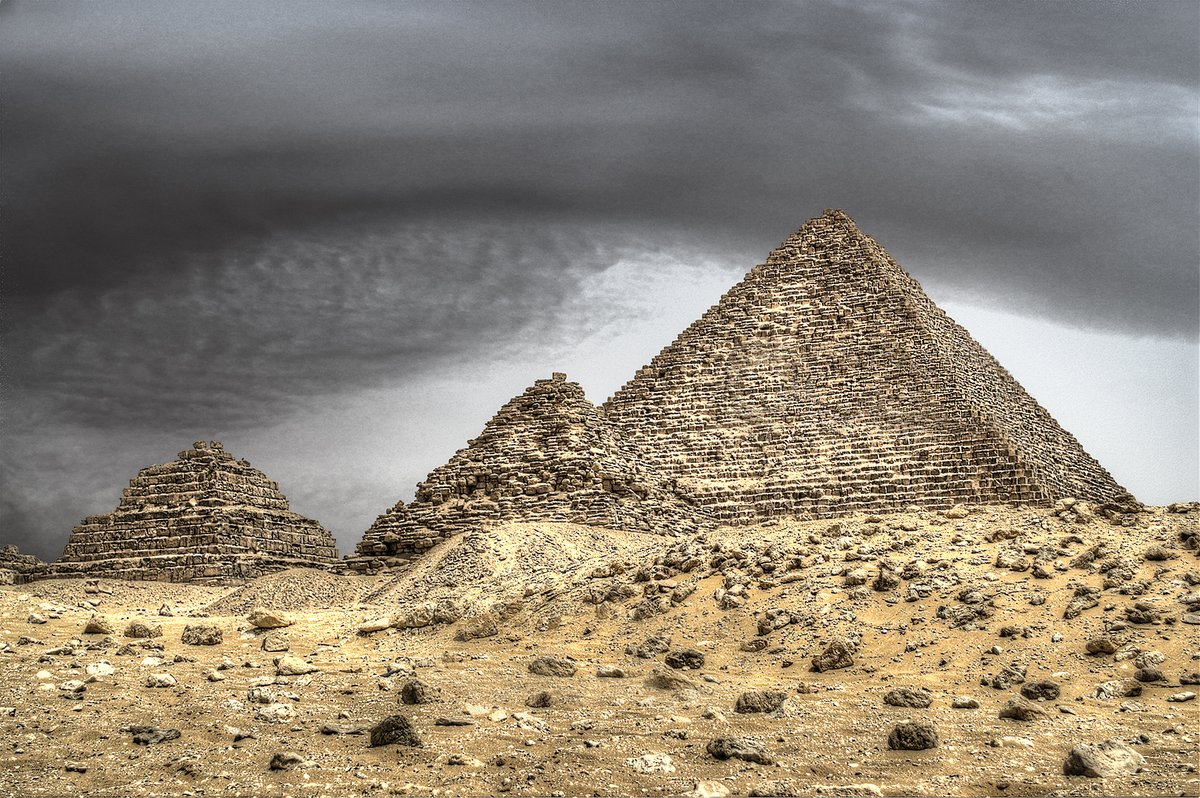
The pyramid of Menkaure, the smallest of the three at 66 meters high, is nonetheless one of the most interesting. Its lower section was clad in red granite from Syene, a luxurious material transported from Aswan. The pharaoh's premature death interrupted the work, and his successors had to complete the upper facades in less noble local limestone. Three small subsidiary pyramids beside it housed royal wives.3
The Great Sphinx, carved from a natural rock outcrop, has guarded the approach to Khafre's complex for more than 4,500 years. Between its front paws, King Thutmose IV erected the "Dream Stele" in the 15th century BCE, recounting how the Sphinx promised him the throne in exchange for its restoration. Egyptologists still debate its precise construction date and the identity of the pharaoh whose face it bears.
Since the 1990s, systematic excavations in the workers' town at Giza have revealed a real city with bakeries, breweries, dispensaries, and archives. These builders were not slaves but paid workers, fed and cared for by the state. This SLICE Histoire documentary explores what Giza holds beyond the Great Pyramid and the most recent discoveries at this exceptional site.4
No comments yet. Be the first.