There is something dizzying in the idea that the billions of human beings now scattered across every continent, from the Inuit of the far north to the Aboriginal peoples of Australia, from Andeans to Siberians, descend, for the bulk of their genetic heritage, from a mere handful of populations that left AfricaAfricaThe cradle of humankind: the continent where the first hominins appeared, then Homo sapiens around 300,000 years ago, before the expansion to the rest of the world.→ some sixty thousand years ago. This is the heart of what science calls the "Out of AfricaOut of AfricaThe dispersals of Homo sapiens out of Africa, including a major expansion c. 70,000 to 60,000 years ago and earlier exits.→" scenario: the now firmly established account according to which our species, Homo sapiensHomo sapiensThe present-day human species, which emerged in Africa around 300,000 years ago, the only surviving human lineage after the extinction of Neanderthals and Denisovans.→, arose on African soil before fanning out across the world and replacing, everywhere, the other humanities that had preceded it beyond the continent.
This narrative, which seems almost self-evident today, was long disputed. Throughout the second half of the twentieth century, two schools clashed: the proponents of a multiregional origin, who imagined a parallel evolution of Homo sapiens on several continents from local Homo erectus populations, and those of a recent, single African origin. It is this second hypothesis that prevailed, carried first by palaeogeneticsPalaeogeneticsThe study of ancient DNADNAThe molecule carrying genetic information, used to reconstruct kinship between species.→ extracted from remains (bones, teeth, sediments, walls) to reconstruct the past of populations.→, the study of ancient DNAAncient DNAGenetic material preserved in old remains, often degraded, sequenced with cutting-edge techniques.→ and present-day genomes, then confirmed by palaeoanthropologyPalaeoanthropologyThe science that studies human evolution from the fossil remains of hominins (bones, teeth, footprints) and their context, to reconstruct our biological origins.→ and archaeology. This article retraces that great adventure: the African origin of our species, the chronology of successive departures, the routes taken towards the LevantLevantA region of the eastern Mediterranean Near East (Israel, Lebanon, Syria, Jordan), a major crossroads of the first human migrations out of Africa.→ and Arabia, the genetic proof of mitochondrial Eve, the riddle of the bottleneck and the Toba eruption, the interbreedingInterbreedingGenetic mixing between human populations or species; between Neanderthals and Homo sapiens it left 1 to 2% of Neanderthal DNA in non-Africans.→ with NeanderthalsNeanderthalsA fossil humanity of Eurasia, robust and cold-adapted, extinct around 40,000 years before present.→ and Denisovans, and finally the actual peopling of the entire planet.
The African origin of Homo sapiens
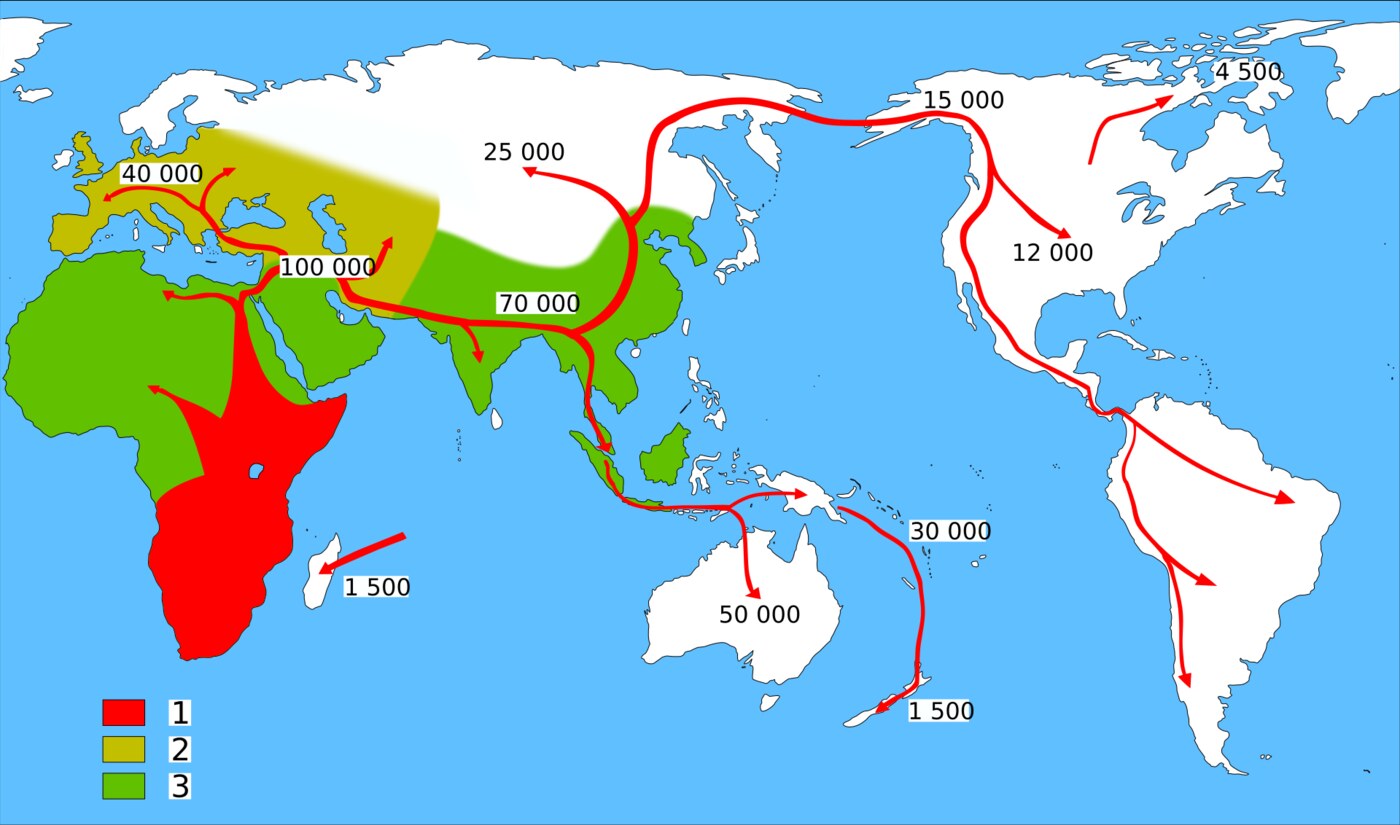
Before it could leave Africa, Homo sapiens first had to be born there. On this very point, the last twenty years have profoundly renewed our understanding. For a long time, our species was thought to have appeared in East Africa, in the region of the Great Rift Valley, around two hundred thousand years ago. The fossils of Omo Kibish, in Ethiopia, dated to roughly one hundred and ninety-five thousand years, and those of Herto, also Ethiopian, one hundred and sixty thousand years old, seemed to confirm this eastern cradle. These skulls, the Herto specimens being designated Homo sapiens idaltu, already display the essentials of modern anatomy: a high, rounded braincase, a vertical forehead, a reduced face, a bony chin.
But in 2017, the revised dating of the Jebel Irhoud site in Morocco pushed this date back and shifted the geography of the problem. The human remains of Jebel Irhoud, long poorly dated, were attributed to around three hundred thousand years thanks to thermoluminescence dating of the associated burnt flints. These Moroccan fossils, which combine an already modern face with a still elongated, archaicArchaicRefers to an ancient, now-extinct human population or form (Neanderthals, Denisovans, ghost lineages), as opposed to anatomically modern humans.→ braincase, are probably not our direct ancestors in the strict sense, but they testify that at the dawn of our lineage, populations with a morphology close to ours already lived at the far north-western tip of Africa, thousands of kilometres from the Rift.
From this accumulation of data a new idea was born, defended notably by the palaeoanthropologist Eleanor Scerri: that of a "pan-African" origin of Homo sapiens. Rather than a single, localised cradle, our species would have emerged from a mosaic of populations dispersed across the whole continent, from Morocco to southern Africa, sometimes isolated by deserts or forests, sometimes reconnected as the climateClimateThe long-term average atmospheric conditions of a region; its variations (glaciations, aridifications) shaped migrations, agriculture and the collapse of prehistoric societies.→ oscillated. It would be from these intermittent exchanges, from this continent-wide mixing, that the morphology and genome of modern humanity gradually emerged. Our species would be less the product of a place than that of a network, of an African metapopulation.
One departure or several? The early exit and the great dispersal
The question of the dates of departure is one of the most debated in the discipline, and it has grown considerably more complicated as new fossils have surfaced. The classic scheme, still largely valid for explaining the ancestry of present-day populations, places the great dispersal between sixty and fifty thousand years ago. It is this wave, and this wave alone, that would have left a lasting genetic imprint on all humans living today outside Africa. But the signs of older incursions have multiplied.
At Misliya, on Mount Carmel in Israel, a fragment of upper jaw dated between one hundred and seventy-seven and one hundred and ninety-four thousand years shows that Homo sapiens had reached the Levant well before the great exit. The neighbouring caves of Skhul and QafzehQafzehA cave in Lower Galilee (Israel) yielding Homo sapiens and some of the oldest known burials outside Africa.→ have yielded sapiens burials one hundred to one hundred and twenty thousand years old. Further still, teeth discovered at Daoxian, in southern China, suggest a presence of modern humans in East Asia some eighty thousand to one hundred and twenty thousand years ago. Finally, in Arabia, the site of Al Wusta has yielded a modern human finger bone dated to about eighty-five thousand years.
How can these early traces be reconciled with the almost exclusively "recent" ancestry of present-day populations? The most widely accepted answer distinguishes two kinds of events. On the one hand, early departures, from one hundred to one hundred and twenty thousand years ago, that would have carried small groups of sapiens as far as the Levant and perhaps as far as Asia, but that for the most part died out or were reabsorbed, leaving only a marginal genetic contribution, if any, in the living. On the other hand, the great dispersal of sixty thousand years ago, demographically victorious, from which all present-day non-Africans descend. The early exits would thus be aborted buds, the "dress rehearsals" of an exodus of which only the last was crowned with success.
The routes: the Levant and the Arabian "southern route"

To leave Africa, two great gateways offered themselves to Homo sapiens. The first, the more northerly, is the Levantine corridor: by following the Nile valley up and then crossing the isthmus of Suez, one emerges into the Syro-Palestinian corridor, which naturally links Africa to Eurasia. It was through here, no doubt, that the sapiens of Misliya, Skhul and Qafzeh passed. This route had one major drawback, however: it depended closely on climate. In humid periods the Sahara and the Levant were covered with savannahs and lakes, what is called the "Green SaharaGreen SaharaA name for the Sahara during the "African Humid Period" (c. 14,500 to 5,000 years ago), when increased monsoon rainfall sustained lakes, rivers and savannas, making the region habitable before its gradual desiccation.→", and the passage became practicable; in arid periods the desert closed again like an impassable barrier.
The second, southern gateway is the famous "southern route". It assumes a crossing of the Bab-el-Mandeb strait, at the end of the Red Sea, where the Horn of Africa is separated from Arabia by only some thirty kilometres. During glacial maxima, the lowering of the sea level, which could reach a hundred and twenty metres, further reduced this distance and brought islands and shallows to the surface, making the crossing conceivable even for groups with only rudimentary craft. Once in Arabia, the migrants are thought to have hugged the shores of the Indian Ocean, exploiting littoral resources, shellfish, fish, in a coastal way of life that may have favoured rapid progress eastward, as far as India, Southeast Asia and finally Sahul.
The southern-route hypothesis, also called "rapid coastal dispersal", is appealing for its consistency with the genetic data, which suggest a lightning-fast expansion along the Asian coasts. But it remains hard to document archaeologically, for the coastal sites of the time are now submerged beneath tens of metres of water, the sea level having risen since the last glaciation. It is in fact likely that both routes were used at different times, and that the exit from Africa was not a single event but a series of migratory pulses conditioned by fluctuations in climate and vegetation.
The genetic proof: mitochondrial Eve and Y-chromosome Adam
If the exit from Africa eventually established itself as a paradigm, it is above all thanks to population genetics. As early as 1987, a team led by Rebecca Cann, Mark Stoneking and Allan Wilson published a founding study on mitochondrial DNA. Mitochondrial DNA, transmitted exclusively by the mother, does not recombine: it passes from generation to generation accumulating only point mutations, which makes it an ideal molecular clock for tracing maternal lineages back in time. By comparing the mitochondrial DNA of populations the world over, the researchers found that all lineages converged towards a single common ancestor, a woman who had lived in Africa some one hundred and fifty to two hundred thousand years ago: "mitochondrial Eve".
A stubborn misconception must be dispelled at once. Mitochondrial Eve was by no means the only woman alive in her time, nor the "mother of humanity" in the biblical sense. She is simply the most recent common ancestor along the strictly maternal line of all present-day humans: thousands of other women lived at the same time as her, but their mitochondrial lineages died out over time, for lack of daughters in some generation. A symmetrical reasoning, applied to the Y chromosome passed from father to son, leads to a "Y-chromosome Adam", himself African. The major fact, for our purposes, is that human genetic diversity is greatest in Africa and decreases as one moves away from it: this is exactly what one would expect if humanity spread from an African hearth, each wave of migrants carrying away only a subsample of the variability of the parent population.
This signature, the so-called "serial" founder signature, constitutes the most robust genetic argument in favour of a recent African origin. The further a population is from Africa in terms of migratory routes, Native Americans, Aboriginal Australians, the less genetically diverse it is, because it results from a succession of foundings by small numbers. The map of human genetic diversity is thus, quite literally, the map of our dispersal from the ancestral continent.
The bottleneck and the Toba eruption
The expansion of Homo sapiens out of Africa was preceded and accompanied by a major demographic phenomenon: a bottleneckBottleneckA sharp, temporary reduction in a population's size that lastingly impoverishes its genetic diversity.→, that is, a drastic and temporary reduction in the size of the population. Genetic analyses indicate that the ancestors of all non-Africans descend from a strikingly small founder group, a few thousand individuals of childbearing age, perhaps fewer. This bottleneck explains the relative poverty of genetic diversity outside Africa and the close kinship of all Eurasian populations with one another.
One of the explanations long advanced for this bottleneck was the Toba eruption. Around seventy-four thousand years ago, the Toba supervolcanoSupervolcanoA volcano capable of an eruption of magnitude 8 on the Volcanic Explosivity Index (VEI), ejecting more than 1,000 km³ of material. Such "super-eruptions" are extremely rare and leave a giant caldera rather than a cone.→, located on the island of Sumatra, underwent one of the most colossal eruptions of the last two million years. It hurled out thousands of cubic kilometres of material, laid down a layer of ash as far as the Indian subcontinent, and may have triggered a planetary "volcanic winterVolcanic winterA prolonged global cooling of the climate caused by the injection of sulfate aerosols and ash into the stratosphere during a large eruption, which reflect sunlight and lower temperatures for several years.→", a brutal cooling of several degrees lasting perhaps a few years to a few centuries. According to the "Toba catastrophe theory", formulated by the geologist Stanley Ambrose, this winter would have decimated human populations, reducing Homo sapiens to the brink of extinction and creating precisely the bottleneck read in our genomes.
Appealing as it is, this hypothesis has nonetheless been strongly qualified. Excavations carried out in India and southern Africa, notably at sites overlain by Toba ash, show a continuity of human occupations on either side of the eruption, with no clear break. Moreover, the most recent genetic estimates place the founder bottleneck not so much at the moment of Toba as at the very heart of the dispersal process: the small number of founders would be above all the consequence of the small number of migrants who actually left Africa and spread into Eurasia, independently of any volcanic catastrophe. Toba doubtless affected certain populations locally, but it is probably not the grand director of the global bottleneck that some have wished to see in it.
The interbreeding: Neanderthals and Denisovans along the way
Far from migrating into an empty world, the sapiens who left Africa entered a Eurasian continent already peopled by other humanitiesHomininHomininMember of the subtribe Hominina, comprising the human lineage (Homo, Australopithecus, Paranthropus…) but excluding orangutans and gibbons. The term progressively replaces "hominid" in its narrow sense.→A member of the human lineage in the broad sense, including modern humans, their ancestors and related great apesgreat apesThe family of great apes (Hominidae) comprising orangutans, gorillas, chimpanzees, bonobos and humans.→.→. In Europe and the Near EastNear EastA region of western Asia (Levant, Mesopotamia, Anatolia, Iran), cradle of the Neolithic revolution, agriculture, the first cities and writing.→ lived the Neanderthals, established for hundreds of thousands of years; across central and eastern Asia roamed the DenisovansDenisovanAn extinct human population, cousin of the Neanderthals, identified in 2010 from the DNA of remains in Denisova Cave (Siberia).→, that ghost population revealed by the DNA of a Siberian finger bone. When Homo sapiens encountered these lineages, it did not merely brush against them or replace them: it united with them. Interbreeding between human species, long held to be impossible or taboo, is today an established genetic fact, a form of hybridisationHybridisationCrossing between two distinct species or lineages, such as Homo sapiens and Neanderthals, leaving a trace in the genome.→.
The sequencingSequencingReading the order of the bases (A, T, G, C) of a DNA molecule; high-throughput sequencing reads millions of fragments in parallel.→ of the Neanderthal genome, completed in 2010 by the team of Svante Pääbo, revealed that all present-day non-African humans carry between one and two percent of Neanderthal DNA. This interbreeding occurred shortly after the exit from Africa, probably in the Near East, around fifty to sixty thousand years ago, when the first migrants crossed paths with the local Neanderthals. Likewise, the populations of Oceania, Papuans, Aboriginal Australians, Melanesians, carry up to four or five percent of Denisovan DNA, inherited from encounters along the way, somewhere in Southeast Asia, with these still little-known cousins.
These archaic fragments are not mere inert relics. Some have been preserved by natural selection because they conferred an advantage: Neanderthal genes linked to immunity, pigmentation or metabolism, or the famous variant of the EPAS1 gene, inherited from the Denisovans, which today helps Tibetans tolerate the lack of oxygen at high altitude. The exit from Africa was therefore not only a diffusion, but also an absorption: as it spread, Homo sapiens gathered and integrated fragments of the genetic heritage of the humanities it met, which, through these traces, survive in us still.
The peopling of the world: Europe, Asia, Sahul, the Americas
Once the gateways of Africa were crossed, the dispersal of Homo sapiens across the world was, on the scale of prehistoric time, of startling rapidity. By around forty-five thousand years ago, modern humans were reaching Europe, where they are associated with the AurignacianAurignacianThe earliest culture of the European Upper Palaeolithic (c. 43,000–33,000 BC), tied to the arrival of Homo sapiens and the first artworks.→ culture and the first works of figurative art, while coexisting for several millennia with the last Neanderthals, before the latter went extinct around forty thousand years ago. In Asia, progress was just as vigorous, along the coasts as inland, as far as the Siberian reaches.
One of the most remarkable feats was the colonisation of SahulSahulThe continent formed during the ice ages by the union of Australia, New Guinea and Tasmania when sea levels were low.→, the continent that, during the low sea levels of the PleistocenePleistoceneThe geological epoch of the great ice ages (c. 2.6 Ma–11,700 BP), spanning most of human prehistoryPrehistoryThe span of human history before the invention of writing, from the Palaeolithic to the Metal Ages, known mainly through material remains.→.→, joined Australia, New Guinea and Tasmania. To reach Sahul from Southeast Asia required crossing several deep sea straits, which were never entirely dried out even at the height of the glaciations: it was therefore by navigation, on craft of which we know nothing, that the ancestors of the Aboriginal peoples reached Australia at least sixty-five thousand years ago, according to the dating of the Madjedbebe site. This deliberate sea crossing, the oldest attested in human history, testifies to fully modern cognitive and technical capacities.
The last great continent to be peopled was America. Through BeringiaBeringiaA vast land bridge emergent between Siberia and Alaska during the last glaciation, at the site of today's Bering Strait; a cold steppe through which the first Americans passed.→, the land bridge that joined Siberia to Alaska when the sea level was low, populations from Asia entered the New World, probably between twenty thousand and sixteen thousand years ago, perhaps earlier according to controversial sites such as White Sands, whose footprints may date back more than twenty thousand years. From Alaska to Tierra del Fuego, these pioneers descended the whole of the Americas in just a few thousand years. Thus, having set out from an African hearth, modern humanity had, within the span of fifty thousand years, reached and inhabited almost all the emerged lands of the planet.
Current debates
The Out of Africa model, sound as it is in its broad outlines, remains a scientific work in full ferment. Several questions continue to divide specialists. The first concerns the exact number and chronology of the departures: a single late dispersal, or several staggered waves of which only one left descendants? The increasingly ancient fossils discovered in Asia and Arabia complicate the picture and argue for a multiple-pulse scenario.
The second concerns the African origin itself: the pan-African metapopulation model still stands opposed to the idea of a more circumscribed cradle, and the scarcity of fossils in certain regions of the continent leaves vast grey areas. The third touches on the exact role of climate: it is increasingly understood that the "gateways" of departure opened and closed to the rhythm of humid and arid cycles, and palaeoclimatic modelling is becoming a central tool for reconstructing the possible windows of migration. Finally, the question of multiple interbreedings is continually enriched: older and more complex introgressions are now suspected, including archaic "ghost" populations within Africa itself, whose DNA would have contributed to the genome of certain present-day African populations.
Conclusion
The exit from Africa is not merely one episode of prehistory among others: it is the matrix event of human unity. It reminds us that, beyond the extraordinary apparent diversity of peoples, all present-day human populations share a common and recent origin, and that the differences that separate us are minute in the light of this shared heritage. Born in Africa three hundred thousand years ago, mixed on the scale of a whole continent, having gone out through the gateways of the Levant and Arabia as the climate oscillated, squeezed through a demographic bottleneck and then enriched by its encounters with Neanderthals and Denisovans, Homo sapiens conquered the entire planet in a few tens of thousands of years.
This epic, reconstructed stone by stone, gene by gene, remains unfinished: every new excavation, every new ancient genome sequenced redraws its contours. But its central lesson does not change. We are all, under every latitude, the descendants of those African travellers of the PalaeolithicPalaeolithicThe oldest and longest period of prehistory (c. 3.3 Ma–12,000 BC), defined by chipped stone tools and a hunter-gatherer way of life.→ who, without being aware of it, following the herds and the coasts, made the whole Earth the territory of a single humanity.
The deep African origins
Before speaking of an exit, one must understand what was being exited. The emergence of Homo sapiens was not a single moment but a long process rooted in the depth of African time. The major discovery at Jebel Irhoud, in Morocco, overturned the accepted chronology: the human remains unearthed at this site, long dated uncertainly, were placed by thermoluminescence methods at a weighted average age of about three hundred and fifteen thousand years, pushing back at a stroke by a hundred thousand years the recognised origin of our species. These fossils, associated with Middle Stone AgeMiddle Stone AgeA long phase of African prehistory (c. 300,000 to 40,000 years ago), the African equivalent of the Middle Palaeolithic, marked by the rise of symbolic behaviour.→ tools, present a face that is already decidedly modern set against a still elongated braincase, a mosaic of derived and plesiomorphicPlesiomorphicDescribes an ancestral (primitive) anatomical character inherited from a common ancestor, as opposed to recent derived traits.→ traits that perfectly illustrates the gradual nature of our becoming.
Jebel Irhoud, however, forms only one piece of a wider whole. The Florisbad skull, in South Africa, dated to about two hundred and sixty thousand years and long placed in a taxonomic grey zone, has been attributed to archaic Homo sapiens in the light of the new datings. Further east, in Ethiopia, the sites of Omo Kibish and Herto provide crucial markers: the Omo remains, once estimated at one hundred and ninety-five thousand years and recently aged through the dating of overlying volcanic layers, and those of Herto, dated to about one hundred and sixty thousand years, rank among the oldest fossils incontestably attributable to our species. Together, these sites scattered from the Maghreb to the Horn of Africa trace a geography of emergence that is nothing like a single point on the map.
This very dispersal of the oldest witnesses raises a fundamental question. How could populations bearing modern traits appear simultaneously in the north-west, the south and the east of the continent, separated by thousands of kilometres and by tens of thousands of years? The answer, sketched by palaeogeneticsPalaeogeneticsThe study of ancient DNA extracted from remains (bones, teeth, sediments, walls) to reconstruct the past of populations.→ and archaeology, points towards a model of diffuse emergence rather than a single hearth, and it is precisely this model that structures today's debate over the cradle of humanity.
The pan-African hypothesis against the single cradle
For decades, two great frameworks competed to explain our origin. The first, the recent African origin model in its classic version, posited a single, geographically circumscribed cradle, often placed in East Africa, from which a founding population spread, progressively replacing all archaic forms. The second, called pan-African or African multiregional, proposes on the contrary that Homo sapiens emerged not in one place but on the scale of an entire continent, within a fragmented metapopulation linked by intermittent gene flow.
According to this pan-African view, groups of Homo scattered across the savannas, forests and coasts of Africa would have exchanged genes and cultural innovations as the connections and isolations imposed by climatic fluctuations allowed. Now united during the humid phases that greened the Sahara, now separated by the expansion of the deserts, these subsets would have evolved in mosaic fashion, each contributing in part to the heritage of the species in formation. Modern traits would therefore not have appeared all at once in a single place, but would have assembled gradually, mixed across the whole continent, until they formed the characteristic bundle of present-day humanity.
This model now receives considerable support from the genetics of African populations, which prove to carry a diversity far greater than that of all other populations of the world combined. This genealogical depth betrays a long, structured history, made of ancient lineages that diverged and sometimes recrossed on African soil. The distinction between the two models is moreover not absolute: most researchers now accept a compromise in which East Africa retains the role of a major demographic crossroads, without being the unique matrix from which everything came forth. The cradle of humanity would be less a cradle than a vast continental nursery.
The early exits: Misliya, Apidima, Skhul and Qafzeh
If the great dispersal that peopled the world occurred relatively late, it was preceded by several older incursions, long underestimated and today recognised as chapters in their own right of the history of the exits. The most spectacular of these testimonies comes from Misliya cave, on Mount Carmel in Israel: an upper half-jaw was dated there to a range between one hundred and seventy-seven thousand and one hundred and ninety-four thousand years, making it the oldest known Homo sapiens fossil outside Africa and pushing back by about sixty thousand years the date of the first documented crossing of the African threshold.
Other clues reinforce this advance-guard picture. In Greece, a cranial fragment from Apidima cave, dated to about two hundred and ten thousand years, could, according to some researchers, belong to a very early sapiens, an attribution that remains contested, for want of sufficient diagnostic features, but which, if confirmed, would testify to a fleeting presence of our species as far as south-eastern Europe at an extraordinarily remote period. Later, between ninety thousand and one hundred and twenty thousand years ago, the burials of Skhul and Qafzeh, again in the Levant, yield incontestable modern humans, long regarded as the first African emigrants before the revelation of Misliya.
These early incursions nonetheless share a decisive trait: they seem to have left no descendants in the genetic heritage of present-day populations. The people of Skhul, Qafzeh or Misliya probably represent advances without a sequel, pioneer branches that died out or were reabsorbed without contributing durably to the peopling of Eurasia. Their interest is no less for that: they prove that the gateway of the Levant opened and closed several times, to the rhythm of the climate's oscillations, long before the decisive migration surged through this interstice and spread out for good.
The great dispersal and its genetic evidence
Beyond these aborted attempts, it was a later migration, set around sixty thousand years ago, that gave rise to all present-day non-African populations. The convergence between archaeology and genetics is here remarkable. The analysis of mitochondrialAncient DNAGenetic material preserved in old remains, often degraded, sequenced with cutting-edge techniques.→ lineages shows that all non-Africans descend from two great branches, haplogroups M and N, themselves issued from an ancestral African haplogroup, L3, whose age is estimated at around seventy thousand years. This concordance is not fortuitous: the same demographic episode that saw the expansion of L3 in East Africa appears to have fed the exit of a small founding group that would people the rest of the world.
The relative youth of the non-African lineages imposes a strong conclusion: despite the ancient incursions attested by the Levantine fossils, the overwhelming majority of the ancestry of Eurasians, Oceanians and Native Americans goes back to this single successful dispersal. The first genetically detectable expansion is set between fifty-nine thousand and sixty-nine thousand years ago, colonising western Asia and India before rapidly reaching East Asia. The low genetic diversity observed among non-Africans, compared to the richness of the populations that remained in Africa, marks the trace of a founding bottleneckBottleneckA sharp, temporary reduction in a population's size that lastingly impoverishes its genetic diversity.→: only a reduced fraction of African variability crossed the threshold and spread beyond.
This genetic signature of the founding bottleneck constitutes one of the pillars of the Out of Africa model. It explains why two individuals taken at random from an African population may differ more, in their DNA, than do a European and an East Asian. All extra-African humanity descends from a handful of travellers, and this narrow origin can still be read, tens of thousands of years later, in each of our genomes.
Mitochondrial DNA and the Y chromosome: Eve and Adam
Two singular fragments of the human genome offer a privileged window onto this history of origins: mitochondrial DNA, transmitted exclusively by mothers, and the Y chromosome, transmitted exclusively from father to son. Because they escape the shuffling of sexual reproduction and are passed on in a block along a single lineage, they make it possible to trace the maternal and paternal genealogies of humanity back to their respective common ancestors.
The maternal genealogy converges towards a figure nicknamed Mitochondrial Eve, the matrilineal most recent common ancestor of all living humans, whom estimates place around one hundred and fifty thousand to two hundred thousand years ago, with some recent analyses tightening this range to about one hundred to one hundred and sixty thousand years. On the paternal side, Y-chromosomal Adam, the patrilineal common ancestor, is set, according to the studies, between one hundred and twenty thousand and two hundred thousand years ago. One must guard against a tenacious misreading: neither Mitochondrial Eve nor Y-chromosomal Adam was the only human of their time, nor a primordial couple. They were merely two individuals among a numerous population, simply the only ones whose maternal or paternal lineage survived unbroken down to us.
These two ancestors moreover lived in Africa, and probably at distinct epochs, separated by tens of thousands of years, the romantic idea of an original couple dissolves into the statistics of genetic coalescence. Their interest lies elsewhere: by dating these points of convergence and mapping the diversity of the lineages that descend from them, geneticists reconstruct the family tree of the species, confirm the African rooting of all its branches, and read in the topology of this tree the trace of the great migrations. The greater depth of the African lineages, both maternal and paternal, appears there as the indelible mark of the matrix continent.
The northern route and the southern route
By which way, exactly, did humanity leave Africa? Two great itineraries have been proposed, long presented as rivals and today regarded as complementary. The northern route followed the Levantine corridor: ascending the Nile valley and then crossing the Sinai, the migrants emerged into the Near East, that crossroads where the fossils of Misliya, Skhul and Qafzeh were found. It is by this way that the first early incursions seem to have been made, thanks to the humid phases that rendered the Sinai desert and the Levant temporarily hospitable.
The southern route crossed the strait of Bab-el-Mandeb, at the southern tip of the Red Sea, where Africa and the Arabian Peninsula face each other across only a few tens of kilometres. During the low sea levels of the PleistocenePleistoceneThe geological epoch of the great ice ages (c. 2.6 Ma–11,700 BP), spanning most of human prehistory.→, this passage narrowed, and a brief crossing sufficed to reach Arabia. Now the image of an eternally desert Arabia is misleading: on several occasions the warming of the monsoons greened the peninsula, multiplying lakes, rivers and savannas into a "Green Arabia" studded with oases. These windows of humidity opened corridors of dispersal across what is today but an ocean of sand, and the archaeological discoveries of Palaeolithic tools in the Arabian desert attest to these repeated passages.
Far from excluding each other, the two routes probably functioned at different moments, each according to the climatic windows that swung open. The northern gateway and the southern gateway beat to the rhythm of the cycles of aridity and humidity, opening during the optima only to close during the dry phases. The major dispersal is thought to have followed a largely coastal trajectory, skirting the shores of the Indian Ocean from Arabia to Southeast Asia, exploiting the abundant marine resources of a littoral now largely submerged by the post-glacial rise of the waters.
Toba and the bottleneck debate
At the heart of this history looms the shadow of a catastrophe: the eruption of the Toba supervolcano, in Sumatra, which occurred about seventy-four thousand years ago, one of the most powerful of the Quaternary. The Toba catastrophe theory proposed that this super-eruption hurled into the atmosphere colossal volumes of ash and aerosols, triggering a global cooling lasting several years and plunging human numbers below the threshold of ten thousand individuals. The genetic bottleneck observed in modern humanity would thus have its origin in this volcanic near-extinction.
Appealing as it is, this hypothesis has nonetheless been strongly qualified, even contested. Excavations carried out in India and southern Africa, notably at sites overlain by Toba ash, show a continuity of human occupations on either side of the eruption, with no clear break in the peopling. Populations survived and remained active after the catastrophe, which weakens the idea that this event was the main cause of the founding bottleneck. Moreover, the most recent genetic estimates place this bottleneck not so much at the moment of Toba as at the very heart of the dispersal process: the small number of founders would be above all the consequence of the small number of migrants who actually left Africa, independently of any volcanic catastrophe.
The debate nonetheless retains its sharpness. That the date of Toba slightly precedes the expansion of haplogroup L3 is doubtless not pure chance, and some researchers maintain that a cooling, even a brief one, could have reshaped populations and reconfigured the windows of migration. Toba certainly affected certain regions locally; but it is probably not the grand director of the global bottleneck that some have wished to see in it. The demographic tightening of the founders seems above all inherent in the very mechanics of dispersal, which no catastrophe was needed to produce.
Adaptations to new worlds
In spreading under every latitude, Homo sapiens encountered environments radically foreign to those of the tropical savanna that had seen it born: cold deserts, high plateaus, boreal forests, regions of little sunlight. Natural selection, operating at accelerated rates on these pioneer fronts, fashioned in a few thousand generations a range of local adaptations still legible in present-day physiological diversity. Skin pigmentation offers the most visible example: under the weakly sunlit latitudes of Eurasia, variants of pigmentation genes such as SLC24A5 and SLC45A2 were selected to lighten the skin and favour the synthesis of vitamin D, while the dark skin of the origins protected against the intense ultraviolet of the tropics.
Other adaptations testify to the plasticity of the species in the face of specific challenges. Lactase persistence, which allows the digestion of lactose into adulthood, arose independently in several herding populations, in Europe as in Africa, through distinct mutations of the LCT gene, a textbook case of convergent evolution linked to pastoralismPastoralismA way of life based on herding livestock (cattle, sheep, goats), often mobile, which spread across the Green Sahara and, in that region, preceded farming proper.→. At high altitude, on the Tibetan plateau where the air thins above four thousand metres, the variant of the EPAS1 gene, inherited from the DenisovansDenisovanAn extinct human population, cousin of the Neanderthals, identified in 2010 from the DNA of remains in Denisova Cave (Siberia).→ through an ancient interbreedingHybridisationCrossing between two distinct species or lineages, such as Homo sapiens and Neanderthals, leaving a trace in the genome.→, modulates the production of red blood cells and allows hypoxia to be tolerated without the deleterious effects of blood overproduction.
Metabolism itself bears the mark of these adjustments: variants of the FADS genes, involved in the transformation of fatty acids, were selected according to local diets, whether rich in marine, terrestrial or plant resources. These adaptations, scattered through the genome, in no way divide humanity into watertight groups: they form a marquetry of pointed responses to precise environmental pressures, superimposed on an overwhelming common genetic background. The visible diversity of peoples is but the thin adaptive film of a deep unity.
What the genomics of present-day populations reveals
Palaeogenetics feeds not only on fossil bones; it also interrogates, and with growing fecundity, the genome of living populations. The large-scale sequencing of thousands of individuals from every continent has confirmed and refined the picture of the exit from Africa. The most robust finding is that of a gradient of diversity decreasing as one moves away from Africa: the more geographically distant a population is from the matrix continent, the more impoverished its genetic diversity, in keeping with the model of successive bottlenecks that pared down variability at each new stage of colonisation.
This fan-shaped structure, rooted in Africa and thinning towards the edges of the peopling, constitutes the very signature of an expansion from a single hearth. The genome of present-day populations records besides, like a palimpsest, the traces of ancient interbreedings: the percentage of Neanderthal DNA among Eurasians, the Denisovan fraction among Oceanians, and even more obscure introgressions, attributed to "ghost" populations of which we know no fossil but whose DNA persists in certain present-day African lineages.
The genomics of living populations finally illuminates the routes of dispersal. The geographical distribution of haplogroups, the dating of their ramifications, the mapping of affinities between human groups make it possible to reconstruct the itineraries, speeds and directions of the great migration. Each individual genome is thus an archive: it carries, inscribed in the sequence of its bases, the memory of the journeys of its ancestors, from the African cradle to the inhabited extremities of the planet. Molecular biology has become, in its way, a historical science.
Uncertainties and prospects
Sound as it is in its broad outlines, the narrative of the exit from Africa remains an open building site, crossed by grey areas and fertile controversies. The fine chronology of the departures continues to grow more complex as new fossils, ever more ancient, are brought to light in Asia and Arabia: should one imagine a single late and decisive dispersal, or a succession of migratory pulses of which only one spread durably? The genetic data lean towards the second hypothesis, without excluding that tenuous traces of older migrations persist in certain Asian genomes, as murmurs drowned in the dominant flow.
We are all, under every latitude, the heirs of one and the same African odyssey; the diversity of peoples is but the surface of an abyssal kinship.
Other uncertainties weigh on the picture. The exact role of climate in the opening and closing of the "gateways" of departure is becoming clearer thanks to palaeoclimatic modelling, now a central instrument for identifying the possible windows of migration, but the resolution of these models remains coarse in relation to the fineness of the demographic events. The question of interbreedings, for its part, continues to deepen: more numerous, older and more complex introgressions are suspected than the initial scheme suggested, including within Africa itself. Every ancient genome sequenced, every layer of sediment analysed for its environmental DNAEnvironmental DNADNA shed by organisms into their surroundings (soil, sediment, water, rock wall) and recoverable without any identifiable bodily remains.→, redraws a little the contours of the epic. Far from shaking the general framework, these uncertainties confirm its vitality: the exit from Africa is not a fixed dogma but a science on the move, whose coming discoveries will refine the narrative further without overturning its central lesson.
At the end of this journey, one certainty dominates all the controversies of detail. Whatever the routes taken, the exact number of waves or the respective share of catastrophes and demographic chance, contemporary humanity forms a single dispersed people. Born in Africa within a continental metapopulation some three hundred thousand years ago, having left through the thresholds of the Levant and Bab-el-Mandeb as the climate oscillated, squeezed through a founding bottleneck and then enriched by its encounters with other humanitiesHomininA member of the human lineage in the broad sense, including modern humans, their ancestors and related great apes.→, our species wove in a few tens of millennia a web of peopling covering almost all the emerged lands. Palaeogenetics and archaeology, by ceaselessly confronting their results, finish demonstrating what the old stories sensed in their own way: beyond the apparent mosaic of faces and tongues, it is one and the same lineage of PalaeolithicPalaeolithicThe oldest and longest period of prehistory (c. 3.3 Ma–12,000 BC), defined by chipped stone tools and a hunter-gatherer way of life.→ travellers that recognises itself, today, in the mirror of its own genome.
It is worth dwelling, finally, on the sheer evidential richness that makes this reconstruction possible. No single discipline could have established the story alone: it is the convergence of stratigraphyStratigraphyThe study of the superimposed layers (strata) of an archaeological site; each layer corresponds to a phase of occupation and yields a relative chronology.→ and radiometric dating, of comparative anatomy and statistical phylogeneticsphylogeneticsThe study of evolutionary kinship among species, often represented as a branching tree.→, of climate proxies drawn from ice cores and ocean sediments, that lends the model its solidity. Where the fossils fall silent, the genomes speak; where the genomes blur, the archaeology of stone tools and shell middens supplies the missing strokes. This methodological dialogue, more than any single spectacular find, is the true engine of progress in the study of human origins. Each line of evidence corrects and constrains the others, so that the picture that emerges is not the fragile conjecture of one specialty but the robust intersection of many. The exit from Africa thus stands today as one of the best-attested grand narratives of prehistory, precisely because it has had to survive the cross-examination of so many independent witnesses, each speaking a different scientific language yet telling, in the end, the same story of a single humanity setting out from a single continent to inherit the Earth.
Merci pour cet article. Je l'ai utilisé comme point de départ pour un projet maison sur la préhistoire.
Merci de rendre ces sujets accessibles. On n'a pas tous eu la chance de faire des études d'histoire.
L'approche est exactement ce qu'on demande en histoire : chronologie, sources, contexte. Bravo.
La théorie Out of Africa reste le cadre interprétatif dominant mais elle doit aujourd'hui intégrer des données de plus en plus complexes. La découverte de fossiles d'Homo sapiens hors d'Afrique datés de plus de 100 000 ans à Misliya en Israel et dans la péninsule arabique suggère des sorties précoces qui ne correspondent pas toujours à la colonisation finale du globe. Le débat est loin d'être clos.
Le modèle Out of Africa a été largement confirmé par la génétique des populations mais il se révèle beaucoup plus complexe qu'initialement proposé. Les données génomiques modernes et anciennes suggèrent des sorties d'Afrique multiples, des retours possibles vers l'Afrique, et des métissages avec des populations archaïques en Asie et en Europe. Le modèle de remplacement complet est remplacé par un modèle d'assimilation partielle.