A continent as laboratory
Forty thousand years ago, the vast plain stretching from the Atlantic to eastern Siberia formed a single open domain, cold and windswept, roamed by herds of mammoth, reindeer and horse. It was in this mammoth steppeMammoth steppeA vast cold, dry steppe-tundra ecosystem covering glacial Eurasia, home to mammoths, woolly rhinos, reindeer, horses and bison.→Mammoth steppeA now-vanished Ice Age ecosystem blending dry grassland and tundra, very rich in large herbivores.→ that the first Homo sapiensHomo sapiensThe present-day human species, which emerged in Africa around 300,000 years ago, the only surviving human lineage after the extinction of Neanderthals and Denisovans.→ of Eastern Europe pitched their camps, buried their dead and carved ivory. The Russian and Siberian sites of the Upper PalaeolithicPalaeolithicThe oldest and longest period of prehistory (c. 3.3 Ma–12,000 BC), defined by chipped stone tools and a hunter-gatherer way of life.→Upper PalaeolithicThe final phase of the Palaeolithic (c. 45,000 to 10,000 years ago), marked by Homo sapiens in Europe, art, ornaments and a succession of cultures (AurignacianAurignacianThe earliest culture of the European Upper Palaeolithic (c. 43,000–33,000 BC), tied to the arrival of Homo sapiens and the first artworks.→, GravettianGravettianAn Upper Palaeolithic culture (c. 33,000–21,000 BC) spanning from the Atlantic to Siberia, famous for its ivory female figurines ("Venuses") and, at Dolní Věstonice, the oldest fired ceramics.→, SolutreanSolutreanA European Upper Palaeolithic culture (c. 22,000–17,000 BC), remarkable for its leaf-shaped lithic points worked with flat retouch. Contemporary with the second art phase of Cosquer Cave.→, MagdalenianMagdalenianThe last great Upper Palaeolithic culture (c. 17,000–12,000 BC), the peak of cave art (Lascaux).→).→ rank among the richest in the world, and over the past decade the study of ancient DNADNAThe molecule carrying genetic information, used to reconstruct kinship between species.→Ancient DNAGenetic material preserved in old remains, often degraded, sequenced with cutting-edge techniques.→ has turned the region into an exceptional laboratory for understanding the peopling of Eurasia.
Far from being a remote margin, the East European Plain was one of the principal stages in the expansion of our species. Archaeologists have uncovered concentrations of sites of remarkable density there, knappingknappingThe set of operations for fracturing a stone block to extract flakes or blades.→ workshops, hearths, storage pits and dwelling structures that attest to a durable, organised occupation. Three complexes alone sum up this history: Kostenki on the Don, Sungir near Vladimir, and Mal'ta-Buret' in southern Siberia. Each illuminates a different facet of these societies, their genetics, their funerary rites, their art.
For a long time, the story of the Upper Palaeolithic was written almost exclusively from the sites of France and Spain, Lascaux, Chauvet, Altamira. The east of the continent looked like a poor relation, for lack of comparable painted caves. Research over recent decades has corrected this imbalance: the plain has no spectacular parietal art because it has almost no caves, but it possesses portable art and burials that rank among the richest in the world, and a chronological depth that makes it a privileged point of entry for Homo sapiens into Europe.
Kostenki-Borshchevo: at the gates of Europe
On the right bank of the Don, a few hundred kilometres south of Moscow, the Kostenki-Borshchevo complex gathers some twenty sites tiered across river terraces. Human occupation begins very early there, around forty-five to forty thousand years ago, placing Kostenki among the first bridgeheads of Homo sapiens in Europe. The oldest levels have yielded tools, ornaments of shell and ivory, and layers of volcanic ash that help to pin down the chronology precisely.
It was at Kostenki 14, a deposit nicknamed Markina Gora, that an almost complete male skeleton was found in 1954. In 2014, an international team sequenced his genome from a fragment of bone, obtaining one of the oldest human genomes in Europe, dated to roughly thirty-six to thirty-eight thousand years1. The results were striking. The man of Markina Gora already belonged to a population whose genetic structure prefigures that of present-day Europeans: it contains the three major components that would later recombine across Europe. His DNA also carried slightly more Neanderthal segments, and longer ones, than that of Europeans today, the trace of an ancient admixture with NeanderthalsNeanderthalsA fossil humanity of Eurasia, robust and cold-adapted, extinct around 40,000 years before present.→ that occurred more than forty-five thousand years earlier. The authors concluded that the western Eurasian and East Asian lineages had already diverged by that date, and that the genetic fabric of Europe had its roots in the Upper Palaeolithic5.
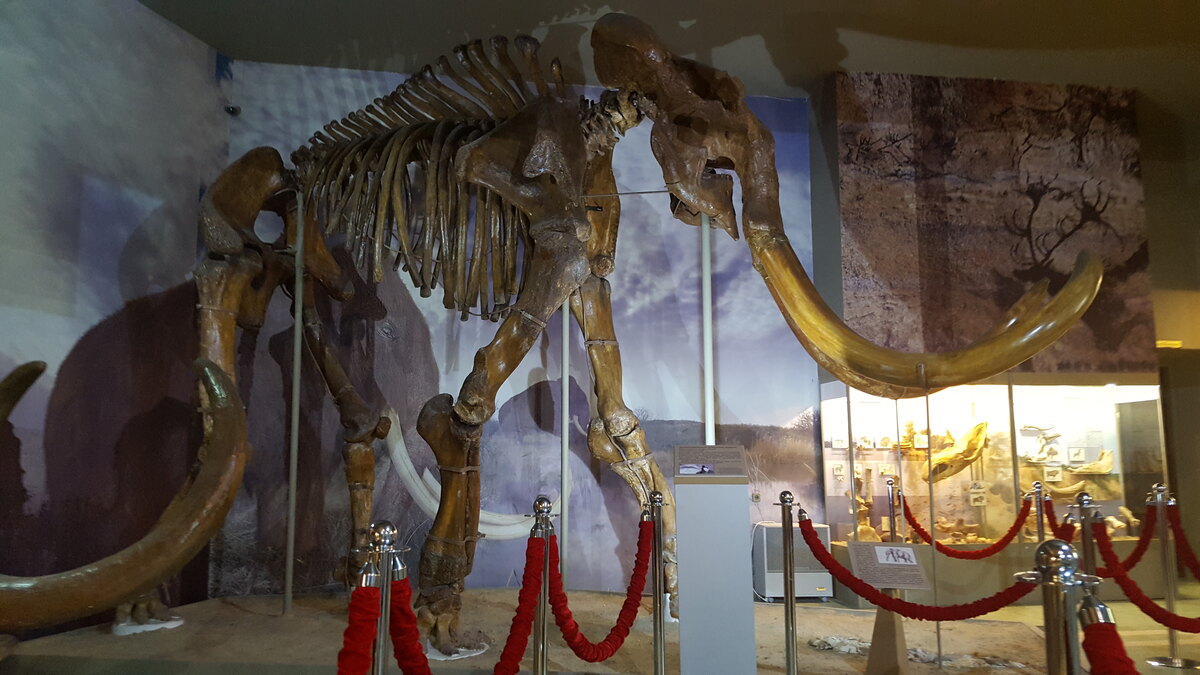
Kostenki also illustrates a technical feat of the plain's hunters: the circular dwellings built from mammoth bone. At Kostenki 11, archaeologists have studied a ring-shaped structure nearly twelve metres across, raised about twenty-five thousand years ago from the bones of at least sixty mammoths, including some sixty skulls and around fifty mandibles2. Long interpreted as winter huts, these rings raise questions: recent analysis has revealed charred wood and seeds, but a lower intensity of occupation than would be expected for a permanent base camp. A storage place, a ritual structure, a seasonal shelter? The debate remains open, but the scale of the work, one of the largest of the Ice Age, attests to an impressive collective command.
These mammoth rings are not isolated: around seventy are known across Ukraine and the western Russian Plain, often associated with pits dug nearby, variously interpreted as food stores, fuel deposits, rubbish dumps or loess quarries. In a landscape almost without wood, mammoth bone and tusk provided the framework, the furnishings and sometimes the fuel of the camps. Gathering the remains of dozens of beasts, whether hunted or, more probably, collected from accumulated carcasses, represented a considerable logistical effort, a sign of long-term planning and of an intimate knowledge of the territory.
Sungir: death arrayed in ivory
Some two hundred kilometres east of Moscow, near Vladimir, the site of Sungir has yielded one of the most extraordinary funerary assemblages in all of prehistoryPrehistoryThe span of human history before the invention of writing, from the Palaeolithic to the Metal Ages, known mainly through material remains.→. Dated to around thirty-four to thirty thousand years ago, it owes its fame to burials adorned with tens of thousands of mammoth-ivory beads, each pierced and polished by hand, representing a considerable investment of labour.
The grave of an adult man alone held several thousand beads, laid out in rows that trace the outline of garments now vanished: hood, shirt, trousers, boots. But it is the double child burial that is most arresting. Two adolescents lay there head to head, covered in ornaments and accompanied by an exceptional set of grave goods, including long spears cut from straightened mammoth ivoryMammoth ivoryMammoth tusk worked by Palaeolithic craftspeople to carve figurines, beads, points and ornaments.→, among the largest known, as well as pierced discs, perforated rods and animal figurines. The quantity of worked ivory, the sophistication of the objects and the energy expended on these young dead suggest a society capable of complex rites and perhaps of emerging social hierarchies.
In 2017, the genetic study of the Sungir individuals renewed our reading of the site3. Researchers showed that the people buried together were not close relatives: none were related at the third degree or closer. This result carries considerable weight, for it indicates that these hunters, like many recent peoples, avoided unions between close kin by organising networks of marriage exchange between groups. The analysis also revealed that one of the adolescents, long considered a girl, was in fact a boy. Genetically, the people of Sungir attached to the populations of the European Upper Palaeolithic and proved close to those of Kostenki, confirming the unity of a vast world of hunters across the plain.
The labour invested in these ornaments is staggering. The making of a single bead, cut, pierced and polished in ivory, has been estimated to require on the order of an hour of work; the thousands of beads in a single burial thus represent months of cumulative effort, well before death. The bodies were moreover dusted with red ochreOchreA red or yellow mineral pigment (iron oxides), used from prehistory for adornment, funerary rites and art.→, a pigment loaded with meaning throughout the Upper Palaeolithic, and accompanied by enigmatic objects such as pierced ivory discs or a small, finely engraved horse pendant. That such a lavish expenditure of goods was devoted to children, whose economic contribution remained limited, suggests that status could be inherited or conferred independently of age, a precious clue to the social organisation of these communities.
Mal'ta-Buret': the Siberian child and the Ancient North Eurasians
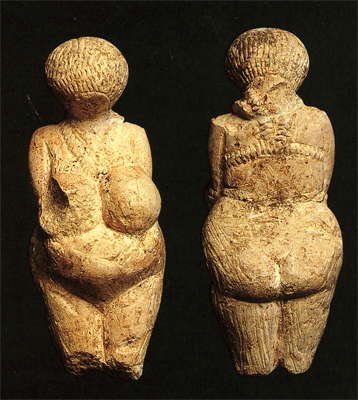
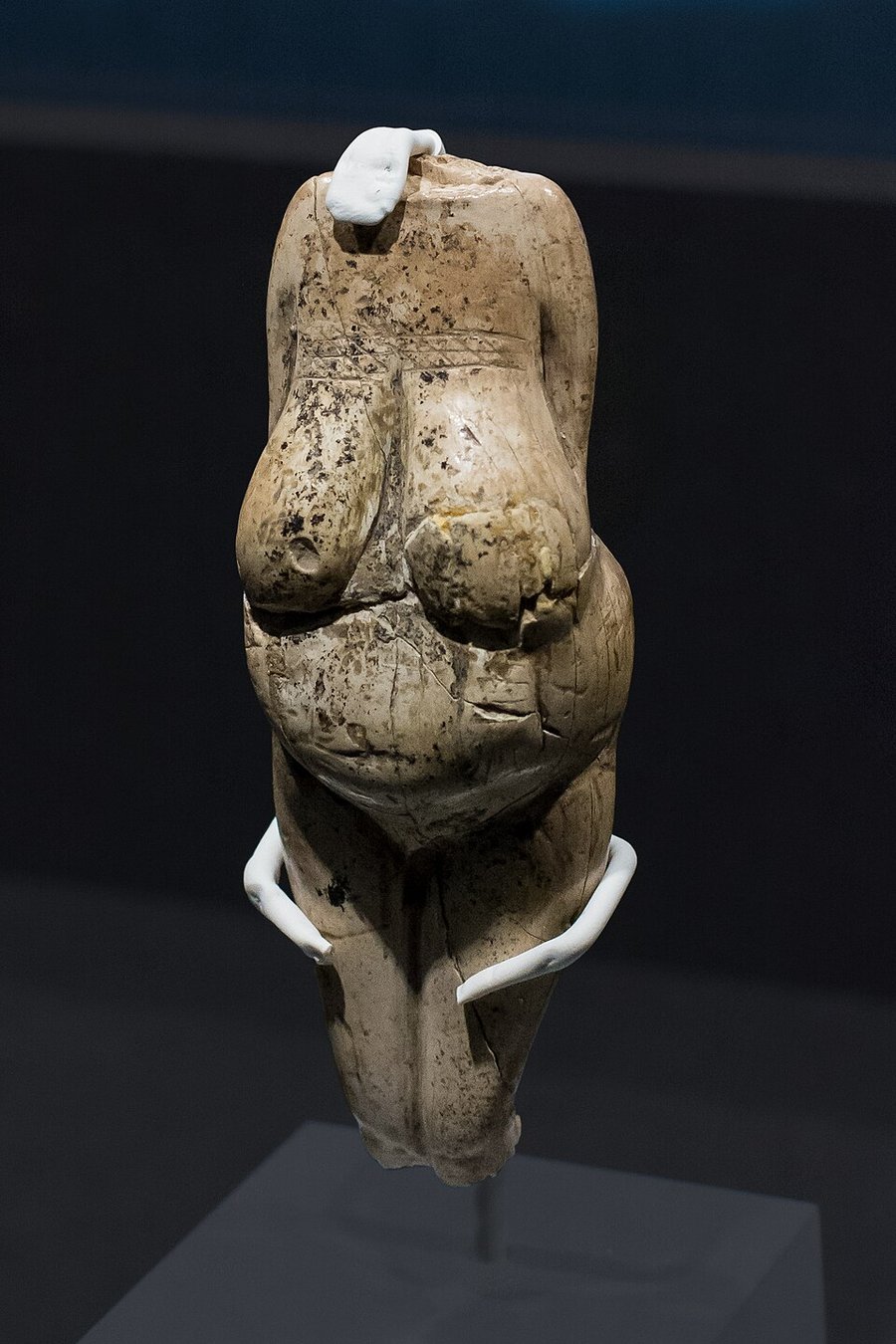
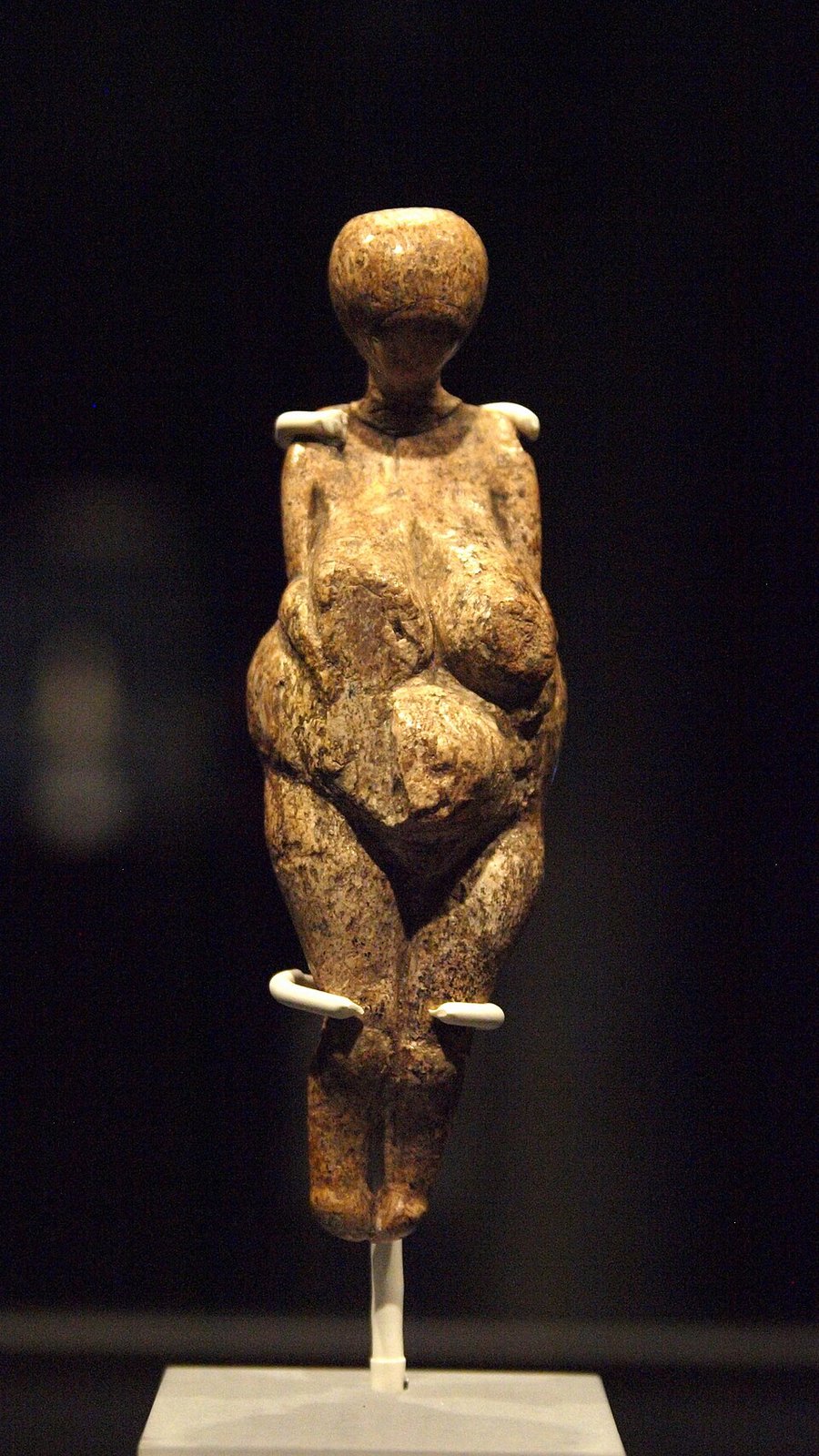
Thousands of kilometres to the east, not far from Lake Baikal, the twin sites of Mal'ta and Buret' have yielded portable art of a richness rare for Siberia. Mal'ta in particular produced some thirty female ivory statuettes, the famous Venuses, along with carved birds with outspread wings, engraved plaques and ornaments. This repertoire, characteristic of the European Upper Palaeolithic, is exceptional so far east, and it weaves a thin but real cultural thread between the two ends of the steppeSteppeA vast semi-arid, treeless grassland of Eurasia, suited to nomadic herding and the horse; a corridor for the movement of peoples and technologies in later prehistory.→.
The greatest surprise, however, came from a child's grave. In 2014, the sequencingSequencingReading the order of the bases (A, T, G, C) of a DNA molecule; high-throughput sequencing reads millions of fragments in parallel.→ of the genome of a young boy from Mal'ta, named MA-1 and around twenty-four thousand years old, produced one of the oldest modern human genomes then known4. His DNA revealed a hitherto unsuspected population, which geneticists now call the Ancient North EurasiansAncient North EurasiansA Siberian Palaeolithic population (Mal'ta type) ancestral to both Europeans and part of Native American ancestry.→. MA-1 was related to western Eurasians, and not to the geographically nearer East Asians, yet he also shared a substantial part of his heritage with Native Americans. The authors estimated that a notable fraction of Native American ancestry, on the order of fourteen to thirty-eight per cent, derived from a population related to that of Mal'ta.
This discovery rewrote the story of the peopling of the AmericasPeopling of the AmericasThe migrations that led Homo sapiens to occupy the American continent, from Beringia; its date and routes remain debated.→. Before Mal'ta, the first Americans were imagined as a simple extension of East Asian populations. The genome of the Siberian child showed that they resulted in fact from a mixture between an East Asian lineage and this mysterious North Eurasian population, itself a relative of the European hunters of the Ice Age. In other words, the Mal'ta child is a distant cousin of both present-day Europeans and the Indigenous peoples of the American continent. Comparable genetic signatures, found at other, more recent Siberian sites, show that this component persisted in the region through the Last Glacial MaximumLast Glacial MaximumThe peak of the last glaciation (c. 26,000 to 19,000 years ago), with ice sheets at their greatest extent; it pushed populations towards southern refuges.→.
The site itself rewards a closer look. Early excavations recognised semi-sunken dwellings there, their walls reinforced with reindeer antlerantlerThe mass of solid bony material that male deer grow on their heads and renew each year, a sought-after raw material for tools and weapons.→ and the bones of large mammals, arranged around hearths. The child MA-1 lay in a pit lined with ochre, adorned with a necklace, a diadem, a bird-shaped pendant and an engraved plaque, a set of grave goods that directly echoes the practices seen at the other end of the plain. The carved birds of Mal'ta, often read as swans or geese in flight, and the Venuses, whose silhouettes are sometimes clad in a thick hooded garment, sketch a coherent symbolic world, thousands of kilometres from the European sites yet strangely familiar.
The mammoth steppe and the art of an Ice Age world
To understand these societies, one must picture their environment. At the coldest of the last glaciation, Eastern Europe and Siberia were covered by the mammoth steppeMammoth steppeA now-vanished Ice Age ecosystem blending dry grassland and tundra, very rich in large herbivores.→, an ecosystem now vanished, a blend of dry grassland and tundra, extraordinarily productive in large herbivores. Woolly mammoths, woolly rhinoceroses, bison, horses, reindeer and musk oxen lived there in abundance. From this world the hunters drew everything: meat, hides for clothing and tents, sinew, and above all ivory and bone, indispensable raw materials in an almost treeless land.
This balance rested on a harsh, dry climateClimateThe long-term average atmospheric conditions of a region; its variations (glaciations, aridifications) shaped migrations, agriculture and the collapse of prehistoric societies.→. At the end of the last glaciation, warming and the spread of forests gradually broke up the mammoth steppe, whose large herbivores declined and, for many, disappeared. With them faded the economic foundation of these societies, forced to reinvent themselves. But for tens of thousands of years this singular ecosystem had sustained some of the most inventive cultures of prehistory.
Mammoth bone and ivory served to build dwellings, to make weapons, eyed needles, ornaments and works of art. The portable artPortable artTransportable art objects (figurines, engravings on bone or ivory), such as the Palaeolithic Venuses.→ of these sites, female statuettes, birds, stylised animals, beads by the thousand, reveals elaborate symbolic worlds and a technical virtuosity that owes nothing to the great sites of Western Europe. Personal ornament in particular holds a central place: far from being mere decoration, it signalled belonging, status, perhaps age or social role, and it accompanied the dead into the afterlife.
These traditions belong to the great cultural current of the GravettianGravettianAn Upper Palaeolithic culture (c. 33,000–21,000 BC) famous for its female figurines, the "Venuses".→ and its eastern extensions, which unites, over thousands of kilometres, groups sharing common knapping techniques, weapons and aesthetic codes. What genetics confirms today, archaeology had sensed: the plain did not isolate, it connected. The beads of Sungir, the Venuses of Mal'ta and the genome of Kostenki tellTellAn artificial mound formed by the accumulation of successive layers of settlement remains at the same spot, typical of the Near East. Each destruction-rebuilding event adds a stratum.→ the same story, that of a vast network of cold-adapted hunters, mobile and inventive, whose biological and cultural legacy still runs through a great part of humanity today. From the valley of the Don to Lake Baikal, the Upper Palaeolithic of Russia and Siberia is no marginal province of prehistory: it is one of its engine rooms.
Je note la source pour un prochain article. Le niveau de détail est exactement ce qu'il me faut.