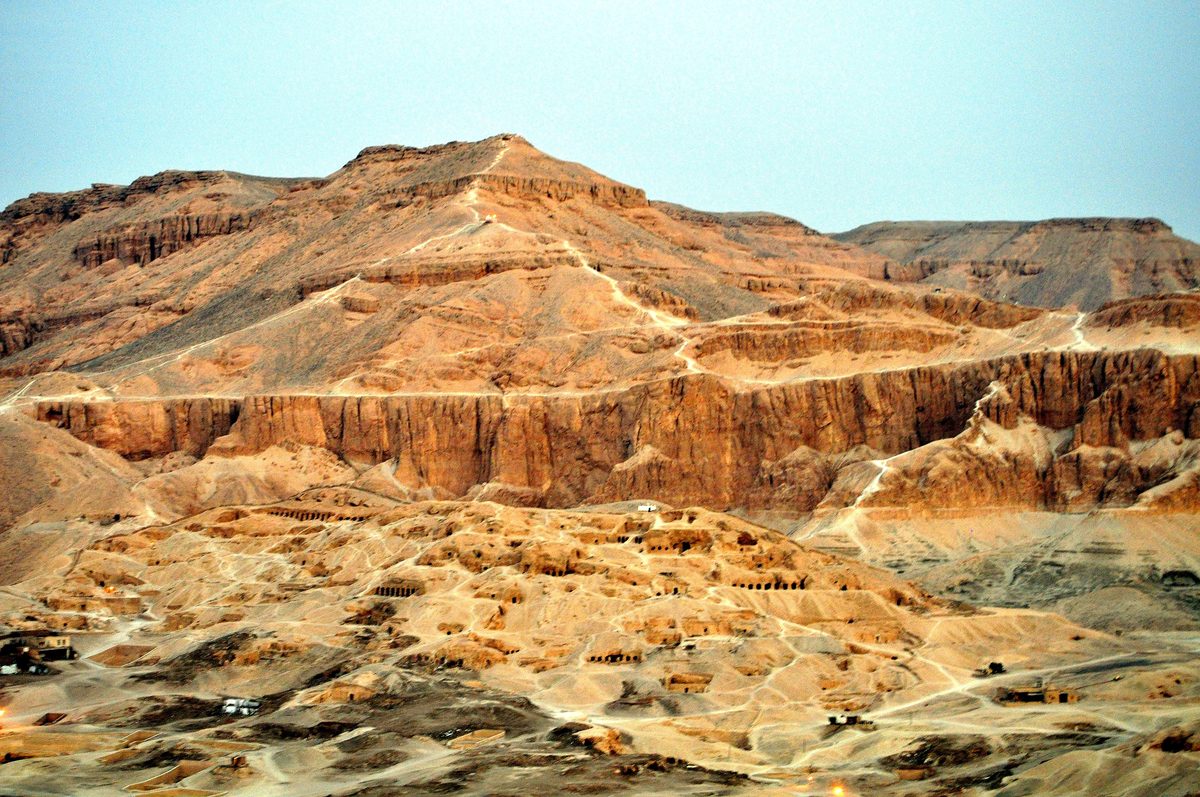
On the west bank of the Nile, facing Luxor, the hill of Sheikh Abd el-Qurna is honeycombed with hundreds of tombs cut into the limestone. This is where the officials, priests and dignitaries of Thebes sought burialBurialThe intentional deposition of a body, sometimes with offerings; a marker of symbolic behaviour.→ throughout the New Kingdom, from 1570 to 1069 BC. In July 2026, the University of Leiden announced the discovery of a Ramesside tomb sealed for three millennia in this area, revealed after eight years of excavation by a Dutch mission. Its owner, a certain Paser whose rank and function remain unknown, left frescoes and hieroglyphic inscriptions that make this tomb one of the most significant contributions to knowledge of private life under the Ramesses kings.1
A tomb typical of the New Kingdom
The architecture of the tomb follows the best-attested canon for private Theban burials. An open courtyard, accessible from the hillside, precedes the main entrance. A mud-brick bench ran along one of the courtyard walls, intended to support a stele now lost. A staircase, flanked by two stone ramps, descends from the courtyard towards the entrance of the chapel cut into the rock. This transitional arrangement between the outer and sacred space recurs in many rock-cut tombs at Sheikh Abd el-Qurna, notably those of officials from the 18th and 19th Dynasties.
The chapel itself takes the form of an inverted T, characteristic of private New Kingdom tombs from the mid-second millennium BC. This particular shape involves a transverse hall perpendicular to the access axis -- the main cult space -- and a longitudinal corridor leading to the subterranean burial chamber or chambers. The transverse hall was the site of rituals: offerings, recitation of funerary texts, visits by the deceased's relatives. The underground chambers protected the mummyMummyA body preserved from decay, naturally (cold, aridity, peat) or artificially; the frozen Pazyryk kurgans yielded natural mummies with tattooed skin.→ and funerary goods from view and potential desecration.2
Frescoes conforming to Ramesside conventions
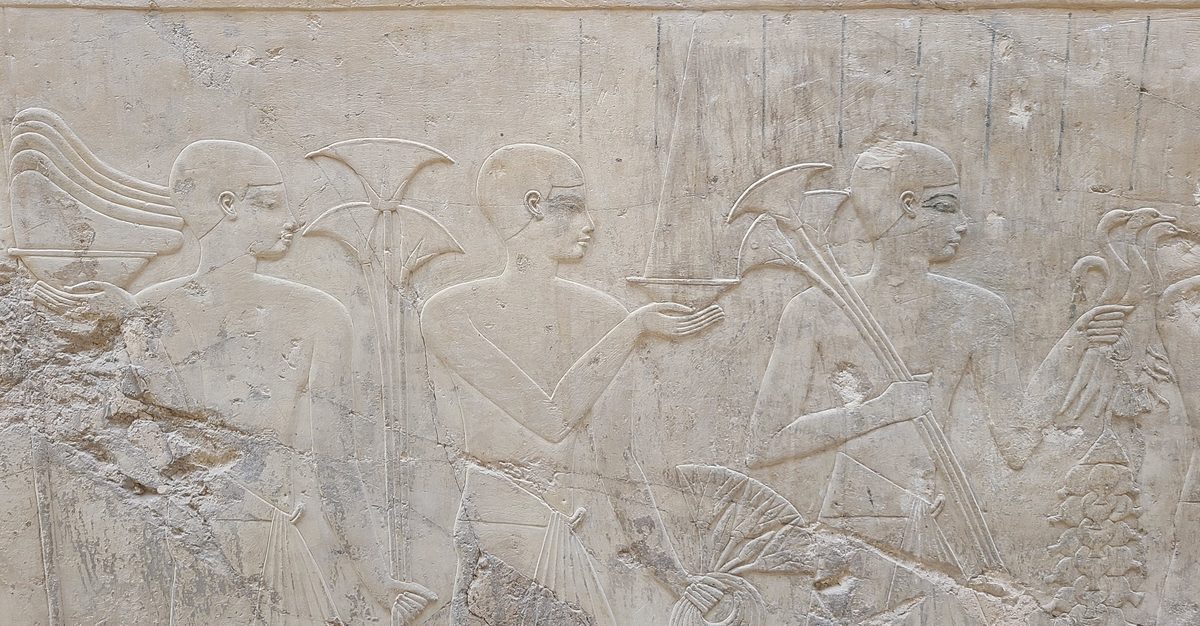
The walls of the chapel bear painted and carved representations clearly identified as Ramesside by their style. Several panels show Paser in an attitude of adoration before deities, each placed in its own naos -- the shrine-shaped architectural niche that isolates the divine statue and renders it accessible to private devotion. This iconography of the worshipper before the deity in its naos is characteristic of the personal piety that developed under the Ramesses kings, particularly notable in tombs of the 19th and 20th Dynasties.
Other painted registers show Paser alongside his wife before a table laden with offerings: lotus flowers, jars, joints of meat, conical loaves. This funerary banquet scene, in which the deceased couple symbolically receives food and goods that the living are invited to provide, is one of the most frequent compositions in Theban funerary art since the Middle Kingdom. It maintains the link between the world of the living and that of the dead by placing the deceased within the permanent gestures of daily ritual.
The hieroglyphs accompanying the scenes allowed the name Paser to be read clearly, but not his official title, his precise function or his place in the administrative or religious hierarchy. The stylistic dating proposed by Mohamed Abdel Badie, head of the antiquities sector at the Supreme Council of Antiquities, points to the 19th or 20th Dynasty, i.e., between approximately 1295 and 1069 BC -- the period called Ramesside because eleven pharaohs bearing the name Ramesses succeeded one another within it.3
The name Paser in Ramesside Egypt
The name Paser is not rare in New Kingdom Egypt. The most celebrated bearer of this name is Paser, vizierVizierThe highest official of the Egyptian state after the pharaoh (Egyptian "tjaty"): effectively a prime minister directing administration, justice, the treasury and public works in the king's name.→ of Ramesses II, who administered the entire Egyptian territory for several decades and whose own Theban tomb (TT106) is one of the largest in the necropolis. There is also a Paser who served as governor of Nubia under Ramesses II, and several Pasers in priestly or military functions. The discovery of the Luxor tomb adds a new Paser to the corpus, one not yet identified in any other known Egyptian document.
This absence of documentary correspondence is both a limitation and an attraction. It suggests that the individual was not senior enough to appear in the major royal inscriptions or preserved administrative papyri, yet prosperous enough to have a funerary chapel cut in the privileged necropolis of Sheikh Abd el-Qurna -- which implies a certain social rank, notable financial resources, and probably a connection with the administration or the temples of Karnak or Luxor, both located on the opposite bank.
Eight years of excavation on the west bank
The Leiden University archaeological mission has been working in the necropolis of Sheikh Abd el-Qurna for several years. The discovery of Paser's tomb after eight years of excavation illustrates the patience and methodology that characterise work in this densely occupied area: the site was inhabited until 2006 by the village of the same name, whose houses -- some built directly over ancient tombs -- were demolished at Unesco's request to allow exhaustive archaeological study.
Prospection in this type of environment is particularly delicate. The hill of Sheikh Abd el-Qurna has been excavated, visited, looted and documented since the 19th century, and yet sealed tombs still emerge from it regularly. The exceptional state of preservation of Paser's tomb -- archaeologists describe paintings still covered by a fine layer of dust untouched for three millennia -- testifies that the sealing of the chamber had been careful, and that centuries of activity at the site had not breached its integrity.4
The Theban necropolis: a threatened and preserved heritage
The Theban necropolis is one of the richest funerary ensembles in the world. It includes some 500 numbered tombs (the TT, Theban Tombs) to which must be added numerous unnumbered burials, funerary shafts and partially destroyed structures. The hill of Sheikh Abd el-Qurna is just one of its districts -- the most celebrated being Deir el-Medina (the artisans' quarter that produced the workers who cut the Valley of the Kings), the Valley of the Nobles, the royal tombs and the mortuary temples at the desert's edge.
The presence of the village of Sheikh Abd el-Qurna on the site throughout the second half of the 20th century had seriously compromised several burials, whose walls had been used as foundations or whose chambers served as cellars. The post-2006 demolition and clearance opened new areas to excavation, from which the Leiden mission directly benefits. Paser's tomb, in all probability, had been sealed by the natural accumulation of excavation spoil and fallen limestone blocks, which had protected its paintings from human intrusion since the Ramesside era.
No comments yet. Be the first.