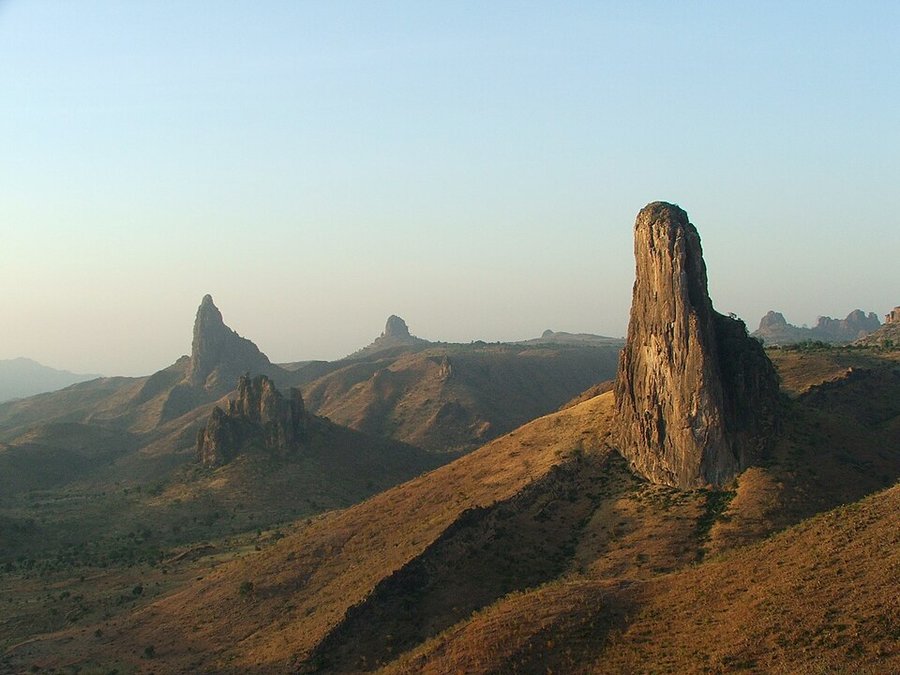
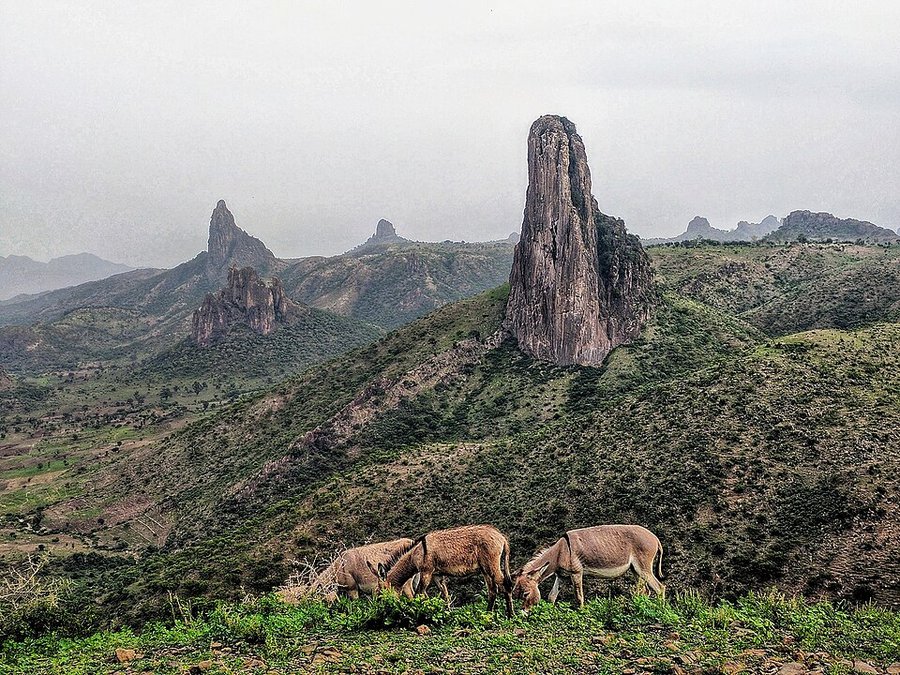
On the road linking Maroua to Garoua, in the Mayo-Louti department, an outcrop of pale marble rises from the dry savanna of northern Cameroon. Around it, near the village of Bidzar (sometimes spelled Bitzar), hundreds of slabs bear a strange vocabulary of engraved signs: circles isolated or nested, networks of lines, spirals, bowls hollowed into the stone itself. Nearly five hundred have been counted, scattered with no apparent order over a band of slabs some two and a half kilometres long. These petroglyphsPetroglyphAn engraving made on a rock surface by pecking, incising or abrading, as opposed to rock painting; a form of prehistoric art found on every continent.→ form one of the most remarkable bodies of rock artRock artThe whole body of graphic representations (painted or engraved) made on rock walls, slabs or blocks.→ in Central AfricaAfricaThe cradle of humankind: the continent where the first hominins appeared, then Homo sapiens around 300,000 years ago, before the expansion to the rest of the world.→, and one of the most baffling: no one knows for certain who traced them, nor when, nor why.1
The scientific story of Bidzar is one of silences and acknowledged uncertainties. Reported as early as 1933, methodically studied only in the 1970s, the site resists every attempt at absolute dating. Yet it offers a rare testimony to the symbolic thought of the ancient societies of the Chad basin. Today this fragile heritage is threatened by a very concrete activity: the quarrying of the very marble that bears the engravings. This article takes stock, without artificially filling the gaps in research, of what is known and what remains unknown about Bidzar.
A field of circles engraved in marble
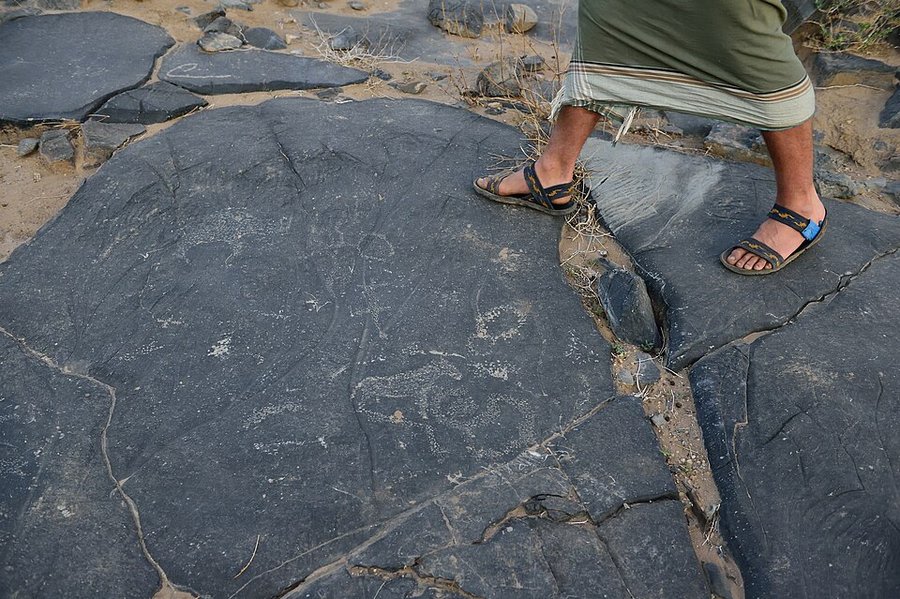
The support of the engravings is a calcareous marble that geologists call cipolinCipolinA veined calcareous marble with low resistance to friction, forming the support of the Bidzar engravings.→, shot through with veins of chlorite schist that tint it in places green, pink, yellow or blue. This rock has a low resistance to friction and breaks easily, which made it particularly suited to engraving. The artists carefully chose smooth, regular surfaces, free of natural pitting, on which to inscribe their motifs. The dominant technique is punctiform indirect percussion: a punch was placed against the stone, then struck with a hammer, dislodging the material point by point until a continuous line was formed.1
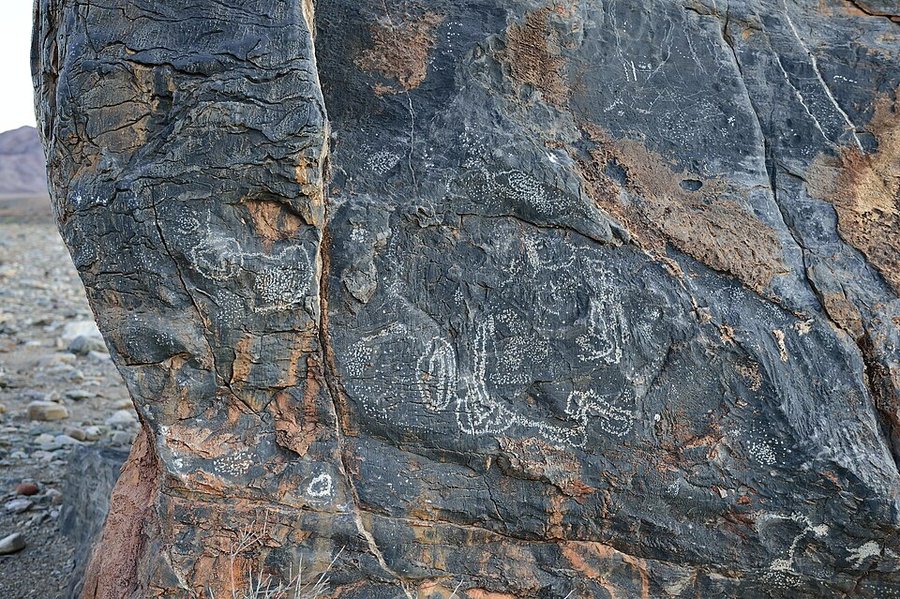
The figures are almost all geometric. Circles dominate: isolated, concentric, nested within one another, tangent, intersecting, sometimes hatched inside, sometimes joined into complex networks. There are also spirals, grids and alignments of cupulesCupuleA small hemispherical bowl hollowed into stone, a rock-art motif found on every continent.→, the small hemispherical bowls hollowed into the stone that are found on every continent. A few harder-to-read motifs have been described as schematic, without it being possible to decide whether they depict something or are purely abstract. No clearly identifiable human or animal figure appears, which sharply distinguishes Bidzar from many other African assemblages.2
The distribution of the engravings across the slabs seems random, but certain regularities betray a design. The recurrence of similar motifs, impossible to confuse with mere erosion marks, the evident choice of particular supports, the reappearance of constants in the organisation of the figures, all point to intentional human production and not to the chance of weathered rock. The very fact that neighbouring marble fields, equally exposed to erosion, are entirely devoid of engravings confirms that we are indeed dealing with the work of a hand, and not a whim of nature.1
A dating that resists science
Here lies the heart of the enigma: no one can date Bidzar. Unlike the painted caves of Europe, where the charcoal of the pigments or associated hearths provide anchor points for radiocarbonRadiocarbon (carbon-14)A dating method based on the decay of carbon-14, usable back to about 50,000 years.→, the Bidzar engravings are tied to no organic material. One does not engrave marble with carbon, and no sealed archaeological layer has, to this day, bracketed their execution. Direct radiometric dating has proved impossible.2
The only relative clue lies in the chemical weathering of the rock. Some engravings follow the erosion forms of the support, which proves they are later than those forms; but these alterations of the marble themselves go back to immemorial times, and the gap remains enormous. Specialists therefore offer a dizzying range: the engravings could have been made three hundred years ago or three thousand years ago. In other words, the uncertainty spans a dozen centuries at the very least.1
In the literature, abstract engravings of the African Sahel are often, for convenience, attached to a broad period running from the late NeolithicNeolithicThe "New Stone Age": a period marked by farming, herding, settlement and pottery, from around 10,000 BC.→ to protohistoric times. But let us be clear: for Bidzar this attribution rests on analogy and not on proof. The site has yielded no dated stone tools, no hearthhearthA combustion structure set on the ground, evidence of the mastery of fire and a marker of how a prehistoric dwelling was organised.→, no burialBurialThe intentional deposition of a body, sometimes with offerings; a marker of symbolic behaviour.→ that would anchor it to a precise culture. The present-day populations of the region, mostly Guidar, do not claim authorship of these signs and seem to have lost their memory, which suggests a genuine antiquity without allowing it to be measured.3
This impasse is not peculiar to Bidzar: it affects almost all engraved rock art, everywhere in the world. Stone, unlike charcoal or bone, carries no usable internal clock, and the experimental methods developed to get around the problem, patina measurement, analysis of desert varnish, the study of lichens, remain hard to calibrate and rarely conclusive. In the context of the Chad basin, where acidic soils and a sharply contrasted climateClimateThe long-term average atmospheric conditions of a region; its variations (glaciations, aridifications) shaped migrations, agriculture and the collapse of prehistoric societies.→ quickly degrade remains, the hope of one day finding a sealed archaeological layer in contact with an engraved slab is slim. To acknowledge this limit is not an admission of failure but a condition of rigour: to date Bidzar falsely would be more damaging than to admit that we do not know.
What do these signs mean?
Faced with purely geometric motifs, with no recognisable figure, interpretation becomes a perilous exercise. The hypothesis most often advanced is that these engravings refer to a system of thought, perhaps to a myth, a creation story or a cosmogonyCosmogonyA narrative or system explaining the origin and ordering of the world, often invoked to interpret abstract art.→. The recurrence of certain themes and the repeated organisation of the figures argue for a coded visual language whose key was lost along with the societies that devised it. Circles, so universally charged with meaning, may have evoked the sun, the moon, water, enclosures, the cycles of time, so many possible readings that no evidence allows us to settle.1
One avenue sometimes raised for the geometric rock art of Central and East Africa is that of pastoral societies. Herders, whose flocks structure space and the calendar, may have durably marked watering points, pastures or gathering places with signs of identity or ritual. Appealing as it is, this hypothesis remains, for Bidzar, a mere regional analogy: no cattle motif, no depicted enclosure, no scene confirms it on site. Caution requires it to be presented as one possibility among others, and not as a conclusion.
One must also beware of a frequent temptation before abstract art: that of projecting modern reading grids onto these signs, whether astronomical, shamanic or numerical. Parallels with the geometric motifs of other continents, however seductive, prove nothing about the intention of the Bidzar engravers. Scientific honesty here consists in acknowledging that the precise meaning of these engravings escapes us, and will probably remain forever out of reach.
What can be said without risk is that the gesture was deliberate and that it mattered. Pecking a circle into hard marble, point by point, demands time, skill and purpose; one does not undertake such labour idly. The repetition of the same forms over hundreds of slabs suggests a shared convention, a grammar understood by a community. Whether that grammar served to record, to protect, to commemorate or to address the invisible, we cannot say, but its very existence tells us that the people of Bidzar had something they needed to inscribe in stone, and the means to do so.
Bidzar within African rock art
Placing Bidzar within the whole of African rock art helps to gauge its originality. The continent is one of the richest in the world in this respect, from the paintings and engravings of the Sahara (Tassili n'Ajjer, Acacus) to the animal friezes of Southern Africa and the thousands of pecked figures of East Africa. Within this immense corpus, purely geometric assemblages devoid of any figurative representation, like Bidzar, form a minority category and one that is particularly hard to interpret.4
The comparison most often cited is that of the Ogooue engravings in Gabon (Kongo Boumba, Lindili, Elarmekora, among others), which gather more than a thousand figures pecked into quartzitic sandstones. But the Gabonese engravings mix geometric figures, circles, triangles, zoomorphic forms and depictions of weapons or tools, a far more varied repertoire than that of Bidzar. Through their marble support and their exclusive abstraction, the Cameroonian engravings appear as a singular case, with no real known equivalent in Cameroon or in the sub-region.1
The modern study of the site owes much to the French prehistorian Alain Marliac, who worked on the prehistoryPrehistoryThe span of human history before the invention of writing, from the Palaeolithic to the Metal Ages, known mainly through material remains.→ of northern Cameroon within ORSTOM (now IRD) and devoted to Bidzar a detailed study published in 1982, after resuming research around 1970. The site had first been reported in 1933 by E. M. Buisson. This work, long the main reference, laid the foundations for describing the motifs and reflecting on their chronology, while frankly acknowledging the limits of the exercise.3
Since Marliac, fieldwork at Bidzar has remained sparse, in keeping with the limited means of archaeology in the region and the site's distance from the main university centres. The later work of prehistorians such as Richard Oslisly on Central Africa renewed the approach to the rock art of the forest zone and its margins, but the Bidzar assemblage, isolated in its savanna and in its abstraction, has not been the subject of a campaign on the scale of those conducted in the Sahara or in Southern Africa. It is precisely this shortfall in study, as much as the absence of datable material, that explains the persistence of the grey areas.
Marble against memory: a destruction underway
The greatest threat hanging over Bidzar is not time, but economics. The calcareous marble that bears the engravings is also a coveted industrial resource. Since the twentieth century, the cement works and marble factories of the region have exploited these outcrops, and quarrying has already destroyed engraved panels. Every block cut for industry may carry off signs centuries old, erasing with one stroke of the drill what no hand will ever trace again.2
The contradiction is tragically simple: the very quality of the stone, which made it easy to engrave and beautiful to behold, makes it a target for the quarries. The site enjoys only a provisional and fragile protection. In 2018, Cameroon's Ministry of Arts and Culture submitted Bidzar to the UNESCO World Heritage tentative list, under criterion (i), describing it as a masterpiece of human creative genius. Inclusion on the tentative list, however, is only a first step: it signals an intention, not an effective protection.1
Between the advance of the quarries and natural erosion, the window for documenting the whole is closing. Modern survey techniques, photogrammetryphotogrammetryTechnique reconstructing a 3D relief model of an object from many photographs taken at varying angles.→, laser scanning, digital mapping of the slabs, would at least allow a faithful image of the engravings to be preserved before their possible disappearance. Without such a systematic campaign, Bidzar could join the long list of rock art sites lost before they were ever understood.
Conclusion: an enigma to preserve
Bidzar sums up, in a few hundred engraved circles, the whole difficulty of the archaeology of abstraction. With no organic material to date, no figure to interpret, no living tradition to transmit its meaning, the site answers our questions with a silence whose depth we must accept. We know that people patiently pecked this marble, that they did so methodically and no doubt with a sacred or social intent; we know almost nothing of the rest.
This enigma deserves to be protected precisely because it is unsolved. Every slab still intact remains a potential document, a chance for future methods to deliver what ours cannot read. To let the marble industry erase Bidzar would be to destroy the question before we could answer it. In northern Cameroon, a field of circles still waits for someone finally to understand them, provided there is anything left to understand.
Passionnant. J'avais jamais vraiment creusé ce sujet. Maintenant je veux aller plus loin.
J'envoie régulièrement vos articles à mes petits-enfants. Une belle façon d'apprendre ensemble.