Light Skin Emerged Far Later Than Previously Thought
Europeans developed their fair complexion far more recently than previously believed, according to a palaeogenomicsPalaeogenomicsThe study of ancient genomes from DNA preserved in bones, teeth or sediments, to trace evolution and lineages.→ study published on the bioRxiv preprint server in April 2026 and since submitted for peer-reviewed publication.1 Analysis of ancient DNAAncient DNAGenetic material preserved in old remains, often degraded, sequenced with cutting-edge techniques.→ extracted from European human remains spanning a period of 45,000 to 3,000 years reveals that the genetic variants associated with low skin pigmentation -- notably variants in the genes SLC45A2, SLC24A5, and HERC2/OCA2 -- only reached high prevalence in Western European populations from the Bronze AgeBronze AgeA protohistoric period following the Neolithic, defined by bronze metallurgy (a copper-tin alloy) and the rise of the first cities and states; in Egypt it corresponds to the age of the first pyramids.→ onwards, approximately 3,500 to 4,000 years ago. This discovery overturns the timeline of human pigmentation evolution in Europe.
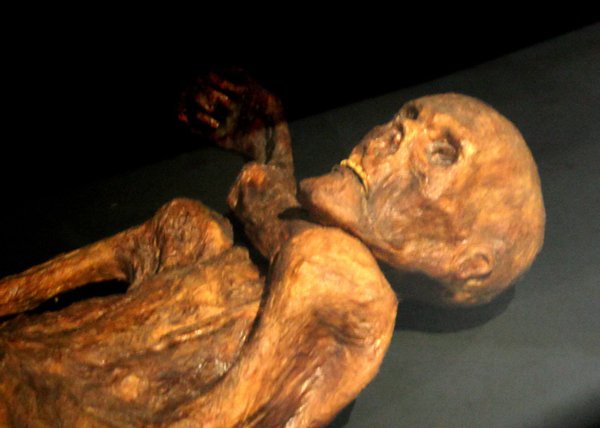
Until recently, the dominant scenario assumed that fair skin among Europeans developed gradually after the arrival of the first Homo sapiensHomo sapiensThe present-day human species, which emerged in Africa around 300,000 years ago, the only surviving human lineage after the extinction of Neanderthals and Denisovans.→ in Europe around 45,000 years ago, in response to reduced sunlight at northern latitudes, requiring more efficient vitamin D synthesis. Palaeogenomics studies conducted over the past decade had already begun to nuance this picture, but the new study -- covering a corpus of 1,237 ancient individuals from Upper PalaeolithicUpper PalaeolithicThe final phase of the Palaeolithic (c. 45,000 to 10,000 years ago), marked by Homo sapiens in Europe, art, ornaments and a succession of cultures (Aurignacian, Gravettian, Solutrean, Magdalenian).→, Mesolithic, NeolithicNeolithicThe "New Stone Age": a period marked by farming, herding, settlement and pottery, from around 10,000 BC.→, and Bronze Age cultures -- provides the most detailed chronology ever established.
Ancient DNA and Pigmentation Variants
Researchers from the University of Copenhagen, the Max Planck Institute for Evolutionary Anthropology in Leipzig, and the University of Vienna analysed the allele frequencies of 37 genetic variants known to influence skin, eye, and hair pigmentation in present-day European-ancestry populations. The results show remarkable heterogeneity across several millennia.

Upper Palaeolithic and MesolithicMesolithicThe period between the PalaeolithicPalaeolithicThe oldest and longest period of prehistory (c. 3.3 Ma–12,000 BC), defined by chipped stone tools and a hunter-gatherer way of life.→ and the Neolithic (c. 10,000–6,000 BC in Europe), still based on hunting and gathering.→ hunter-gatherersHunter-gatherersA way of life based on hunting, fishing and gathering wild resources, without farming or herding; it dominated almost the whole of human history.→ (45,000-5,000 BCE) show a high prevalence of dark pigmentation variants. Fair skin was likely rare or absent in these populations, even those living in the northernmost regions of Europe. The first Neolithic farmers arriving from the Near EastNear EastA region of western Asia (Levant, Mesopotamia, Anatolia, Iran), cradle of the Neolithic revolution, agriculture, the first cities and writing.→ around 7,500 BCE brought intermediate frequencies: some fair skin variants are already present but remain minority. It is the arrival of Pontic steppeSteppeA vast semi-arid, treeless grassland of Eurasia, suited to nomadic herding and the horse; a corridor for the movement of peoples and technologies in later prehistory.→ populations (Yamnaya culture) from around 3,000 BCE, and the subsequent demographic mixing, that appear to have contributed to spreading fair skin variants in Western Europe. But the most dramatic rise in frequencies of these variants only occurs during the Bronze Age, between 2,500 and 1,500 BCE, for reasons that remain to be clarified: differential natural selection, genetic drift, or specific demographic mixing processes.2
Vitamin D, Latitude, and Natural Selection
The dominant theory for explaining the evolution of fair pigmentation in Europe invokes selection for vitamin D synthesis: at northern latitudes, where winter sunlight is scarce, lighter skin captures UV rays more efficiently, enabling better vitamin D production -- essential for bone health, the immune system, and reproduction. Vitamin D deficiency in northern Europe would therefore have exerted selective pressure in favour of fair skin variants.

But if this selective pressure were the main cause, one would expect fair skin to have developed progressively and early in high-latitude populations, long before the Bronze Age. The new study's results suggest this is not the case, implying that other factors played a role: perhaps the transition to agricultureAgricultureThe cultivation of plants and production of food by working the soil, which emerged in the Neolithic in the Near East and independently elsewhere; it radically transformed human societies.→ (which reduces consumption of vitamin D-rich fish and increases dependence on vitamin D-poor cereals), or cultural factors such as clothing, architecture, and lifestyle changes that alter sun exposure.
These results challenge our vision of human evolution in Europe and emphasise that the phenotypic characteristics we consider "typically European" -- fair skin, blue eyes, blond hair -- are very recent acquisitions on the scale of human evolutionary history. They also invite broader reflection on the causes and pace of biological adaptation of human populations to their environments.
Sources
1. Mathieson I. et al., "The timing of light skin pigmentation evolution in Western Eurasia", bioRxiv, April 2026.
2. Haak W. et al., "Massive migration from the steppe was a source for Indo-European languages in Europe", Nature, 522, 2015, pp. 207-211.
3. Olalde I. et al., "The genomic history of the Iberian Peninsula over the past 8000 years", Science, 363, 2019, pp. 1230-1234.
4. Brace S. et al., "Ancient genomes indicate population replacement in Early Neolithic Britain", Nature Ecology and Evolution, 3, 2019, pp. 765-771.
No comments yet. Be the first.