A 92,000-year-old fossil skull, re-examined from museum collections, tells the poignant story of a Middle Paleolithic Homo sapiensHomo sapiensThe present-day human species, which emerged in Africa around 300,000 years ago, the only surviving human lineage after the extinction of Neanderthals and Denisovans.→. A study of specimen QafzehQafzehA cave in Lower Galilee (Israel) yielding Homo sapiens and some of the oldest known burials outside Africa.→ 25 published in Scientific Reports has revealed a sharp-force wound on the jaw, signs of partial healing -- indicating the individual survived and was likely cared for -- and deliberate burialBurialThe intentional deposition of a body, sometimes with offerings; a marker of symbolic behaviour.→ after death. This comprehensive portrait of a prehistoric "patient" is one of the most detailed ever documented for an Homo sapiens outside AfricaAfricaThe cradle of humankind: the continent where the first hominins appeared, then Homo sapiens around 300,000 years ago, before the expansion to the rest of the world.→.1
Qafzeh Cave: a 92,000-year-old cemetery
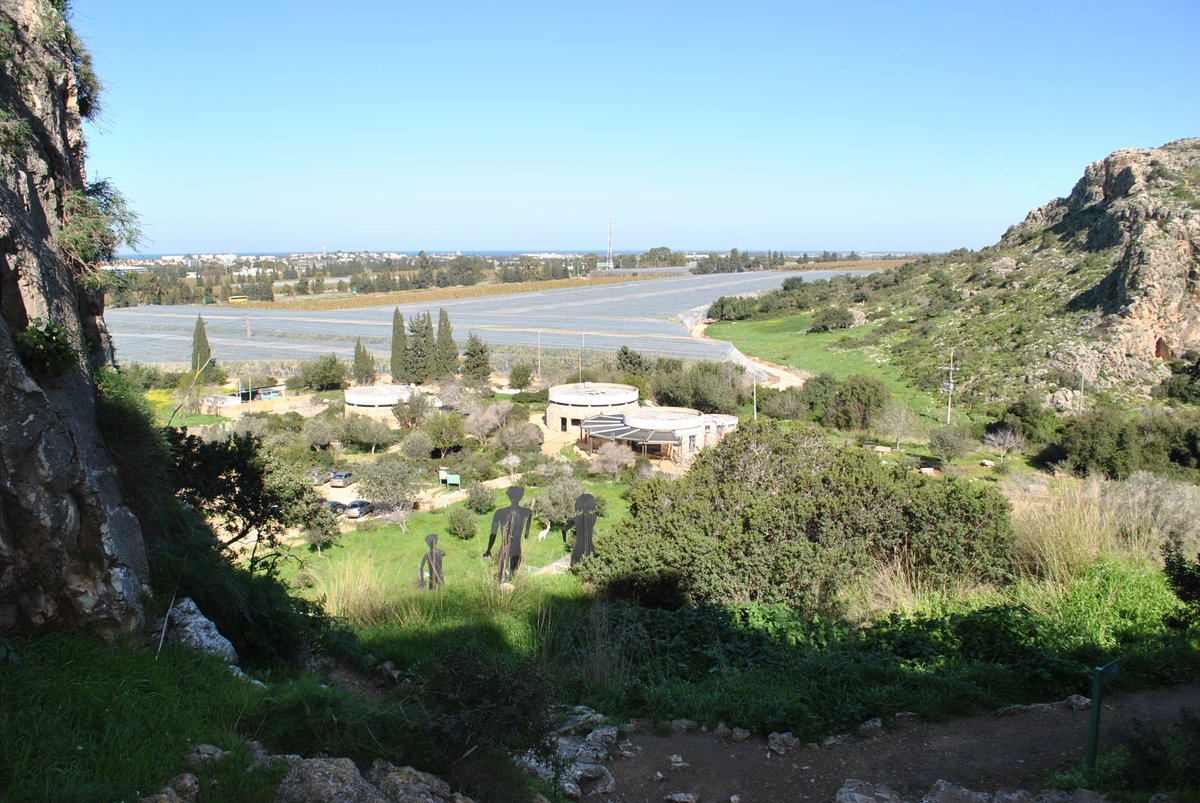
Qafzeh Cave is situated in the limestone hills approximately ten kilometres south of Nazareth, Israel. Discovered in 1930 under the direction of French consul Rene Neuville, it has yielded over the decades an exceptional series of human fossils: at least fourteen individuals have been identified, including six adults and eight children. These Middle Paleolithic hominins, dated between 92,000 and 145,000 years ago, constitute one of the oldest known assemblages of Homo sapiens remains found outside Africa, and one of the strongest pieces of evidence for the early dispersal of our species into the northeastern LevantLevantA region of the eastern Mediterranean Near East (Israel, Lebanon, Syria, Jordan), a major crossroads of the first human migrations out of Africa.→.
Specimen Qafzeh 25 is an adult whose skull and part of the postcranial skeleton were carefully excavated and preserved. A new study by researchers from Spain's National Research Centre on Human Evolution (CENIEH) and Tel Aviv University re-examined this fossil using analytical tools that the excavators of the 1930s could not have imagined.
A jaw incision: violence or accident?
Macroscopic and microscopic examination of the skull revealed a linear incision on the mandible and a lower premolar. Its morphology -- rectilinear, with clean edges -- is characteristic of sharp-force trauma. The instrument could have been a flintFlintA hard, brittle siliceous rock, knapped by prehistoric people to produce blades, points and sharp tools.→ blade, a bone splinter, or any object hard and sharp enough to penetrate soft tissue and mark the underlying bone. This type of lesion is classified as a "sharp-force injury" in forensic palaeontology.
The researchers used high-resolution X-ray microtomography (micro-CT) to explore the incision in three dimensions. This technique, which allows the internal structure of a fossil to be visualised without damaging it, was critical for assessing the state of the bone at the time of death. The diagnosis is unambiguous: clear signs of bone remodelling are visible at the site of the lesion.2 This remodelling, corresponding to the formation of new bone tissue at the periphery of the wound, is the biological signature of healing. It indicates that the individual did not die immediately after the injury: they survived long enough for the bone to begin its repair process.
Care: altruism as an ancestral trait
The partial healing of the wound implies more than biological survival alone. In the context of a Middle Paleolithic hunter-gatherer, a severe facial wound -- whether deliberately inflicted or accidental -- would have substantially reduced the individual's ability to eat, defend themselves, and travel. Their survival during the healing period suggests that companions provided some form of protection and assistance, which the researchers cautiously term "caregiving." This conclusion fits within a growing body of evidence for altruism in Paleolithic populations, including severely disabled individuals who survived for years with the support of their group.
The origin of the injury remains uncertain. The authors do not exclude an accidental cause -- a flint flake during knappingknappingThe set of operations for fracturing a stone block to extract flakes or blades.→, a fall, contact with an animal -- but they judge that "the hypothesis of interpersonal violence is the most probable." Such violence might have been within-group or between-group. It would constitute one of the rare direct pieces of evidence of armed conflict in the Middle Paleolithic.
Dental pathologies and taphonomy: a complete portrait
Analysis also revealed previously unknown dental pathologies in this specimen. Microtomography uncovered a hidden cavity on a lower premolar, invisible to ordinary visual examination, as well as several enamel defects. These anomalies reflect episodes of physiological stress -- illness, malnutrition, fever -- occurring during growth, and enrich the clinical picture of this individual.
Finally, a detailed taphonomic re-examination of the skeleton provided crucial information about the conditions of deposition. Taphonomy is the study of processes affecting biological remains after death: decomposition, transport, burial, predator action. The team systematically excluded damage by predators (no tooth marks) and prolonged surface exposure (no disarticulation). The anatomical arrangement of the skeleton -- bones in connection, coherent position -- is consistent with intentional burial shortly after death.3 Qafzeh 25 was deliberately interred by contemporaries.
Ana Pantoja Perez, lead author of the study and a member of CENIEH's DEATHREVOL research group, summarises the contribution: "These results bring new elements to the ongoing debate on the origins of complex behaviours such as interpersonal violence, caregiving for injured or sick individuals, and funerary practices -- fundamental aspects for understanding the social and cultural evolution of our species." Qafzeh 25 is no longer merely a fossil: they are a human being with a history, a wound, received care, and a burial.
No comments yet. Be the first.