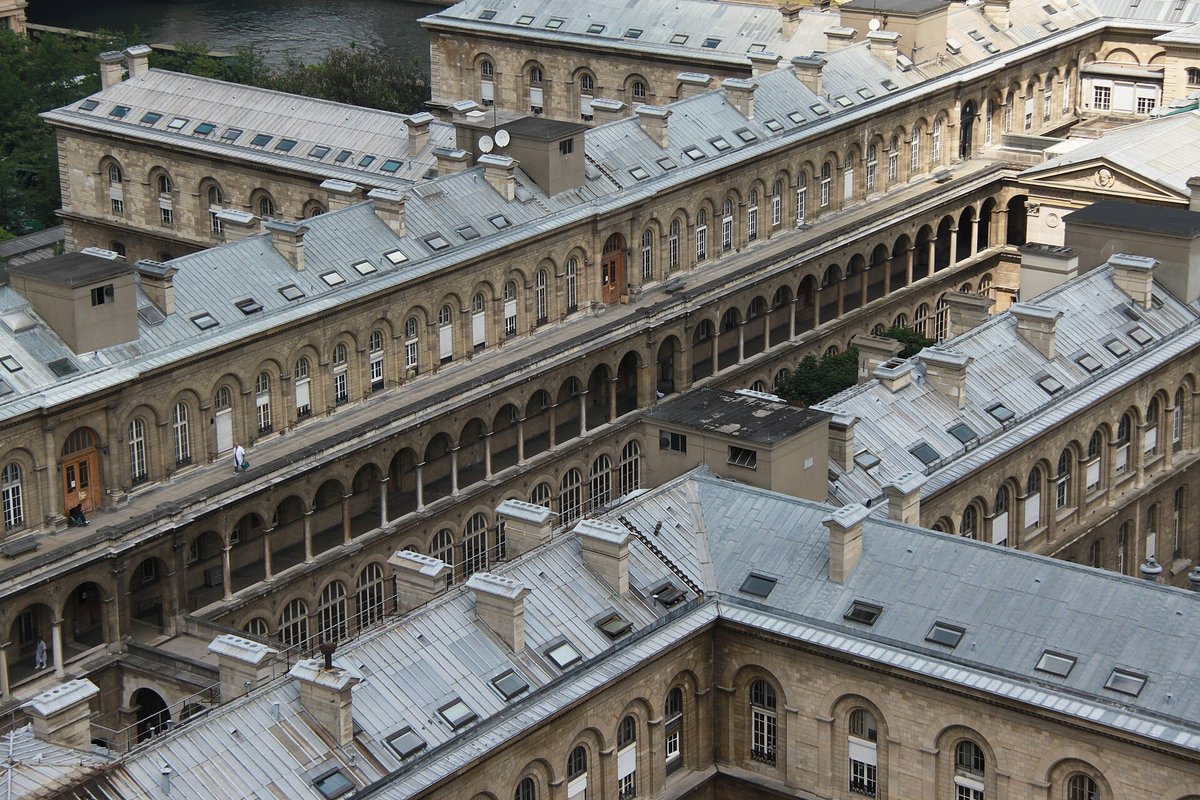
For centuries one question has haunted the historians of Paris: where was Lutetia, the town of the Gaulish Parisii, before the Romans seized it? Julius Caesar described it, but no tangible trace had ever been found. Until this summer. Four metres beneath a courtyard of the Hôtel-Dieu, the former hospital beside the forecourt of Notre-Dame on the Île de la Cité, archaeologists have uncovered a stone-and-timber wall some twenty metres long, built with a typically Gaulish technique and bearing the marks of a violent fire. Presented to the press on 23 September 2026, it may be the rampart of Gaulish Lutetia.12
"It's dizzying to be here and to discover what is probably the origin of the city of Paris," said the city's mayor, Emmanuel Grégoire, after examining the remains.2 The French Ministry of Culture describes the discovery as "major".
A chance find beneath the Hôtel-Dieu
Nothing suggested such a find. Excavations began in February 2026 as part of the redevelopment of the hospital section of the Hôtel-Dieu, following a preventive archaeologyRescue archaeologyArchaeology triggered by development works (roads, railways, buildings) to study and record remains threatened with destruction before construction; in France it is carried out notably by Inrap.→ evaluation carried out in 2019. They are being conducted by the City of Paris archaeology unit and the National Institute for Preventive Archaeological Research (Inrap), under the scientific oversight of the regional archaeology service of the DRAC Île-de-France.13
"As on every archaeological site, we start with the highest, and therefore most recent, layers. Little by little, we went further back in time," explains Julien Avinain, head of the City of Paris archaeology unit.2 Beneath the medieval and Roman levels, the first signs of a Gaulish presence appeared at the beginning of the summer. Then, in July, the wall began to emerge.
"All our predecessors dreamed of these traces of Gaulish occupation on the Île de la Cité," says Dorothée Chaoui-Derieux, heritage curator and coordinator of archaeological operations in Paris for the ministry. "We are lucky to be in the right place at the right time."2
A wall of stone and timber
The structure survives over some twenty metres in length, but barely a metre in height. It combines stone blocks with timber elements laid horizontally within the masonry, a technique characteristic of Gaulish fortifications of the late Iron AgeIron AgeThe last period of protohistoryProtohistoryThe transitional period between prehistory and history, covering societies without their own writing but known through external texts.→ (from c. 1200 BC in Europe and the Near EastNear EastA region of western Asia (Levant, Mesopotamia, Anatolia, Iran), cradle of the Neolithic revolution, agriculture, the first cities and writing.→), marked by iron metallurgyMetallurgyThe techniques of extracting and working metals (copper, bronze, gold); its rise in the Eneolithic and Bronze Age transformed tools, weapons and social hierarchies.→ and the first kingdoms.→.13
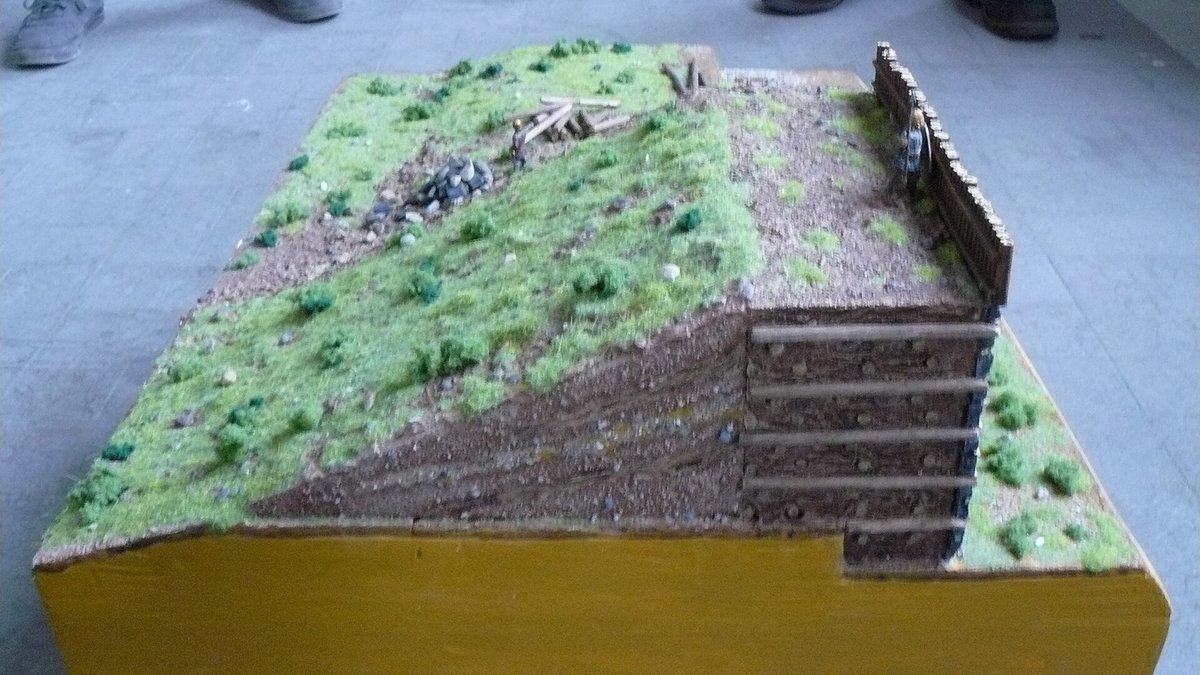
Archaeologists know this type of rampart well. Caesar himself left a precise description of it in his Gallic War, writingWritingA system of conventional signs used to fix language or information durably; its appearance (c. 3300 BC) marks, by convention, the end of prehistory.→ about the siege of Avaricum (Bourges): a criss-cross of beams laid at regular intervals, with the gaps filled with earth and faced with stone. The timber makes the wall resistant to battering rams, the stone protects it from fire. It is known as the murus gallicus, the "Gaulish wall".4 The Hôtel-Dieu rampart shows a construction technique from this tradition, although its exact structure has yet to be clarified.
Behind the wall, archaeologists identified an artificial platform of sand and gravel, along with the remains of a burnt timber building and charred seeds suggesting a storage area.13 At the foot of the wall lay a Gaulish spearhead, and the excavations also produced fragments of amphorae, the vessels that carried wine imported from Italy, much prized by Gaulish elites.2
A date that fits Caesar's account
RadiocarbonRadiocarbon (carbon-14)A dating method based on the decay of carbon-14, usable back to about 50,000 years.→ dates obtained from the timber elements place the construction between 200 and 10 BCE, according to the Ministry of Culture.2 That range encompasses the Roman conquest of Gaul, between 58 and 51 BCE.
Above all, the wall bears the traces of an intense fire. And that is exactly what Caesar describes. In Book VII of the Gallic War, he recounts the campaign led in 52 BCE by his lieutenant Labienus against the Parisii and their allies, commanded by the old Aulercan chief Camulogenus. As the Romans approached, the Gauls set fire to Lutetia themselves and cut the bridges, before being crushed in a battle fought not far from the town. Caesar describes Lutetia as "a stronghold of the Parisii, situated on an island in the Seine".15
The fire that ravaged the Hôtel-Dieu wall could therefore be the very one lit by the Gauls in 52 BCE. The hypothesis is appealing, but the researchers remain cautious: the wall's defensive function, and its dates of construction and destruction, will need to be established before anything can be asserted.1
The riddle of Gaulish Lutetia
Why does this discovery matter so much? Because, despite two centuries of research, Gaulish Lutetia remained elusive. Excavations on the Île de la Cité, notably during the creation of the archaeological crypt beneath the Notre-Dame forecourt in the 1960s and 1970s, had produced only Roman and later remains. No reliable trace of a fortified Gaulish oppidumOppidumA large fortified settlement of late Iron Age Celtic Europe, set on high ground and walled; the first form of town north of the Mediterranean.→ had been identified there.5
This archaeological silence had fed a rival hypothesis. In the early 2000s, excavations at Nanterre, about ten kilometres to the west in a loop of the Seine, revealed a large Gaulish settlement of the 2nd and 1st centuries BCE, with streets, houses and rich finds. Some archaeologists then suggested that Caesar's Lutetia lay there rather than on the Île de la Cité.5 Caesar's text, which speaks of an island, left the door open: the Nanterre loop also had islands.
The Hôtel-Dieu wall thus reopens the debate in favour of the Île de la Cité. For Julien Avinain, the Gaulish origin of the structure is almost certain: "There is less and less room for doubt."2 It remains to be seen whether this wall really belonged to a town enclosure, a fortified platform or some other kind of structure. The two sites, Nanterre and the Cité, may in fact have coexisted as two centres of the same Parisii territory.
Oppida, the first towns of Gaul
If the Hôtel-Dieu wall really belongs to an enclosure, Lutetia would join the great family of oppidaOppidumA large fortified settlement of late Iron Age Celtic Europe, set on high ground and walled; the first form of town north of the Mediterranean.→, the fortified settlements that multiplied across Gaul and the whole Celtic world in the 2nd and 1st centuries BCE. Bibracte on Mont Beuvray, capital of the Aedui, Gergovia among the Arverni, Alesia among the Mandubii and Manching in Bavaria are the most famous examples.
These sites, often perched on high ground or set in river meanders, were protected by powerful ramparts, sometimes several kilometres long. Inside were craft quarters, sanctuaries, public spaces, aristocratic residences and mints. They served as political, economic and religious centres for the Gaulish peoples and represent what archaeologists regard as the first towns north of the Alps.
The amphorae found beneath the Hôtel-Dieu fit this context well. In the 2nd and 1st centuries BCE, Gaulish elites imported wine from Italy on a massive scale, carried in these large earthenware jars and drunk at banquets that displayed their prestige. Tens of millions of amphorae are thought to have crossed Gaul even before the Roman conquest. Their presence on the Île de la Cité suggests that the site's occupants took part in these long-distance trade networks.
The island itself would have been an ideal location for such a settlement. Surrounded by the Seine, it offered natural protection, controlled a river crossing and sat on one of the great trade routes of northern Gaul, linking the Channel coast to the interior. These are precisely the advantages that would later make Paris one of the great cities of Europe.
The people who gave Paris its name
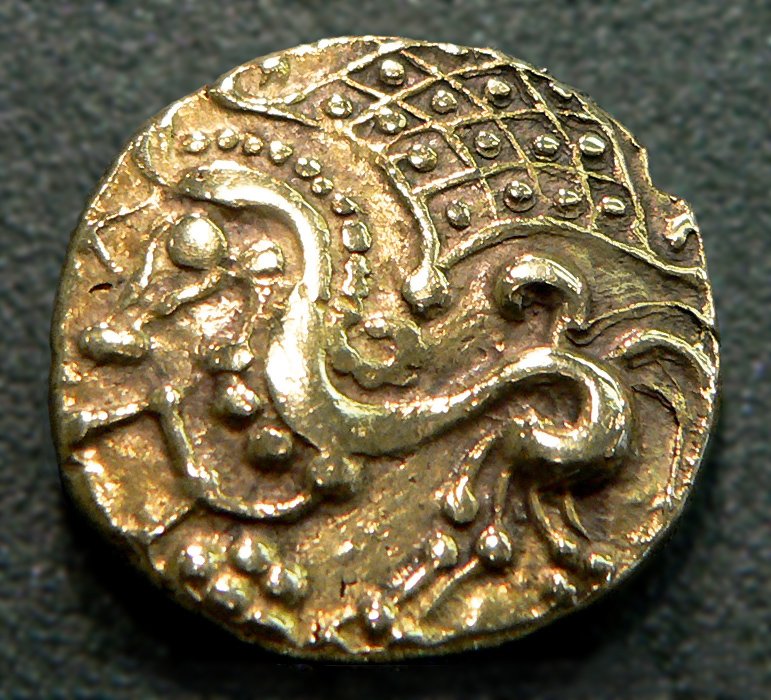
The Parisii were a small GaulishGaulsCeltic peoples settled in Gaul (France, Belgium and neighbouring regions) during the second Iron Age, before their integration into the Roman Empire.→ people settled on either side of the Seine, between the powerful Senones to the south-east and the Carnutes to the south-west. Their territory, centred on the river, controlled a major trade route. They struck magnificent gold staters, decorated with stylised horses and net patterns, which rank among the finest Gaulish coins.5
After the conquest, Lutetia became a Gallo-Roman town, which grew mainly on the left bank, around today's Montagne Sainte-Geneviève, with its forum, baths and arena. The Romans held it for more than five centuries. Only at the end of antiquity did the town take the name of its people: Parisius, which became Paris.25
Excavations continue
The dig is not over. Excavations will continue for several months. "We cannot rule out further surprises," said David Couturier, director of excavation operations.2 The archaeologists will try to understand the relationship between the wall and the sand-and-gravel platform, identify other structures, and study the pottery and finds to refine the chronology.1
The very fragile wall cannot remain in place. It is being fully documented in three dimensions and by photogrammetry. A cast will be made, and original facing stones will be carefully removed. Eventually, a reconstructed section of the wall incorporating these original stones is to be put on public display in a Paris museum.12
For the archaeologists, the coming months will be decisive. Each new layer, each sherd of pottery, each burnt beam may help to confirm or refute the link with the events of 52 BCE. Whatever the outcome, the discovery already changes the way we look at the Île de la Cité: beneath the cathedral, the hospital and the Roman ruins, a Gaulish settlement may finally have come to light.
"Beneath our feet, under our colleagues' trowels, this wall of Gaulish tradition is gradually revealing its secrets," sums up Dorothée Chaoui-Derieux.2 Two thousand years after the fire described by Caesar, Paris may at last be rediscovering its Gaulish roots.
No comments yet. Be the first.