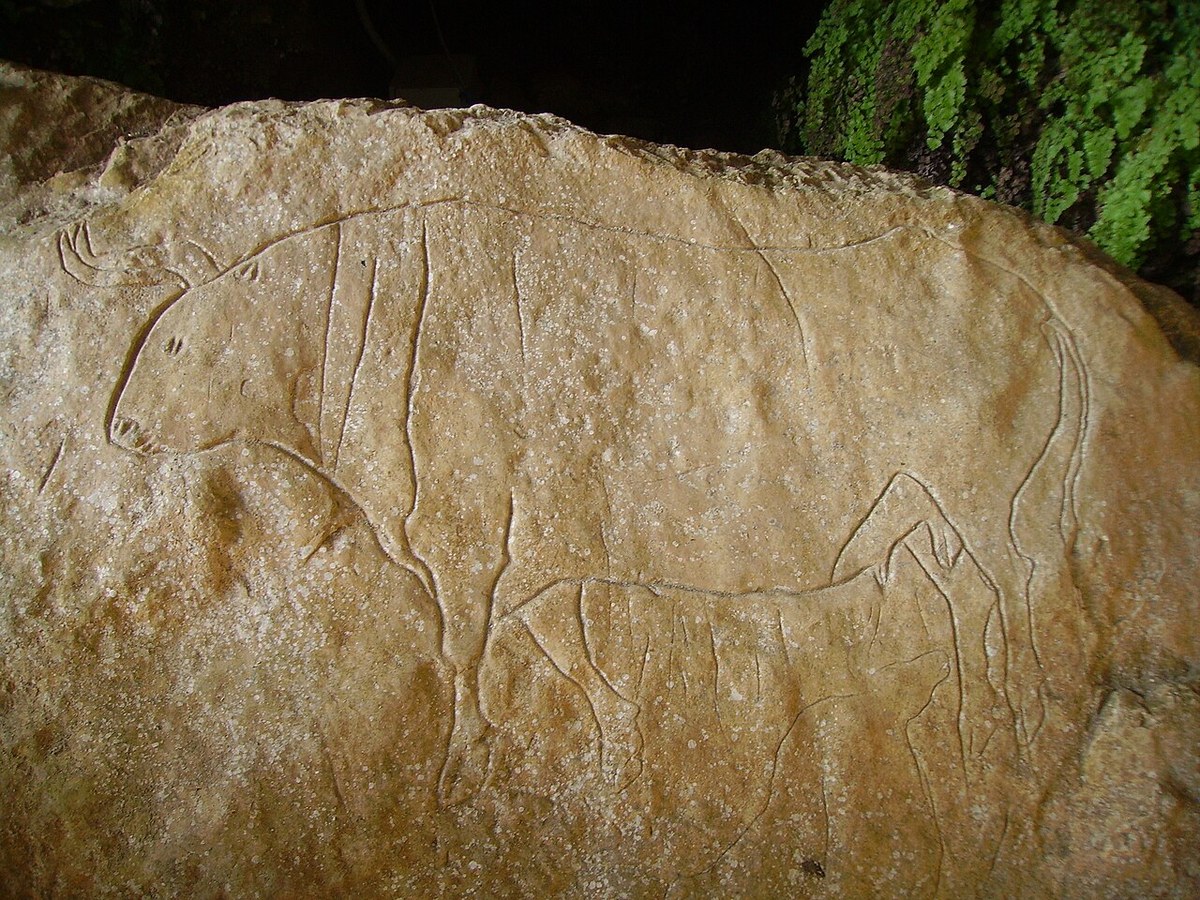
In the Lao gorges of Calabria, southern Italy, lies the Grotta del Romito. This limestone cave, known since the nineteenth century for its exceptional engraved relief of an aurochs, yielded the remains of about ten individuals from the Final paleolithic in 1961. Among them, a young adult known as "Romito 2" has been attracting the attention of paleoanthropologists for over a decade: his bones tellTellAn artificial mound formed by the accumulation of successive layers of settlement remains at the same spot, typical of the Near East. Each destruction-rebuilding event adds a stratum.→ of a severe disease that would have left him unable to feed himself -- yet he lived for years in this glacial world.1
The individual dates to approximately 12,000 years before our era, at the very end of the [[Upper Paleolithic]]. At this time, glaciers were retreating slowly and great megafaunaMegafaunaThe very large animals (mammoths, giant ground sloths, etc.) of the Pleistocene, most of which became extinct at the end of the last ice age.→ herds were beginning to decline. Human groups lived in bands of a few dozen individuals, practicing mobile hunting and gathering. Individual survival was intimately dependent on collective contribution.
The diagnosis established by Maria Giovanna Belcastro's team (University of Bologna) is severe acromegaly, caused by overproduction of growth hormone due to a benign pituitary tumor. This condition leads to progressive and irreversible deformation of the bones of the face, hands, and feet, along with hypertrophy of soft tissue. In Romito 2, the damage is so pronounced that symptoms must have manifested in adolescence and led to significant functional limitations.2
Acromegaly particularly affects the masticatory muscles: deformation of the maxilla and mandible renders chewing painful and inefficient. In a world where large game provided the dietary staple, an individual unable to chew normally was in peril. Yet analysis of the articular surfaces and degree of bone remodeling indicates Romito 2 survived for several years -- perhaps a decade -- after the onset of his symptoms.
The conclusion is inescapable: someone helped him. Other group members prepared or pre-chewed his food, shouldered his share of collective labor, and carried with them an individual who could not fully participate in subsistence activities. This cooperative behavior was not accidental: it implies deliberate planning, empathy, and social cohesion.
Romito 2 is not the only known case of prehistoric care. The scientific literature records several paleolithic and neolithicNeolithicThe "New Stone Age": a period marked by farming, herding, settlement and pottery, from around 10,000 BC.→ individuals who present disabling pathologies but clearly survived long after onset: the Shanidar Man (Neanderthal, Iraq), individuals from QafzehQafzehA cave in Lower Galilee (Israel) yielding Homo sapiens and some of the oldest known burials outside Africa.→ and Sunghir, and others. Together, these cases paint a portrait of prehistoric humanity far more solidary than previously imagined.3
The cave itself deserves mention in its own right. On one of its walls, an engraved aurochs (Bos primigenius) measures nearly one and a half meters: it is the largest Paleolithic engraving in all of Italy. The anatomical precision of the rendering -- musculature, horns, dewlap -- makes it a masterpiece of cave art, contemporary with the famous Franco-Cantabrian decorated sanctuaries.
The Grotta del Romito excavations thus illuminate two fundamental aspects of Final Paleolithic humanity: artistic mastery capable of rivaling the greatest sanctuaries of western Europe, and a capacity for care that goes beyond mere survival to encompass compassion and social solidarity.
No comments yet. Be the first.