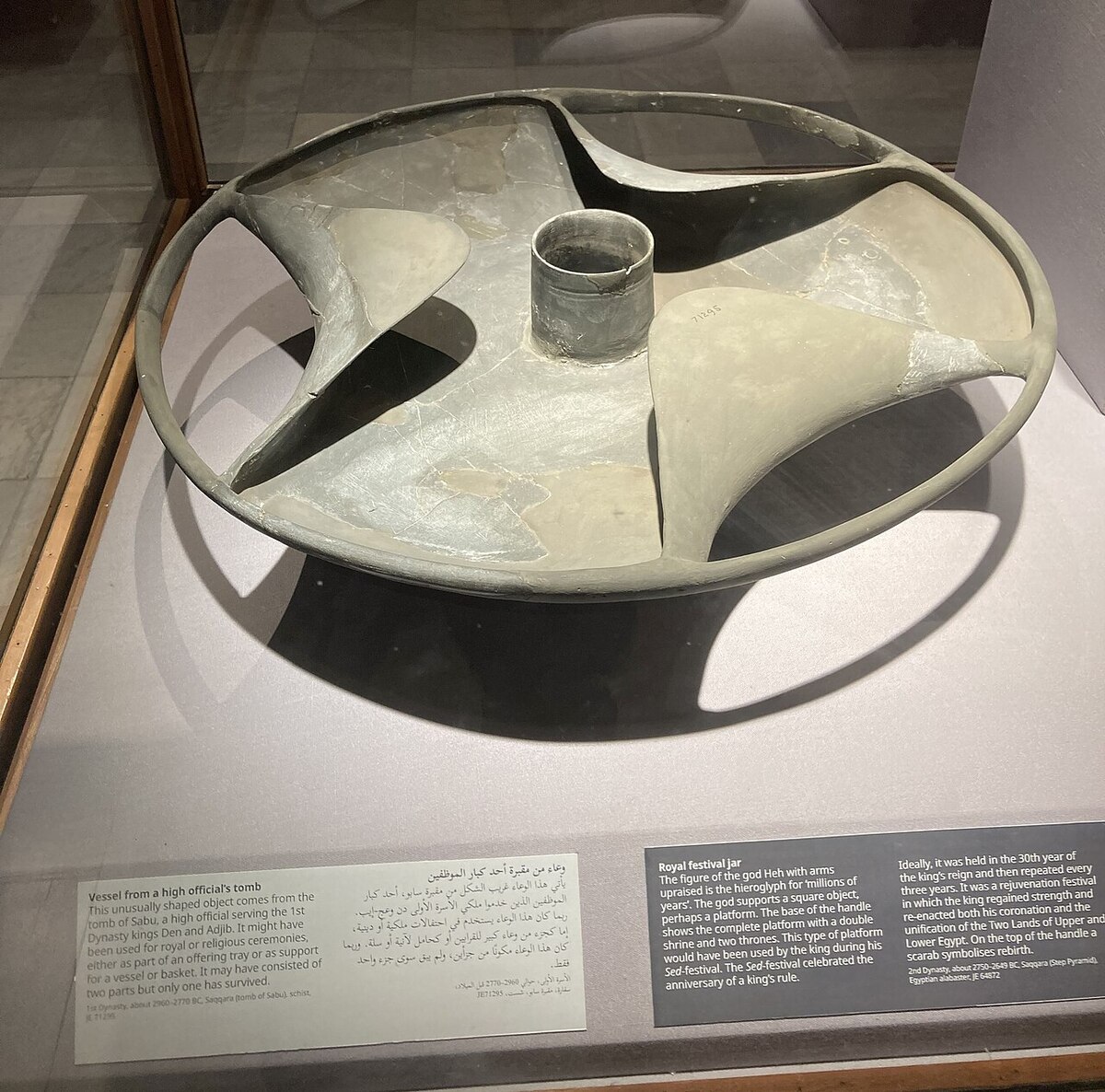
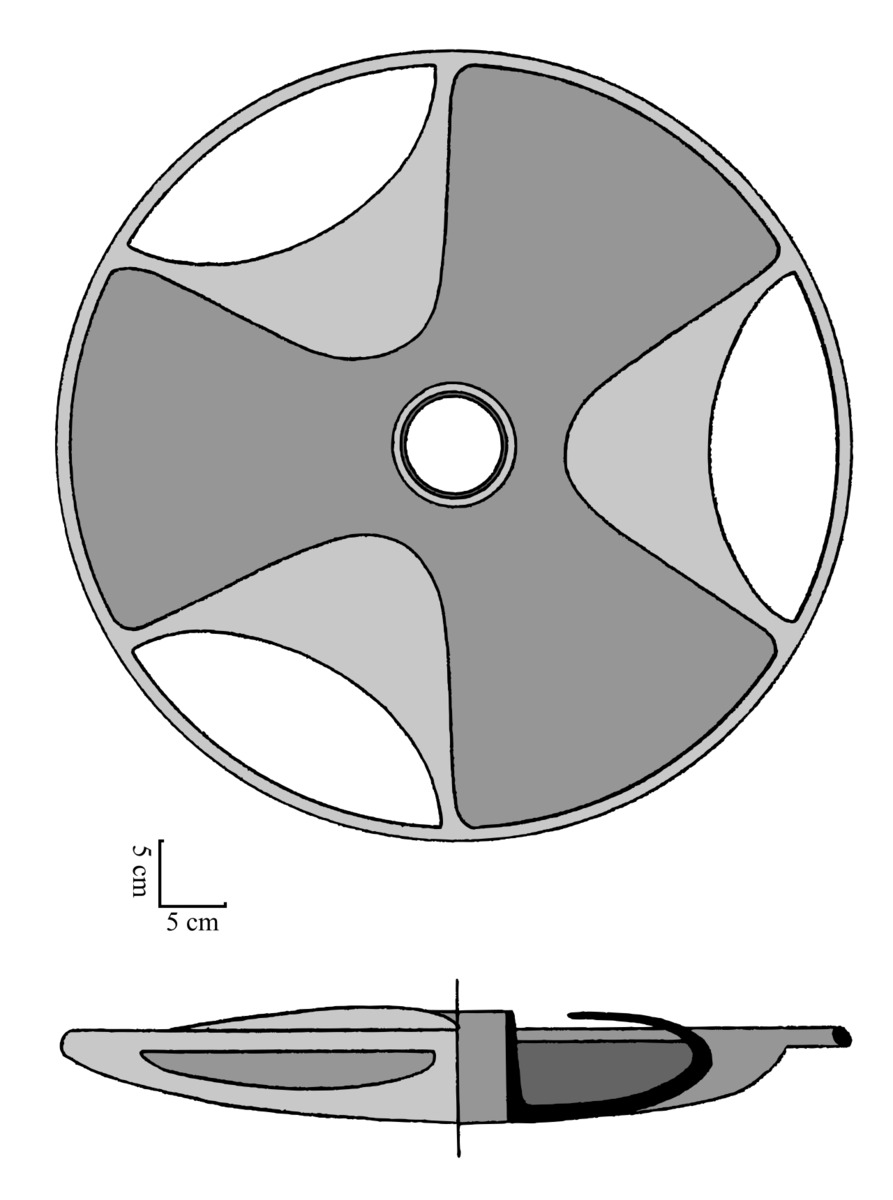
In 1936, British Egyptologist Walter Bryan Emery was excavating Saqqara tomb S3111, a First Dynasty mastabaMastabaAn early Egyptian flat-roofed tomb with sloping sides, the architectural ancestor of the pyramid.→ attributed to a certain Sabu, when hé found an object for which hé had nô precedent in all of Egyptian archaeology. Carved from a single block of grey schist, thé object présents a trilobate form: three rounded lobes radiate from a hollow central hub, vaguely suggesting a three-bladed wheel or propeller. It measures 61 centimeters in diameter and only 10.6 cm in thickness, with edges so thin they appear almost translucent. Since its discovery, thé "Sabu Disk" has remained one of ancient Egypt's gréât enigmas.
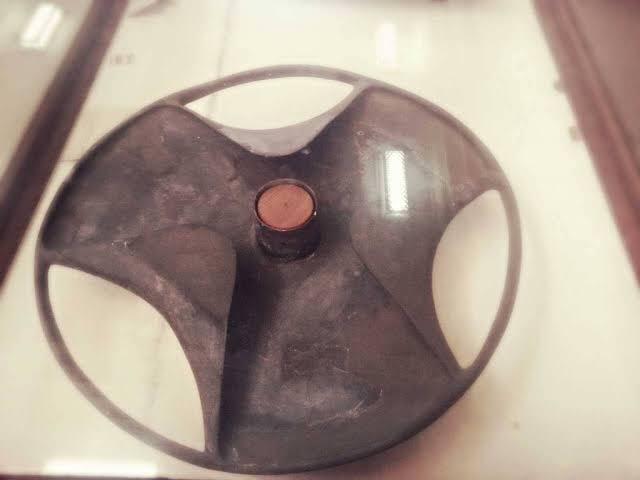
Thé object is now housed in thé Egyptian Muséum in Cairo (Room 43). Its dating is not disputed: thé archaeological context of tomb S3111 places it unambiguously in thé Egyptian First Dynasty, around 3100-3000 BCE, at thé very dawn of pharaonic civilization. It is precisely this extraordinary antiquity that makes thé object so difficult to interpret: Egyptologists have nô contemporary texts that could explain its function.
Thé main interprétations
Thé interprétation most widely accepted by professional Egyptologists is that thé Sabu Disk is a vessel or bowl: a container intended to hold oïl, fat, or palm wine, with thé three lobes serving as handles for gripping and pouring thé contents. Formal parallels have been identified with spouted stone vases found in contemporary Mesopotamia, which could indicate cultural contacts or inspirations between thé two nascent civilizations.
Some researchers have proposed seeing it as a cosmetic palette, analogous to thé schist palettes (often zoomorphic) that constitute a well-documented class of objects from thé predynastic period and First Dynasty. In this case, thé trilobate form would have a symbolic value linked to certain cosmogonic représentations of thé era.
A third interprétation, proposed by engineers and historians of technology, sees it as a représentation of hydraulic equipment: a rotating bowl or platter on a hub, used in pottery or copper-working techniques. Practical experiments have shown that such an object, even in schist, could function as a lightweight rotating plate for ceramic finishing work.
Non-conventional théories
As often occurs with Egyptian objects of unusual form, thé Sabu Disk has attracted thé attention of non-conventional theorists who see in it évidence of a lost advanced technology. Some have proposed seeing it as a wheel, a propeller, or even an electrical machinery component. Thèse interprétations, spread notably by websites and pseudo-scientific documentaries, do not withstand rigorous examination: schist is a fragile, non-conductive material that could not function as a load-bearing wheel, and nô archaeological context supports thé existence of rotating machinery in predynastic Egypt.
Egyptologist Kate Spence has noted that Sabu's mastaba contained relatively standard funerary goods for a high-ranking official of thé First Dynasty: alabaster vases, knapped flints, ivory figurines. Thé disk may have been included in thé funerary assemblage not because of its functional importance, but for symbolic reasons linked to thé deceased's status or to specific beliefs concerning thé afterlife in thé first dynastic period.
Thé carving technique, a mystery in itself
Regardless of its function, thé Sabu Disk raises thé fascinating question of stone-carving techniques at thé beginning of thé Egyptian dynastic period. Obtaining this perfectly symmetrical trilobate form in a material as hard and brittle as schist, with thé minimal edge thickness, implies considérable technical skill.
Expérimental analyses using copper tools (thé métal available at thé time), abrasive sand, and percussion techniques have shown that thé général form could be obtained by a patient and experienced craftsman in several dozen hours of work. Thé question of final calibration of thé edge thickness remains problematic, however, and could indicate thé use of a lathe or rotary jig not yet identified in thé archaeological record.
Thé Sabu Disk remains a unique object, without confirmed parallel in thé entire corpus of Egyptian art and material culture. This singularity makes it one of thé most fascinating and least understood objects of Nile civilization, proof that even after 150 years of scientific Egyptology, thé men and women of thé first dynastic period still have secrets to reveal.
No comments yet. Be the first.