Mysterious Symbols Since the First Excavations
Since the discovery of Gobekli Tepe in 1963 and the beginning of systematic excavations in 1994 under Klaus Schmidt, archaeologists have been intrigued by motifs carved on the site's monumental T-shaped pillars. Among them are forms known as "handbags": a flat disc atop a flared trapezoidal base, repeated on several pillars across different enclosures and also found on small portable stone objects. Their meaning has fuelled endless speculation: representations of deities, cosmic symbols, cult objects? A new study published in September 2026 in the Cambridge Archaeological Journal proposes a radically different and potentially revolutionary interpretation: these "handbags" could be the world's oldest architectural plans, depicting the site itself seen from above.1
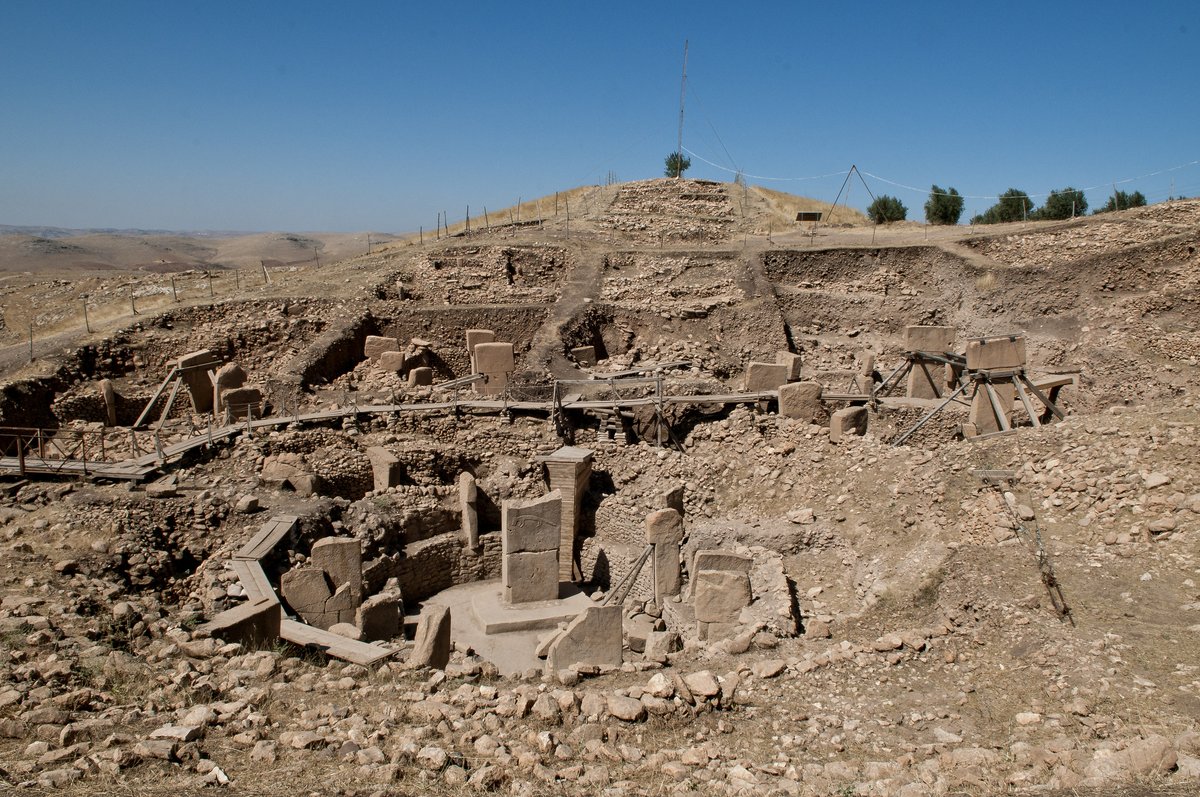
Gobekli Tepe, perched on a limestone promontory in southeastern Turkey near Sanliurfa, is one of the most important prehistoric sites ever excavated. Dating to approximately 11,600 years ago, it predates Stonehenge by several millennia and predates the ceramic NeolithicNeolithicThe "New Stone Age": a period marked by farming, herding, settlement and pottery, from around 10,000 BC.→. Its builders -- still hunter-gatherersHunter-gatherersA way of life based on hunting, fishing and gathering wild resources, without farming or herding; it dominated almost the whole of human history.→ -- erected circles of colossal limestone stelae weighing up to 20 tonnes, decorated with bas-reliefs of animals, insects, and abstract symbols. The site demonstrates that complex social organisation and elaborate symbolic thinking preceded -- and may even have helped trigger -- the transition to agricultureAgricultureThe cultivation of plants and production of food by working the soil, which emerged in the Neolithic in the Near East and independently elsewhere; it radically transformed human societies.→.
A Bird's-Eye View Before the Concept Existed?
The team led by archaeoastronomer Giulio Magli (Politecnico di Milano) and archaeologist Juan Antonio Belmonte (Instituto de Astrofisica de Canarias) conducted a careful geometric analysis. By overlaying the outline of the "handbags" with the topographic plan of Gobekli Tepe's enclosures seen from above, the researchers observed a striking correspondence: the upper disc would match the rounded hilltop, and the flared base the contours of the circular enclosures as they would appear to an elevated observer.1

If this reading is correct, Gobekli Tepe's builders were capable of schematically representing their own construction from a top-down perspective -- an architectural plan in the most fundamental sense. This would predate by over 7,000 years the oldest known plans: the Mesopotamian clay tablets from Lagash and TellTellAn artificial mound formed by the accumulation of successive layers of settlement remains at the same spot, typical of the Near East. Each destruction-rebuilding event adds a stratum.→ Asmar, dated to around 2300 BCE. The authors draw on three converging arguments: first, geometry -- the trapezoidal shape matches the contour-line trace of the enclosures; second, context -- some symbols were found inside the enclosures themselves, possibly serving as references during construction; and third, comparison with the nearby site of Karahan Tepe -- currently under intensive excavation -- which shows comparable symbols in structurally similar configurations.2
Cognition and Social Organisation in the Pre-Pottery NeolithicPre-Pottery NeolithicThe first phase of the Neolithic (c. 9,600–6,900 BC), before the invention of pottery.→
If confirmed, this hypothesis would have major implications for our understanding of human cognition twelve millennia ago. Representing a three-dimensional space in two dimensions, and conceiving an aerial perspective of a place one cannot physically fly over, requires advanced cognitive faculties: spatial abstraction, symbolic thinking, and language sophisticated enough to communicate such representations. These faculties appear to have been present in the hunter-gatherers of the Pre-Pottery Neolithic Near EastNear EastA region of western Asia (Levant, Mesopotamia, Anatolia, Iran), cradle of the Neolithic revolution, agriculture, the first cities and writing.→ long before the material conditions of sedentarism were in place.

Gobekli Tepe's builders had to coordinate hundreds of people across multiple seasons, transport multi-tonne blocks from quarries, and maintain a collective vision of the project over decades. A planning reference -- even a schematic one -- would have been an invaluable communication and coordination tool. Architectural plans may therefore not be an invention of Mesopotamian literate civilisations: they could trace back to the first monumental societies of Anatolia.
Some researchers remain cautious. The geometric correspondence, however suggestive, is not conclusive in itself: trapezoidal shapes appear in many symbolic contexts without necessarily representing plans. The question of the reference frame is also crucial: did the builders actually have access to an aerial perspective, even by observing the site from neighbouring hillsides? Ongoing excavations in Gobekli Tepe's still-unexplored sectors -- less than 5% of the site has been uncovered -- may yield decisive new evidence. Each new discovery reshapes our understanding of the whole, and the "handbag" question will remain open until a consensus emerges.
Sources
1. Magli G., Belmonte J. A., "The Handbag Symbols of Gobekli Tepe as Possible Architectural Plans", Cambridge Archaeological Journal, September 2026.
2. Gobekli Tepe Research Project, excavation reports 2019-2024, German Archaeological Institute.
3. Schmidt K., Sie bauten die ersten Tempel, C.H. Beck, Munich, 2006.
4. Curry A., "Gobekli Tepe: The World's First Temple?", Smithsonian Magazine, November 2008.
No comments yet. Be the first.