Less than 30 kilometres from Cairo, buried beneath the sands of the Saqqarah necropolisNecropolisA large organised burial ground, a "city of the dead", often spanning several periods.→, stand pyramids that harbour one of the most extraordinary treasures of ancient Egypt: the Pyramid Texts. This corpus of magical and religious spells, carved into the inner walls of royal burialBurialThe intentional deposition of a body, sometimes with offerings; a marker of symbolic behaviour.→ chambers, constitutes the oldest known collection of religious texts in the world. Inscribed in stone nearly 4,500 years ago, they offer a unique window into the cosmology and spirituality of pharaonic Egypt.
First appearing during the 5th Dynasty, around 2400 BCE, in the pyramid of PharaohPharaohThe title of the ruler of ancient Egypt, regarded as a living god guaranteeing cosmic order (Maat), supreme head of state, army and worship.→ Unas, these texts later spread to the royal tombs of Teti, Pepi I[1], Merenre, and Pepi II, all buried at Saqqarah. They comprise more than 800 formulas, or "utterances," designed to guarantee the resurrection of the deceased ruler and ensure his safe passage into the afterlife. Each incantation served a precise function: warding off invisible dangers, nourishing the royal soul, unifying it with the gods, and helping it ascend toward the sky in the company of Ra and Osiris.
The Pyramid of Pepi II: a long-sealed treasure
Among all the pyramids at Saqqarah, that of Pepi II holds a singular place. This 6th Dynasty pharaoh, who reigned for more than sixty years around 2278-2184 BCE, erected a vast funerary complex whose burial chamber houses the largest known collection of Pyramid Texts[2]. Closed to the public for decades, few researchers had ever had the opportunity to fully explore it.
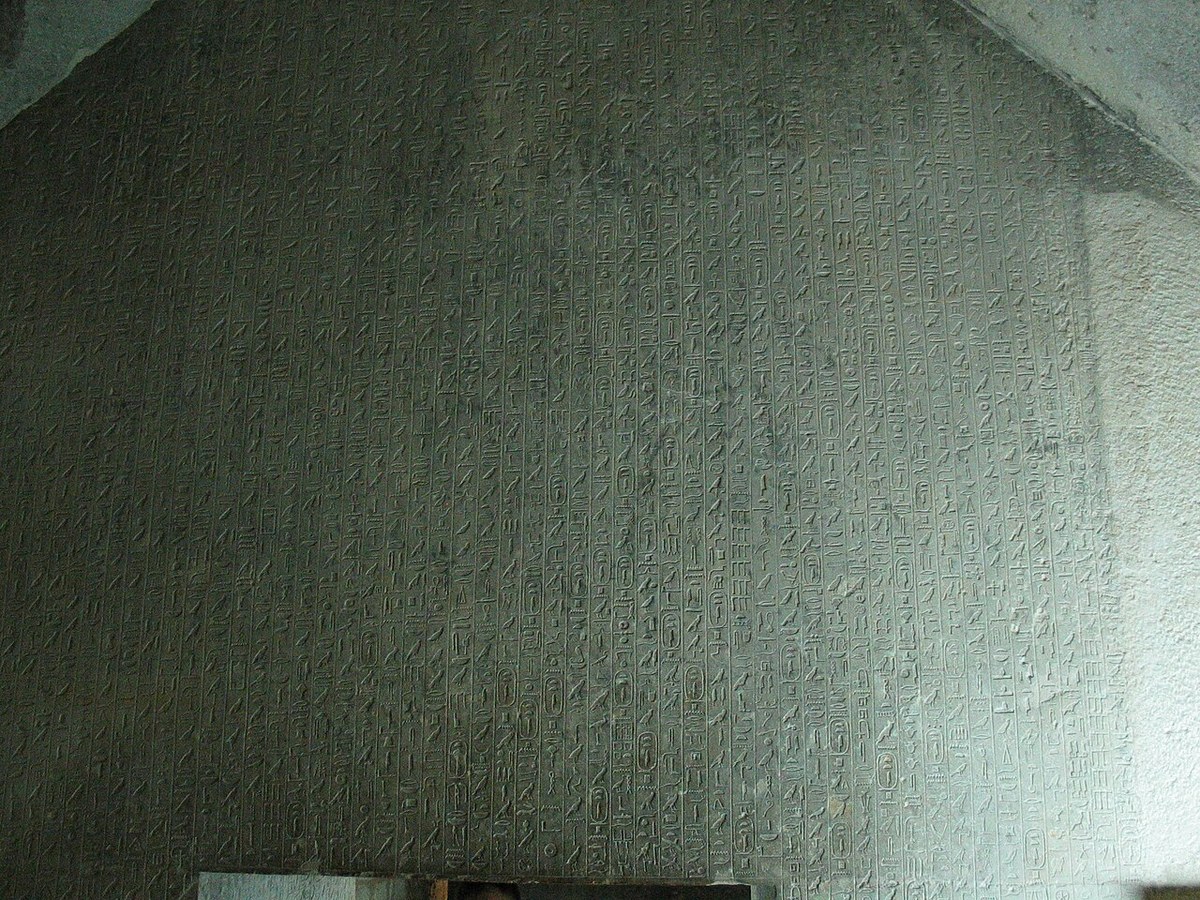
For the first time in ninety years, the International Archaeological Mission at Saqqarah obtained permission to reopen and systematically study this exceptional tomb. Research teams entered with an unprecedented array of technology: photogrammetry, endoscopes, hyperspectral cameras, and very high-resolution photography. These tools allow every detail of the hieroglyphs to be recorded without damaging the fragile walls, revealing pigments invisible to the naked eye, and digitally reconstructing the chamber's interior architecture.
Reading the walls: the challenge of deciphermentDeciphermentThe reconstruction of the meaning and value of the signs of an unknown script, often from bilingual texts, repeated proper names or statistical regularities.→
Deciphering the Pyramid Texts is no simple task. While hieroglyphs have been read since the nineteenth century, interpreting these ancient formulas remains a painstaking undertaking. The language used is an archaicArchaicRefers to an ancient, now-extinct human population or form (Neanderthals, Denisovans, ghost lineages), as opposed to anatomically modern humans.→ form of classical Egyptian, often elliptical, whose mythological references demand in-depth knowledge of the Old KingdomOld KingdomThe first great period of unified pharaonic Egypt (c. 2700-2200 BC, 3rd-6th Dynasties), the golden age of the great pyramids and of a strongly centralised state.→ pantheon and cosmology. Some formulas evoke the myth of Osiris, others invoke Horus or Thoth; still others resemble ritual "recipes" whose meaning continues to be debated among specialists.
Hyperspectral cameras prove invaluable here: they detect traces of paint or ink invisible to the naked eye, which can fundamentally change the reading of a sign. Some columns of text, previously deemed illegible, have been partially restored using these techniques[3]. An entirely new layer of Egyptian civilisation is thus revealed, inscribed in stone for more than four millennia.
A legacy that transformed funerary religion
The influence of the Pyramid Texts on Egyptian civilisation was immense. They formed the foundation upon which the Coffin Texts developed during the Middle Kingdom, and later, during the New Kingdom, the celebrated Book of the Dead. This intellectual and spiritual lineage spans more than two thousand years, making the Saqqarah texts one of the deepest roots of ancient Egyptian religious thought. To understand their content, organisation, and evolution is to grasp the most fundamental origins of a civilisation that has never ceased to fascinate humanity.
The International Archaeological Mission at Saqqarah continues its work with the ambition of eventually producing a complete, annotated edition of all the texts in Pepi II's pyramid - a monumental undertaking, but an essential one for all who wish to understand how the Egyptians conceived of death, the cosmos, and humanity's place in the universe.
No comments yet. Be the first.