In the most remote regions of Mongolia and the Altai mountains, beneath earthen and stone mounds called kurgans, lies one of Antiquity's best-kept secrets. For 2,500 years, permafrostPermafrostPermanently frozen ground; in the Altai, water seeping into kurgans froze into ice lenses that preserved bodies, textiles and wood for millennia.→ has acted as a natural vault, preserving burials of extraordinary richness intact. This SLICE Histoire documentary takes us to the heart of excavations that are pushing the boundaries of our knowledge about the ScythiansScythiansNomadic horse peoples of the Eurasian steppes (1st millennium BC), known for animal-style art, goldwork and kurgan burials; the Pazyryk culture is an eastern expression of them.→.
The Scythians, lords of the steppes
Between the 7th and 3rd centuries BC, the Scythians dominated a vast territory stretching from the shores of the Black Sea to the far reaches of Mongolia and Siberia. These nomadic Iranian-speaking peoples, feared as horsemen and warriors, developed a complex civilization whose material traces were long underestimated by Western historians. Their kurgans -- monumental funerary mounds -- number in the thousands across the Eurasian steppes.
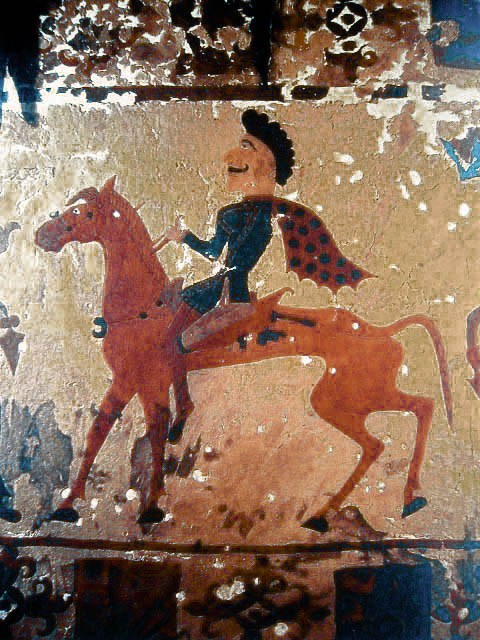
The populations of the Altai and Mongolia, often referred to as the Pazyryk culture (named after the eponymous site in the Russian Altai), belong to the same cultural sphere. Their funerary rites were remarkably sophisticated: high-ranking deceased were buried with their horses, weapons, ornaments and provisions for the afterlife, in carefully assembled larch-wood chambers.
Cold, guardian of centuries
The key to the exceptional preservation of these burials lies in geology. In the high valleys of the Altai and on the Ukok Plateau (at approximately 2,400 meters altitude), permafrost -- permanently frozen ground -- seeped into the funerary chambers shortly after their construction. Constant sub-zero temperatures froze time, preserving organic materials that would have left no trace under other conditions: leather, wool, silk, wood, feltFeltA non-woven fabric made by pressing and matting wool fibres; steppe nomads used it for rugs, saddles and appliqués, remarkably preserved in the frozen Pazyryk tombs.→ and even human flesh.
This natural phenomenon turned these kurgans into time capsules of inestimable scientific value. While Scythian burials on the Ukrainian steppes often yield only skeletons and metal artifacts, those of the Altai and Mongolia preserve a vivid picture of Iron AgeIron AgeThe last period of protohistory (from c. 1200 BC in Europe and the Near East), marked by iron metallurgy and the first kingdoms.→ nomadic societies.
The Ice Maiden of the Ukok
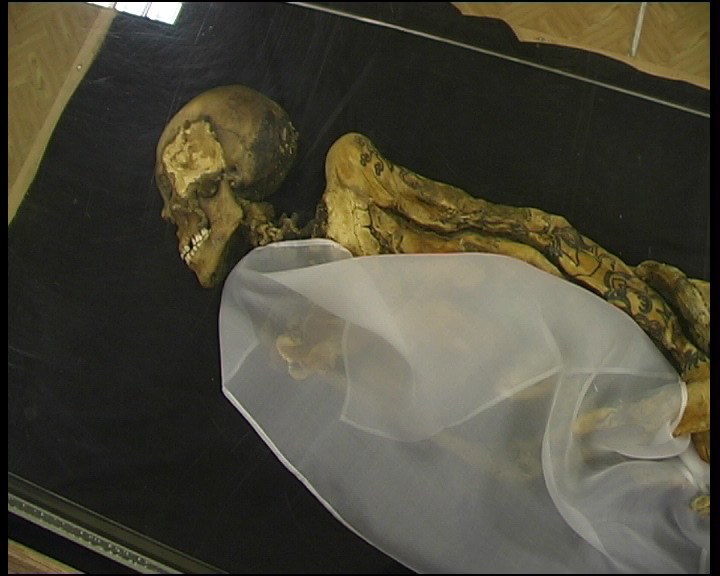
In 1993, Russian archaeologist Natalia Polosmak unearthed an exceptional burialBurialThe intentional deposition of a body, sometimes with offerings; a marker of symbolic behaviour.→ on the Ukok Plateau (Russian Altai, near the Mongolian border). Encased in a block of ice, the mummy of a young woman in her twenties had been perfectly preserved for 2,500 years. Immediately dubbed the "Ukok Princess" or "Ice Maiden," this high-ranking woman bore remarkably fine tattoos on her arms: a fantastical deer with a bird's head, a snow leopard, and other animals stylized in pure Scythian fashion.
Her attire also revealed her status: a yellow silk dress imported from China, a wig of carefully braided horsehair, a pyramidal headdress adorned with gilded wooden figures. At her side, six harnessed horses had been sacrificed. Analysis of her remains revealed she suffered from breast cancer and scoliosis, and may have used cannabis as a painkiller -- traces were found in a container placed in her tomb.
The Pazyryk carpet: the world's oldest
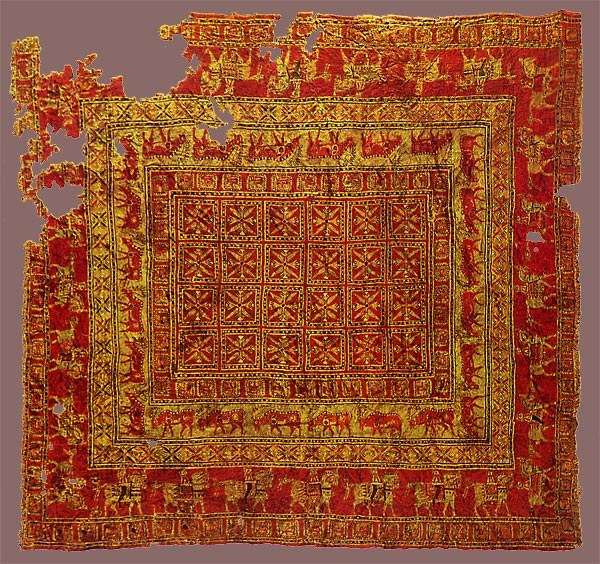
Among the artifacts retrieved from Altai kurgans, the Pazyryk carpet holds a unique place in the history of human craftsmanship. Discovered in 1949 by Soviet archaeologist Sergei Rudenko in a kurganKurganA burial mound of the Eurasian steppes, of earth and stone over a timber chamber holding a high-status individual and grave goods.→ at the Pazyryk site, this pile carpet dates to the 5th century BC. Measuring 2.0 m x 1.83 m with 3,600 knots per square decimeter, it is the oldest known carpet of this type.
Its patterns are of astonishing complexity: a central band of rosettes, deer on a frieze, mounted warriors and winged griffins. The exact origin of its manufacture remains debated: some researchers see it as local Altaic production, others argue for a Persian or Medo-Persian provenance. Regardless, it testifies to the intense trade that connected these steppeSteppeA vast semi-arid, treeless grassland of Eurasia, suited to nomadic herding and the horse; a corridor for the movement of peoples and technologies in later prehistory.→ nomads to the great sedentary civilizations of the era.
Excavations revolutionizing our view of nomads
Recent excavations in Mongolia have documented Scythian kurgans whose wealth rivals those of the Russian Altai. French-Mongolian, American-Mongolian and Japanese-Mongolian teams have been working since the 1990s at sites such as Gol Mod, in Arkhangai Province, where royal burials of the Xiongnu culture (associated with Eastern Scythians) dating from the 1st century BC to the 1st century AD have been uncovered. One of them, excavated in 2001, contained the remains of 30 horses and an abundance of Chinese lacquer, silk and gold artifacts.
These discoveries challenge the image of a uniform Scythian civilization. We now distinguish several distinct cultures sharing the same symbolic foundation -- notably the triad of gold, horses and weapons -- but with artistic expressions and funerary practices that vary considerably by region and period.
Scythian animal art
One of the most distinctive features of Scythian culture is its animal art, unmistakable in its style. Deer with curled antlers, griffins, snow leopards, bears, eagles: Scythian craftsmen depicted animals in combat or seizing poses, often with bodies twisted into impossible positions. This art, sculpted in gold, bronze or bone, decorated horse harnesses, weapons and personal ornaments.
The tattooed mummies of the Ukok show that these motifs also adorned the bodies of their wearers. The Ukok Princess's tattoos, made with a pricking stick and soot, depict the same fantastic creatures sculpted in gold -- suggesting that tattooing played a strong identity and perhaps spiritual role in this society.
The challenges of conservation
The preservation of these ice treasures is now threatened by climateClimateThe long-term average atmospheric conditions of a region; its variations (glaciations, aridifications) shaped migrations, agriculture and the collapse of prehistoric societies.→ change. The thawing of permafrost in Siberia and Mongolia is advancing by several centimeters per year, irreversibly destroying burials that have resisted for two millennia. Kurgans excavated in recent years have yielded artifacts in advanced states of decomposition, victims of thawing that occurred before their discovery.
A race against time is underway. Archaeologists worldwide are mobilizing to locate and excavate still-intact kurgans before the permafrost disappears. Each preserved burial is an irreplaceable window onto the world of Iron Age nomads -- a window that is slowly closing under the effects of global warming.
No comments yet. Be the first.