One of the oldest known burials
On the slopes of Mount CarmelMount CarmelLimestone range of northern Israel, south of Haifa, whose caves (Skhūl, el-Wad, Tabun) have yielded major human fossils.→, south of Haifa, Skhūl Cave holds a singular place in the history of palaeoanthropologyPalaeoanthropologyThe science that studies human evolution from the fossil remains of hominins (bones, teeth, footprints) and their context, to reconstruct our biological origins.→. In the early 1930s, excavations led by Theodore McCown and Dorothy Garrod uncovered some ten human skeletons laid out with care, several of them bearing signs of deliberate funerary deposition. Among them, a small fragmented skull catalogued as Skhūl I belonged to a child who died around the age of three to five, in all likelihood a girl.
What has drawn researchers' attention for nearly a century is not only the age of the remains, estimated at about 140,000 years, but the gesture that accompanies them. The arrangement of the bodies, the shaping of the graves and the organisation of the space make Skhūl one of the oldest sets of intentional burialsBurialThe intentional deposition of a body, sometimes with offerings; a marker of symbolic behaviourSymbolic behaviourA set of practices (adornment, pigments, art, burial) reflecting symbolic thought; long ascribed to Homo sapiens alone, now attested for Neanderthals too.→.→ ever documented. To bury a dead person implies an awareness of loss, a form of ritual and a structured social life, long before the symbolic flowering of the European Upper PalaeolithicUpper PalaeolithicThe final phase of the Palaeolithic (c. 45,000 to 10,000 years ago), marked by Homo sapiens in Europe, art, ornaments and a succession of cultures (Aurignacian, Gravettian, Solutrean, Magdalenian).→.
The site has never stopped fuelling debate. The first describers saw in the Skhūl fossils a transitional population between Neanderthals and modern humans. The hypothesis of interbreedingInterbreedingGenetic mixing between human populations or species; between Neanderthals and Homo sapiens it left 1 to 2% of Neanderthal DNA in non-Africans.→ was then put forward, then set aside, and the remains ended up classed, for the most part, as anatomically modern humans. It is this now consensual attribution that a 2025 study in the journal L'Anthropologie, by Anne Dambricourt Malassé, Jean-Luc Bouvier, Marcel Otte and colleagues, sets out to unsettle, proposing a full re-reading of the child's neurocranium and mandible.
The stakes go well beyond a single anatomical case. If Skhūl I can no longer be attributed without reservation to our species, then the very status of one of the world's oldest graves is called into question, and with it the matter of who was burying their dead in the Near EastNear EastA region of western Asia (Levant, Mesopotamia, Anatolia, Iran), cradle of the Neolithic revolution, agriculture, the first cities and writing.→ some 140,000 years ago.
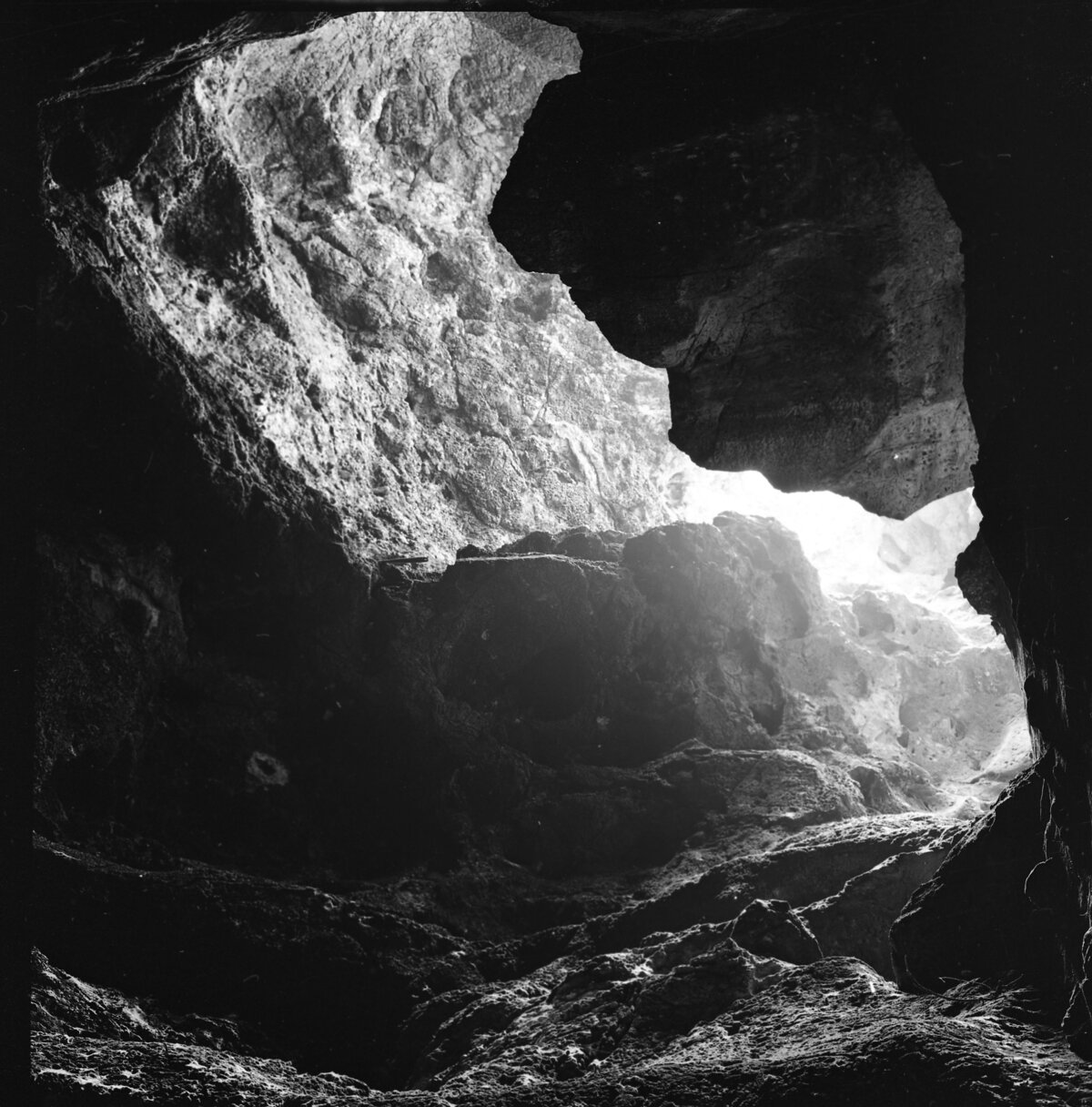
The cave itself is no monumental sanctuary. It is a modest shelter, opening in the cliff, to which the living returned to lay their dead. This repetition of the funerary gesture at a single place is in itself valuable information: it suggests an attachment to a territory, a memory of the deceased and perhaps a handing down of practices from one generation to the next. The Skhūl fossils are thus not mere bones, but witnesses to a humanity already able to give meaning to death, and to anchor it in a chosen place.
A mosaic skull: modern above, archaicArchaicRefers to an ancient, now-extinct human population or form (Neanderthals, Denisovans, ghost lineages), as opposed to anatomically modern humans.→ below
The heart of the argument lies in a contrast. The upper part of the skull, the neurocranium, shows features usually associated with Homo sapiensHomo sapiensThe present-day human species, which emerged in Africa around 300,000 years ago, the only surviving human lineage after the extinction of Neanderthals and Denisovans.→: a gracile architecture, thin walls, a near-vertical cranial base and a bony labyrinth of the inner ear of modern type. The mandible, by contrast, long studied separately from the braincase, lines up characters the authors judge to be archaic.
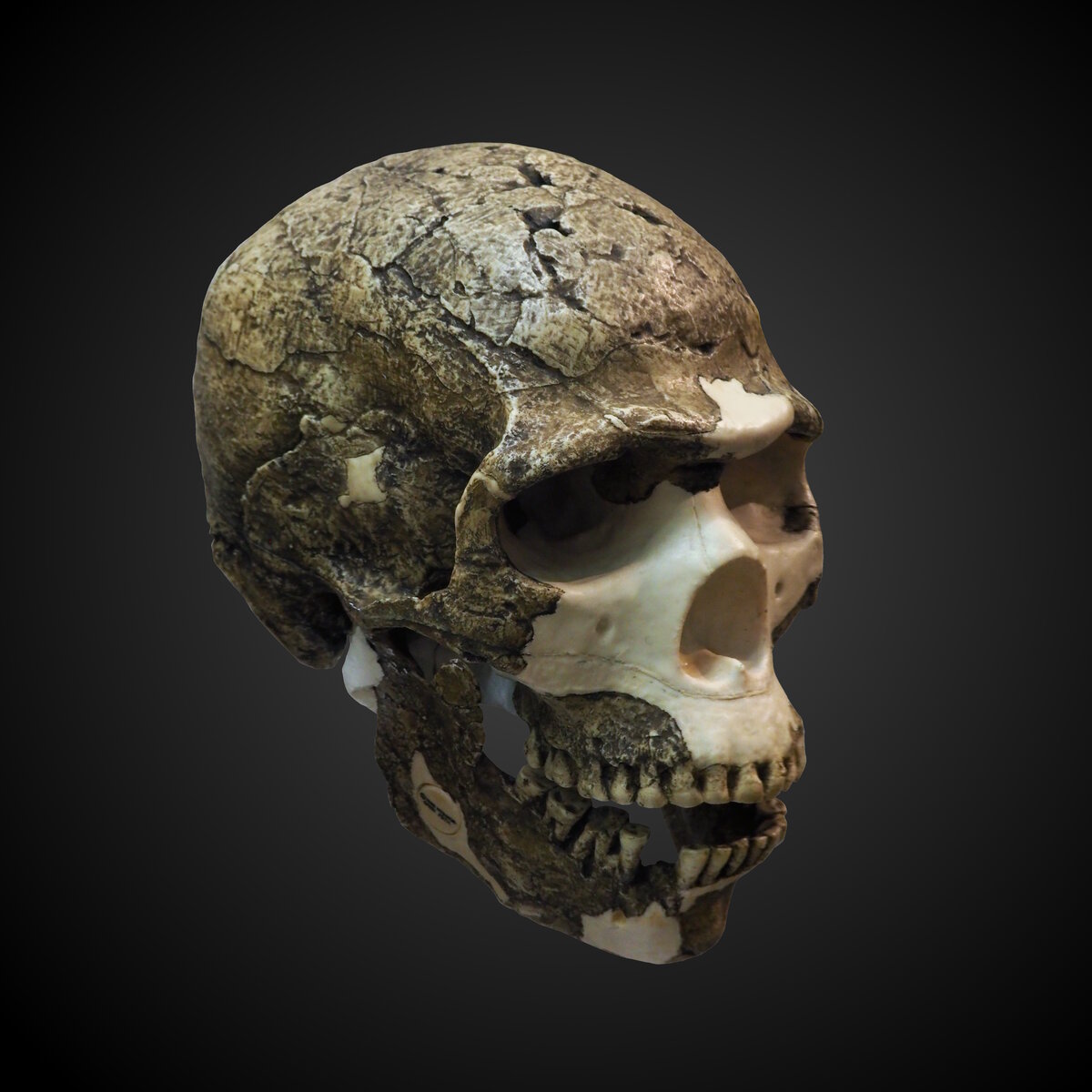
This jaw bears no chin, the bony projection at the base of the face that is one of the most constant signatures of our species. Its alveolar plane, the zone where the teeth are set, slopes backward. The dental arch is wide, and the whole strongly evokes the morphology of NeanderthalNeanderthalsA fossil humanity of Eurasia, robust and cold-adapted, extinct around 40,000 years before present.→ children. The researchers also note, at the junction between enamel and dentine, a break in curvature typically seen in Neanderthals.
For Anne Dambricourt Malassé, a palaeoanthropologist at the CNRS and the National Museum of Natural History in France, such a combination cannot stemstemThe narrowed base of a point, used to haft it onto a shaft or handle.→ from variability within a single species. She sees in it, bluntly, the objective sign of hybridizationHybridisationCrossing between two distinct species or lineages, such as Homo sapiens and Neanderthals, leaving a trace in the genome.→, or failing that of a still unknown lineage. Jean-Luc Bouvier, for his part, stresses two features of the braincase that in his view set it apart from Homo sapiens: an occipital, at the back of the skull, that is too elongated, and a forehead judged too low and receding.
The word hybrid carries a strong charge, for it evokes direct crossing between two populations long held to be distinct. The authors themselves remain cautious in their written formulation, holding that the combination of characters seen in Skhūl I may suggest that the child is a hybrid. The nuance matters: between a suggestion grounded in morphology and a demonstration there remains a step that anatomy alone does not take.
The term mosaic, used by palaeoanthropologists, describes precisely this coexistence, within a single individual, of characters that seem to belong to different species. In the child, the upper skull and the lower face tellTellAn artificial mound formed by the accumulation of successive layers of settlement remains at the same spot, typical of the Near East. Each destruction-rebuilding event adds a stratum.→ two distinct stories. The question is whether this duality reflects a composite biological inheritance, that is, interbreeding, or simply the diversity of an ancient population in the midst of change, in which archaic and modern traits could still sit side by side in one and the same subject, with no crossing involved.
The CT scan and the virtually removed plaster
What sets the 2025 study apart from earlier analyses owes as much to method as to conclusions. The child's skull is a damaged object: the middle of the face and a large part of the base are missing, and the rest survives in pieces. In the 1930s, restorers reassembled and consolidated these fragments with plaster, a saving gesture for the time, but one that froze the object and hampered later examinations.
The team turned to high-resolution computed tomography, the medical CT scan applied to fossils, coupled with three-dimensional modelling. This approach allows a move that would have been physically unthinkable: to virtually remove the plaster added a century ago, fragment by fragment, in order to recover the original geometry of the bones and compare it with that of other specimens, modern children as well as young Neanderthals.
It is in this framework that the mandible could, for the first time, be genuinely confronted with the neurocranium. The two pieces do not, however, articulate directly, for no bony connection between them has been preserved, and this impossibility of fitting them together feeds one of the criticisms levelled at the study: pairing an archaic jaw with a modern braincase rests, in part, on a choice of reconstruction.
The method nonetheless marks real progress. It gives historic fossils, often handled and restored before the digital era, a second analytical life without risk to the original, and it makes measurements reproducible. It is precisely this fineness of reading that let the authors register details, such as the break in the enamel-dentine junction, invisible to the naked eye.
Compared with the first descriptions of the 1930s, based on direct observation and casting, this digital re-reading changes the scale of inquiry. Where earlier researchers had to rely on what the plaster allowed them to see, present-day imaging passes through the matter and renders the inside of the bones, the structure of the inner ear or the microarchitecture of the teeth. It is this depth of field, as much as fresh measurements, that lets the authors reopen a case many had held to be closed for decades.
The Levant, an evolutionary crossroads between AfricaAfricaThe cradle of humankind: the continent where the first hominins appeared, then Homo sapiens around 300,000 years ago, before the expansion to the rest of the world.→ and Eurasia
If the interbreeding hypothesis holds attention, it is also because the geography lends itself to it. The LevantLevantA region of the eastern Mediterranean Near East (Israel, Lebanon, Syria, Jordan), a major crossroads of the first human migrationsMigrationsLong-distance movements of populations; a major driver of human history (the exit from Africa, the peopling of continents, Neolithic and steppe expansions).→ out of AfricaOut of AfricaThe dispersals of Homo sapiens out of Africa, including a major expansion c. 70,000 to 60,000 years ago and earlier exits.→.→, that strip of land linking Africa to Eurasia along the eastern Mediterranean, functioned as a corridor of settlement throughout the PleistocenePleistoceneThe geological epoch of the great ice ages (c. 2.6 Ma–11,700 BP), spanning most of human prehistory.→. Populations out of Africa and those established in Eurasia could cross paths there, following the climatic swings that made the region by turns welcoming and hostile.
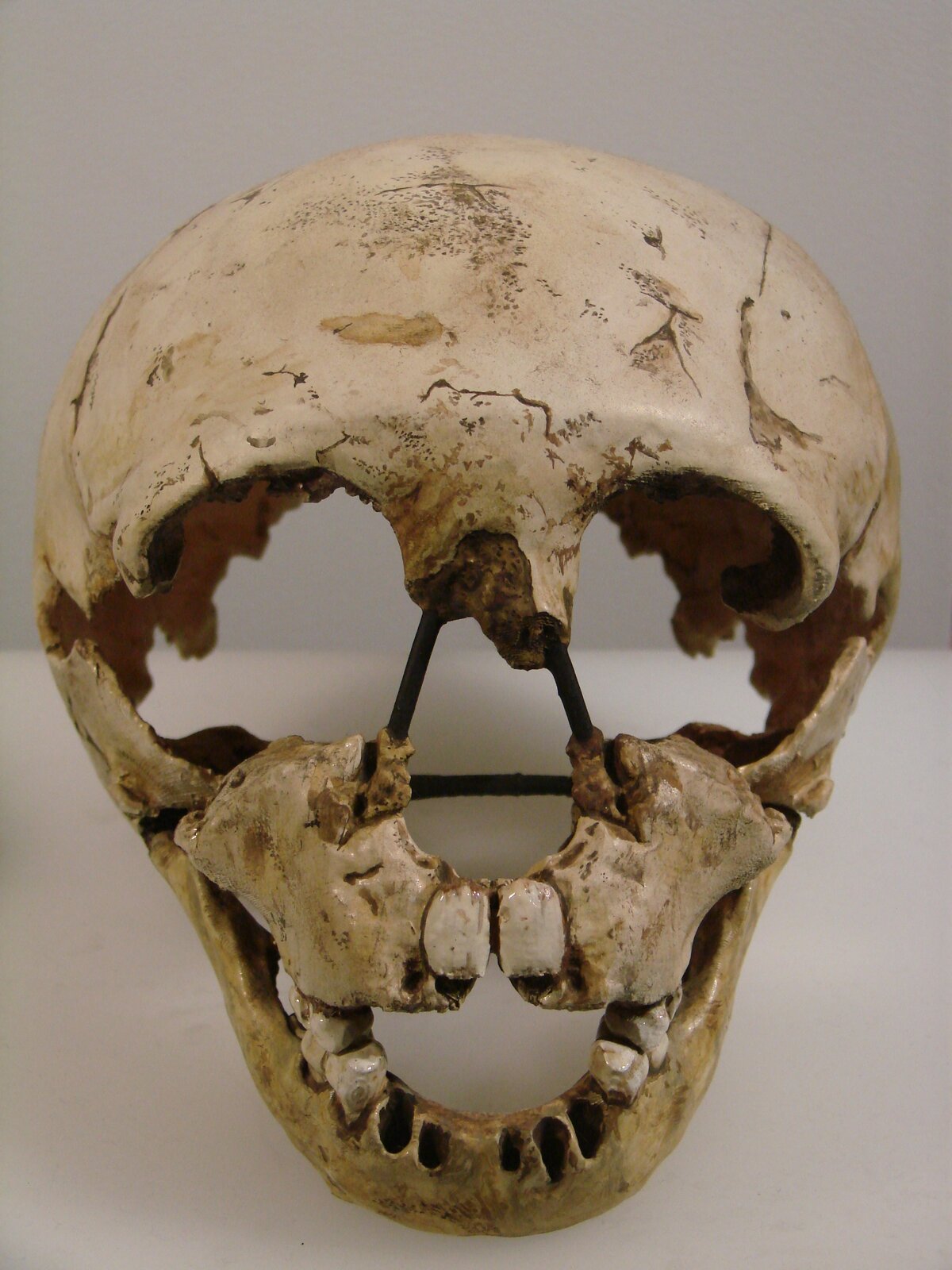
The caves of Mount Carmel and the Jordan valley have yielded, at Skhūl as at nearby Qafzeh, some of the oldest known Homo sapiens outside Africa, dated to roughly 90,000 to 130,000 years. Further north, and later in time, Neanderthals occupied the same landscapes. The Levant thus appears as a privileged stage where distinct human lineages could, at certain periods, share a single territory.
This reading fits a scientific picture in motion. Genetic work published in recent years suggests episodes of gene exchange between Neanderthals and modern humans far older than once thought, perhaps around 100,000 years ago. Against this backdrop, a Near Eastern child with a mixed anatomy takes on particular relief, not as isolated proof, but as a possible piece of a larger puzzle.
One must nonetheless beware of confusing geographic proximity with demonstrated contact. That the Levant was a crossroads does not mean that every lineage met there at every moment. Caution is all the more warranted because the chronology, here, raises a serious problem.
The great swings of the Pleistocene climateClimateThe long-term average atmospheric conditions of a region; its variations (glaciations, aridifications) shaped migrations, agriculture and the collapse of prehistoric societies.→ play a decisive part here. During wetter phases, the deserts separating Africa from Asia retreated, opening green corridors that human populations, like the fauna, could follow. During arid phases, those same corridors closed again and isolated the groups. The Levant, set at the hinge of the continents, records these pulses: it could in turn receive waves from the south and incursions from the north, without our knowing precisely which of them overlapped in time.
A debated hypothesis, not an established fact
The first obstacle is temporal. The oldest clearly identified Neanderthal fossils in the Levant, at Kebara and Amud, scarcely exceed 70,000 years. Between them and the Skhūl child opens a gap of about 70,000 years, a chasm that makes it hard to assert direct contact between the two populations at the time of the burial. To posit interbreeding 140,000 years ago therefore requires the still poorly documented presence of Neanderthals, or of a related lineage, in the region at that date.
The reservations also come from specialists outside the study. Chris Stringer, a palaeoanthropologist at the Natural History Museum in London, acknowledges the primitive character of the mandible, but holds that, considering all the Skhūl fossils, skeletons included, the material remains above all aligned with Homo sapiens. He concedes, however, that the remains could reflect some gene flow between the two populations, without the child being a first-generation hybrid for all that.
John Hawks, an anthropologist at the University of Wisconsin, raises an objection of principle. Ancient populations were extremely variable, and an individual could show a mosaic of traits without any crossing with Neanderthals coming into play. An unusual assemblage of characters, however striking, is thus not enough to prove interbreeding; it describes a morphology, it does not deliver its cause.
At bottom, the case of Skhūl I illustrates a recurring difficulty of palaeoanthropology: reading a history of populations from a single individual, and moreover a child whose skull had not finished growing. The proportions of a young subject differ from those of an adult, and some traits judged archaic could in part owe to age at death rather than to membership of a particular lineage. This added uncertainty calls for restraint, without stripping the study of its value or the richness of its observations.
That would leave ancient DNAAncient DNAGenetic material preserved in old remains, often degraded, sequenced with cutting-edge techniques.→, the only judge able to settle the question of descent. But the warm, humid Levant preserves molecules very poorly, and no usable genetic data could be drawn from these fossils. A further difficulty is ethical: taking a sample from so rare and so meaning-laden a piece, at the risk of damaging it, is not a decision taken lightly. Lacking a genome, the discussion remains suspended on the reading of the bones alone.
The Skhūl child should therefore be presented for what it is: the support of a stimulating and seriously argued hypothesis, but a contested one, and not the first proven hybrid of human history. Press headlines have at times hardened the claim to the point of speaking of the earliest proof of interbreeding, a more assertive wording than that of the authors themselves. What the study establishes with certainty is that a child was carefully buried 140,000 years ago on Mount Carmel, and that its skull continues, nearly a century after its discovery, to resist any simple label.
No comments yet. Be the first.