There is a quiet valley in Burgundy where a famous river enters the world. On the plateauGaulsCeltic peoples settled in Gaul (France, Belgium and neighbouring regions) during the second Iron AgeIron AgeThe last period of protohistory (from c. 1200 BC in Europe and the Near East), marked by iron metallurgy and the first kingdoms.→, before their integration into the Roman Empire.→ of Langres, some forty kilometres northwest of Dijon, a few threads of clear water seep from the rock and gather to form the Seine. This modest place was, more than two thousand years ago, one of the great healing sanctuaries of GaulGaulsCeltic peoples settled in Gaul (France, Belgium and neighbouring regions) during the second Iron Age, before their integration into the Roman Empire.→. The local CeltsCeltsA set of Iron Age peoples sharing related languages and cultures, spread from central Europe to the Atlantic.→ worshipped a goddess of the springs, Sequana, and came to lay offerings carved in her image into the water. The most astonishing thing is that the soil, saturated with moisture, has preserved hundreds of these wooden offerings intact, a material that almost always vanishes from archaeological sites. Left unpublished for nearly sixty years, these ex-votos have just been placed back under study, at the very moment a new excavation campaign reopens the file on this landmark of Gaulish protohistoryProtohistoryThe transitional period between prehistory and history, covering societies without their own writing but known through external texts.→.1
A sacred spring at the heart of the land of the Lingones
The sources of the Seine lie today within the commune of Source-Seine, in the Côte-d'Or, at the southwestern edge of the territory of a great Gaulish people, the LingonesLingonesA Gaulish people of the Langres plateau and present-day Burgundy, on whose territory the sanctuary of the sources of the Seine stands.→. In antiquity they were called the Fontes Sequanae, the springs of Sequana. The valley is anything but a spectacular backdrop, and it is precisely this grave, secluded character that explains its calling. For the GaulsGaulsCeltic peoples settled in Gaul (France, Belgium and neighbouring regions) during the second Iron Age, before their integration into the Roman Empire.→, springs, confluences and waters welling up from the earth were seen as thresholds between the world of the living and that of the invisible powers. A spring that gives birth to a watercourse destined to become a major river carried an obvious symbolic charge.
It is from the end of La TèneLa TèneThe European second Iron Age (c. 450-50 BC), named after a Swiss site; the Celtic apogee, curvilinear art, oppida and coinage.→, the last great phase of the Gaulish Iron Age, that the place took on a monumental dimension. The Lingones laid out the valley, channelled the waters and organised the space around the pool fed by the main spring.2 The sanctuary was therefore not an invention of the Roman occupier. It was rooted in a native religious practice predating Caesar's conquest, a deeply Celtic cult of the waters echoed throughout eastern Gaul. The goddess honoured at Source-Seine belongs to this Gaulish background, before being reinterpreted, later, through the lens of Roman religion. This continuity, from an open-air Gaulish sanctuary to a built complex of temples and porticoes, is one of the site's great interests for understanding the passage from protohistory to the Gallo-Roman era.
Sequana, Gaulish goddess of the waters
The goddess bears the very name of the river. Sequana is the Seine, and probably the origin of the name of the Sequani, the Gaulish people settled in what is now Franche-Comté. No ancient text recounts her story or her myths. We know her only through the objects unearthed in her sanctuary and through short Latin inscriptions carved by the faithful. These dedications, often clumsily spelled, reveal a modest, largely illiterate public who addressed the deity to obtain healing or prosperity.2 One of the most famous simply bears the formula DEA SEQUANA, the goddess Sequana, and nine inscriptions in all name the deity directly.
The cult of Sequana is a cult of the waters in the fullest sense. The aquatic element is not merely a sacred backdrop, it is the divine presence itself. The gushing spring, the water that flows and heals, that is the focal point around which the whole veneration is organised. This conception is rooted in the spirituality of the CeltsCeltsA set of Iron Age peoples sharing related languages and cultures, spread from central Europe to the Atlantic.→, for whom living water held a purifying and regenerating power. A dedication by a woman, offered for the welfare of a relative (pro salute nepotis, for the welfare of my grandson or nephew), shows that people also came to pray for others, and not only for themselves. The sanctuary worked as a public place, open to all, where the sick, the pilgrims and passing travellers crossed paths in search of a relief that ancient medicine could not give them.
Ex-votos by the hundred, offerings for healing
The ritual was simple and deeply moving. The pilgrim reached the sanctuary, performed his ablutions, passed by the goddess's temple, then laid down an offering, an ex-votoex-votoAn offering placed in a sanctuary to obtain a favour from a deity or to give thanks, often depicting the body part to be healed.→, depicting either the ailing part of his body or his own person in prayer. One asked for healing, or gave thanks for a healing already obtained. Nearly a thousand of these offerings, carved in bronze, stone or wood, have been brought to light over the course of the excavations, and some inventories count up to a thousand and a half.1
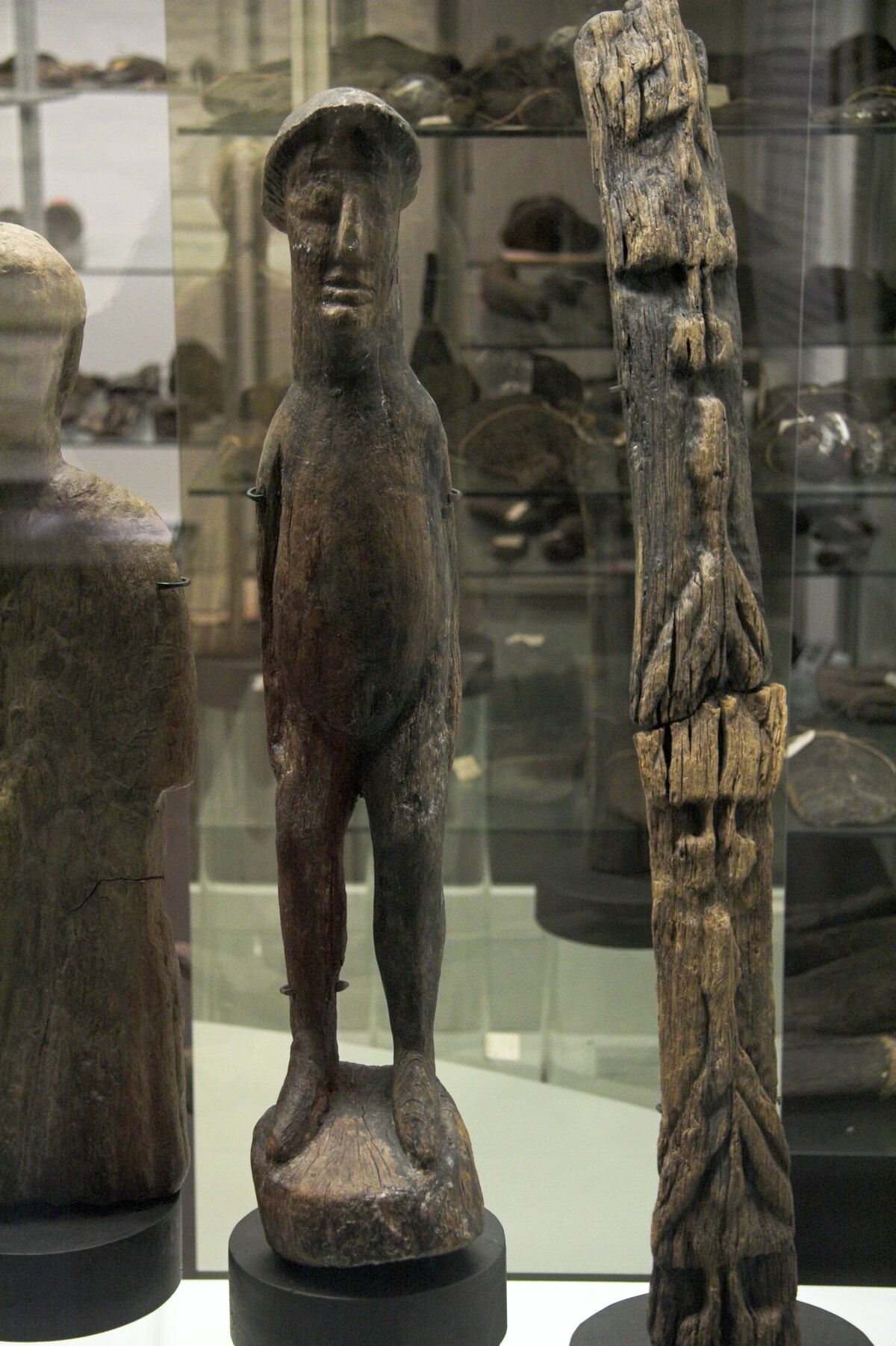
The gallery of these objects forms a veritable inventory of human suffering. It includes heads, eyes, limbs, torsos, but also, remarkably, internal organs rendered with a striking concern for realism. Whole figures, draped in long robes, sometimes hold an offering against themselves. A swaddled child, a female figure, a face with pared-down features, each piece tells of an expectation, a prayer, an illness. The afflictions evoked, blindness, paralysis, rheumatism, various infections, sketch the tender portrait of a population that placed in the goddess the hope that medicine could not fulfil. Through these ex-votos, it is the anonymous people of Gaul who speak to us, not through texts, but through the image of their own bodies entrusted to the sacred water.
The miracle of preservation, wood that crossed twenty centuries
What makes the sanctuary of Sequana exceptional is the very material of a large part of its offerings. Wood, on the vast majority of archaeological sites, rots and disappears within a few decades. Here, the permanent saturation of the soil with water created an oxygen-starved environment that prevented decomposition. Ex-votos carved from oak some two thousand years ago have thus crossed the centuries almost intact, buried in the waterlogged mud of the ancient pools.3 This is a case of preservation of remarkable rarity for ancient wood, comparable to the great waterlogged deposit sites known elsewhere in Europe.
These carved woods are no mere curiosities. They constitute a direct source on Gaulish and Gallo-Roman sculpture, an art which, most often produced in perishable materials, almost entirely escapes us. Thanks to them, we glimpse the skill of woodcarvers, conventions of representation, a way of depicting the body and the face that owes much to the native background. The wood has also yielded precious information for dating, since the study of the offerings places the first major use of the sanctuary around the beginning of our era, at the turning point between Gaulish independence and the establishment of the Gallo-Roman world.1 These fragile objects are therefore at once religious witnesses, works of art and chronological archives.
From Gaulish La Tène to the Gallo-Roman heyday
The history of the sanctuary is one of long continuity rather than rupture. The cult took hold at the end of La TèneLa TèneThe European second Iron Age (c. 450-50 BC), named after a Swiss site; the Celtic apogee, curvilinear art, oppida and coinage.→, in a Gaul still independent, around a spring already held to be sacred. After the Roman conquest, devotion to Sequana did not vanish, quite the contrary. It continued and grew, but in a new setting, that of Roman architecture. The Lingones, now Gallo-Romans, endowed the place with two temples, a colonnaded enclosure, masonry pools and stone channels, the whole still organised around the spring and the sacred basin.2
The sanctuary reached its peak from the first to the fourth century of our era. This was the great age of ancient spa cures, where religion and medicine merged, and where healing spring sanctuaries functioned as centres of care as much as of devotion. Other deities of the Roman pantheon, Apollo, Hercules, then came to share the domain of the Gaulish goddess, without ever erasing her.2 This syncretism illustrates the flexibility of the Gallo-Roman religious world, able to layer figures without disowning the native core. For a site whose story runs from the PalaeolithicPalaeolithicThe oldest and longest period of prehistory (c. 3.3 Ma–12,000 BC), defined by chipped stone tools and a hunter-gatherer way of life.→ to the eve of our era, Source-Seine thus offers a precious example of how a Gaulish belief, born in protohistory, survived and prospered under Roman rule, to the point of giving its name to the river that flows through Paris today.
The goddess on her boat and the bronze treasure
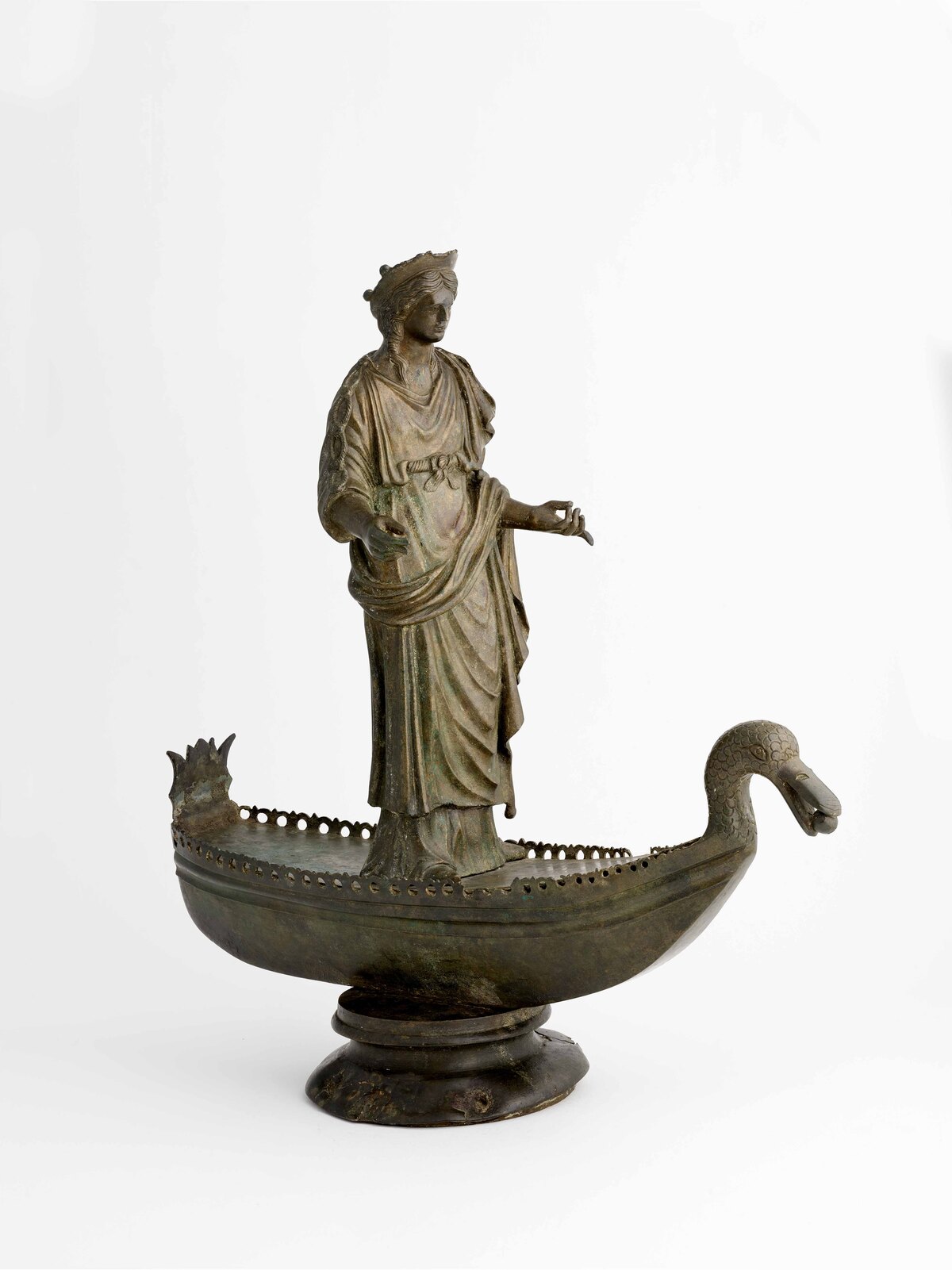
The sanctuary has yielded more than anatomical offerings. It also gave back its masterpiece, a bronze statuette that has become the emblem of the site and no doubt the most famous image of Sequana. Discovered in 1933 by the archaeologist Henry Corot, in three pieces hidden in a small pit, it depicts the goddess standing, arms outstretched before her, wearing a long robe and crowned with a diadem.2 She stands on a flat-bottomed boat, of the kind that once sailed the region's rivers, whose prow ends in a bird's head, a duck said to hold a small berry in its beak.
This figure of the goddess on her boat belongs to an iconography deeply linked to water and river navigation, a motif found in several cults of river deities. She was found alongside a second bronze statuette, a young faun, in what archaeologists regard as a deposit, a temple treasure carefully buried. Held at the archaeological museum of Dijon, the bronze Sequana alone captures the sanctuary's twofold face, a deity with Gaulish roots, caught in a style indebted to Gallo-Roman art, symbolically guiding the waters and the faithful. Around her, the museum today holds the reference collection of offerings from Source-Seine, from the finest bronze to the humble ex-votos of wood and stone.3
Sixty years of slumber, the sanctuary rediscovered
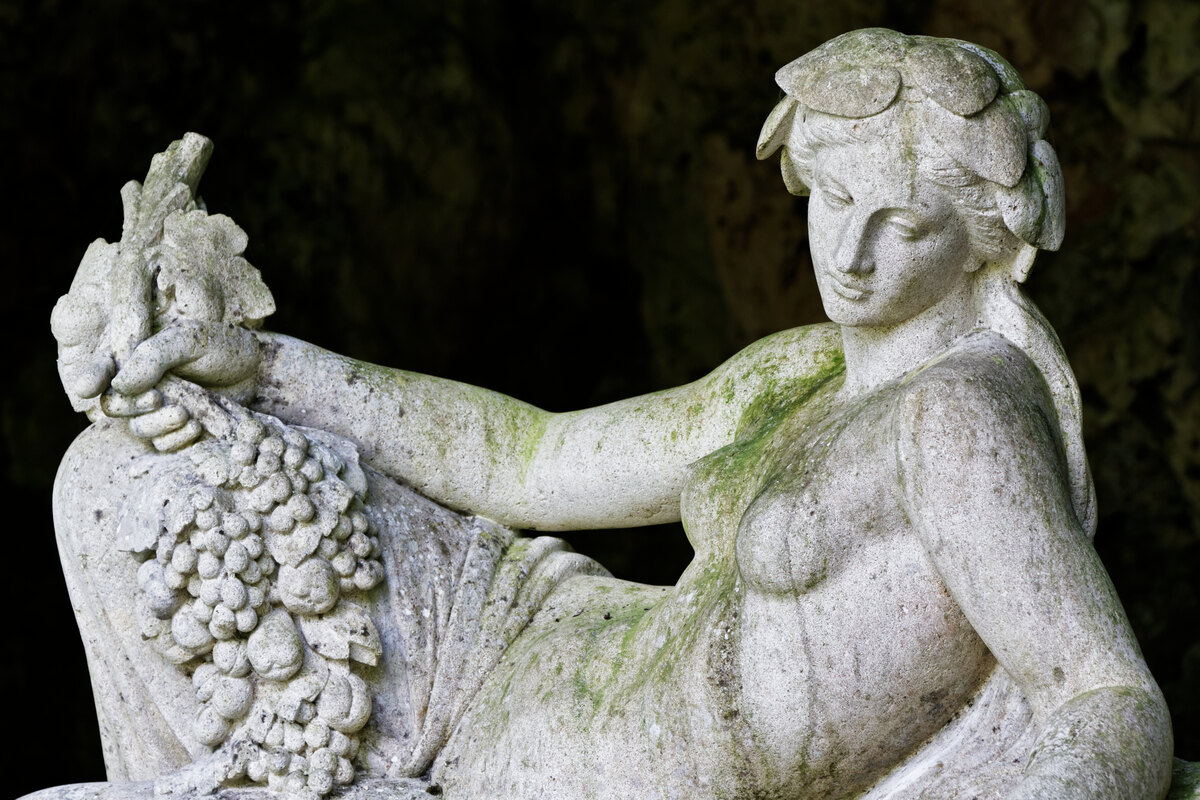
The excavation history of Source-Seine is long and eventful. As early as 1836, investigations established the presence of a healing sanctuary, which would lead the City of Paris, under prefect Haussmann, to buy the land in 1864 and lay out a landscaped park inaugurated in 1867, with its artificial grotto and its stone nymph. The great archaeological campaigns followed in the twentieth century, that of Henry Corot in the 1930s, then that of Dean Roland Martin in the 1950s and 1960s.2 It was in October 1963, during a clean-up ahead of a redevelopment, that nearly two hundred carved woods were suddenly brought to light, causing a huge stir among archaeologists and the general public alike, so rare is the preservation of ancient wood.4
Then, paradoxically, silence fell again. The remains were left abandoned, and a large part of the hundreds of wooden ex-votos unearthed some sixty years ago remained unpublished, never studied in detail. It is this neglect that contemporary archaeology now sets out to remedy. A new multi-year research programme, led by the National Institute for Preventive Archaeological Research (Inrap) under the direction of Loïc Gaëtan, reopens the site nearly sixty years after the last investigations.1 The first operations combine the study of archives, the re-reading of these long-silent woods, geophysical surveys to map the buried extent of the sanctuary and the clearing of the masonry structures, partly eaten away by frost and erosion.
The stakes go beyond mere curiosity. The aim is to save a threatened site, to place these offerings back in their context and to better understand the Gaulish birth of a cult that outlived the Roman conquest. Each oak ex-voto returned to study is a voice recovered, that of an inhabitant of Gaul who, two thousand years before us, walked up this valley to entrust his body and his hopes to the goddess of the springs. By giving these forgotten woods back their voice, the archaeologists do not merely revive a sanctuary, they restore their history to the men and women of protohistory who, first of all, made the birth of the Seine a sacred place.
Toujours utile d'avoir des sources récentes quand on enseigne. Cet article s'y prête vraiment.
J'ai croisé ces données avec la chrono-carte. La cohérence chronologique et géographique est remarquable.