It was not standing upright, nor lying on the ground, nor buried in a pit. It lay horizontally, slipped into the thickness of a stone wall, the way one tucks a precious object into a hiding place. For more than 12,000 years, a human statue rested like this at the heart of Göbekli Tepe, in south-eastern Turkey, the site often presented as the oldest monumental complex in the world. Its discovery, announced in autumn 2025 and back in the spotlight in October 2026, intrigues prehistorians: why would hunter-gatherersHunter-gatherersA way of life based on hunting, fishing and gathering wild resources, without farming or herding; it dominated almost the whole of human history.→ of the Pre-Pottery NeolithicNeolithicThe "New Stone Age": a period marked by farming, herding, settlement and pottery, from around 10,000 BC.→Pre-Pottery NeolithicThe first phase of the Neolithic (c. 9,600–6,900 BC), before the invention of pottery.→ have walled up the image of a human being?12
The find was made by the team of Professor Necmi Karul of Istanbul University, who directs the excavations at Göbekli Tepe and coordinates the vast regional Taş Tepeler ("Stone Hills") programme. It has not yet been the subject of a detailed scientific publication: the statue is being cleaned and studied, and those in charge have deliberately limited the release of images so as not to compromise its conservation treatment.2
A carefully hidden deposit
It was Turkey's Minister of Culture and Tourism, Mehmet Nuri Ersoy, who revealed the find on 19 September 2025, during a visit to the site by Princess Akiko of Mikasa, a member of the Japanese imperial family. The statue was uncovered in an area between Structures B and D, two of the large circular pillared enclosures that made the site famous. It had been inserted horizontally into a cavity built into the wall of a room.1
For the archaeologists, this position is no accident. A statue that had fallen or been discarded would turn up in the fill, broken or askew. This one was placed, wedged, then covered by the masonry. The act was deliberate, and everything suggests it had ritual significance. The researchers see it as a votive offering, a deposit intended to imbue the building with a presence, to protect it or to consecrate it.12 "It provides a deeper understanding of Neolithic rituals and the symbolic world of early human communities," Mehmet Nuri Ersoy stressed.1
An 11,600-year-old monument
To grasp the significance of the find, it helps to recall what Göbekli Tepe is. Perched on a limestone hill some fifteen kilometres from Şanlıurfa, the site forms an artificial tellTellAn artificial mound formed by the accumulation of successive layers of settlement remains at the same spot, typical of the Near EastNear EastA region of western Asia (Levant, Mesopotamia, Anatolia, Iran), cradle of the Neolithic revolution, agriculture, the first cities and writing.→. Each destruction-rebuilding event adds a stratum.→ fifteen metres high and about eight hectares in extent. Its first buildings date back to around 9500 BCE, and it was used for at least 1,500 years, until around 8000 BCE. Its circular enclosures, 10 to 30 metres across, are ringed by stone walls into which monolithic T-shaped pillarsT-pillarA T-shaped stone monolith of the Anatolian sanctuaries (Göbekli Tepe, Karahan Tepe), often carved with animals or human limbs.→ are set, the tallest exceeding five metres. Two taller pillars face each other at the centre of each enclosure.3
These monuments were raised by communities who knew neither pottery, nor writingWritingA system of conventional signs used to fix language or information durably; its appearance (c. 3300 BC) marks, by convention, the end of prehistory.→, nor metallurgyMetallurgyThe techniques of extracting and working metals (copper, bronze, gold); its rise in the Eneolithic and Bronze Age transformed tools, weapons and social hierarchies.→, and who did not yet practise fully domesticated agricultureAgricultureThe cultivation of plants and production of food by working the soil, which emerged in the Neolithic in the Near East and independently elsewhere; it radically transformed human societies.→. Since the first excavations by the German archaeologist Klaus Schmidt in 1995, Göbekli Tepe has thus upended the idea that monumental architecture was a luxury reserved for farming societies. Geophysical surveys indicate that at least twenty large enclosures still lie beneath the hill, and only a small part of the site has been excavated. Inscribed on the UNESCO World Heritage List in 2018, it now draws hundreds of thousands of visitors every year.37
The human being, a rare figure
What makes the statue so precious is its very nature. At Göbekli Tepe, complete human representations are rare. The vast majority of sculpted images are animals: foxes, boars, snakes, vultures, scorpions, big cats, aurochs. These animals are almost always male and often shown in an aggressive posture, fangs bared or tail raised. The game on which the community depended, such as gazelle, is curiously scarce.3
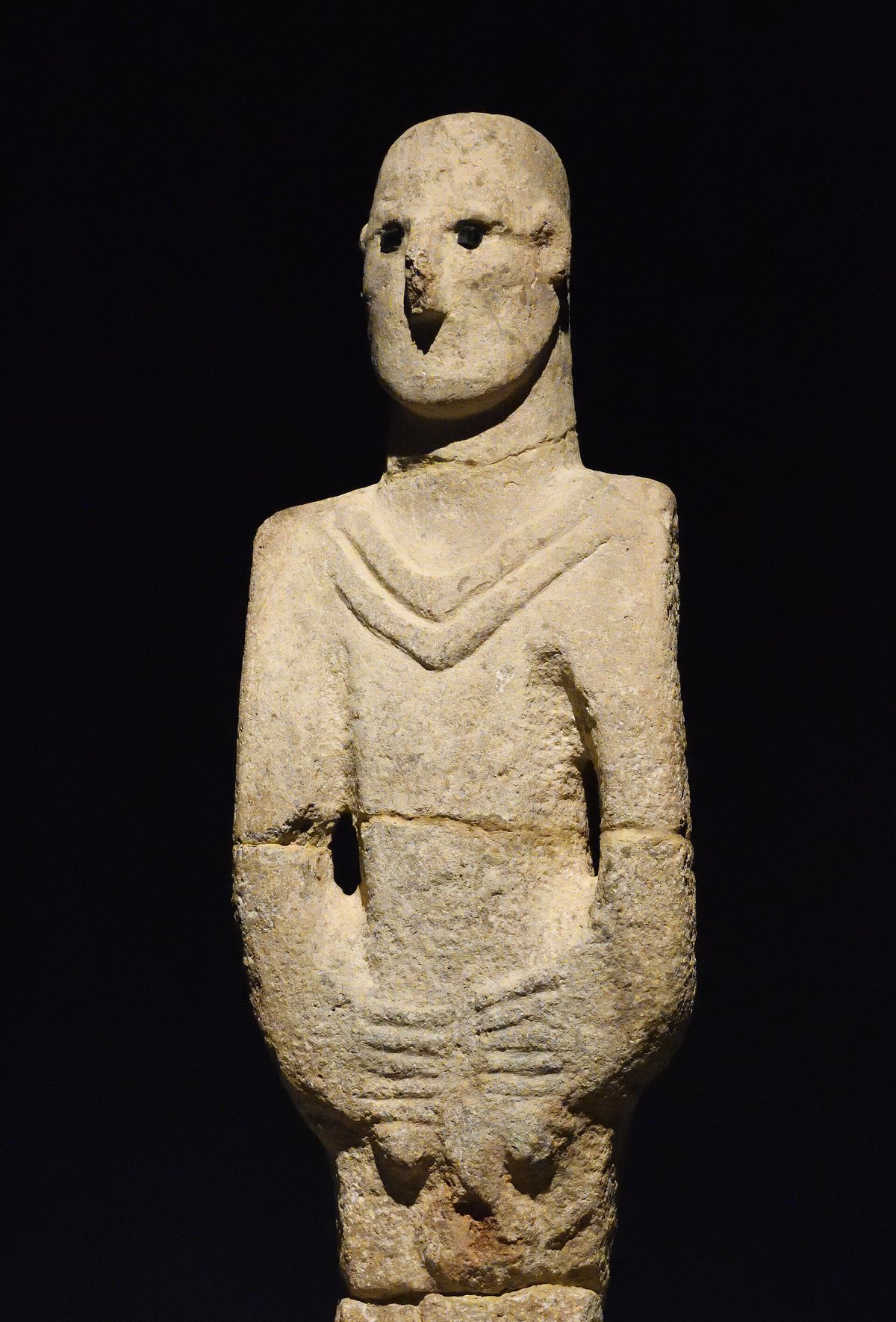
Yet the human being is not absent. It is in fact everywhere, but in abstract form. The great T-pillars are anthropomorphic beings: the shaft represents the body, the horizontal top the head. On the two central pillars of Enclosure D, arms carved in low relief run down the sides, long-fingered hands meet over the abdomen, above a belt and a fox-pelt loincloth. These faceless stone giants may embody ancestors, spirits or deities.3
Human statues in the round, however, can be counted on one hand. The most famous, the "Urfa Man", was found in 1993 during building works in the historic centre of Şanlıurfa, near the Balıklıgöl pool. Nearly two metres tall, with eyes inlaid with obsidian, it is regarded as the oldest known life-size human statue. Göbekli Tepe has also yielded a 1.92-metre "totem pole" stacking hybrid, half-human half-animal beings flanked by snakes, as well as carved human heads, some of them deliberately broken.3 In such a small corpus, the appearance of a human figure built into the very architecture of a building marks a significant break.2
Karahan Tepe, the other piece of the puzzle
The walled-up statue is not entirely without parallel. Comparable deposits have been documented at Karahan Tepe, a contemporary site about fifty kilometres to the east, also excavated by Necmi Karul's team.1 In recent years Karahan Tepe has produced some of the most spectacular sculptures of the Neolithic: a rock-cut chamber bristling with phallic pillars, watched over by a human head that seems to emerge from the wall, and, in 2023, a large statue of a seated man, carved with striking realism.
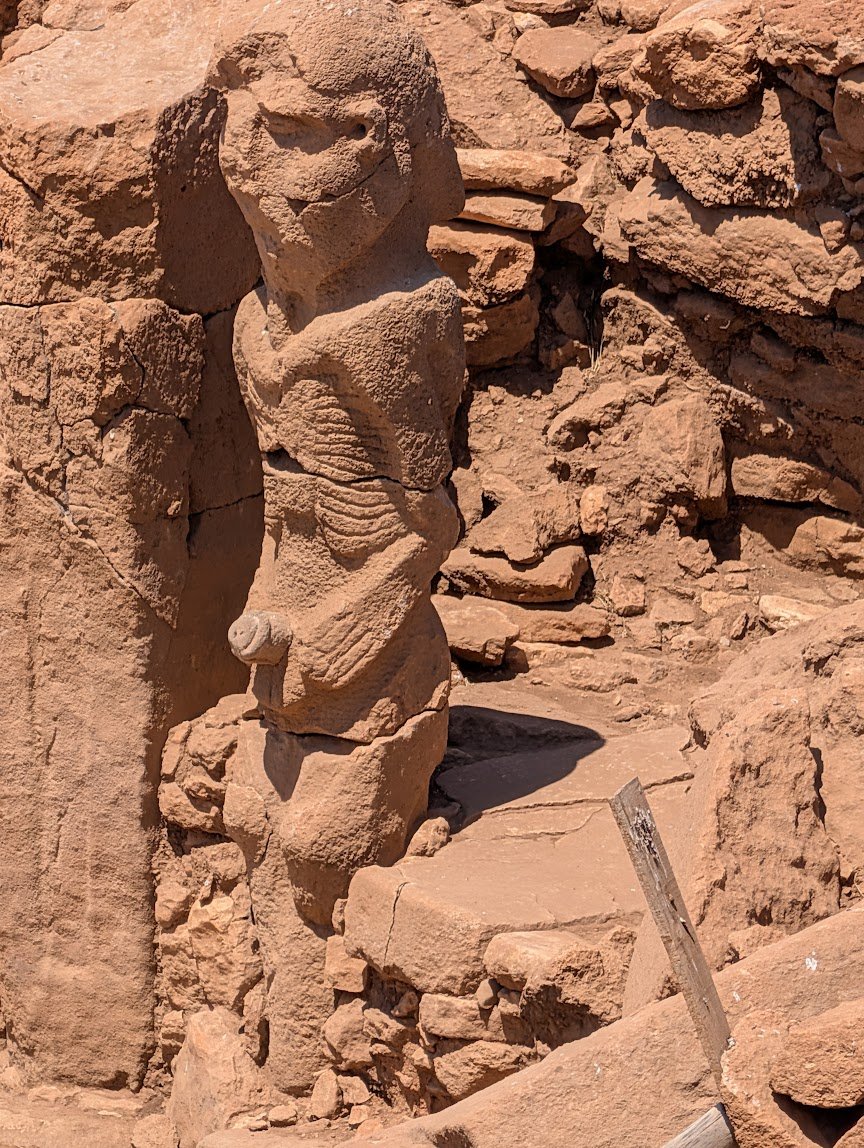
These finds are gradually sketching out a shared symbolic world, common to a dozen sites in the Şanlıurfa region brought together in the Taş Tepeler programme. The project involves 36 scientific institutions and more than 220 researchers. Everywhere one finds T-pillars, the same bestiary, the same emphasis on the male body, the same interplay between human and animal. And now, it seems, a shared practice of placing sculpted figures in the heart of walls.12
A run of spectacular discoveries
The walled-up statue is part of a series of finds that have marked recent seasons. In October 2023, the Göbekli Tepe excavators had already uncovered, in Enclosure D, a life-size limestone wild boar statue that still bore traces of red, white and black pigment. It rested on a bench carved with an H-shaped symbol, a crescent, two snakes and three human faces. It is the oldest known painted statue of the Neolithic.4
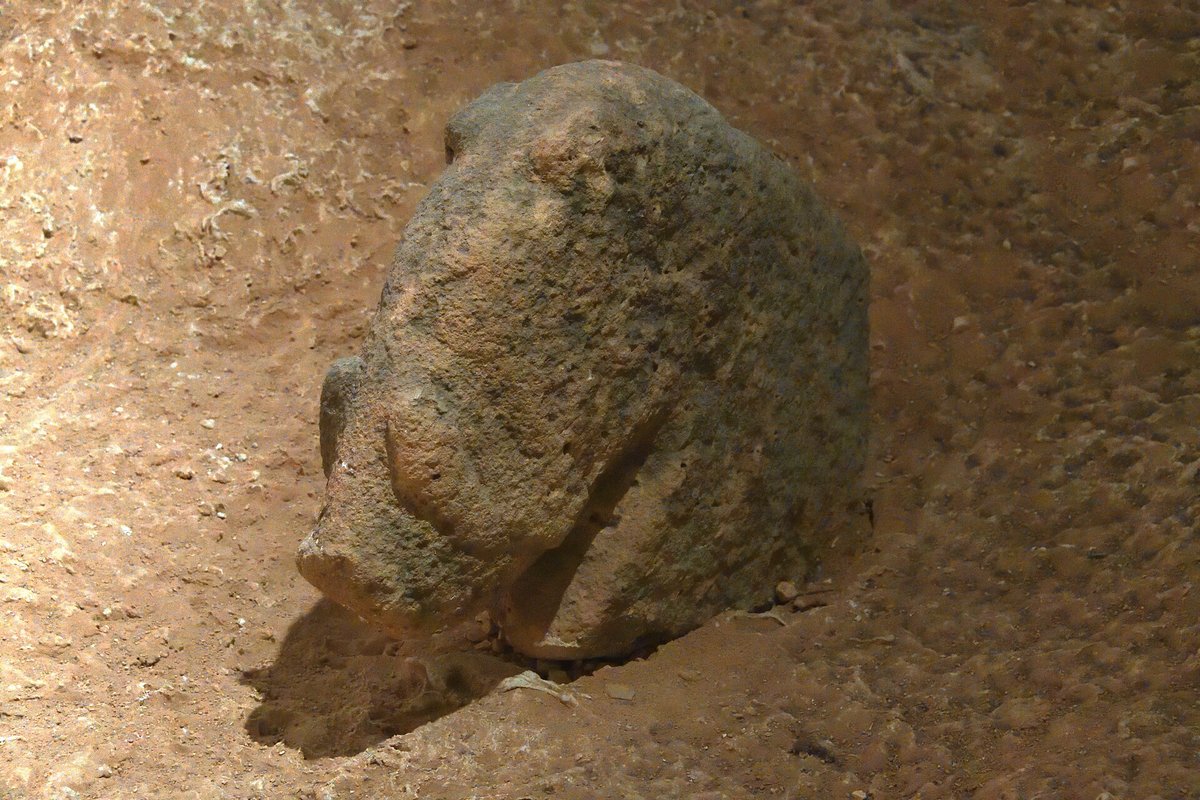
These objects are a reminder that the pillars were only part of a much richer decorative programme. Colour, portable statues, hidden offerings: the buildings of Göbekli Tepe must have been spaces charged with meaning, where every element took part in a discourse we can no longer read.
Sanctuary or village? A debate reignited
The discovery comes at a pivotal moment for the interpretation of the site. Klaus Schmidt, who died in 2014, saw Göbekli Tepe as a mountain sanctuary where bands of nomadic hunter-gatherers gathered periodically to build, feast and then disperse. An idea summed up in his famous formula: "first came the temple, then the city". According to this thesis, it was shared beliefs that drove humans to settle down, not agriculture.3
Research since then has nuanced this picture. From 2015, the German Archaeological Institute team led by Lee Clare identified domestic buildings, thousands of grinding stones and mortars, a rainwater-harvesting system with cisterns cut into the rock, and burials. Göbekli Tepe now appears as a genuine settlement, where people lived and where ritual sat alongside daily life.7 In August 2026, Necmi Karul's team uncovered, in a new 1,500-square-metre area north of the main sector, rectangular buildings from the second phase of occupation. "Our first impression is that they were used as dwellings," the researcher said.6
The walled-up statue does not settle this debate, but it enriches it. If it was placed in the wall of an ordinary room, it would show that the sacred was not confined to the great pillared enclosures but also permeated everyday architecture. For Necmi Karul, social bonds, shared myths and collective practices were the cement of the first permanent human settlements.2
Restore, exhibit, pass on
Alongside the excavations, the site has undergone major works. As part of the Turkish Ministry of Culture's "Legacy for the Future" programme, Structure C has been restored: several pillars were put back in place and the surrounding walls consolidated with a mortar reinforced with goat hair, drawing on Neolithic techniques identified on site.12
Göbekli Tepe also travels. From 6 February to 19 July 2026, the James-Simon-Galerie on Berlin's Museum Island hosted the exhibition "Building community. Göbeklitepe, Taş Tepeler and life 12,000 years ago", organised by the Vorderasiatisches Museum with the Şanlıurfa Archaeology Museum, Istanbul University and the German Archaeological Institute. It featured colossal statues, decorated T-pillars and around a hundred everyday objects from these early builders.5
What we are still waiting for
Many questions remain open. What is the statue's exact size, and what does it represent: a man, a woman, an ancestor, a supernatural being? Does it bear traces of paint, like the boar from Enclosure D? Can the wall that held it be dated precisely, and with it the moment of deposition? The answers will come from the expected scientific publication, once conservation studies are complete.2
In the meantime, this figure lying in the stone is a reminder of how far Göbekli Tepe is from having revealed all its secrets. Thirty years after Klaus Schmidt's first trowel strokes, every season brings its share of surprises. And beneath the hill, some twenty enclosures are still waiting to be explored.
No comments yet. Be the first.