Beyond the Pillars of Hercules, where the known world of the Ancients came to an end, a civilisation shone. The Greeks called it TartessosTartessosIron Age civilisation of the south-west of the Iberian Peninsula (ninth to fifth century BCE), born of the encounter between native populations and Phoenician merchants.→, the Hebrews Tarshish, and they spoke of it with wonder: a fabulous city overflowing with silver, tin and bronze, governed by a king said to have lived one hundred and twenty years. Hovering between legend and history, Tartessos remains one of the most captivating enigmas of Western Antiquity.1
Tartessos is not merely a city. It is a full civilisation, born from the encounter between the indigenous populations of the Iberian Peninsula and the PhoenicianPhoenicianRelating to the merchants and seafarers of the Levant who founded trading posts on the Iberian coasts and deeply influenced Tartessos.→ merchants who settled there from the 8th century BC. Hybrid and creative, it invented its own writingWritingA system of conventional signs used to fix language or information durably; its appearance (c. 3300 BC) marks, by convention, the end of prehistory.→ system, produced its own art, and achieved a commercial prosperity that earned it mention from the Bible to the earliest Greek sources.
Herodotus and the King of a Hundred and Twenty Years
The first major literary witness to Tartessos is Herodotus, in the 5th century BC. He recounts how Phocaean sailors from Asia Minor sailed beyond the Pillars of Hercules and reached this fabulous harbour. The region was then governed by Arganthonios, whose name means "the Silver Man" in Greek, a king said to have reigned for eighty years and lived to a hundred and twenty, who offered the Phocaeans the silver they needed to fortify their home city against the Persian threat.1
Other ancient sources complete the picture. Strabo, in the 1st century AD, identifies the river Tartessos with the Baetis (today's Guadalquivir) and places the city at its mouth. Pausanias specifies that it was founded between the two arms of a tidal river. Pliny the Elder confuses it with Carteia, near Gibraltar. These discrepancies show that by the time Roman authors were writing, the city had already disappeared for several centuries, leaving only rumour and confusion.2
The biblical tradition adds another layer. "Tarshish", mentioned several times in the Old Testament in the Books of Ezekiel and Kings as a source of precious metals and commercial partner of Tyre, is often identified by scholars with Tartessos. The prophet Ezekiel describes "those of Tarshish" trading with Tyre in "silver, iron, tin and lead". This metallurgical wealth, confirmed by archaeology, is one of the fundamental characteristics of Tartessian civilisation.
The Geography of an Enigma
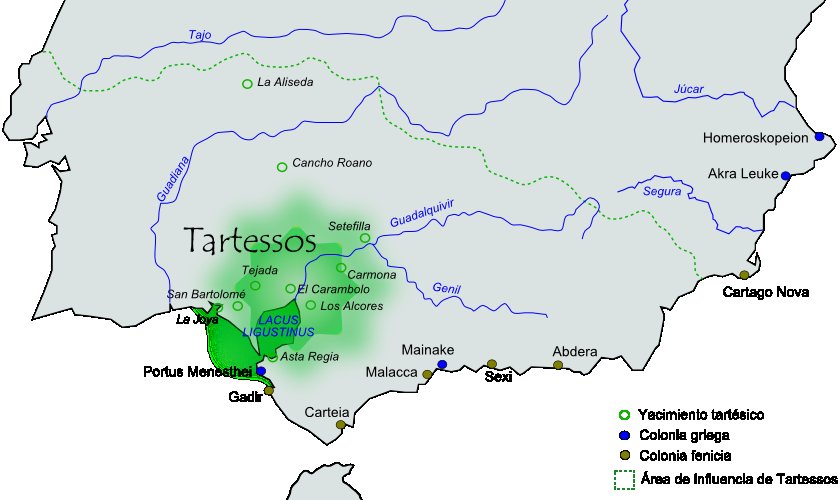
Where exactly was Tartessos? The question has fascinated archaeologists since the 19th century. Western Andalusia, watered by the Guadalquivir and its tributaries, is the region most often cited. Several sites concentrate the hypotheses.
Huelva is today the most credible candidate. Urban excavations have yielded some 90,000 ceramic fragments dating from the 10th to the 8th century BC, including high-quality Greek and Phoenician imports. This accumulation of luxury goods, across an estimated area of twenty hectares, makes ancient Huelva one of the most important emporia in the western Mediterranean for that period.3
Donana National Park, northwest of Huelva, was explored from the 1920s by the German archaeologist Adolf Schulten, who believed the sunken city lay there. In 2011, an American team led by Richard Freund claimed to have found "strong evidence" for Tartessos's location in this marshy park through underground and underwater surveys. Spanish researchers reacted with scepticism, calling the claims "fanciful". The comparison Freund drew with the Atlantis myth did little for his scientific credibility.
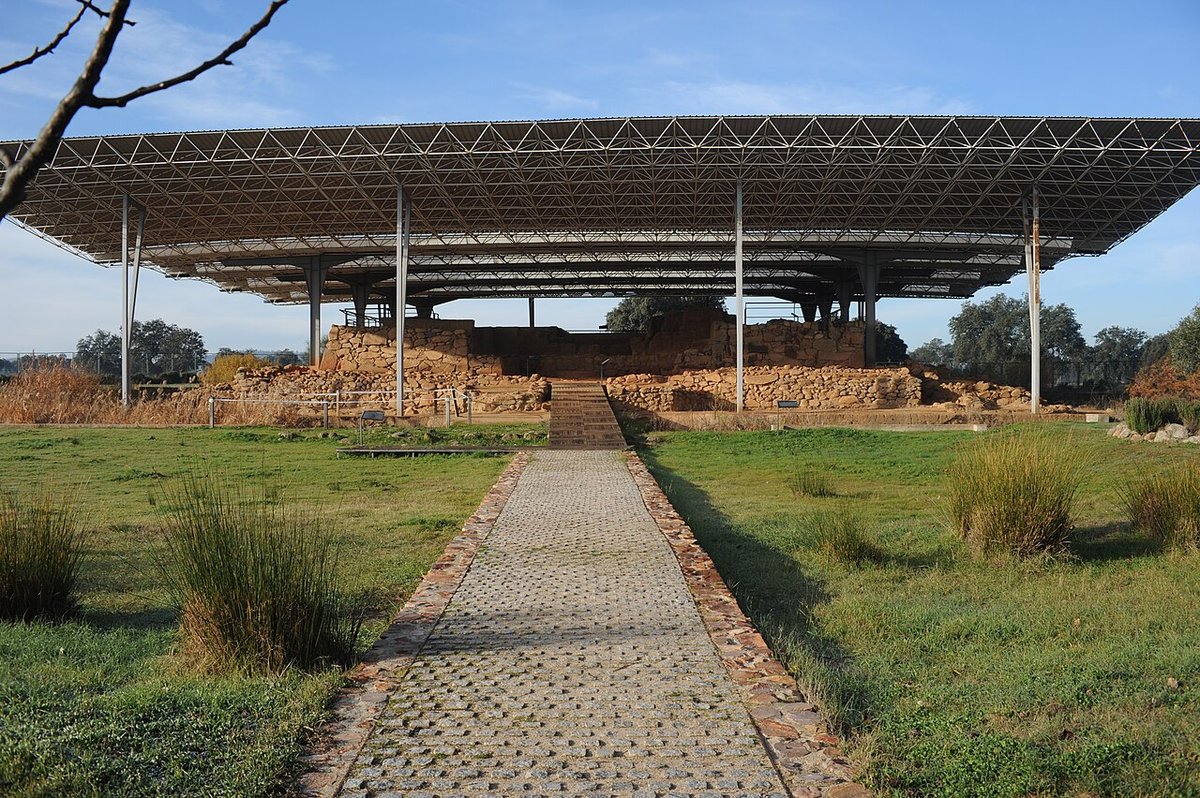
Turuñuelo (Guarena, Extremadura), discovered in the 2010s, is one of the most recent revelations. This exceptional Tartessian site preserves unique monumental architecture: a large multi-storey mudbrick building with a ceremonially sealed staircase, and the largest ritual animal deposit in all of European prehistoryPrehistoryThe span of human history before the invention of writing, from the Palaeolithic to the Metal Ages, known mainly through material remains.→, including horses, cattle, pigs and dozens of other sacrificed animals. In 2023, excavations yielded the first human representations of Tartessian civilisation: two sculpted stone busts, adorned with jewellery and elaborate hairstyles, resembling deities from the Phoenician pantheon.
Goldsmithing: the Art of a People of Gold
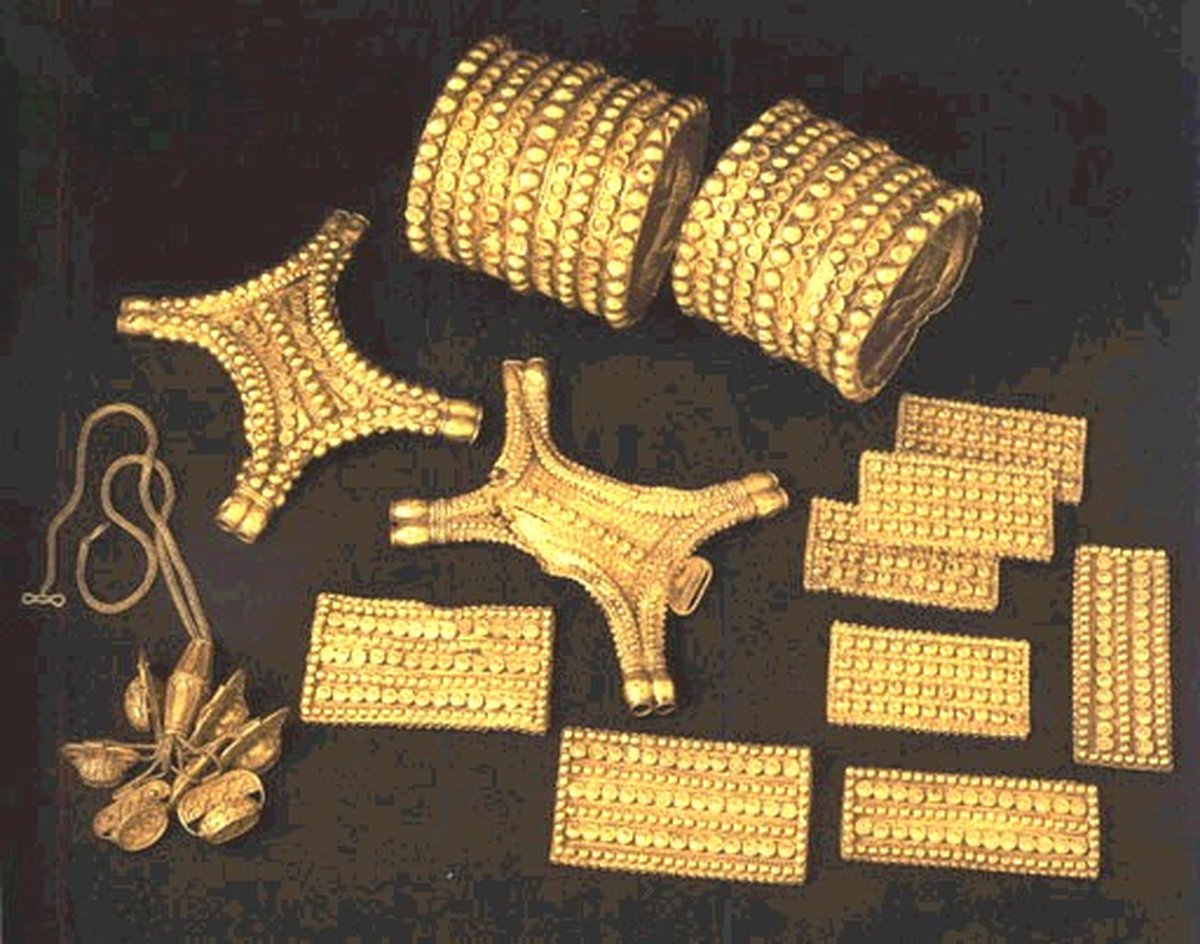
The El Carambolo treasure, discovered in 1958 near Seville, is the most famous symbol of Tartessian civilisation. Twenty-one pieces of solid gold, of remarkable technical refinement: two bracelets, two pectorals, a necklace of sixteen plaques and a central rectangular plaque. The filigree and granulation work, with geometric and floral motifs, illustrates the extraordinary mastery of Tartessian goldsmiths and bears witness to the OrientalisingOrientalisingCultural phase during which Iberian elites adopted the techniques, luxury goods and motifs of the eastern world spread by the Phoenicians.→ Phoenician influence on local art.4
Other treasures complete the picture: the Aliseda treasure (Caceres), with its magnificent serpentiform fibulae and bracelets, and the bronze candelabras of Lebrija. These objects reveal an elite culture that practised long-distance prestige exchange and mastered sophisticated metallurgical techniques. MetallurgyMetallurgyThe techniques of extracting and working metals (copper, bronze, gold); its rise in the Eneolithic and Bronze Age transformed tools, weapons and social hierarchies.→ was indeed one of the foundations of Tartessian power: the Huelva region possessed one of Europe's richest pyritic belts, with the Rio Tinto and its surroundings being exploited on a near-industrial scale for silver and copper extraction.
A People Between Two Worlds: Orientalisation
Tartessian civilisation was born from the encounter between a local Atlantic Bronze AgeBronze AgePeriod of late prehistory marked by bronze metallurgy and the rise of maritime trade, beginning in the Near East around 3300 BCE.→ substrate and the cultural contributions of the PhoeniciansPhoeniciansA people of sailors and traders from the Levant (modern Lebanon) who founded trading posts across the western Mediterranean from the start of the first millennium BC.→, who established themselves at Cadiz (Gadir) around 1100 BC. This hybridisationHybridisationCrossing between two distinct species or lineages, such as Homo sapiens and Neanderthals, leaving a trace in the genome.→ gave rise to what archaeologists call the "Orientalising phase" (c. 750-550 BC): a period during which Oriental forms, motifs and techniques blended into an original artistic creation specifically Iberian in character.3
During this period, settlements transformed. The circular or oval huts of the Bronze Age gave way to rectangular houses with dry-stone foundations and plastered walls. Sites organised themselves into planned layouts. At Castulo (Jaen), a river-pebble mosaic dating to the late 6th century BC is considered the earliest mosaic in western Europe. The fast potter's wheel, a Phoenician introduction, replaced hand-building techniques to produce grey wares imitating imported goods.
Religion also bore the mark of this exchange. The Tartessians appear to have adopted Phoenician deities, including Astarte, goddess of love and fertility, and Melqart, protector of sailors. Sanctuaries inspired by Phoenician architecture have been identified at Castulo and near Carmona. The two busts discovered at Turuñuelo in 2023 may represent these divinities in Iberian guise.
Tartessian Writing: the Oldest in Iberia
One of the most spectacular contributions of Tartessian civilisation is its writing system. The Tartessian inscriptions, numbering some 97, constitute the oldest indigenous texts of the Iberian Peninsula, dating from the 7th and 6th centuries BC. They are carved on stone stelae, found primarily in the southwest of the peninsula (Andalusia, Alentejo, Algarve).2
The system used is described as "semi-syllabic" or the "Southwest script": it adapts the Phoenician alphabetalphabetA writing system in which each sign notes a single elementary sound, allowing writing with a very small number of letters.→ while incorporating syllabic elements, creating a hybrid system whose deciphermentDeciphermentThe reconstruction of the meaning and value of the signs of an unknown script, often from bilingual texts, repeated proper names or statistical regularities.→ remains partial. The underlying language, Tartessian, is considered a language isolate, with no established kinship with the other languages of the region. Some linguists propose links with paleo-Hispanic languages or even, more controversially, with Celtic languages. The matter is far from settled.
The Mysterious End: a Disappearance Without Explanation
In the 5th century BC, Tartessian civilisation disappears. Sites are abandoned, activity ceases, commercial exchanges stop. This disappearance is one of the most intriguing mysteries in Mediterranean archaeology. Several hypotheses have been advanced.
The first points to Carthage. After the Battle of Alalia (c. 535 BC), the Carthaginians took control of western Mediterranean trade routes. The Phoenician trade that fuelled Tartessian prosperity may have been disrupted by this reorientation of exchanges. Deprived of their privileged trading partners, the Tartessians may have been unable to sustain their level of development.
A second hypothesis invokes natural catastrophes: rising water levels in the Guadalquivir delta, floods, coastal modifications. The idea that the main city was engulfed beneath the Donana marshes dates to Schulten and has since fuelled Atlantis-related theories.
A third avenue suggests an internal transformation: Tartessos did not disappear but evolved into the Turdetanian culture, its direct successors in the region, who would themselves be absorbed by Rome. This thesis would reduce the "mysterious" character of the disappearance, turning it into a gradual evolution rather than a sudden rupture.
Tartessos and the Atlantis Myth
Since the early 20th century, some researchers have drawn links between Tartessos and Plato's legend of Atlantis. Adolf Schulten in 1922 was among the first to propose that the city swallowed by the waters beyond the Pillars of Hercules might be Tartessos. The parallel is seductive: a rich and powerful civilisation, situated beyond the Pillars of Hercules, vanished beneath the waves. But serious historians and archaeologists remain very cautious: Plato's city is a literary creation with philosophical intent, and no rigorous correspondence can be established with the archaeological record.1
The Tartessos enigma remains intact. Between the splendours described by Herodotus, the spectacular discoveries at Turuñuelo and the unanswered questions surrounding the disappearance of this civilisation, the "pearl of the West" continues to fascinate. It represents the missing chapter of a history that the western Mediterranean has not yet fully disclosed.
No comments yet. Be the first.