Spanish and Egyptian archaeologists announced in 2025 the definitive identification of the tomb of PharaohPharaohThe title of the ruler of ancient Egypt, regarded as a living god guaranteeing cosmic order (Maat), supreme head of state, army and worship.→ Thutmosis II, ruler of the 18th Dynasty who reigned over Egypt from approximately 1493 to 1479 BCE. The tomb, catalogued C4 in the archaeological nomenclature, had been located for the first time in 2022 during a survey mission in the Western Wadis, a zone of arid ravines to the west of the Valley of the Kings, at Luxor. It is the first royal tomb positively identified in the Theban necropolisNecropolisA large organised burial ground, a "city of the dead", often spanning several periods.→ since Howard Carter's discovery of Tutankhamun's tomb in 19221. The discovery fills a gap in our knowledge of the beginning of the 18th Dynasty and opens new perspectives on one of the most fascinating periods in the history of ancient Egypt.
A discovery in the forgotten wadis
The location of tomb C4 is the result of several years of systematic work in an area of the Theban hills long neglected by archaeologists. The Western Wadis, a series of ravines carved by seasonal torrents to the west of the famous royal valleys (Valley of the Kings and Valley of the Queens), had yielded some 18th and 19th Dynasty tombs but remained largely unexplored. The Djeser-Djeseru project, directed by Spanish archaeologist Piers Litherland and supported by the Archaeological Heritage Research Fund, launched in 2018 a systematic mapping of the area using LiDARLiDARLaser-based remote sensing (from "Light Detection And Ranging"): a sensor fires light pulses and measures the echo's return time to map a surface in three dimensions. Mounted on a plane or a drone, it slips through gaps in the canopy and reconstructs the bare-earth relief, revealing structures invisible beneath vegetation.→ and ground-penetrating radar.
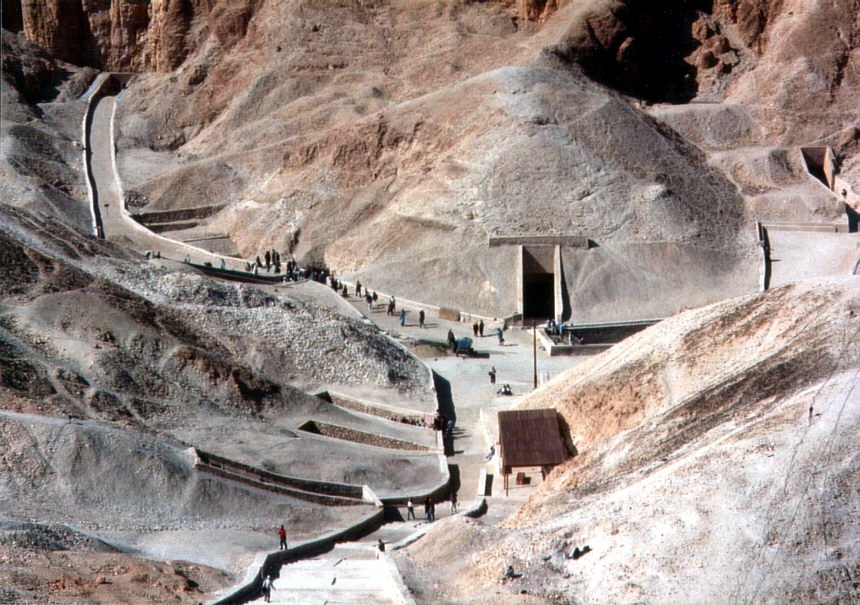
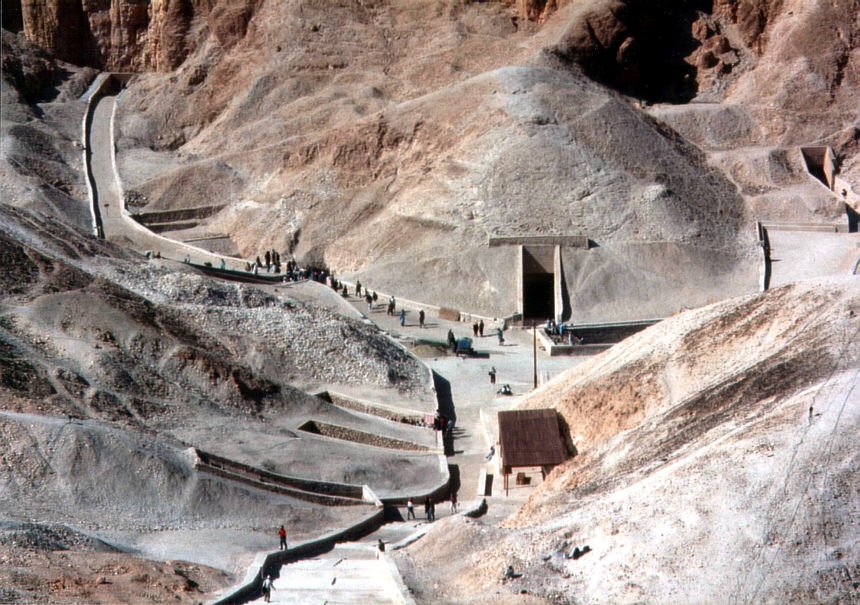
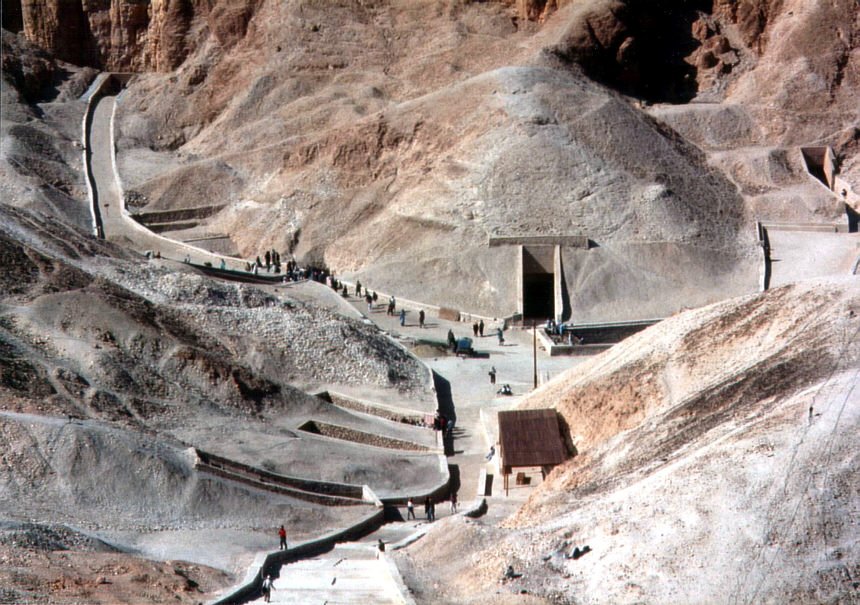
Tomb C4 was identified in 2022 thanks to subsurface anomalies revealed by geophysical instruments, in a particular sector of the Western Wadis. Its geographic position is singular: the tomb entrance lies directly below a series of natural waterfalls formed when exceptional rainfall descends the Theban cliffs. This location, far from accidental, appears to have been deliberately chosen by the royal architects who hoped that periodic flooding would deter robbers by filling the tomb access with sediments and rock debris2.
A royal decoration leaving no doubt
The identification of tomb C4 as belonging to Thutmosis II rests on several convergent elements. The first is the decoration of the burialBurialThe intentional deposition of a body, sometimes with offerings; a marker of symbolic behaviour.→ chamber ceiling: it is painted deep blue, scattered with yellow stars, a decorative programme reserved for royal burial chambers of the early 18th Dynasty. The blue of the night sky and the golden stars form the vault of the cosmos in Egyptian funerary cosmology, and their presence in this tomb signals its royal status without ambiguity.
The burial chamber walls are decorated with extracts from the Amduat, the "Book of What is in the Underworld", one of the great funerary texts of the Egyptian New Kingdom3. At the time of Thutmosis II, the Amduat was a royal text par excellence, reserved for pharaonic burials, which constitutes a second decisive argument for identifying the tomb. It describes the journey of the sun-god Ra through the twelve hours of the night, depicted in twelve registers of scenes and texts unfolding around the chamber walls.
The canopic jars and epigraphic confirmation
The most convincing element for the attribution of the tomb is the discovery of alabaster canopic jar fragments bearing royal cartouches. Two names can be read: that of Thutmosis II himself and that of his Great Royal Wife Hatshepsut, who succeeded him on the throne and ruled as pharaoh for some twenty years before the assumption of power by Thutmosis III. The joint presence of both names on the funerary material confirms the identity of the tomb owner beyond any reasonable doubt.
Thutmosis II is one of the least well-documented pharaohs of the 18th Dynasty. He reigned for approximately thirteen years, a relatively short duration, and his reign is largely overshadowed in historical sources by those of his father Thutmosis I and his successors Hatshepsut and Thutmosis III. His mummyMummyA body preserved from decay, naturally (cold, aridity, peat) or artificially; the frozen Pazyryk kurgans yielded natural mummies with tattooed skin.→ had been known since 1881, when it was found in the Deir el-Bahari royal cache, but the location of his original tomb had been a puzzle for more than a century. The discovery of C4 finally resolves this mystery and allows another step to be traced in the evolution of royal funerary practices at the very beginning of the New Kingdom.
The tomb suffered significant flood damage over the millennia. Many paintings are partially damaged or covered in dried mud deposits. Paradoxically, these same floods helped preserve certain organic materials that would otherwise have disappeared. Fragments of linen cloth, painted wood splinters, and botanical remains (probably floral offerings deposited at the funeral) were found in remarkable preservation conditions, thanks to rapid sealing of the tomb by sediments after the floods.
The excavation campaign continues in the Western Wadis sector. Piers Litherland's team has identified further subsurface anomalies that could correspond to new royal tombs or administrative structures associated with the necropolis. The story of the discovery of Thutmosis II's tomb may be only the first chapter in a series of revelations about this hitherto little-explored sector of the Theban necropolis.
No comments yet. Be the first.