In spring 2026, an Austrian archaeological mission from the University of Salzburg, in cooperation with the Austrian Archaeological Institute, announced a remarkable find on Kolona hill, Aegina, Greece: an assemblage of 32 jewellery pieces in gold and carnelian, dating to the Middle Bronze AgeBronze AgeA protohistoric period following the Neolithic, defined by bronze metallurgy (a copper-tin alloy) and the rise of the first cities and states; in Egypt it corresponds to the age of the first pyramids.→ (c. 1700 BC), in excellent condition1.
The objects include eight disc-shaped gold amulets, seven biconical beads, a cylindrical bead, eight decorative gold-leaf sheets, seven spherical carnelian beads and one additional pendant. Their arrangement suggests they originally formed a single necklace or pendant assemblage. They were found in or near a large stone structure adjoining the site's defensive wall, probably as grave goods associated with a Middle Bronze Age burialBurialThe intentional deposition of a body, sometimes with offerings; a marker of symbolic behaviour.→ whose skeletal remains could not be identified1.
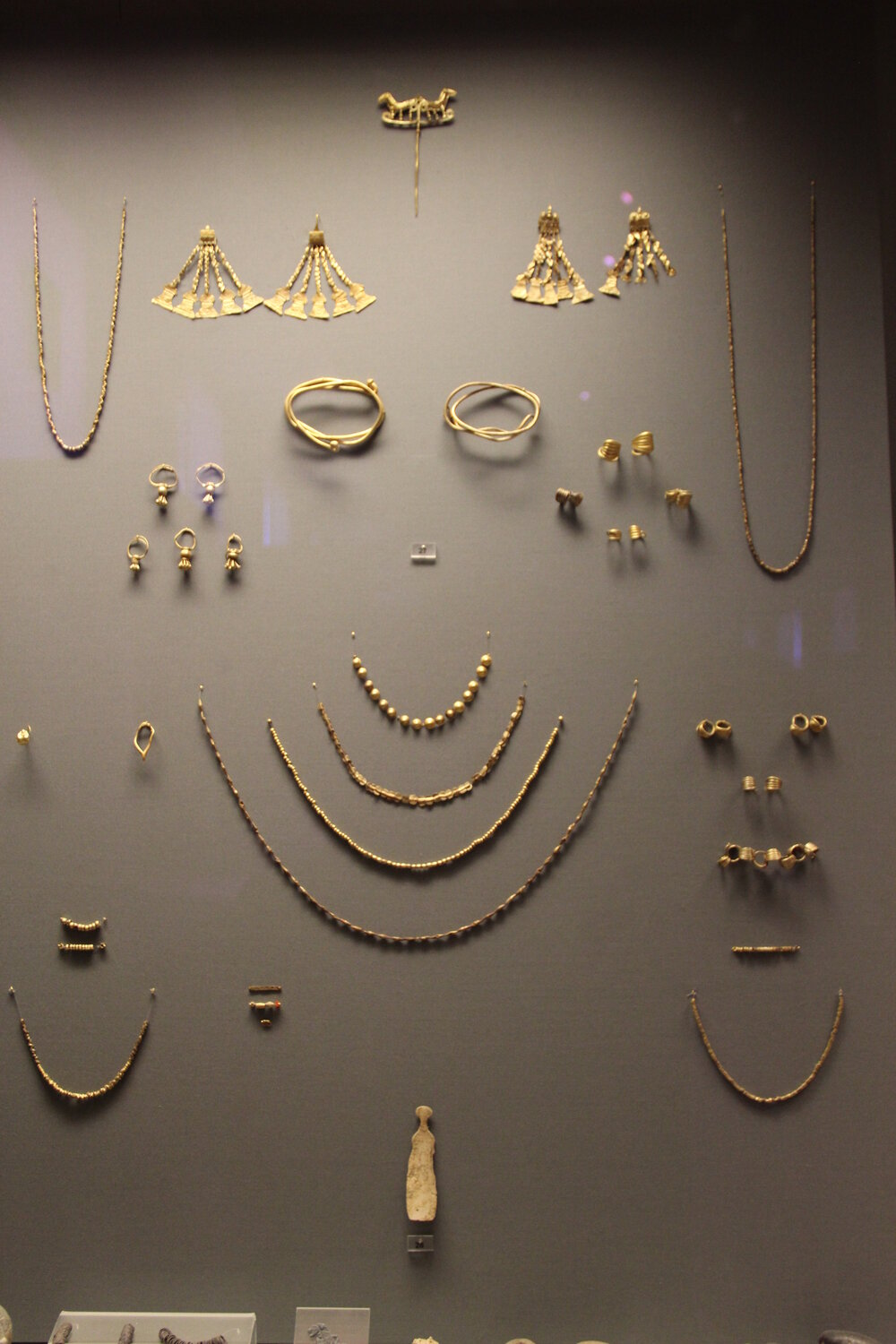
The echo of the Aegina Treasure
What makes the discovery particularly exciting is its stylistic kinship with the famous Aegina Treasure, a collection of extraordinary prehistoric jewellery illicitly exported from Aegina in the nineteenth century and held at the British Museum since 1892. The pendants found at Kolona bear a striking resemblance to several pieces in the London collection2.
The difference is fundamental: unlike the British Museum treasure, removed from its archaeological context in obscure circumstances, the Kolona pieces come from a rigorous scientific excavation. They are precisely datable, geolocated and associated with a stratigraphic and architectural context. For the first time, there is a firm anchor for these extraordinary objects, suggesting their style is a genuine local creation of the Middle Bronze Age Aegean.
Mediterranean-scale exchange networks
The presence of carnelian in the assemblage is particularly significant. This semi-precious stone, absent from Aegean geology, had to be imported — probably from Anatolia, Syria or Minoan Crete. Its use alongside gold at Aegina in the mid-second millennium BC attests to the island's integration into long-distance exchange networks linking mainland Greece, the Cyclades, Crete and the Near EastNear EastA region of western Asia (Levant, Mesopotamia, Anatolia, Iran), cradle of the Neolithic revolution, agriculture, the first cities and writing.→1.
Kolona, whose name recalls a lone Doric column still standing, has been excavated since the nineteenth century. The Middle Bronze Age (2000–1550 BC) is represented there by a prosperous fortified settlement closely connected to pre-Hellenic commercial networks. The new discovery confirms that Aegina was, in that era, far more than a stopover: a craft and political centre whose elite rivalled those of Mycenae or Knossos in prestige and goldsmithy.
Les migrations préhistoriques deviennent enfin lisibles quand on les relie à votre carte. Beau travail.
Je vais utiliser cet article comme document-source en classe. La clarté de l'écriture est rare.
Les premières formes d'expression humaine me fascinent. Cet article nourrit vraiment ma réflexion.
Je connais l'ile d'Egine comme destination de vacances mais je ne savais pas qu'elle avait une telle importance archéologique. L'idée qu'un tel trésor a été enfoui là il y a 3 500 ans et attendait d'être découvert est romanesque. C'est ce que j'aime dans l'archéologie : le passé surgit de manière totalement inattendue.
Le trésor d'Egine est un ensemble exceptionnel qui témoigne des échanges commerciaux dans le monde égéen au Bronze moyen. La présence d'objets d'origines diverses (minoenne, anatolienne, levantine) dans un meme dépôt illustre l'intensité des réseaux d'échanges à longue distance dès le IIe millénaire avant notre ère. Ce type de dépôt pose toujours la question de sa nature : thésaurisation, offrande ou stock commercial ?